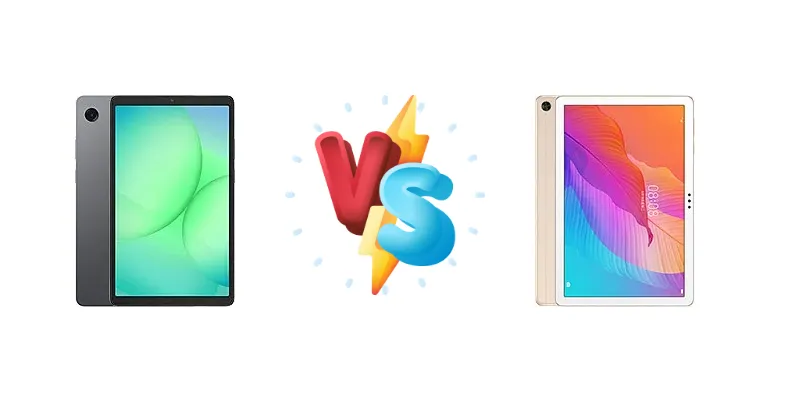
The Samsung Galaxy Tab A11 and Huawei MatePad T 10s represent compelling options in the crowded budget tablet space. While both aim to deliver an affordable Android experience, they take distinctly different approaches to achieving that goal, primarily through their chipset choices. This comparison dissects the key differences between the Mediatek Helio G99-powered Tab A11 and the Kirin 710A-equipped MatePad T 10s, focusing on performance, battery life, and overall value.
🏆 Quick Verdict
For the average user prioritizing performance and longevity, the Samsung Galaxy Tab A11 emerges as the stronger choice. Its Mediatek Helio G99 chipset, built on a more efficient 6nm process, delivers significantly better processing power and sustained performance compared to the Huawei MatePad T 10s’ older Kirin 710A. While the MatePad T 10s offers a lower price point, the A11’s superior efficiency and endurance justify the price difference.
| Network |
|---|
| 2G bands | GSM 850 / 900 / 1800 / 1900 - cellular model only | GSM 850 / 900 / 1800 / 1900 |
| 3G bands | HSDPA 850 / 900 / 1700(AWS) / 1900 / 2100 - cellular model only | HSDPA 850 / 900 / 1700(AWS) / 1900 / 2100 |
| 4G bands | 1, 2, 3, 4, 5, 7, 8, 12, 17, 20, 26, 28, 38, 40, 41, 66 - cellular model only | 1, 3, 5, 7, 8, 18, 19, 20, 26, 28, 38, 40, 41 |
| Speed | HSPA, LTE - cellular model only | HSPA, LTE - cellular model only |
| Technology | GSM / HSPA / LTE | GSM / HSPA / LTE |
| Launch |
|---|
| Announced | 2025, September 12 | 2020, September 09. Released 2020, September 09 |
| Status | Available. Released 2025, September | Discontinued |
| Body |
|---|
| Dimensions | 211 x 124.7 x 8 mm (8.31 x 4.91 x 0.31 in) | 240.2 x 159 x 7.9 mm (9.46 x 6.26 x 0.31 in) |
| SIM | Nano-SIM (cellular model only) | Nano-SIM (cellular model only) |
| Weight | 335 g or 337 g (11.82 oz) | 450 g (0.99 lb) |
| | - | Stylus support |
| Display |
|---|
| Protection | Mohs level 5 | - |
| Resolution | 800 x 1340 pixels, 5:3 ratio (~179 ppi density) | 1200 x 1920 pixels, 16:10 ratio (~224 ppi density) |
| Size | 8.7 inches, 214.9 cm2 (~81.7% screen-to-body ratio) | 10.1 inches, 295.8 cm2 (~77.4% screen-to-body ratio) |
| Type | TFT LCD, 90Hz | IPS LCD |
| Platform |
|---|
| CPU | Octa-core (2x2.2 GHz Cortex-A76 & 6x2.0 GHz Cortex-A55) | Octa-core (4x2.0 GHz Cortex-A73 & 4x1.7 GHz Cortex-A53) |
| Chipset | Mediatek Helio G99 (6 nm) | Kirin 710A (14 nm) |
| GPU | Mali-G57 MC2 | Mali-G51 MP4 |
| OS | Android 15, upgradable to Android 16, One UI 8, up to 7 major Android upgrades | Android 10, EMUI 10.1, no Google Play Services |
| Memory |
|---|
| Card slot | microSDXC (dedicated slot) | microSDXC |
| Internal | 64GB 4GB RAM, 128GB 8GB RAM | 16GB 2GB RAM, 32GB 2GB RAM, 64GB 3GB RAM, 64GB 4GB RAM, 128GB 4GB RAM |
| | - | eMMC 5.1 |
| Main Camera |
|---|
| Features | - | HDR, panorama |
| Single | 8 MP, AF | 5 MP, f/2.2, PDAF |
| Video | 1080p@30fps | 1080p@30fps |
| Selfie camera |
|---|
| Single | 5 MP | 2 MP, f/2.4 |
| Video | Yes | - |
| Sound |
|---|
| 3.5mm jack | - | Yes |
| 35mm jack | Yes | Yes |
| Loudspeaker | Yes, with stereo speakers (with Dolby Atmos) | Yes, with stereo speakers |
| | - | Tuned by Harman Kardon |
| Comms |
|---|
| Bluetooth | 5.3, A2DP, LE | 5.0, A2DP, LE |
| NFC | No | No |
| Positioning | GPS, GLONASS, BDS, GALILEO, QZSS - cellular model only | GPS, GLONASS, BDS - cellular model only |
| Radio | No | No |
| USB | USB Type-C 2.0 | USB Type-C 2.0, OTG |
| WLAN | Wi-Fi 802.11 a/b/g/n/ac, dual-band, Wi-Fi Direct | Wi-Fi 802.11 a/b/g/n/ac, dual-band, Wi-Fi Direct |
| Features |
|---|
| Sensors | Accelerometer, proximity, compass | Accelerometer, proximity |
| Battery |
|---|
| Charging | 15W wired | 10W wired |
| Type | 5100 mAh | Li-Po 5100 mAh |
| Misc |
|---|
| Colors | Gray, Silver | Gold, Deepsea Blue |
| Models | SM-X133, SM-X135, SM-X135F | AGS3-L09, AGS3-W09, AGS3K-W09 |
| Price | About 180 EUR | About 200 EUR |
| SAR | 0.60 W/kg (head) 1.37 W/kg (body) | - |
| SAR EU | 0.29 W/kg (body) | - |
| EU LABEL |
|---|
| Battery | 93:40h endurance, 1200 cycles | - |
| Energy | Class D | - |
| Free fall | Class C (104 falls) | - |
| Repairability | Class C | - |
Samsung Galaxy Tab A11
- Superior Performance: The Helio G99 chipset delivers significantly faster processing speeds.
- Longer Battery Life: 93:40h endurance provides all-day usability.
- Improved Efficiency: 6nm process reduces heat and extends battery life.
- Potentially Higher Price: May cost more than the MatePad T 10s.
- Limited Camera Details: Camera specifications are not readily available.
Huawei MatePad T 10s
- Lower Price: Offers a more affordable entry point into the tablet market.
- Acceptable for Basic Tasks: Suitable for web browsing, video streaming, and light use.
- Huawei Ecosystem Integration: Benefits from Huawei's software features (depending on region).
- Outdated Chipset: The Kirin 710A is less powerful and less efficient.
- Slower Charging: 10W charging takes longer to replenish the battery.
- Limited Performance: Struggles with demanding applications and multitasking.
Display Comparison
Display specifications are not provided, so a direct comparison is limited. However, given the price points, both tablets likely utilize IPS LCD panels. The key differentiator will be resolution and brightness. The Tab A11, being newer, may benefit from slightly improved color accuracy and viewing angles. Bezels are expected to be substantial on both devices, reflecting their budget positioning.
Camera Comparison
Camera details are unavailable, but given the target market, expectations should be tempered. Both tablets likely feature basic camera setups suitable for casual snapshots and video calls. The absence of detailed specifications suggests neither device will excel in photography. Focusing on megapixel counts alone would be misleading; image processing and sensor size are more critical, and those details are missing.
Performance
The performance gap between these tablets is substantial. The Samsung Galaxy Tab A11’s Mediatek Helio G99, fabricated on a 6nm process, boasts a modern CPU configuration – 2x2.2 GHz Cortex-A76 and 6x2.0 GHz Cortex-A55 cores. This contrasts sharply with the Huawei MatePad T 10s’ Kirin 710A (14nm), featuring 4x2.0 GHz Cortex-A73 and 4x1.7 GHz Cortex-A53 cores. The 6nm node of the Helio G99 translates to significantly improved power efficiency and thermal management, allowing for sustained performance under load. The Cortex-A76 cores in the Tab A11 also offer a noticeable architectural advantage over the older Cortex-A73 cores in the MatePad T 10s, resulting in faster single-core and multi-core performance. This benefits everything from app launch times to smoother multitasking.
Battery Life
The Samsung Galaxy Tab A11 claims an impressive 93:40h endurance with 1200 charge cycles, suggesting a focus on long-term battery health and usability. While the exact battery capacity isn’t specified, the Helio G99’s 6nm efficiency plays a crucial role in achieving this longevity. The Huawei MatePad T 10s, with its 10W wired charging, will likely require more frequent charging cycles. The slower charging speed, combined with the less efficient Kirin 710A, means the MatePad T 10s will spend more time tethered to a power outlet.
Buying Guide
Buy the Samsung Galaxy Tab A11 if you need a tablet capable of handling multitasking, moderate gaming, and demanding applications with relative ease. Its modern chipset and longer battery endurance make it ideal for students, travelers, or anyone who relies on their tablet for productivity. Buy the Huawei MatePad T 10s if you prioritize absolute affordability and basic tablet functionality – web browsing, video streaming, and light tasks – and are willing to compromise on performance and future-proofing.
Frequently Asked Questions
❓ Will the Mediatek Helio G99 in the Tab A11 handle demanding games like PUBG or Call of Duty Mobile?
The Helio G99 is a capable chipset for mobile gaming. While it won't deliver flagship-level performance, it should be able to run PUBG and Call of Duty Mobile at medium settings with acceptable frame rates. The 6nm process also helps mitigate thermal throttling during extended gaming sessions, providing a more consistent experience than the Kirin 710A.
❓ Does the Huawei MatePad T 10s support Google Mobile Services (GMS)?
This is a critical consideration. Due to ongoing restrictions, the Huawei MatePad T 10s typically does *not* come with Google Mobile Services pre-installed. Instead, it relies on Huawei Mobile Services (HMS) and the AppGallery. This means access to popular apps like Gmail, YouTube, and Google Maps requires workarounds, potentially impacting usability for users heavily invested in the Google ecosystem.
❓ How does the 1200 charge cycle claim on the Tab A11 translate to real-world battery health?
Samsung's claim of 1200 charge cycles suggests the Tab A11's battery is designed to retain a significant portion of its original capacity even after extensive use. This is a strong indicator of long-term battery health and reduces the likelihood of needing a battery replacement within the typical lifespan of the tablet. It's a significant advantage over devices with lower-rated battery cycles.