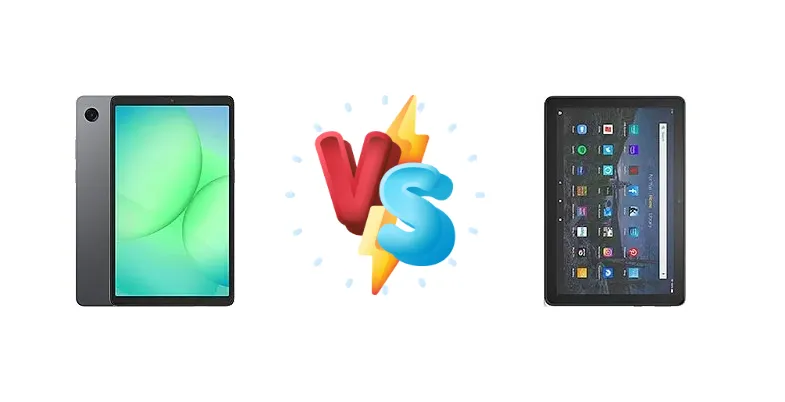
The budget tablet market is fiercely competitive, and the Samsung Galaxy Tab A11 and Amazon Fire HD 10 Plus (2021) represent two compelling options. While both aim to deliver an affordable tablet experience, they take distinctly different approaches to performance, features, and ecosystem integration. This comparison dives deep into the specifications to determine which tablet offers the best value for your needs.
🏆 Quick Verdict
For users prioritizing performance and longevity, the Samsung Galaxy Tab A11 emerges as the stronger choice. Its newer Mediatek Helio G99 chipset and impressive 93:40h battery endurance provide a smoother experience and longer usability compared to the Amazon Fire HD 10 Plus's older Helio P60T.
| Network |
|---|
| 2G bands | GSM 850 / 900 / 1800 / 1900 - cellular model only | N/A |
| 3G bands | HSDPA 850 / 900 / 1700(AWS) / 1900 / 2100 - cellular model only | - |
| 4G bands | 1, 2, 3, 4, 5, 7, 8, 12, 17, 20, 26, 28, 38, 40, 41, 66 - cellular model only | - |
| EDGE | - | No |
| GPRS | - | No |
| Speed | HSPA, LTE - cellular model only | - |
| Technology | GSM / HSPA / LTE | No cellular connectivity |
| Launch |
|---|
| Announced | 2025, September 12 | 2021, April 27. Released 2021, May 26 |
| Status | Available. Released 2025, September | Discontinued |
| Body |
|---|
| Dimensions | 211 x 124.7 x 8 mm (8.31 x 4.91 x 0.31 in) | 247 x 166 x 9.2 mm (9.72 x 6.54 x 0.36 in) |
| SIM | Nano-SIM (cellular model only) | No |
| Weight | 335 g or 337 g (11.82 oz) | 468 g (1.03 lb) |
| Display |
|---|
| Protection | Mohs level 5 | Aluminosilicate glass |
| Resolution | 800 x 1340 pixels, 5:3 ratio (~179 ppi density) | 1920 x 1200 pixels, 16:10 ratio (~224 ppi density) |
| Size | 8.7 inches, 214.9 cm2 (~81.7% screen-to-body ratio) | 10.1 inches, 295.8 cm2 (~72.1% screen-to-body ratio) |
| Type | TFT LCD, 90Hz | IPS LCD |
| Platform |
|---|
| CPU | Octa-core (2x2.2 GHz Cortex-A76 & 6x2.0 GHz Cortex-A55) | Octa-core (4x2.0 GHz Cortex-A73 & 4x2.0 GHz Cortex-A53) |
| Chipset | Mediatek Helio G99 (6 nm) | Mediatek MT8183 Helio P60T (12 nm) |
| GPU | Mali-G57 MC2 | Mali-G72 MP3 |
| OS | Android 15, upgradable to Android 16, One UI 8, up to 7 major Android upgrades | Android 9.0 (Pie), Fire OS 7 |
| Memory |
|---|
| Card slot | microSDXC (dedicated slot) | microSDXC (dedicated slot) |
| Internal | 64GB 4GB RAM, 128GB 8GB RAM | 32GB 4GB RAM, 64GB 4GB RAM |
| | - | eMMC 5.1 |
| Main Camera |
|---|
| Single | 8 MP, AF | 5 MP |
| Video | 1080p@30fps | 720p |
| Selfie camera |
|---|
| Single | 5 MP | 2 MP |
| Video | Yes | 720p |
| Sound |
|---|
| 3.5mm jack | - | Yes |
| 35mm jack | Yes | Yes |
| Loudspeaker | Yes, with stereo speakers (with Dolby Atmos) | Yes, with stereo speakers |
| Comms |
|---|
| Bluetooth | 5.3, A2DP, LE | 5.0, A2DP, LE |
| NFC | No | No |
| Positioning | GPS, GLONASS, BDS, GALILEO, QZSS - cellular model only | No |
| Radio | No | No |
| USB | USB Type-C 2.0 | USB Type-C 2.0, OTG |
| WLAN | Wi-Fi 802.11 a/b/g/n/ac, dual-band, Wi-Fi Direct | Wi-Fi 802.11 a/b/g/n/ac, dual-band |
| Features |
|---|
| Sensors | Accelerometer, proximity, compass | Accelerometer |
| | - | Text-to-Speech English-language content reader |
| Battery |
|---|
| Charging | 15W wired | Wireless |
| Type | 5100 mAh | Li-Ion |
| Misc |
|---|
| Colors | Gray, Silver | Slate |
| Models | SM-X133, SM-X135, SM-X135F | T76N2P |
| Price | About 180 EUR | About 150 EUR |
| SAR | 0.60 W/kg (head) 1.37 W/kg (body) | - |
| SAR EU | 0.29 W/kg (body) | - |
| EU LABEL |
|---|
| Battery | 93:40h endurance, 1200 cycles | - |
| Energy | Class D | - |
| Free fall | Class C (104 falls) | - |
| Repairability | Class C | - |
Samsung Galaxy Tab A11
- Superior performance with the Mediatek Helio G99 chipset.
- Exceptional battery life (93:40h endurance).
- Longer battery lifespan with 1200 charge cycles.
- Lacks wireless charging.
- Display specs are unknown, potentially limiting visual experience.
Amazon Fire HD 10 Plus (2021)
- Convenient wireless charging.
- Lower initial price point.
- Deep integration with the Amazon ecosystem.
- Older, less efficient Mediatek Helio P60T chipset.
- Likely shorter battery life compared to the Tab A11.
Display Comparison
Neither device boasts a particularly high-end display, but differences exist. While specific display specs (resolution, brightness) are missing for both, the focus here is on the underlying processing power needed to drive them. The Tab A11’s Helio G99 is better equipped to handle more demanding graphical tasks, potentially resulting in smoother animations and a more responsive interface. The Fire HD 10 Plus’s wireless charging capability is a notable convenience feature, absent on the Tab A11.
Camera Comparison
Given the budget nature of both tablets, camera performance isn’t a primary focus. Specific camera specs are unavailable, but it’s safe to assume both feature basic camera setups suitable for casual snapshots and video calls. The absence of detailed camera information suggests neither device is intended for serious photography.
Performance
The core difference lies in the chipsets. The Samsung Galaxy Tab A11’s Mediatek Helio G99 (6nm) represents a significant architectural leap over the Amazon Fire HD 10 Plus’s Mediatek MT8183 Helio P60T (12nm). The 6nm process node allows for greater transistor density and improved power efficiency, translating to better performance and reduced heat generation. The Tab A11’s CPU configuration – 2x2.2 GHz Cortex-A76 & 6x2.0 GHz Cortex-A55 – is also more modern and efficient than the Fire HD 10 Plus’s 4x2.0 GHz Cortex-A73 & 4x2.0 GHz Cortex-A53. This means the Tab A11 will handle multitasking, app loading, and gaming with noticeably less lag.
Battery Life
The Samsung Galaxy Tab A11’s endurance of 93:40h is a standout feature. While the Fire HD 10 Plus’s battery capacity is unknown, the older, less efficient Helio P60T chipset likely results in shorter runtimes. The Tab A11’s 15W wired charging is standard, while the Fire HD 10 Plus compensates with wireless charging, offering a different convenience factor. The Tab A11’s reported 1200 charge cycles suggest a longer lifespan before significant battery degradation.
Buying Guide
Buy the Samsung Galaxy Tab A11 if you need a tablet capable of handling modern Android apps, multitasking, and light gaming with a longer-lasting battery. It’s ideal for students, casual users, and those who want a more versatile Android experience. Buy the Amazon Fire HD 10 Plus (2021) if you primarily consume media, read ebooks, and are heavily invested in the Amazon ecosystem, valuing wireless charging and a lower initial price point.
Frequently Asked Questions
❓ Will the Helio G99 in the Tab A11 handle demanding games like Genshin Impact?
While the Helio G99 is a capable chipset, Genshin Impact is a particularly demanding title. Expect to play at lower graphical settings and potentially experience some frame rate drops. The Tab A11 will offer a playable experience, but it won't match the performance of flagship devices.
❓ How does the Amazon Fire HD 10 Plus's Fire OS compare to standard Android?
Fire OS is a heavily customized version of Android. It lacks access to the Google Play Store and relies on the Amazon Appstore, which has a smaller selection of apps. It's also more focused on Amazon's services, like Prime Video and Kindle. This can be a benefit for Amazon users, but a limitation for those accustomed to the full Android experience.
❓ Is the lack of Google Play Store on the Fire HD 10 Plus a dealbreaker?
It depends on your app needs. If you rely heavily on apps only available through the Google Play Store, then yes, it's a significant limitation. However, many popular apps have Amazon Appstore equivalents, and sideloading is possible (though not officially supported).