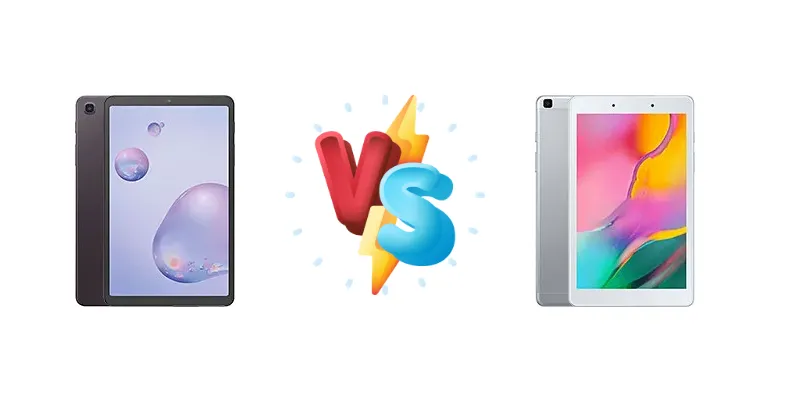
Samsung's Galaxy Tab A series consistently delivers affordable tablet options. The Tab A 8.4 (2020) and Tab A 8.0 (2019) represent two iterations aimed at the budget-conscious user. However, a year separates their releases, bringing with it a significant chipset upgrade. This comparison dives deep into the differences, focusing on performance, efficiency, and which tablet best suits your needs.
🏆 Quick Verdict
For most users, the Samsung Galaxy Tab A 8.4 (2020) is the superior choice. Its Exynos 7904 chipset provides a substantial performance boost over the Snapdragon 429 in the 2019 model, making it better suited for multitasking and light gaming. While the battery capacity isn't dramatically different, the improved efficiency of the 14nm process gives it a slight edge.
| Network |
|---|
| 2G bands | GSM 850 / 900 / 1800 / 1900 | GSM 850 / 900 / 1800 / 1900 |
| 3G bands | HSDPA 850 / 900 / 1900 / 2100 | HSDPA 850 / 900 / 1700(AWS) / 1900 / 2100 |
| 4G bands | 1, 3, 4, 5, 7, 13, 20, 66 | 1, 2, 3, 4, 5, 7, 8, 12, 17, 20, 28, 38, 40, 41 |
| Speed | HSPA 42.2/5.76 Mbps, LTE Cat4 150/50 Mbps | HSPA 42.2/5.76 Mbps, LTE Cat4 150/50 Mbps - cellular model only |
| Technology | GSM / HSPA / LTE | GSM / HSPA / LTE |
| Launch |
|---|
| Announced | 2020, March 25. Released 2020, March 25 | 2019, July 05. Released 2019, July |
| Status | Discontinued | Discontinued |
| Body |
|---|
| Build | Glass front, plastic frame, plastic back | Glass front, aluminum back, plastic frame |
| Dimensions | 202 x 125.2 x 7.1 mm (7.95 x 4.93 x 0.28 in) | 210 x 124.4 x 8 mm (8.27 x 4.90 x 0.31 in) |
| SIM | Nano-SIM | Nano-SIM (cellular model only) |
| Weight | 309 g (10.90 oz) | 345g (Wi-Fi), 347g (LTE) (12.24 oz) |
| Display |
|---|
| Resolution | 1200 x 1920 pixels, 16:10 ratio (~270 ppi density) | 800 x 1280 pixels, 16:10 ratio (~189 ppi density) |
| Size | 8.4 inches, 204.6 cm2 (~80.9% screen-to-body ratio) | 8.0 inches, 185.6 cm2 (~71.0% screen-to-body ratio) |
| Type | TFT LCD | TFT LCD |
| Platform |
|---|
| CPU | Octa-core (2x1.8 GHz Cortex-A73 & 6x1.6 GHz Cortex-A53) | Quad-core 2.0 GHz Cortex-A53 |
| Chipset | Exynos 7904 (14 nm) | Qualcomm SDM429 Snapdragon 429 (12 nm) |
| GPU | Mali-G71 MP2 | Adreno 504 |
| OS | Android 10, upgradable to Android 11, One UI 3.1 | Android 9.0 (Pie), upgradable to Android 11 |
| Memory |
|---|
| Card slot | microSDXC (dedicated slot) | microSDXC (dedicated slot) |
| Internal | 32GB 3GB RAM | 32GB 2GB RAM, 32GB 3GB RAM, 64GB 2GB RAM |
| | eMMC 5.1 | eMMC 5.1 |
| Main Camera |
|---|
| Single | 8 MP, AF | 8 MP, AF |
| Video | 1080p@30fps | 1080p@30fps |
| Selfie camera |
|---|
| Single | 5 MP | 2 MP |
| Sound |
|---|
| 3.5mm jack | Yes | Yes |
| 35mm jack | Yes | Yes |
| Loudspeaker | Yes, with dual speakers | Yes, with dual speakers |
| Comms |
|---|
| Bluetooth | 5.0, A2DP, LE | 4.2, A2DP, LE |
| NFC | No | No |
| Positioning | GPS, GLONASS | GPS, GLONASS, GALILEO, BDS - cellular model only |
| Radio | No | No |
| USB | USB Type-C 2.0 | microUSB 2.0 |
| WLAN | Wi-Fi 802.11 a/b/g/n/ac, dual-band, Wi-Fi Direct | Wi-Fi 802.11 a/b/g/n, dual-band, Wi-Fi Direct |
| Features |
|---|
| Sensors | Accelerometer | Accelerometer |
| | ANT+ | - |
| Battery |
|---|
| Charging | Wired | - |
| Type | Li-Po 5000 mAh | Li-Po 5100 mAh, non-removable |
| Misc |
|---|
| Colors | Mocha | Carbon Black, Silver Gray |
| Models | SM-T307U | SM-T290, SM-T295 |
| Price | About 240 EUR | About 130 EUR |
| SAR | 1.35 W/kg (body) | - |
| SAR EU | - | 0.75 W/kg (head) 1.19 W/kg (body) |
Samsung Galaxy Tab A 8.4 (2020)
- Significantly faster processor for smoother performance.
- More capable for multitasking and light gaming.
- Potentially better long-term software support.
- May be slightly more expensive than the Tab A 8.0 (2019).
- Detailed battery capacity and charging speed are unknown.
Samsung Galaxy Tab A 8.0 (2019)
- Lower price point makes it very accessible.
- Sufficient for basic tasks like web browsing and video playback.
- Potentially slightly better idle battery life.
- Noticeably slower processor, leading to lag and stuttering.
- Struggles with multitasking and demanding applications.
- May receive fewer software updates.
Display Comparison
Both tablets feature 8-inch displays, but detailed display specs like resolution, brightness, and panel type are not provided. However, given the market positioning, it's safe to assume both utilize LCD panels. The 0.4-inch size difference in the 8.4 model may offer a slightly more immersive viewing experience. The lack of information prevents a detailed comparison of color accuracy or viewing angles, but both are likely adequate for casual use.
Camera Comparison
Camera specifications are limited, but both tablets likely feature modest camera setups geared towards casual snapshots. Detailed sensor sizes and lens apertures are unavailable. The focus should not be on camera quality when considering these devices; they are primarily for content consumption, not creation. Any differences in image quality will likely be minimal and overshadowed by the limitations of the sensors themselves.
Performance
The core difference lies in the chipsets. The Tab A 8.4 (2020) boasts the Exynos 7904, a 14nm octa-core processor with a Cortex-A73/A53 configuration. This is a significant upgrade over the Tab A 8.0 (2019)'s Snapdragon 429, a 12nm quad-core Cortex-A53 processor. The Exynos 7904's more modern architecture and higher clock speeds (1.8GHz vs 2.0GHz, but with more cores) translate to noticeably faster app loading times, smoother multitasking, and improved responsiveness. The Snapdragon 429, while sufficient for basic tasks, will struggle with more demanding applications. The 12nm process of the Snapdragon 429 *should* offer slightly better power efficiency at idle, but the Exynos's overall efficiency gains from its architecture likely offset this.
Battery Life
Battery capacity details are missing. However, given the similar form factors and target market, we can assume capacities are relatively close. The Exynos 7904's 14nm process, despite having more cores, is likely more power-efficient than the Snapdragon 429's 12nm process under load. Both tablets support wired charging, but specific wattage details are unavailable. Real-world battery life will depend heavily on usage patterns, but the Tab A 8.4 (2020) is expected to offer slightly longer endurance due to its more efficient processor.
Buying Guide
Buy the Samsung Galaxy Tab A 8.4 (2020) if you prioritize smoother performance for everyday tasks, occasional gaming, and future-proofing. Its more powerful processor will handle demanding apps and multitasking with greater ease. Buy the Samsung Galaxy Tab A 8.0 (2019) if you are on an extremely tight budget and primarily need a tablet for basic media consumption and light web browsing; its lower price point may be attractive for minimal usage scenarios.
Frequently Asked Questions
❓ Does the Exynos 7904 chip in the Tab A 8.4 (2020) overheat during extended gaming sessions?
The Exynos 7904 is a relatively efficient chip. While it will generate heat during prolonged gaming, its thermal design within the Tab A 8.4 (2020) should prevent significant throttling. Expect some performance reduction after extended play, but it shouldn't become unusable.
❓ Is the performance difference between the Snapdragon 429 and Exynos 7904 noticeable in everyday tasks like browsing and email?
Yes, the difference is quite noticeable. The Exynos 7904's octa-core architecture and faster processing speeds result in snappier app launches, smoother scrolling, and a more responsive user experience, even in basic tasks. The Snapdragon 429 can feel sluggish in comparison.
❓ Will the Tab A 8.4 (2020) run demanding games like PUBG Mobile smoothly?
The Tab A 8.4 (2020) can run PUBG Mobile, but likely at medium graphics settings to maintain a stable frame rate. Don't expect a flagship gaming experience, but it's significantly more capable than the Tab A 8.0 (2019) for gaming.
❓ How does the software update support compare between these two tablets?
Generally, newer devices receive longer software support. The Tab A 8.4 (2020) is likely to receive more Android version updates and security patches than the Tab A 8.0 (2019), extending its usable lifespan.