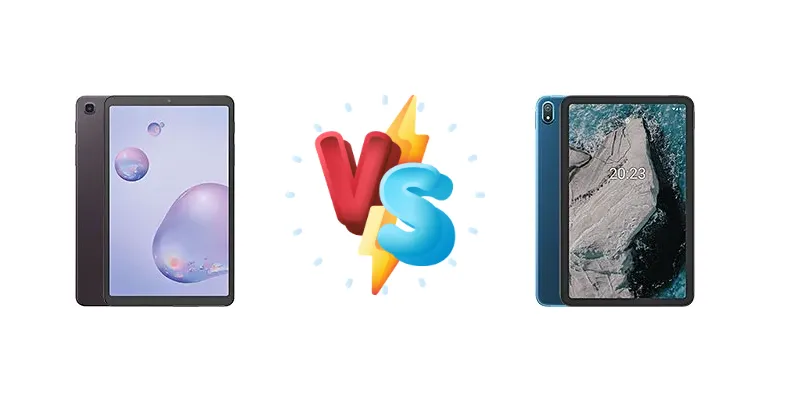
The budget tablet market is fiercely competitive, and the Nokia T20 and Samsung Galaxy Tab A 8.4 (2020) represent compelling options for users seeking affordability without completely sacrificing functionality. This comparison dives deep into their specifications, performance, and real-world usability to determine which tablet offers the best value.
🏆 Quick Verdict
For most users, the Nokia T20 emerges as the better choice. Its newer Unisoc T610 chipset, fabricated on a more efficient 12nm process, coupled with a brighter 422 nit display, provides a smoother and more visually pleasing experience than the Samsung Tab A 8.4's older Exynos 7904.
| Network |
|---|
| 2G bands | GSM 850 / 900 / 1800 / 1900 | GSM 850 / 900 / 1800 / 1900 |
| 3G bands | HSDPA 850 / 900 / 1900 / 2100 | HSDPA 850 / 900 / 1700(AWS) / 1900 / 2100 - US, LATAM |
| 4G bands | 1, 3, 4, 5, 7, 13, 20, 66 | 1, 2, 3, 4, 5, 7, 8, 12, 13, 17, 20, 28, 40, 66 - US, LATAM |
| Speed | HSPA 42.2/5.76 Mbps, LTE Cat4 150/50 Mbps | HSPA, LTE Cat4 150/50 Mbps - cellular model only |
| Technology | GSM / HSPA / LTE | GSM / HSPA / LTE |
| | - | 1, 3, 5, 7, 8, 20, 28, 38, 40, 41 - International |
| Launch |
|---|
| Announced | 2020, March 25. Released 2020, March 25 | 2021, October 06 |
| Status | Discontinued | Available. Released 2021, November 02 |
| Body |
|---|
| Build | Glass front, plastic frame, plastic back | Glass front, aluminum back |
| Dimensions | 202 x 125.2 x 7.1 mm (7.95 x 4.93 x 0.28 in) | 247.6 x 157.5 x 7.8 mm (9.75 x 6.20 x 0.31 in) |
| SIM | Nano-SIM | Nano-SIM (cellular model only) |
| Weight | 309 g (10.90 oz) | 465 g (Wi-Fi), 470 g (LTE) (1.03 lb) |
| | - | Splash resistant |
| Display |
|---|
| Protection | - | Scratch-resistant glass |
| Resolution | 1200 x 1920 pixels, 16:10 ratio (~270 ppi density) | 1200 x 2000 pixels, 5:3 ratio (~224 ppi density) |
| Size | 8.4 inches, 204.6 cm2 (~80.9% screen-to-body ratio) | 10.4 inches, 307.9 cm2 (~78.9% screen-to-body ratio) |
| Type | TFT LCD | IPS LCD, 400 nits (typ) |
| Platform |
|---|
| CPU | Octa-core (2x1.8 GHz Cortex-A73 & 6x1.6 GHz Cortex-A53) | Octa-core (2x1.8 GHz Cortex-A75 & 6x1.8 GHz Cortex-A55) |
| Chipset | Exynos 7904 (14 nm) | Unisoc T610 (12 nm) |
| GPU | Mali-G71 MP2 | Mali-G52 MP2 |
| OS | Android 10, upgradable to Android 11, One UI 3.1 | Android 11, upgradable to Android 13 |
| Memory |
|---|
| Card slot | microSDXC (dedicated slot) | microSDXC (dedicated slot) |
| Internal | 32GB 3GB RAM | 32GB 3GB RAM, 64GB 4GB RAM |
| | eMMC 5.1 | eMMC 5.1 |
| Main Camera |
|---|
| Features | - | LED flash |
| Single | 8 MP, AF | 8 MP, AF |
| Video | 1080p@30fps | 1080p@30fps |
| Selfie camera |
|---|
| Single | 5 MP | 5 MP |
| Video | - | Yes |
| Sound |
|---|
| 3.5mm jack | Yes | Yes |
| 35mm jack | Yes | Yes |
| Loudspeaker | Yes, with dual speakers | Yes, with stereo speakers |
| Comms |
|---|
| Bluetooth | 5.0, A2DP, LE | 5.0, A2DP, LE |
| NFC | No | No |
| Positioning | GPS, GLONASS | GPS - cellular model only |
| Radio | No | FM radio |
| USB | USB Type-C 2.0 | USB Type-C 2.0 |
| WLAN | Wi-Fi 802.11 a/b/g/n/ac, dual-band, Wi-Fi Direct | Wi-Fi 802.11 a/b/g/n/ac, dual-band |
| Features |
|---|
| Sensors | Accelerometer | Accelerometer |
| | ANT+ | - |
| Battery |
|---|
| Charging | Wired | 15W wired |
| Type | Li-Po 5000 mAh | Li-Po 8200 mAh |
| Misc |
|---|
| Colors | Mocha | Deep Ocean |
| Models | SM-T307U | TA-1397, TA-1394, TA-1392 |
| Price | About 240 EUR | About 200 EUR |
| SAR | 1.35 W/kg (body) | 1.34 W/kg (body) |
| SAR EU | - | 1.35 W/kg (body) |
Samsung Galaxy Tab A 8.4 (2020)
- Compact and portable 8.4-inch display
- Established Samsung brand reputation
- Familiar Android experience
- Older Exynos 7904 chipset
- Likely lower display brightness
- Less efficient 14nm fabrication process
Nokia T20
- Brighter 422 nit display with 1786:1 contrast
- More efficient Unisoc T610 chipset (12nm)
- Faster 15W wired charging
- Less well-known Nokia brand in tablets
- Potentially less refined software experience
- Larger form factor may be less portable
Display Comparison
The Nokia T20 boasts a significant advantage in display quality, achieving a measured peak brightness of 422 nits compared to the Samsung Tab A 8.4’s unspecified brightness. This higher brightness translates to better outdoor visibility. Furthermore, the T20’s 1786:1 contrast ratio suggests deeper blacks and more vibrant colors. While both tablets likely utilize IPS LCD panels, the Nokia T20’s specifications indicate a more refined viewing experience. The Tab A 8.4’s smaller 8.4-inch screen may appeal to those prioritizing portability, but the T20’s larger display offers more screen real estate for productivity and media consumption.
Camera Comparison
Neither tablet is intended as a photography powerhouse, and detailed camera specs are limited. Both are likely equipped with basic rear and front-facing cameras suitable for video calls and occasional snapshots. Given the lack of detailed information, it’s difficult to definitively declare a winner. However, the Nokia T20’s focus on overall system improvements suggests a potentially more refined image processing pipeline, even with similar sensor hardware. We can assume both will struggle in low-light conditions.
Performance
Under the hood, the Nokia T20’s Unisoc T610 (12nm) and its Cortex-A75 cores represent a generational improvement over the Samsung Tab A 8.4’s Exynos 7904 (14nm). The Cortex-A75 cores in the T20 offer a noticeable performance uplift over the A73 cores in the Tab A 8.4, particularly in single-core tasks. While both feature an octa-core configuration with six Cortex-A53/A55 cores for efficiency, the 12nm fabrication process of the Unisoc T610 should result in better power efficiency. This doesn't necessarily translate to dramatically faster gaming, but it will provide a smoother experience during everyday tasks and multitasking. The Tab A 8.4’s older chipset may exhibit more noticeable slowdowns when running multiple apps simultaneously.
Battery Life
Battery capacity isn’t specified for either device, making a direct comparison challenging. However, the Nokia T20’s more efficient Unisoc T610 chipset, built on a 12nm process, is likely to deliver longer battery life than the Samsung Tab A 8.4’s 14nm Exynos 7904. The Nokia T20 also supports 15W wired charging, while the Tab A 8.4 is limited to unspecified wired charging. This faster charging speed on the T20 will reduce downtime and provide a more convenient user experience.
Buying Guide
Buy the Samsung Galaxy Tab A 8.4 (2020) if you prioritize brand recognition and a compact form factor, and your usage is limited to basic tasks like web browsing and light video consumption. Buy the Nokia T20 if you value a brighter, more modern display, slightly improved performance for multitasking, and a more efficient chipset that may translate to better battery life during sustained use.
Frequently Asked Questions
❓ Does the Exynos 7904 in the Samsung Tab A 8.4 overheat during prolonged gaming sessions?
The Exynos 7904 is known to throttle under sustained load, meaning performance will decrease over time during demanding games. While it won't necessarily overheat to the point of being unusable, expect frame rate drops and a warmer device compared to the Nokia T20's Unisoc T610.
❓ Is the 15W charging on the Nokia T20 significantly faster than the Samsung Tab A 8.4?
Yes, the Nokia T20's 15W charging will noticeably reduce charging times compared to the Samsung Tab A 8.4, which lacks a specified charging wattage. While not as fast as modern fast-charging standards, it provides a more convenient top-up experience.
❓ How does the Unisoc T610 in the Nokia T20 perform with multitasking compared to the Exynos 7904?
The Unisoc T610, with its newer Cortex-A75 cores, handles multitasking more efficiently than the Exynos 7904. You'll experience fewer stutters and delays when switching between apps on the Nokia T20, especially with multiple apps open simultaneously.