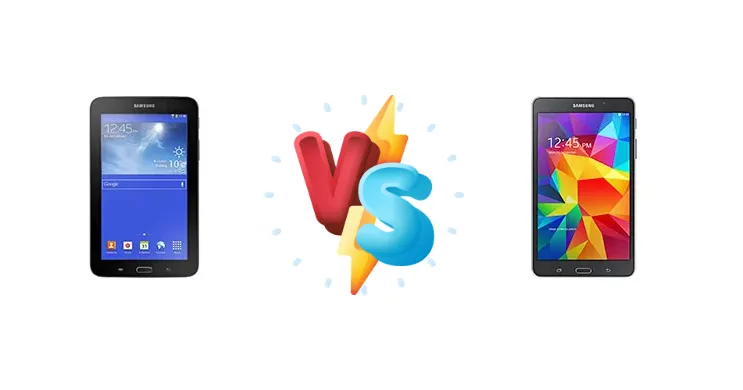
The Samsung Galaxy Tab 3 Lite 7.0 3G and the Galaxy Tab 4 7.0 LTE represent Samsung’s attempts to capture the budget tablet market. While both offer a 7-inch form factor, the Tab 4 7.0 LTE introduces a significant chipset upgrade and the convenience of LTE connectivity, raising the question of whether these improvements justify the potential price difference. This comparison dives deep into the hardware to determine which tablet delivers the best value.
🏆 Quick Verdict
For most users, the Samsung Galaxy Tab 4 7.0 LTE is the superior choice. The Exynos 3470 quad-core processor provides a noticeable performance boost over the Tab 3 Lite’s dual-core Marvell PXA986, making multitasking and app loading significantly smoother. The addition of LTE connectivity further enhances its usability for users who require internet access on the go.
| Network |
|---|
| 2G bands | GSM 850 / 900 / 1800 / 1900 | GSM 850 / 900 / 1800 / 1900 |
| 3G bands | HSDPA 900 / 2100 | HSDPA 850 / 900 / 1900 / 2100 |
| 4G bands | - | 1, 3, 5, 7, 8, 20 |
| Speed | HSPA 21.1/5.76 Mbps | HSPA 42.2/5.76 Mbps, LTE Cat4 150/50 Mbps |
| Technology | GSM / HSPA | GSM / HSPA / LTE |
| Launch |
|---|
| Announced | 2014, January. Released 2014, February | 2014, April. Released 2014, May |
| Status | Discontinued | Discontinued |
| Body |
|---|
| Dimensions | 193.4 x 116.4 x 9.7 mm (7.61 x 4.58 x 0.38 in) | 186.9 x 107.9 x 9 mm (7.36 x 4.25 x 0.35 in) |
| SIM | Micro-SIM | Micro-SIM |
| Weight | 322 g (11.36 oz) | 276 g (9.74 oz) |
| Display |
|---|
| Resolution | 600 x 1024 pixels, 16:9 ratio (~170 ppi density) | 800 x 1280 pixels, 16:10 ratio (~216 ppi density) |
| Size | 7.0 inches, 137.9 cm2 (~61.3% screen-to-body ratio) | 7.0 inches, 142.1 cm2 (~70.5% screen-to-body ratio) |
| Type | TFT | TFT |
| Platform |
|---|
| CPU | Dual-core 1.2 GHz | Quad-core 1.2 GHz Cortex-A7 |
| Chipset | Marvell PXA986 | Exynos 3470 Quad |
| GPU | Vivante GC1000 | Mali-400MP4 |
| OS | Android 4.2 (Jelly Bean) | Android 4.4.2 (KitKat), TouchWiz UX UI |
| Memory |
|---|
| Card slot | microSDHC (dedicated slot) | microSDXC (dedicated slot) |
| Internal | 8GB 1GB RAM | 8GB 1.5GB RAM, 16GB 1.5GB RAM |
| Main Camera |
|---|
| Single | 2 MP | 3.15 MP |
| Video | Yes | 720p@30fps |
| Selfie camera |
|---|
| Single | - | 1.3 MP |
| | No | - |
| Sound |
|---|
| 3.5mm jack | Yes | Yes |
| 35mm jack | Yes | Yes |
| Loudspeaker | Yes | Yes, with dual speakers |
| Comms |
|---|
| Bluetooth | 4.0, LE | 4.0, A2DP |
| Infrared port | - | Yes |
| NFC | No | No |
| Positioning | GPS, GLONASS | GPS, GLONASS |
| Radio | No | No |
| USB | 2.0 | microUSB 2.0 |
| WLAN | Wi-Fi 802.11 b/g/n, Wi-Fi Direct, hotspot | Wi-Fi 802.11 a/b/g/n, dual-band, Wi-Fi Direct, hotspot |
| Features |
|---|
| Sensors | Accelerometer | Accelerometer |
| Battery |
|---|
| Music play | Up to 200 h | Up to 190 h |
| Talk time | Up to 9 h (multimedia) | Up to 10 h (multimedia) |
| Type | Li-Ion 3600 mAh, non-removable | Li-Po 4000 mAh, non-removable |
| Misc |
|---|
| Colors | White, Black, Green, Pink, Yellow | White, Black |
| Models | SM-T111 | SM-T235, SM-T235Y, SM-T239 |
| Price | About 190 EUR | About 280 EUR |
| SAR | 1.45 W/kg (head) 1.60 W/kg (body) | - |
| SAR EU | 0.37 W/kg (head) 0.83 W/kg (body) | - |
Samsung Galaxy Tab 3 Lite 7.0 3G
- Potentially lower price point
- Simpler operating system experience for basic users
- Sufficient for light tasks like reading and web browsing
- Significantly slower performance
- Limited multitasking capabilities
- 3G connectivity is slower and less reliable than LTE
Samsung Galaxy Tab 4 7.0 LTE
- Faster and more responsive performance
- LTE connectivity for on-the-go internet access
- Improved multitasking capabilities
- Potentially higher price
- LTE connectivity can drain battery faster
- May be slightly heavier due to LTE components
Display Comparison
Both tablets feature a 7-inch display, but detailed specifications regarding resolution, panel type (TFT vs IPS), and brightness are absent. Given the market positioning, it’s reasonable to assume both utilize TFT panels. The lack of information prevents a detailed comparison of color accuracy or viewing angles. However, the Tab 4 7.0 likely benefits from slightly improved color reproduction due to the newer chipset’s image processing capabilities. Bezels are expected to be similar, reflecting the design trends of the time.
Camera Comparison
Camera specifications for both tablets are modest. Without specific details, it’s safe to assume both feature a rear-facing camera and a front-facing camera for video calls. The image quality will likely be similar, with both struggling in low-light conditions. Any differences in image processing will be minimal, given the limited capabilities of both chipsets. Focusing on camera performance for these devices is not a primary consideration for potential buyers.
Performance
The core difference lies in the chipset. The Galaxy Tab 3 Lite 7.0 utilizes the Marvell PXA986, featuring a dual-core 1.2 GHz CPU. This is significantly outmatched by the Galaxy Tab 4 7.0 LTE’s Exynos 3470 quad-core 1.2 GHz Cortex-A7 processor. The quad-core architecture of the Exynos 3470 allows for more efficient multitasking and smoother performance in demanding applications. While both CPUs operate at the same clock speed, the Cortex-A7 architecture is more efficient than the cores found in the PXA986. This translates to a more responsive user experience, particularly when switching between apps or browsing complex web pages. The Tab 4 7.0 LTE will exhibit less lag and stuttering during everyday use.
Battery Life
Battery capacity details are unavailable. However, given the similar form factors and display technologies, battery life is likely comparable. The Exynos 3470 in the Tab 4 7.0 LTE is potentially more power-efficient due to its architecture, but the increased power draw from LTE connectivity could offset this advantage. Charging wattage is also unknown, but both tablets likely support standard 5W charging. Real-world battery life will depend heavily on usage patterns, with heavier multitasking and LTE usage draining the battery faster on the Tab 4 7.0 LTE.
Buying Guide
Buy the Samsung Galaxy Tab 3 Lite 7.0 3G if you primarily need a basic tablet for light tasks like reading ebooks, browsing the web over Wi-Fi, and occasional video streaming, and prioritize the lowest possible price. Buy the Samsung Galaxy Tab 4 7.0 LTE if you value faster performance for multitasking and gaming, and require reliable internet connectivity while traveling or away from Wi-Fi hotspots. The LTE capability is a key differentiator for mobile professionals and students.
Frequently Asked Questions
❓ Does the Exynos 3470 chip in the Tab 4 7.0 LTE overheat during extended use?
The Exynos 3470 is a relatively low-power chip and is unlikely to overheat significantly during typical tablet usage. While demanding games or prolonged video recording may cause some warming, it shouldn't reach levels that cause performance throttling or discomfort. The tablet's thermal design is adequate for the chip's power consumption.
❓ Is the LTE connectivity on the Tab 4 7.0 LTE compatible with all carriers?
Compatibility depends on the specific LTE bands supported by the Tab 4 7.0 LTE and the bands used by your carrier. It's crucial to check the tablet's specifications and your carrier's network compatibility information before purchasing to ensure it will work on your network. The Tab 4 7.0 LTE supports a range of LTE bands common in many regions, but compatibility isn't guaranteed.
❓ Will I notice a significant difference in app loading times between the two tablets?
Yes, you will likely notice a substantial difference. The quad-core Exynos 3470 in the Tab 4 7.0 LTE will load apps much faster than the dual-core Marvell PXA986 in the Tab 3 Lite 7.0. This is due to the increased processing power and more efficient architecture of the Exynos chip.