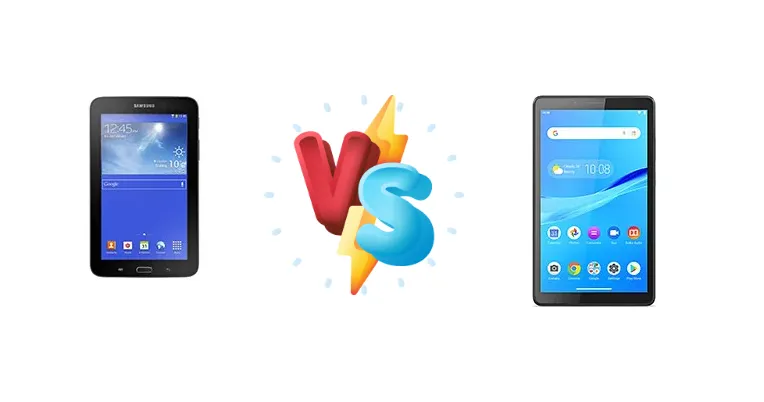
The Samsung Galaxy Tab 3 Lite 7.0 3G and the Lenovo Tab M7 represent the entry-level end of the Android tablet market. While both aim to provide affordable access to tablet functionality, they differ significantly in their internal hardware. This comparison dissects those differences to determine which tablet delivers the best experience for the price, particularly focusing on performance and usability for everyday tasks.
🏆 Quick Verdict
For the average user, the Lenovo Tab M7 emerges as the better choice. Its quad-core Mediatek MT8321 processor, built on a 28nm process, provides a noticeable performance uplift over the Samsung Tab 3 Lite 7.0’s dual-core Marvell PXA986. While both are limited in overall power, the M7 offers a smoother experience for multitasking and app loading.
| Network |
|---|
| 2G bands | GSM 850 / 900 / 1800 / 1900 | GSM 850 / 900 / 1800 / 1900 |
| 3G bands | HSDPA 900 / 2100 | HSDPA 850 / 900 / 1900 / 2100 |
| 4G bands | - | 1, 3, 4, 7, 8, 20 |
| Speed | HSPA 21.1/5.76 Mbps | HSPA, LTE - cellular model only |
| Technology | GSM / HSPA | GSM / HSPA / LTE |
| Launch |
|---|
| Announced | 2014, January. Released 2014, February | 2019, September. Released 2019, October |
| Status | Discontinued | Discontinued |
| Body |
|---|
| Build | - | Glass front, aluminum back, aluminum frame |
| Dimensions | 193.4 x 116.4 x 9.7 mm (7.61 x 4.58 x 0.38 in) | 176.3 x 102.9 x 8.3 mm (6.94 x 4.05 x 0.33 in) |
| SIM | Micro-SIM | Nano-SIM (cellular model only) |
| Weight | 322 g (11.36 oz) | 236 g (8.32 oz) |
| Display |
|---|
| Resolution | 600 x 1024 pixels, 16:9 ratio (~170 ppi density) | 600 x 1024 pixels, 16:9 ratio (~170 ppi density) |
| Size | 7.0 inches, 137.9 cm2 (~61.3% screen-to-body ratio) | 7.0 inches, 137.9 cm2 (~76.0% screen-to-body ratio) |
| Type | TFT | IPS LCD |
| Platform |
|---|
| CPU | Dual-core 1.2 GHz | Quad-core 1.3 GHz |
| Chipset | Marvell PXA986 | Mediatek MT8321 (28 nm) - Wi-FiMediatek MT8765B - Wi-Fi/LTE |
| GPU | Vivante GC1000 | Mali-400 |
| OS | Android 4.2 (Jelly Bean) | Android 9.0 (Pie) - 2GB RAM, Android 9.0 Pie (Go edition) - 1GB RAM |
| Memory |
|---|
| Card slot | microSDHC (dedicated slot) | microSDXC (dedicated slot) |
| Internal | 8GB 1GB RAM | 8GB 1GB RAM, 16GB 1GB RAM, 32GB 2GB RAM |
| Main Camera |
|---|
| Single | 2 MP | 2 MP |
| Video | Yes | 720p |
| Selfie camera |
|---|
| Single | - | 2 MP |
| Video | - | 720p |
| | No | - |
| Sound |
|---|
| 3.5mm jack | Yes | Yes |
| 35mm jack | Yes | Yes |
| Loudspeaker | Yes | Yes |
| Comms |
|---|
| Bluetooth | 4.0, LE | 4.2, A2DP, LE |
| NFC | No | No |
| Positioning | GPS, GLONASS | GPS, GLONASS - cellular model only |
| Radio | No | FM radio |
| USB | 2.0 | microUSB 2.0 |
| WLAN | Wi-Fi 802.11 b/g/n, Wi-Fi Direct, hotspot | Wi-Fi 802.11 b/g/n, Wi-Fi Direct |
| Features |
|---|
| Sensors | Accelerometer | Accelerometer |
| Battery |
|---|
| Music play | Up to 200 h | - |
| Talk time | Up to 9 h (multimedia) | - |
| Type | Li-Ion 3600 mAh, non-removable | Li-Po 3590 mAh, non-removable |
| Misc |
|---|
| Colors | White, Black, Green, Pink, Yellow | Iron Grey, Platinum Grey, Onyx Black |
| Models | SM-T111 | TB-7305F, TB-7305X, TB-7305I |
| Price | About 190 EUR | About 100 EUR |
| SAR | 1.45 W/kg (head) 1.60 W/kg (body) | - |
| SAR EU | 0.37 W/kg (head) 0.83 W/kg (body) | - |
Samsung Galaxy Tab 3 Lite 7.0 3G
- Established Brand Reputation (Samsung)
- 3G Connectivity (for areas with limited Wi-Fi)
- Compact and Portable
- Outdated Dual-Core Processor
- Likely Poor Performance for Multitasking
- Potentially Lower Battery Life
Lenovo Tab M7
- Quad-Core Processor for Improved Performance
- More Efficient 28nm Chipset
- Better Value for Money
- Less Brand Recognition (Lenovo)
- May Lack 3G Connectivity (depending on model)
- Display Quality Likely Similar to Samsung
Display Comparison
Neither tablet boasts a particularly impressive display. Specifics like brightness nits and color accuracy are unavailable, but given their market segment, both likely utilize TN panels with limited viewing angles. The 7-inch form factor is consistent, making portability similar. However, the Lenovo Tab M7 benefits from a more recent manufacturing process for its chipset, potentially freeing up resources for slightly improved display driver optimization, though this is speculative without direct testing.
Camera Comparison
Both tablets feature cameras that are best described as functional for video calls rather than photography. Details on sensor size and aperture are unavailable, but given the price point, expectations should be low. Image quality will likely be poor in anything other than ideal lighting conditions. Focusing on camera performance is not a strength of either device.
Performance
The core difference lies in the processors. The Lenovo Tab M7’s Mediatek MT8321, a quad-core 1.3 GHz chip built on a 28nm process, significantly outperforms the Samsung Galaxy Tab 3 Lite 7.0’s dual-core 1.2 GHz Marvell PXA986. The additional cores and more efficient manufacturing process translate to faster app loading times, smoother multitasking, and a more responsive user interface. While neither chip is a powerhouse, the M7 avoids the noticeable lag that plagues the Tab 3 Lite during even moderate use. The 28nm process also suggests better thermal efficiency, reducing the likelihood of performance throttling under sustained load.
Battery Life
Battery capacity details are missing for both devices. However, the Mediatek MT8321 in the Lenovo Tab M7, being a more efficient chip due to its 28nm process, will likely contribute to longer battery life compared to the Samsung Tab 3 Lite 7.0’s Marvell PXA986. While charging wattage is unknown, the M7’s more efficient processor will likely result in faster overall charge times to full capacity, even with similar battery capacities.
Buying Guide
Buy the Samsung Galaxy Tab 3 Lite 7.0 3G if you prioritize brand recognition and require guaranteed 3G connectivity for areas with limited Wi-Fi access. Buy the Lenovo Tab M7 if you prioritize performance for the price, and are primarily using the tablet for media consumption, light gaming, and browsing on Wi-Fi. The M7’s more modern chipset delivers a more responsive user experience.
Frequently Asked Questions
❓ Will the Lenovo Tab M7 struggle with popular games like PUBG Mobile?
Yes, both tablets will struggle with demanding games like PUBG Mobile. However, the Lenovo Tab M7’s quad-core processor will provide a slightly more playable experience at lower settings compared to the Samsung Tab 3 Lite 7.0’s dual-core chip. Expect significant frame rate drops and lag regardless.
❓ Is the 3G connectivity on the Samsung Tab 3 Lite 7.0 still relevant in 2024?
The relevance of 3G connectivity depends on your location and usage scenario. While 3G networks are being phased out in many regions, it can still be useful in areas with limited or no Wi-Fi access. However, if you primarily use Wi-Fi, the 3G functionality is largely unnecessary.
❓ Can I realistically use the Lenovo Tab M7 for video conferencing?
Yes, the Lenovo Tab M7 is suitable for basic video conferencing using apps like Zoom or Skype. However, the camera quality is low, so image clarity will be limited. Audio quality will likely be adequate for voice calls, but don't expect a premium experience.