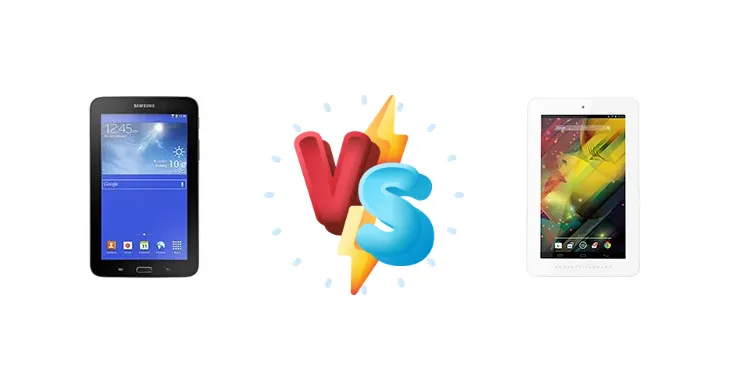
The Samsung Galaxy Tab 3 Lite 7.0 3G and the HP 7 Plus represent the lower end of the Android tablet market, catering to users prioritizing affordability over cutting-edge features. Both devices aim to provide basic functionality for media consumption, light productivity, and casual gaming, but they achieve this with significantly different hardware approaches. This comparison dissects those differences to determine which tablet delivers the best experience for the price.
🏆 Quick Verdict
For the average user seeking a basic, reliable tablet for media consumption and light tasks, the HP 7 Plus emerges as the slightly better choice. Its quad-core processor, despite the lower clock speed, offers a more responsive experience than the dual-core Marvell chip in the Tab 3 Lite, making it better suited for multitasking and app loading.
| Network |
|---|
| 2G bands | GSM 850 / 900 / 1800 / 1900 | N/A |
| 3G bands | HSDPA 900 / 2100 | - |
| EDGE | - | No |
| GPRS | - | No |
| Speed | HSPA 21.1/5.76 Mbps | - |
| Technology | GSM / HSPA | No cellular connectivity |
| Launch |
|---|
| Announced | 2014, January. Released 2014, February | 2014, May. Released 2014, May |
| Status | Discontinued | Discontinued |
| Body |
|---|
| Dimensions | 193.4 x 116.4 x 9.7 mm (7.61 x 4.58 x 0.38 in) | 192.5 x 121.9 x 8.1 mm (7.58 x 4.80 x 0.32 in) |
| SIM | Micro-SIM | No |
| Weight | 322 g (11.36 oz) | 294.8 g (10.37 oz) |
| Display |
|---|
| Resolution | 600 x 1024 pixels, 16:9 ratio (~170 ppi density) | 600 x 1024 pixels, 16:9 ratio (~170 ppi density) |
| Size | 7.0 inches, 137.9 cm2 (~61.3% screen-to-body ratio) | 7.0 inches, 137.9 cm2 (~58.8% screen-to-body ratio) |
| Type | TFT | IPS LCD |
| Platform |
|---|
| CPU | Dual-core 1.2 GHz | Quad-core 1.0 GHz Cortex-A7 |
| Chipset | Marvell PXA986 | Allwinner A31 |
| GPU | Vivante GC1000 | - |
| OS | Android 4.2 (Jelly Bean) | Android 4.2.2 (Jelly Bean) |
| Memory |
|---|
| Card slot | microSDHC (dedicated slot) | microSDHC (dedicated slot) |
| Internal | 8GB 1GB RAM | 8GB 1GB RAM |
| Main Camera |
|---|
| Single | 2 MP | 2 MP |
| Video | Yes | Yes |
| Selfie camera |
|---|
| Single | - | VGA |
| | No | - |
| Sound |
|---|
| 3.5mm jack | Yes | Yes |
| 35mm jack | Yes | Yes |
| Loudspeaker | Yes | Yes |
| Comms |
|---|
| Bluetooth | 4.0, LE | Yes |
| NFC | No | No |
| Positioning | GPS, GLONASS | No |
| Radio | No | No |
| USB | 2.0 | microUSB 2.0 |
| WLAN | Wi-Fi 802.11 b/g/n, Wi-Fi Direct, hotspot | Wi-Fi 802.11 b/g/n |
| Features |
|---|
| Sensors | Accelerometer | Accelerometer |
| Battery |
|---|
| Music play | Up to 200 h | - |
| Talk time | Up to 9 h (multimedia) | Up to 5 h 30 min (multimedia) |
| Type | Li-Ion 3600 mAh, non-removable | Li-Po 2800 mAh, non-removable |
| Misc |
|---|
| Colors | White, Black, Green, Pink, Yellow | Silver |
| Models | SM-T111 | - |
| Price | About 190 EUR | About 70 EUR |
| SAR | 1.45 W/kg (head) 1.60 W/kg (body) | - |
| SAR EU | 0.37 W/kg (head) 0.83 W/kg (body) | - |
Samsung Galaxy Tab 3 Lite 7.0 3G
- Built-in 3G connectivity for on-the-go access.
- Samsung brand recognition and potential software support (though likely outdated).
- Potentially more readily available accessories.
- Dual-core processor limits performance.
- Older chipset may result in slower app loading times.
- Likely lower battery efficiency due to older architecture.
HP 7 Plus
- Quad-core processor offers better multitasking performance.
- More responsive user experience for everyday tasks.
- Potentially better battery life due to processor efficiency.
- Lacks built-in 3G connectivity.
- HP brand may have less software support.
- Build quality may be less premium than the Samsung.
Display Comparison
Neither device boasts a particularly impressive display. Given the context data, we can assume both utilize TN or IPS LCD panels common in this price bracket. The 7-inch size is standard, but specifics like resolution and brightness are unknown. However, the HP 7 Plus’s processor may allow for slightly smoother scrolling and transitions, indirectly improving the perceived display quality. The Tab 3 Lite’s age suggests a potentially lower peak brightness and narrower viewing angles.
Camera Comparison
Both tablets likely feature low-resolution cameras primarily intended for video calls. Without specific sensor details, a detailed comparison is difficult. It’s safe to assume image quality will be subpar on both devices, especially in low-light conditions. Focusing on camera performance for these tablets is largely irrelevant; they are not designed for photography.
Performance
The core difference lies in the processors. The HP 7 Plus’s Allwinner A31 quad-core 1.0 GHz CPU has a clear advantage in core count over the Samsung Galaxy Tab 3 Lite’s dual-core 1.2 GHz Marvell PXA986. While the Tab 3 Lite has a higher clock speed, the A31’s architecture allows for better parallel processing, resulting in faster app launches and smoother multitasking. The Cortex-A7 architecture in the HP 7 Plus, while older, is more efficient than the PXA986 in handling multiple processes simultaneously. This translates to a more fluid experience when switching between apps or browsing the web. The Tab 3 Lite will likely struggle with more demanding applications.
Battery Life
Battery capacity is not specified for either device. However, given the less demanding processor in the HP 7 Plus, it may achieve slightly better battery life despite potentially having a similar capacity to the Tab 3 Lite. The Tab 3 Lite’s older processor and potentially less efficient power management could lead to faster battery drain, especially when utilizing the 3G connectivity. Charging wattage is also unknown, but both likely support standard 5W charging.
Buying Guide
Buy the Samsung Galaxy Tab 3 Lite 7.0 3G if you specifically need 3G connectivity for on-the-go access without relying on Wi-Fi, and brand recognition is a priority. Buy the HP 7 Plus if you prioritize a smoother, more responsive user experience for everyday tasks and are primarily connecting via Wi-Fi. The HP 7 Plus offers better value for users who don't require cellular data.
Frequently Asked Questions
❓ Will the Samsung Galaxy Tab 3 Lite struggle with modern Android apps?
Yes, the dual-core Marvell PXA986 processor and limited RAM (likely 1GB) will likely result in slow loading times and lag when running newer, more demanding Android applications. It's best suited for basic apps and media consumption.
❓ Is the Allwinner A31 in the HP 7 Plus powerful enough for light gaming?
The HP 7 Plus’s quad-core A31 can handle basic 2D games and older 3D titles at lower settings. However, it will struggle with graphically intensive modern games. Expect frame rate drops and potential stuttering.
❓ Can I use a SIM card with the HP 7 Plus to get internet access?
No, the HP 7 Plus does not have cellular connectivity. It relies solely on Wi-Fi for internet access. The Samsung Galaxy Tab 3 Lite 7.0 3G is the only option if you require on-the-go data access.
❓ How much storage does each tablet offer, and can it be expanded?
Storage capacity is not specified, but both likely come with 8GB or 16GB of internal storage. Both tablets almost certainly feature a microSD card slot for storage expansion, allowing you to add more space for apps, photos, and videos.