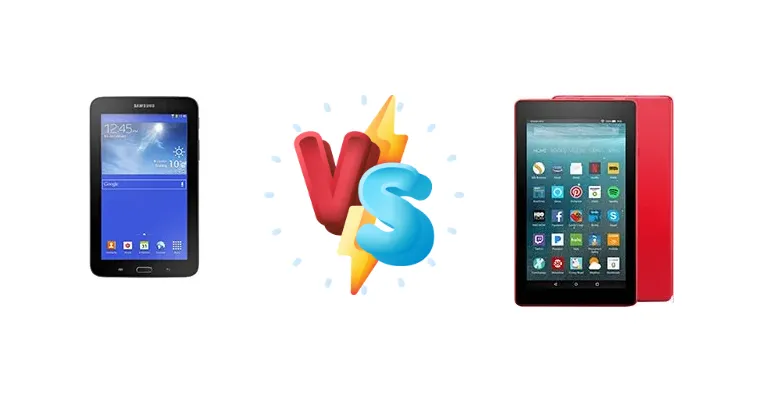
Both the Samsung Galaxy Tab 3 Lite 7.0 3G and the Amazon Fire 7 (2017) represent the lower end of the tablet market, targeting users prioritizing affordability over cutting-edge features. However, their internal architectures and software approaches differ significantly, impacting real-world performance and usability. This comparison dissects these differences to help you choose the right tablet for your needs.
🏆 Quick Verdict
For most users, the Amazon Fire 7 (2017) is the better choice. Its quad-core Mediatek MT8127 processor provides a noticeable performance boost over the Samsung’s dual-core Marvell PXA986, making it more responsive for everyday tasks and light gaming. While the Samsung offers 3G connectivity, the Fire 7’s lower price and improved processing power outweigh this benefit for the average user.
| Network |
|---|
| 2G bands | GSM 850 / 900 / 1800 / 1900 | N/A |
| 3G bands | HSDPA 900 / 2100 | - |
| EDGE | - | No |
| GPRS | - | No |
| Speed | HSPA 21.1/5.76 Mbps | - |
| Technology | GSM / HSPA | No cellular connectivity |
| Launch |
|---|
| Announced | 2014, January. Released 2014, February | 2017, May. Released 2017, June |
| Status | Discontinued | Discontinued |
| Body |
|---|
| Dimensions | 193.4 x 116.4 x 9.7 mm (7.61 x 4.58 x 0.38 in) | 192 x 115 x 9.6 mm (7.56 x 4.53 x 0.38 in) |
| SIM | Micro-SIM | No |
| Weight | 322 g (11.36 oz) | 295 g (10.41 oz) |
| Display |
|---|
| Resolution | 600 x 1024 pixels, 16:9 ratio (~170 ppi density) | 600 x 1024 pixels, 16:9 ratio (~170 ppi density) |
| Size | 7.0 inches, 137.9 cm2 (~61.3% screen-to-body ratio) | 7.0 inches, 137.9 cm2 (~62.5% screen-to-body ratio) |
| Type | TFT | IPS LCD |
| Platform |
|---|
| CPU | Dual-core 1.2 GHz | Quad-core 1.3 GHz Cortex-A7 |
| Chipset | Marvell PXA986 | Mediatek MT8127 (28 nm) |
| GPU | Vivante GC1000 | Mali-450MP4 |
| OS | Android 4.2 (Jelly Bean) | Customized Android 5.1 (Lollipop), Fire 5.4 |
| Memory |
|---|
| Card slot | microSDHC (dedicated slot) | microSDXC (dedicated slot) |
| Internal | 8GB 1GB RAM | 8GB 1GB RAM, 16GB 1GB RAM |
| Main Camera |
|---|
| Single | 2 MP | 2 MP |
| Video | Yes | 720p |
| Selfie camera |
|---|
| Single | - | VGA |
| | No | - |
| Sound |
|---|
| 3.5mm jack | Yes | Yes |
| 35mm jack | Yes | Yes |
| Loudspeaker | Yes | Yes |
| Comms |
|---|
| Bluetooth | 4.0, LE | 4.0, A2DP, LE |
| NFC | No | No |
| Positioning | GPS, GLONASS | No |
| Radio | No | No |
| USB | 2.0 | microUSB 2.0, OTG |
| WLAN | Wi-Fi 802.11 b/g/n, Wi-Fi Direct, hotspot | Wi-Fi 802.11 a/b/g/n, dual-band |
| Features |
|---|
| Sensors | Accelerometer | Accelerometer |
| | - | Alexa natural language commands
Text-to-Speech English-language content reader |
| Battery |
|---|
| Music play | Up to 200 h | - |
| Talk time | Up to 9 h (multimedia) | Up to 8 h |
| Type | Li-Ion 3600 mAh, non-removable | Li-Ion 2980 mAh, non-removable |
| Misc |
|---|
| Colors | White, Black, Green, Pink, Yellow | Black, Canary Yellow, Marine Blue, Punch Red |
| Models | SM-T111 | - |
| Price | About 190 EUR | About 70 EUR |
| SAR | 1.45 W/kg (head) 1.60 W/kg (body) | - |
| SAR EU | 0.37 W/kg (head) 0.83 W/kg (body) | - |
Samsung Galaxy Tab 3 Lite 7.0 3G
- Includes 3G connectivity for data on the go.
- Samsung brand recognition and potentially better software support (though aging).
- May be easier to find accessories due to wider availability historically.
- Significantly slower processor compared to the Fire 7.
- Likely inferior display quality.
- Older chipset architecture and manufacturing process.
Amazon Fire 7 (2017)
- Faster quad-core processor for improved performance.
- More modern chipset manufacturing process (28nm).
- Lower price point, offering better value for money.
- Lacks 3G connectivity; relies on Wi-Fi.
- Amazon’s Fire OS is heavily customized and may not appeal to all users.
- Limited access to the full Google Play Store without sideloading.
Display Comparison
Neither tablet boasts a particularly impressive display. Both are likely to feature TN panels given their price point, meaning limited viewing angles and color accuracy. However, specific details like resolution and brightness are not provided. The Samsung, being an older model, may suffer from more noticeable backlight bleed. The Fire 7’s 28nm chipset suggests a more modern manufacturing process, potentially leading to slightly better power efficiency in display operation, but this is speculative without display specs.
Camera Comparison
Both tablets are unlikely to deliver a compelling camera experience. Given the market segment, camera quality is a low priority. Without specific sensor details, it’s safe to assume both feature low-resolution sensors with limited dynamic range and poor low-light performance. Focusing on camera capabilities for either device would be a misallocation of expectations; they are primarily intended for video calls, not photography.
Performance
The core difference lies in the processors. The Amazon Fire 7’s Mediatek MT8127, a quad-core 1.3 GHz Cortex-A7, demonstrably outperforms the Samsung Galaxy Tab 3 Lite’s dual-core 1.2 GHz Marvell PXA986. The Cortex-A7 architecture, while not the latest, benefits from having four cores versus the Samsung’s two. This translates to faster app launches, smoother multitasking, and a more responsive user interface on the Fire 7. The 28nm process node of the MT8127 also contributes to better thermal efficiency, potentially reducing throttling during sustained workloads. Users will notice a significant difference in responsiveness when browsing the web or using apps on the Fire 7.
Battery Life
Battery life will depend heavily on usage patterns. Neither device’s mAh capacity is specified. However, the Mediatek MT8127’s 28nm process node likely contributes to better power efficiency compared to the older Marvell PXA986. This means the Fire 7 may offer slightly longer battery life under similar usage conditions. Charging wattage is also unknown, but given the budget nature of both devices, expect relatively slow charging times.
Buying Guide
Buy the Samsung Galaxy Tab 3 Lite 7.0 3G if you absolutely require cellular data connectivity without relying on Wi-Fi hotspots, and are willing to sacrifice processing power for that feature. Buy the Amazon Fire 7 (2017) if you prioritize a smoother user experience, faster app loading times, and a lower price point, and primarily use the tablet on Wi-Fi networks for media consumption and basic tasks.
Frequently Asked Questions
❓ Is the Amazon Fire 7 (2017) easy to sideload apps from the Google Play Store?
Yes, sideloading the Google Play Store onto the Fire 7 is a relatively straightforward process, though it requires some technical knowledge and involves enabling developer options and installing a third-party app store enabler. Numerous online guides detail the steps involved.
❓ Does the Samsung Galaxy Tab 3 Lite 7.0 3G's 3G connectivity support voice calls?
Yes, the '3G' designation indicates that the Samsung Galaxy Tab 3 Lite 7.0 supports voice calls over cellular networks, functioning similarly to a basic smartphone in that regard. However, its small screen size may make it less practical for extended phone calls.
❓ How does Amazon’s Fire OS differ from standard Android?
Amazon’s Fire OS is a heavily customized version of Android. It replaces the Google Play Store with the Amazon Appstore, emphasizes Amazon’s services (like Prime Video and Kindle), and features a different user interface. While it’s based on Android, it lacks the full suite of Google apps and services.
❓ Will the Mediatek MT8127 in the Fire 7 handle basic games like Candy Crush or Angry Birds?
Yes, the Mediatek MT8127 is more than capable of handling casual games like Candy Crush or Angry Birds. While it won’t run demanding 3D titles smoothly, it provides a sufficient level of performance for simple, 2D gaming experiences.