
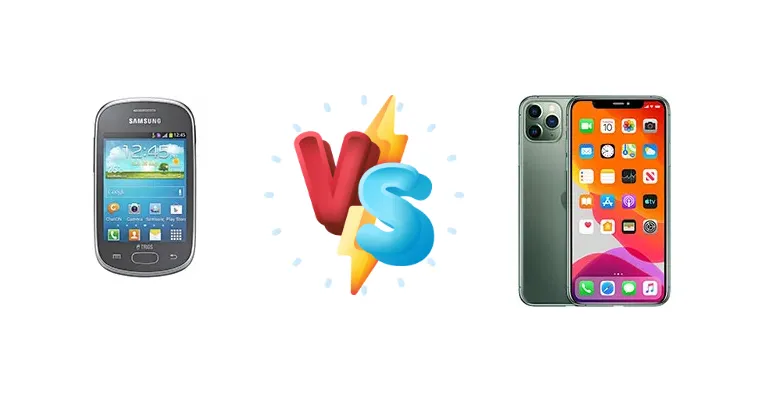
Samsung Galaxy Star Trios vs. iPhone 11 Pro Max: A Generational Leap?
| Phones Images | |||||
|---|---|---|---|---|---|
|
🏆 Quick Verdict
The iPhone 11 Pro Max utterly dominates this comparison. While the Galaxy Star Trios was a decent budget phone in its time, the iPhone's superior performance, camera, display, and battery life make it the clear winner. This is a comparison across generations, not a fair fight.
| PHONES | ||
|---|---|---|
| Phone Names | Samsung Galaxy Star Trios S5283 | Apple iPhone 11 Pro Max |
| Network | ||
|---|---|---|
| 2G bands | GSM 850 / 900 / 1800 / 1900 - SIM 1 & SIM 2 & SIM 3 | GSM 850 / 900 / 1800 / 1900 |
| 3G bands | HSDPA 850 / 2100 | HSDPA 850 / 900 / 1700(AWS) / 1900 / 2100 |
| 4G bands | 2, 4, 5, 12 | 1, 2, 3, 4, 5, 7, 8, 11, 12, 13, 17, 18, 19, 20, 21, 25, 26, 28, 29, 30, 32, 34, 38, 39, 40, 41, 42, 46, 48, 66 - A2218 |
| Speed | HSPA | HSPA, LTE 1.6 Gbps DL, EV-DO Rev.A 3.1 Mbps |
| Technology | GSM / HSPA | GSM / CDMA / HSPA / EVDO / LTE |
| - | 1, 2, 3, 4, 5, 7, 8, 12, 13, 14, 17, 18, 19, 20, 25, 26, 29, 30, 34, 38, 39, 40, 41, 42, 46, 48, 66, 71 - A2161, A2220 | |
| Launch | ||
|---|---|---|
| Announced | 2014, February. Released 2014, May | 2019, September 10 |
| Status | Discontinued | Available. Released 2019, September 20 |
| Body | ||
|---|---|---|
| Build | - | Glass front (Corning-made glass), glass back (Corning-made glass), stainless steel frame |
| Dimensions | 106 x 61 x 11 mm (4.17 x 2.40 x 0.43 in) | 158 x 77.8 x 8.1 mm (6.22 x 3.06 x 0.32 in) |
| SIM | Triple SIM (Mini-SIM) | · Nano-SIM + eSIM· Nano-SIM + Nano-SIM (China) |
| Weight | 105 g (3.70 oz) | 226 g (7.97 oz) |
| - | IP68 dust/water resistant (up to 4m for 30 min) Apple Pay (Visa, MasterCard, AMEX certified) | |
| Display | ||
|---|---|---|
| Protection | - | Scratch-resistant glass |
| Resolution | 240 x 320 pixels, 4:3 ratio (~127 ppi density) | 1242 x 2688 pixels, 19.5:9 ratio (~458 ppi density) |
| Size | 3.14 inches, 30.5 cm2 (~47.2% screen-to-body ratio) | 6.5 inches, 102.9 cm2 (~83.7% screen-to-body ratio) |
| Type | TFT, 256K colors | Super Retina XDR OLED, HDR10, Dolby Vision, 800 nits (HBM), 1200 nits (peak) |
| Platform | ||
|---|---|---|
| CPU | 1.0 GHz Cortex-A5 | Hexa-core (2x2.65 GHz Lightning + 4x1.8 GHz Thunder) |
| Chipset | Qualcomm MSM7225A Snapdragon S1 | Apple A13 Bionic (7 nm+) |
| GPU | Adreno 200 | Apple GPU (4-core graphics) |
| OS | Android 4.1.2 (Jelly Bean) | iOS 13, upgradable to iOS 26.1 |
| Memory | ||
|---|---|---|
| Card slot | microSDHC (dedicated slot) | No |
| Internal | 4GB 512MB RAM | 64GB 4GB RAM, 256GB 4GB RAM, 512GB 4GB RAM |
| - | NVMe | |
| Main Camera | ||
|---|---|---|
| Features | LED flash | Dual-LED dual-tone flash, HDR (photo/panorama) |
| Single | 2 MP | 13 MP, f/2.2, PDAF |
| Triple | - | 12 MP, f/1.8, 26mm (wide), 1/2.55", 1.4µm, dual pixel PDAF, OIS 12 MP, f/2.0, 52mm (telephoto), 1/3.4", 1.0µm, PDAF, OIS, 2x optical zoom 12 MP, f/2.4, 120˚, 13mm (ultrawide), 1/3.6" |
| Video | 480p | 4K@24/25/30/60fps, 1080p@25/30/60/120/240fps, HDR, stereo sound rec. |
| Selfie camera | ||
|---|---|---|
| Features | - | HDR |
| Single | 2 MP | 12 MP, f/2.2, 23mm (wide), 1/3.6", 1.0µm SL 3D, (depth/biometrics sensor) |
| Video | - | 4K@24/25/30/60fps, 1080p@25/30/60/120fps, gyro-EIS |
| No | - | |
| Sound | ||
|---|---|---|
| 3.5mm jack | Yes | No |
| 35mm jack | Yes | No |
| Loudspeaker | Yes | Yes, with stereo speakers |
| Comms | ||
|---|---|---|
| Bluetooth | 4.0, A2DP | 5.0, A2DP, LE |
| NFC | No | Yes |
| Positioning | GPS | GPS, GLONASS, GALILEO, QZSS |
| Radio | FM radio | No |
| USB | microUSB 2.0 | Lightning, USB 2.0 |
| WLAN | Wi-Fi 802.11 b/g/n, Wi-Fi Direct, hotspot | Wi-Fi 802.11 a/b/g/n/ac/6, dual-band, hotspot |
| Features | ||
|---|---|---|
| Sensors | Accelerometer, compass | Face ID, accelerometer, gyro, proximity, compass, barometer |
| - | Ultra Wideband (UWB) support | |
| Battery | ||
|---|---|---|
| Charging | 10W wired | Wired, PD2.0, 50% in 30 min Wireless (Qi) |
| Type | Li-Ion 1300 mAh, removable | Li-Ion 3969 mAh, non-removable (15.04 Wh) |
| Misc | ||
|---|---|---|
| Colors | Black, White | Matte Space Gray, Matte Silver, Matte Gold, Matte Midnight Green |
| Models | GT-S5283B | A2218, A2161, A2220, iPhone12,5 |
| Price | About 120 EUR | $ 233.00 / C$ 369.75 / £ 226.95 / € 249.00 |
| SAR | 1.04 W/kg (head) 1.16 W/kg (body) | 1.16 W/kg (head) 1.17 W/kg (body) |
| SAR EU | 0.96 W/kg (head) 0.38 W/kg (body) | 0.95 W/kg (head) 0.99 W/kg (body) |
| Pricing | ||
|---|---|---|
| 256GB 4GB RAM | - | $ 874.46 |
| 512GB 4GB RAM | - | $ 1,004.31 |
| 64GB 4GB RAM | - | $ 435.00 |
| RENEWED | - | $ 485.00 |
| Tests | ||
|---|---|---|
| Audio quality | - | Noise -94.3dB / Crosstalk -81.5dB |
| Battery life | - | Endurance rating 102h |
| Camera | - | Photo / Video |
| Display | - | Contrast ratio: Infinite (nominal) |
| Loudspeaker | - | -25.6 LUFS (Very good) |
| Performance | - | AnTuTu: 459713 (v7), 536883 (v8) GeekBench: 13870 (v4.4), 3503 (v5.1) GFXBench: 57fps (ES 3.1 onscreen) |
Samsung Galaxy Star Trios S5283
- Extremely affordable
- Compact size
- Basic functionality
- Outdated hardware
- Poor performance
- Low-resolution display
- Limited storage
- Short battery life
- Basic camera
Apple iPhone 11 Pro Max
- Exceptional performance
- Premium camera system
- Stunning display
- Long battery life
- Large storage options
- Wireless charging
- Robust ecosystem
- High price
- Can be bulky
- No expandable storage
Display Comparison
The iPhone 11 Pro Max boasts a stunning Super Retina XDR display with a peak brightness of 820 nits and an infinite contrast ratio, offering vibrant colors and exceptional clarity. The Galaxy Star Trios has a small, low-resolution display that pales in comparison. The iPhone's larger size and higher resolution also provide a significantly better viewing experience.
Camera Comparison
The iPhone 11 Pro Max's camera system is renowned for its exceptional image quality, offering advanced features like Night mode and Cinematic mode. The Galaxy Star Trios has a basic camera that captures passable photos in good lighting conditions, but lacks the detail and versatility of the iPhone.
Performance
The A13 Bionic chip in the iPhone 11 Pro Max is a powerhouse, delivering blazing-fast performance for demanding tasks and games. The Galaxy Star Trios's single-core Cortex-A5 processor is significantly slower and struggles with modern applications. The iPhone's hexa-core architecture provides a massive performance advantage.
Battery Life
The iPhone 11 Pro Max's battery provides exceptional endurance, achieving an impressive 102-hour rating. The Galaxy Star Trios has a smaller battery and less efficient hardware, resulting in significantly shorter battery life.
Buying Guide
The Samsung Galaxy Star Trios is suitable for someone needing a basic phone for calls and texts, perhaps in a developing market where cost is the primary concern. The iPhone 11 Pro Max is for users who demand top-tier performance, a premium camera, and a long-lasting battery, and are willing to pay a premium price.