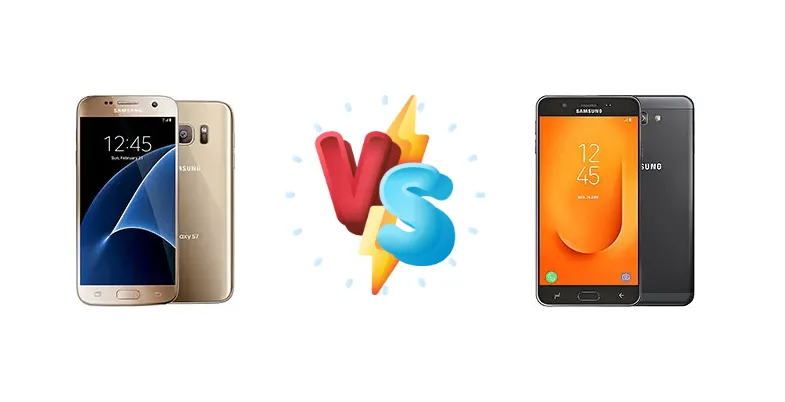
Choosing a new Android phone can be overwhelming. The Samsung Galaxy S7 was a flagship powerhouse, while the J7 Prime 2 aimed for affordability. But which one holds up best today? Let's dive into a comprehensive comparison to help you decide.
🏆 Quick Verdict
The Galaxy S7 is the clear winner, offering significantly superior performance, a better camera, and a premium design. However, the J7 Prime 2 remains a viable option for budget-conscious users prioritizing a reliable and functional device.
| Network |
|---|
| 2G bands | GSM 850 / 900 / 1800 / 1900 | GSM 850 / 900 / 1800 / 1900 |
| 3G bands | HSDPA 850 / 900 / 1900 / 2100 - G930A, G930V | HSDPA 850 / 900 / 1900 / 2100 |
| 4G bands | 1, 2, 3, 4, 5, 7, 8, 12, 20, 29, 30, 38, 39, 40, 41 - G930A | 1, 3, 5, 7, 8, 20, 38, 40 |
| Speed | HSPA 42.2/5.76 Mbps, LTE (3CA) Cat9 450/50 Mbps, EV-DO Rev.A 3.1 Mbps | HSPA 42.2/5.76 Mbps, LTE Cat4 150/50 Mbps |
| Technology | GSM / CDMA / HSPA / EVDO / LTE | GSM / HSPA / LTE |
| | 2, 4, 5, 12, 13, 17, 25 - G930R | - |
| Launch |
|---|
| Announced | 2016, February. Released 2016, March | 2018, March. Released 2018, April |
| Status | Discontinued | Discontinued |
| Body |
|---|
| Build | Glass front (Gorilla Glass 4), glass back (Gorilla Glass 4), aluminum frame | Glass front (Gorilla Glass), aluminum/plastic back, aluminum frame |
| Dimensions | 142.4 x 69.6 x 7.9 mm (5.61 x 2.74 x 0.31 in) | 151.7 x 75 x 8 mm (5.97 x 2.95 x 0.31 in) |
| SIM | Nano-SIM | · Nano-SIM· Nano-SIM + Nano-SIM |
| Weight | 152 g (5.36 oz) | 170 g (6.00 oz) |
| | IP68 dust/water resistant (up to 1.5m for 30 min) | - |
| Display |
|---|
| Protection | Corning Gorilla Glass 4 | Corning Gorilla Glass (market dependent) |
| Resolution | 1440 x 2560 pixels, 16:9 ratio (~576 ppi density) | 1080 x 1920 pixels, 16:9 ratio (~401 ppi density) |
| Size | 5.1 inches, 71.7 cm2 (~72.3% screen-to-body ratio) | 5.5 inches, 83.4 cm2 (~73.3% screen-to-body ratio) |
| Type | Super AMOLED | PLS LCD |
| | Always-on display | - |
| Platform |
|---|
| CPU | Quad-core (2x2.15 GHz Kryo & 2x1.6 GHz Kryo) | Octa-core 1.6 GHz Cortex-A53 |
| Chipset | Qualcomm MSM8996 Snapdragon 820 (14 nm) | Exynos 7870 Octa (14 nm) |
| GPU | Adreno 530 | Mali-T830 MP1 |
| OS | Android 6.0 (Marshmallow), upgradable to Android 8.0 (Oreo), TouchWiz UI | Android 7.0 (Nougat), upgradable to Android 9.0 (Pie) |
| Memory |
|---|
| Card slot | microSDXC (dedicated slot) | microSDXC (dedicated slot) |
| Internal | 32GB 4GB RAM | 32GB 3GB RAM |
| | - | eMMC 5.1 |
| Main Camera |
|---|
| Features | LED flash, auto-HDR, panorama | LED flash, panorama, HDR |
| Single | 12 MP, f/1.7, 26mm (wide), 1/2.55", 1.4µm, dual pixel PDAF, OIS | 13 MP, f/1.9, 28mm (wide), AF |
| Video | 4K@30fps, 1080p@30fps (gyro-EIS), 1080p@60fps, 720p@240fps, HDR, stereo sound rec., OIS | 1080p@30fps |
| Selfie camera |
|---|
| Features | HDR | - |
| Single | 5 MP, f/1.7, 22mm (wide), 1/4.1", 1.34µm | 13 MP, f/1.9, 1/3.1", 1.12µm |
| Video | - | 1080p@30fps |
| Sound |
|---|
| 3.5mm jack | Yes | Yes |
| 35mm jack | Yes | Yes |
| Loudspeaker | Yes | Yes |
| | 24-bit/192kHz audio
| - |
| Comms |
|---|
| Bluetooth | 4.2, A2DP, LE, aptX | 4.1, A2DP, LE |
| NFC | Yes | No |
| Positioning | GPS, GLONASS | GPS, GLONASS, BDS |
| Radio | No | FM radio |
| USB | microUSB 2.0, OTG | microUSB 2.0, OTG |
| WLAN | Wi-Fi 802.11 a/b/g/n/ac, dual-band, Wi-Fi Direct | Wi-Fi 802.11 b/g/n, Wi-Fi Direct |
| Features |
|---|
| Sensors | Fingerprint (front-mounted), accelerometer, gyro, proximity, compass, barometer, heart rate, SpO2 | Fingerprint (front-mounted), accelerometer, proximity |
| | ANT+
S-Voice natural language commands and dictation
Samsung Pay (Visa, MasterCard certified) | ANT+ |
| Battery |
|---|
| Charging | 15W wired, QC2
Wireless | - |
| Music play | - | Up to 84 h |
| Talk time | - | Up to 21 h (3G) |
| Type | Li-Ion 3000 mAh, non-removable | Li-Ion 3300 mAh, non-removable |
| Misc |
|---|
| Colors | Black Onyx, Silver Titanium, Gold Platinum | Black, Gold, Rose Gold |
| Models | SM-G930A, SM-G930P, SM-G930V, SM-G930T, SM-G930R, SM-G930F, SM-G930U, SM-G930R4, SM-G930T1, SM-G930VL, SM-G930AZ, SM-G930R6, SM-G930R7 | SM-G611F, SM-G611FF, SM-G611M, SM-G611MT, SM-G611K |
| Price | About 320 EUR | About 170 EUR |
| SAR | 1.24 W/kg (head) 1.59 W/kg (body) | 0.61 W/kg (head) |
| SAR EU | - | 0.37 W/kg (head) 1.63 W/kg (body) |
Samsung Galaxy S7 (USA)
- Superior Performance
- Excellent Camera
- Vibrant Display
- Premium Design
- Fast Charging (QC2)
- Older Device (Availability & Support)
- Potential Battery Degradation
- Price (Used Market)
Samsung Galaxy J7 Prime 2
- Affordable Price
- Reliable Performance for Basic Tasks
- Decent Battery Life
- Larger Screen
- Lower Performance
- Mediocre Camera
- HD Display Resolution
- Less Premium Build
Display Comparison
The Galaxy S7 boasts a 5.1-inch Super AMOLED display with a QHD resolution (2560 x 1440), delivering vibrant colors and sharp details. The J7 Prime 2 features a 5.5-inch Super AMOLED display with an HD resolution (1280 x 720). The S7's higher resolution and superior panel technology result in a noticeably better viewing experience.
Camera Comparison
The S7's camera is a standout feature, offering excellent image quality, fast autofocus, and impressive low-light performance. It typically features a 12MP sensor with optical image stabilization (OIS). The J7 Prime 2's camera is adequate for basic photography but lacks the S7's capabilities, typically featuring a 13MP sensor. The S7's video recording capabilities are also superior.
Performance
The Snapdragon 820 chipset in the S7 provides a massive performance advantage over the J7 Prime 2's Exynos 7870. Expect smoother multitasking, faster app loading times, and a more responsive overall experience on the S7. Gaming performance is also significantly better on the S7.
Battery Life
The S7 has a 3000mAh battery, while the J7 Prime 2 has a 3300mAh battery. Despite the slightly larger capacity, the S7's more efficient processor and display often result in comparable or even slightly better battery life due to optimization. Both phones support fast charging, but the S7 supports Quick Charge 2.0.
Buying Guide
The Samsung Galaxy S7 (USA) is ideal for users who demand high performance, a top-tier camera, and a premium experience, even if it means searching for a used device. The Samsung Galaxy J7 Prime 2 is best suited for those on a tight budget who need a dependable phone for basic tasks and aren't concerned with cutting-edge features.
Frequently Asked Questions
❓ Is the Galaxy S7 still worth buying in 2024?
Yes, if you can find one in good condition. It still offers a great experience for the price, but be mindful of battery health and software support.
❓ Which phone has better software support?
The J7 Prime 2 likely has slightly more recent Android updates, though both are past their official support lifecycle. However, custom ROMs are available for the S7.