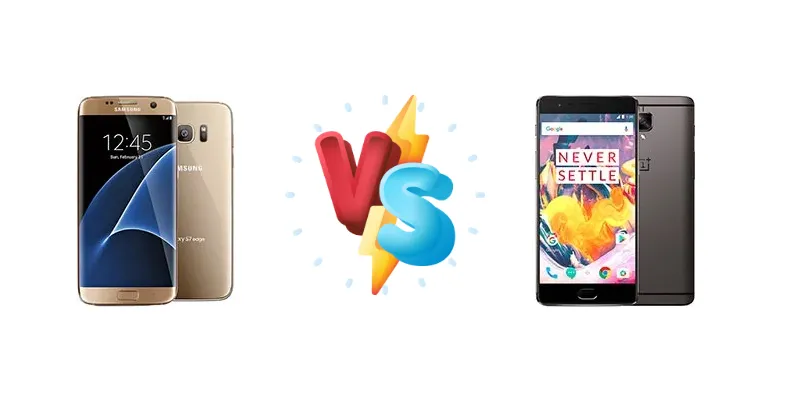
Released within months of each other in 2016, the Samsung Galaxy S7 edge (USA) and the OnePlus 3T represent distinct approaches to the flagship smartphone market. The S7 edge, with its established brand and curved display, aimed for premium refinement, while the OnePlus 3T offered near-flagship performance at a significantly lower price point. This comparison revisits these devices, analyzing their strengths and weaknesses in a modern context.
🏆 Quick Verdict
For the average user in 2024, the OnePlus 3T emerges as the more compelling choice. While the S7 edge boasts a visually striking curved display, the 3T’s Snapdragon 821 chipset provides a noticeable performance edge, coupled with faster 20W charging, making it a more practical daily driver.
| Network |
|---|
| 2G bands | GSM 850 / 900 / 1800 / 1900 | GSM 850 / 900 / 1800 / 1900 - SIM 1 & SIM 2 |
| 3G bands | HSDPA 850 / 900 / 1900 / 2100 - G935A, G935P, G935R | HSDPA 850 / 900 / 1700(AWS) / 1900 / 2100 - North America |
| 4G bands | 1, 2, 3, 4, 5, 7, 8, 12, 20, 29, 30, 38, 39, 40, 41 - G935A | 1, 2, 4, 5, 7, 8, 12, 17, 30 - North America |
| Speed | HSPA 42.2/5.76 Mbps, LTE (3CA) Cat9 450/50 Mbps, EV-DO Rev.A 3.1 Mbps | HSPA 42.2/5.76 Mbps, LTE (2CA) Cat6 300/50 Mbps |
| Technology | GSM / CDMA / HSPA / EVDO / LTE | GSM / HSPA / EVDO / LTE |
| | - | 1, 3, 5, 7, 8, 20, 38, 40 - Global model |
| Launch |
|---|
| Announced | 2016, February. Released 2016, March | 2016, November. Released 2016, November |
| Status | Discontinued | Discontinued |
| Body |
|---|
| Build | Glass front (Gorilla Glass 4), glass back (Gorilla Glass 4), aluminum frame | Glass front (Gorilla Glass 4), aluminum back, aluminum frame |
| Dimensions | 150.9 x 72.6 x 7.7 mm (5.94 x 2.86 x 0.30 in) | 152.7 x 74.7 x 7.4 mm (6.01 x 2.94 x 0.29 in) |
| SIM | Nano-SIM | Nano-SIM + Nano-SIM |
| Weight | 157 g (5.54 oz) | 158 g (5.57 oz) |
| Display |
|---|
| Protection | Corning Gorilla Glass 4 | Corning Gorilla Glass 4 |
| Resolution | 1440 x 2560 pixels, 16:9 ratio (~534 ppi density) | 1080 x 1920 pixels, 16:9 ratio (~401 ppi density) |
| Size | 5.5 inches, 83.4 cm2 (~76.1% screen-to-body ratio) | 5.5 inches, 83.4 cm2 (~73.1% screen-to-body ratio) |
| Type | Super AMOLED | Optic AMOLED |
| Platform |
|---|
| CPU | Quad-core (2x2.15 GHz Kryo & 2x1.6 GHz Kryo) | Quad-core (2x2.35 GHz Kryo & 2x1.6 GHz Kryo) |
| Chipset | Qualcomm MSM8996 Snapdragon 820 (14 nm) | Qualcomm MSM8996 Snapdragon 821 (14 nm) |
| GPU | Adreno 530 | Adreno 530 |
| OS | Android 6.0 (Marshmallow), upgradable to Android 8.0 (Oreo), TouchWiz UI | Android 6.0.1 (Marshmallow), upgradable to Android 9.0 (Pie) |
| Memory |
|---|
| Card slot | microSDXC (dedicated slot) | No |
| Internal | 32GB 4GB RAM | 64GB 6GB RAM, 128GB 6GB RAM |
| Main Camera |
|---|
| Features | LED flash, auto-HDR, panorama | LED flash, panorama, HDR |
| Single | 12 MP, f/1.7, 26mm (wide), 1/2.55", 1.4µm, dual pixel PDAF, OIS | 16 MP, f/2.0, 1/2.8", 1.12µm, PDAF, OIS |
| Video | 4K@30fps, 1080p@30fps (gyro-EIS), 1080p@60fps, 720p@240fps, HDR, stereo sound rec., OIS | 4K@30fps, 1080p@30/60fps, 720p@120fps, Auto HDR |
| Selfie camera |
|---|
| Features | HDR | - |
| Single | 5 MP, f/1.7, 22mm (wide), 1/4.1", 1.34µm | 16 MP, f/2.0, (wide), 1/3.06", 1.0µm |
| Video | - | 1080p@30fps |
| Sound |
|---|
| 3.5mm jack | - | Yes |
| 35mm jack | Yes | Yes |
| Loudspeaker | Yes | Yes |
| Comms |
|---|
| Bluetooth | 4.2, A2DP, LE, aptX | 4.2, A2DP, aptX HD, LE |
| NFC | Yes | Yes |
| Positioning | GPS, GLONASS | GPS, GLONASS, BDS |
| Radio | FM radio (after SW update; operator dependent) | No |
| USB | microUSB 2.0, OTG | USB Type-C 2.0 |
| WLAN | Wi-Fi 802.11 a/b/g/n/ac, dual-band, Wi-Fi Direct | Wi-Fi 802.11 a/b/g/n/ac, Wi-Fi Direct, DLNA |
| Features |
|---|
| Sensors | Fingerprint (front-mounted), accelerometer, gyro, proximity, compass, barometer, heart rate, SpO2 | Fingerprint (front-mounted), accelerometer, gyro, proximity, compass |
| Battery |
|---|
| Charging | 15W wired, QC2
Wireless | 20W wired |
| Type | Li-Ion 3600 mAh, non-removable | Li-Ion 3400 mAh, non-removable |
| Misc |
|---|
| Colors | Black Onyx, Silver Titanium, Gold Platinum, Coral Blue | Gunmetal, Soft Gold, Midnight Black |
| Models | SM-G935A, SM-G935P, SM-G935V, SM-G935T, SM-G935R, SM-G935U, SM-G935L, SAMSUNG-SM-G935A | A3010, A3003 |
| Price | About 350 EUR | About 440 EUR |
| SAR | 0.64 W/kg (head) 1.59 W/kg (body) | 0.99 W/kg (head) 0.65 W/kg (body) |
| Tests |
|---|
| Audio quality | - |
Noise-94.3dB / Crosstalk -93.4dB |
| Battery life | - |
Endurance rating 83h
|
| Camera | - |
Photo / Video |
| Display | - |
Contrast ratio: Infinite (nominal), 4.232 (sunlight) |
| Loudspeaker | - |
Voice 61dB / Noise 69dB / Ring 78dB
|
| Performance | - |
AnTuTu: 171678 (v7)
GFXBench: 20fps (ES 3.1 onscreen) |
Samsung Galaxy S7 edge (USA)
- Visually striking curved display
- Wireless charging support
- Potentially more refined camera processing
- Slower Snapdragon 820 processor
- Slower 15W charging
- Curved display prone to accidental touches
OnePlus 3T
- Faster Snapdragon 821 processor
- Faster 20W wired charging
- More affordable price point
- Flat display lacks the visual flair of the S7 edge
- Potentially less refined camera processing
- Slightly lower battery endurance rating
Display Comparison
Both devices feature displays with an 'Infinite' contrast ratio (nominal), and a 4.232 contrast ratio in sunlight, suggesting similar outdoor visibility. However, the S7 edge’s defining feature is its dual-edge curved display, offering a more immersive visual experience, albeit at the cost of potential accidental touches. The OnePlus 3T utilizes a flat AMOLED panel, which some users may find more practical. Neither specification details resolution or refresh rate, but both were standard 1080p 60Hz panels for the time.
Camera Comparison
Both phones are listed as having 'Photo / Video' capabilities, but lack specific details. Given Samsung’s history, the S7 edge likely prioritizes vibrant, saturated colors and strong post-processing. The OnePlus 3T, while capable, typically offered a more natural, less processed image. Sensor size and aperture are unknown, but these would be key differentiators. The lack of detail makes a definitive camera comparison difficult, but the S7 edge likely had a more refined camera experience out of the box.
Performance
The core difference lies in the chipset: the S7 edge utilizes the Qualcomm MSM8996 Snapdragon 820, while the OnePlus 3T features the upgraded MSM8996 Snapdragon 821. Both are 14nm processors with a quad-core configuration (2x2.15 GHz Kryo & 2x1.6 GHz Kryo for the S7 edge, and 2x2.35 GHz Kryo & 2x1.6 GHz Kryo for the 3T). The 821’s higher clock speeds translate to a roughly 10-15% performance increase in CPU-intensive tasks and improved GPU performance, benefiting gamers and power users. Both devices likely share similar RAM configurations, but the 821’s architectural improvements offer a more responsive overall experience.
Battery Life
The S7 edge boasts an endurance rating of 87 hours, slightly exceeding the OnePlus 3T’s 83 hours. However, the 3T compensates with significantly faster 20W wired charging (Quick Charge 2.0) compared to the S7 edge’s 15W charging. This means the 3T can replenish its battery much quicker, mitigating the slight difference in overall endurance. Both devices also support wireless charging, a convenience feature absent on many modern phones.
Buying Guide
Buy the Samsung Galaxy S7 edge (USA) if you prioritize a visually immersive curved display and are willing to accept slightly slower performance and charging speeds. Buy the OnePlus 3T if you value raw processing power, faster charging, and a more streamlined software experience at a lower cost. The 3T is the better option for users who prioritize performance and longevity.
Frequently Asked Questions
❓ Is the Snapdragon 821 in the OnePlus 3T significantly faster than the 820 in the S7 edge for everyday tasks?
While both chips are capable, the Snapdragon 821 in the OnePlus 3T offers a noticeable improvement in responsiveness and multitasking. The higher clock speeds and architectural refinements result in smoother app launches and faster overall performance, particularly when running demanding applications.
❓ Does the faster charging of the OnePlus 3T offset its slightly lower battery endurance rating?
Yes, the 20W charging on the OnePlus 3T is a significant advantage. The ability to quickly top up the battery minimizes the impact of the slightly lower endurance rating, making it more convenient for users who frequently need to recharge throughout the day.
❓ Is the curved screen of the S7 edge prone to accidental touches?
Yes, the curved edges of the S7 edge’s display can occasionally register accidental touches, especially when holding the phone with certain grips. This is a common complaint among S7 edge users and a potential usability concern.