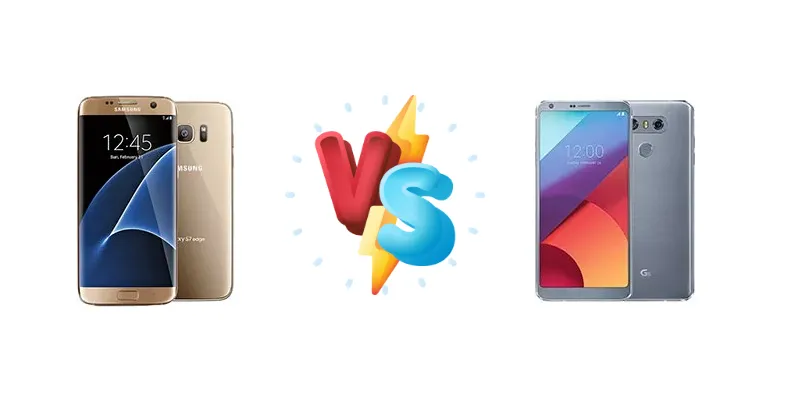
Released within months of each other in 2016, the Samsung Galaxy S7 edge and LG G6 represented distinct approaches to the flagship Android experience. The S7 edge doubled down on Samsung’s established curved-screen design and refined camera, while the LG G6 introduced a wider aspect ratio display and a focus on multimedia consumption. This comparison dissects their key differences to help determine which device holds up better today.
🏆 Quick Verdict
For the average user prioritizing longevity and a more refined software experience, the Samsung Galaxy S7 edge emerges as the winner. Its superior endurance rating of 87 hours significantly outpaces the LG G6’s 72 hours. However, the LG G6’s faster charging and wider display appeal to users valuing quick power-ups and immersive media viewing.
| Network |
|---|
| 2G bands | GSM 850 / 900 / 1800 / 1900 | GSM 850 / 900 / 1800 / 1900 - SIM 1 & SIM 2 (dual-SIM model only) |
| 3G bands | HSDPA 850 / 900 / 1900 / 2100 - G935A, G935P, G935R | HSDPA 850 / 900 / 1700(AWS) / 1900 / 2100 |
| 4G bands | 1, 2, 3, 4, 5, 7, 8, 12, 20, 29, 30, 38, 39, 40, 41 - G935A | 1, 2, 3, 4, 5, 7, 8, 12, 13, 17, 20, 28, 38, 40 |
| Speed | HSPA 42.2/5.76 Mbps, LTE (3CA) Cat9 450/50 Mbps, EV-DO Rev.A 3.1 Mbps | HSPA 42.2/5.76 Mbps, LTE (3CA) Cat12 600/150 Mbps |
| Technology | GSM / CDMA / HSPA / EVDO / LTE | GSM / HSPA / LTE |
| Launch |
|---|
| Announced | 2016, February. Released 2016, March | 2017, February 26. Released 2017, April 07 |
| Status | Discontinued | Discontinued |
| Body |
|---|
| Build | Glass front (Gorilla Glass 4), glass back (Gorilla Glass 4), aluminum frame | Glass front (Gorilla Glass 3), glass back (Gorilla Glass 5), aluminum frame |
| Dimensions | 150.9 x 72.6 x 7.7 mm (5.94 x 2.86 x 0.30 in) | 148.9 x 71.9 x 7.9 mm (5.86 x 2.83 x 0.31 in) |
| SIM | Nano-SIM | · Nano-SIM· Nano-SIM + Nano-SIM |
| Weight | 157 g (5.54 oz) | 163 g (5.75 oz) |
| | - | IP68 dust/water resistant (up to 1.5m for 30 mins)
MIL-STD-810G compliant*
*does not guarantee ruggedness or use in extreme conditions |
| Display |
|---|
| Protection | Corning Gorilla Glass 4 | Corning Gorilla Glass 3 |
| Resolution | 1440 x 2560 pixels, 16:9 ratio (~534 ppi density) | 1440 x 2880 pixels, 18:9 ratio (~564 ppi density) |
| Size | 5.5 inches, 83.4 cm2 (~76.1% screen-to-body ratio) | 5.7 inches, 84.1 cm2 (~78.6% screen-to-body ratio) |
| Type | Super AMOLED | IPS LCD, HDR10, Dolby Vision |
| | - | Always-on display |
| Platform |
|---|
| CPU | Quad-core (2x2.15 GHz Kryo & 2x1.6 GHz Kryo) | Quad-core (2x2.35 GHz Kryo & 2x1.6 GHz Kryo) |
| Chipset | Qualcomm MSM8996 Snapdragon 820 (14 nm) | Qualcomm MSM8996 Snapdragon 821 (14 nm) |
| GPU | Adreno 530 | Adreno 530 |
| OS | Android 6.0 (Marshmallow), upgradable to Android 8.0 (Oreo), TouchWiz UI | Android 7.0 (Nougat), upgradable to Android 9.0 (Pie), LG UX 8 UI |
| Memory |
|---|
| Card slot | microSDXC (dedicated slot) | microSDXC (uses shared SIM slot) - dual SIM model only |
| Internal | 32GB 4GB RAM | 32GB 4GB RAM, 64GB 4GB RAM, 128GB 4GB RAM |
| | - | UFS 2.0 |
| Main Camera |
|---|
| Dual | - | 13 MP, f/1.8, 30mm (standard), 1/3.1", 1.12µm, PDAF, 3-axis OIS
13 MP, f/2.4, 12mm (ultrawide), no AF |
| Features | LED flash, auto-HDR, panorama | Dual-LED flash, HDR, panorama |
| Single | 12 MP, f/1.7, 26mm (wide), 1/2.55", 1.4µm, dual pixel PDAF, OIS | - |
| Video | 4K@30fps, 1080p@30fps (gyro-EIS), 1080p@60fps, 720p@240fps, HDR, stereo sound rec., OIS | 4K@30fps, 1080p@30/60fps, HDR, 24-bit/192kHz stereo sound rec. |
| Selfie camera |
|---|
| Features | HDR | - |
| Single | 5 MP, f/1.7, 22mm (wide), 1/4.1", 1.34µm | 5 MP, f/2.2, 18mm |
| Video | - | 1080p@30fps |
| Sound |
|---|
| 3.5mm jack | - | Yes |
| 35mm jack | Yes | Yes |
| Loudspeaker | Yes | Yes |
| | - | 32-bit/192kHz audio
|
| Comms |
|---|
| Bluetooth | 4.2, A2DP, LE, aptX | 4.2, A2DP, LE, aptX HD |
| NFC | Yes | Yes |
| Positioning | GPS, GLONASS | GPS, GLONASS, BDS |
| Radio | FM radio (after SW update; operator dependent) | FM radio (market dependent) |
| USB | microUSB 2.0, OTG | USB Type-C 3.1, OTG |
| WLAN | Wi-Fi 802.11 a/b/g/n/ac, dual-band, Wi-Fi Direct | Wi-Fi 802.11 a/b/g/n/ac, dual-band, Wi-Fi Direct, DLNA |
| Features |
|---|
| Sensors | Fingerprint (front-mounted), accelerometer, gyro, proximity, compass, barometer, heart rate, SpO2 | Fingerprint (rear-mounted), accelerometer, gyro, proximity, compass, barometer |
| Battery |
|---|
| Charging | 15W wired, QC2
Wireless | 18W wired, QC3, 50% in 30 min
Wireless (USA) |
| Type | Li-Ion 3600 mAh, non-removable | Li-Po 3300 mAh, non-removable |
| Misc |
|---|
| Colors | Black Onyx, Silver Titanium, Gold Platinum, Coral Blue | Astro Black, Ice Platinum, Terra Gold, Marine Blue, Mystic White, Raspberry Rose, Moroccan Blue, Lavender Violet |
| Models | SM-G935A, SM-G935P, SM-G935V, SM-G935T, SM-G935R, SM-G935U, SM-G935L, SAMSUNG-SM-G935A | H870, H870DS, H873, H870S, LGM-G600L, H872, H871, LS993, US997, vs988, VS988, LGM-G600K, LGM-G600S, AS993, LGUS997, H870AR, H872PR, H871S, H870I |
| Price | About 350 EUR | About 240 EUR |
| SAR | 0.64 W/kg (head) 1.59 W/kg (body) | 0.65 W/kg (head) 1.23 W/kg (body) |
| SAR EU | - | 0.23 W/kg (head) 0.15 W/kg (body) |
| Tests |
|---|
| Audio quality | - |
Noise -93.3dB / Crosstalk -94.4dB |
| Battery life | - | Endurance rating 72h |
| Camera | - |
Photo / Video |
| Display | - |
Contrast ratio: 2053 (nominal), 3.556 (sunlight) |
| Loudspeaker | - |
Voice 66dB / Noise 68dB / Ring 74dB |
| Performance | - |
AnTuTu: 158785 (v7)
GeekBench: 4175 (v4.4)
GFXBench: 8.5fps (ES 3.1 onscreen) |
Samsung Galaxy S7 edge (USA)
- Superior battery endurance (87h)
- Distinctive and premium curved screen design
- Mature and feature-rich Samsung software experience
- Slightly slower processor than the LG G6
- Curved screen can lead to accidental touches
LG G6
- Faster charging (18W, QC3, 50% in 30 min)
- Wider 18:9 display for immersive media consumption
- Potentially better performance with Snapdragon 821
- Lower battery endurance (72h)
- Less refined software experience compared to Samsung
Display Comparison
Both the S7 edge and G6 feature displays with a contrast ratio of 2053 (nominal) and 3.556 (sunlight), indicating similar outdoor visibility. However, the S7 edge’s curved screen offers a unique aesthetic and potentially improved ergonomics, though it can introduce accidental edge touches. The LG G6’s 18:9 aspect ratio display, while novel for its time, provides a wider viewing area, beneficial for multitasking and video playback. Neither specification details pixel density or panel type, but both were considered excellent for their era.
Camera Comparison
Both devices feature capable camera systems, but detailed sensor information is lacking. The context data only indicates 'Photo / Video' capabilities. Given Samsung’s history, the S7 edge likely prioritizes vibrant colors and strong contrast, while LG typically aims for more natural image processing. The aperture and sensor size would be critical differentiators, but are not provided. The absence of details regarding OIS (Optical Image Stabilization) makes it difficult to assess low-light performance. The LG G6’s wider aspect ratio display could also influence the framing of photos and videos.
Performance
The LG G6 boasts a slight performance edge thanks to its Qualcomm MSM8996 Snapdragon 821 chipset, clocked at 2x2.35 GHz Kryo cores, compared to the S7 edge’s Snapdragon 820 (2x2.15 GHz Kryo). While both are 14nm processors, the 821 offers incremental improvements in CPU and GPU performance. This translates to slightly faster app loading times and smoother multitasking on the G6. However, both devices share 4GB of RAM, and the real-world performance difference is unlikely to be dramatic for most users. Thermal management is likely comparable given the similar process nodes and cooling solutions.
Battery Life
The Samsung Galaxy S7 edge’s endurance rating of 87 hours significantly surpasses the LG G6’s 72 hours, indicating a substantial advantage in battery life. While the G6 compensates with faster charging – 18W with QC3 and 50% charge in 30 minutes – the S7 edge’s longer runtime is more valuable for users who frequently spend extended periods away from a power source. The S7 edge supports 15W wired charging with QC2 and wireless charging, offering flexibility, but at a slower wired speed than the G6.
Buying Guide
Buy the Samsung Galaxy S7 edge (USA) if you need exceptional battery life, a premium build quality with a distinctive curved display, and a mature, feature-rich software ecosystem. Buy the LG G6 if you prefer a wider, more immersive display for video consumption, faster charging speeds, and a more open, modular approach to accessories (though limited in practice).
Frequently Asked Questions
❓ Does the Snapdragon 820 in the S7 edge suffer from throttling during extended gaming sessions?
While the Snapdragon 820 was known to experience some thermal throttling under sustained load, the S7 edge’s cooling system and software optimizations generally mitigated this issue. However, prolonged gaming at maximum settings could still lead to performance drops. The 821 in the G6 is slightly more efficient, but both will experience some throttling.
❓ Is the LG G6’s modular design actually useful, and are there readily available modules?
LG’s modular design, while innovative, ultimately failed to gain traction. While modules like the Hi-Fi DAC and camera grip were available, they were expensive and didn’t offer a compelling enough benefit to drive widespread adoption. The modularity is largely irrelevant today.
❓ How does the curved screen of the S7 edge affect usability and durability?
The curved screen offers a unique aesthetic and can improve ergonomics, but it also introduces the risk of accidental edge touches. Durability is also a concern, as the curved edges are more susceptible to damage from drops compared to a flat display. Screen protectors can be difficult to apply properly.