
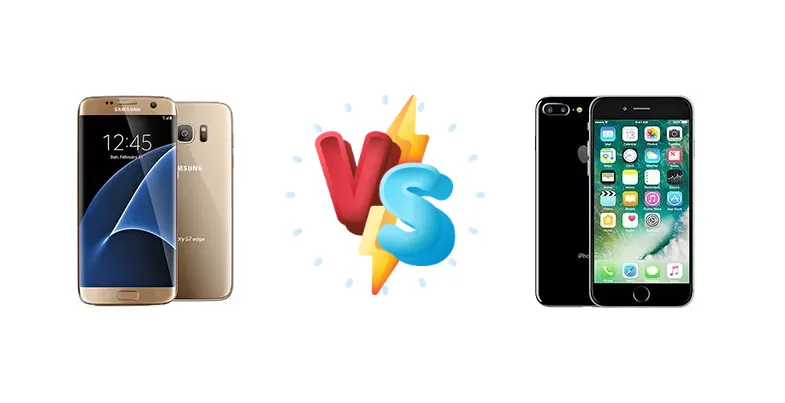
Samsung Galaxy S7 edge vs. iPhone 7 Plus: A 2024 Retrospective
| Phones Images | |||||
|---|---|---|---|---|---|
|
🏆 Quick Verdict
For the average user prioritizing battery life and a visually immersive experience, the Samsung Galaxy S7 edge emerges as the winner. Its 87-hour endurance rating significantly surpasses the iPhone 7 Plus’s 75 hours. However, the iPhone 7 Plus provides a smoother, more consistent experience thanks to Apple’s tight hardware-software integration.
| PHONES | ||
|---|---|---|
| Phone Names | Samsung Galaxy S7 edge (USA) | Apple iPhone 7 Plus |
| Network | ||
|---|---|---|
| 2G bands | GSM 850 / 900 / 1800 / 1900 | GSM 850 / 900 / 1800 / 1900 - A1661, A1784 |
| 3G bands | HSDPA 850 / 900 / 1900 / 2100 - G935A, G935P, G935R | HSDPA 850 / 900 / 1700(AWS) / 1900 / 2100 - A1661, A1784 |
| 4G bands | 1, 2, 3, 4, 5, 7, 8, 12, 20, 29, 30, 38, 39, 40, 41 - G935A | 1, 2, 3, 4, 5, 7, 8, 12, 13, 17, 18, 19, 20, 25, 26, 27, 28, 29, 30, 38, 39, 40, 41 - A1661, A1784 |
| Speed | HSPA 42.2/5.76 Mbps, LTE (3CA) Cat9 450/50 Mbps, EV-DO Rev.A 3.1 Mbps | HSPA 42.2/5.76 Mbps, LTE (3CA) Cat9 450/50 Mbps, EV-DO Rev.A 3.1 Mbps |
| Technology | GSM / CDMA / HSPA / EVDO / LTE | GSM / CDMA / HSPA / EVDO / LTE |
| - | CDMA2000 1xEV-DO & TD-SCDMA - A1661 | |
| Launch | ||
|---|---|---|
| Announced | 2016, February. Released 2016, March | 2016, September 07. Released 2016, September 16 |
| Status | Discontinued | Discontinued |
| Body | ||
|---|---|---|
| Build | Glass front (Gorilla Glass 4), glass back (Gorilla Glass 4), aluminum frame | Glass front (Corning-made glass), aluminum back, aluminum frame |
| Dimensions | 150.9 x 72.6 x 7.7 mm (5.94 x 2.86 x 0.30 in) | 158.2 x 77.9 x 7.3 mm (6.23 x 3.07 x 0.29 in) |
| SIM | Nano-SIM | Nano-SIM |
| Weight | 157 g (5.54 oz) | 188 g (6.63 oz) |
| - | IP67 dust/water resistant (up to 1m for 30 min) Apple Pay (Visa, MasterCard, AMEX certified) | |
| Display | ||
|---|---|---|
| Protection | Corning Gorilla Glass 4 | Ion-strengthened glass |
| Resolution | 1440 x 2560 pixels, 16:9 ratio (~534 ppi density) | 1080 x 1920 pixels, 16:9 ratio (~401 ppi density) |
| Size | 5.5 inches, 83.4 cm2 (~76.1% screen-to-body ratio) | 5.5 inches, 83.4 cm2 (~67.7% screen-to-body ratio) |
| Type | Super AMOLED | Retina IPS LCD, 625 nits (typ) |
| - | 3D Touch display & home button | |
| Platform | ||
|---|---|---|
| CPU | Quad-core (2x2.15 GHz Kryo & 2x1.6 GHz Kryo) | Quad-core 2.34 GHz (2x Hurricane + 2x Zephyr) |
| Chipset | Qualcomm MSM8996 Snapdragon 820 (14 nm) | Apple A10 Fusion (16 nm) |
| GPU | Adreno 530 | PowerVR Series7XT Plus (six-core graphics) |
| OS | Android 6.0 (Marshmallow), upgradable to Android 8.0 (Oreo), TouchWiz UI | iOS 10.0.1, upgradable to iOS 15.8.5 |
| Memory | ||
|---|---|---|
| Card slot | microSDXC (dedicated slot) | No |
| Internal | 32GB 4GB RAM | 32GB 3GB RAM, 128GB 3GB RAM, 256GB 3GB RAM |
| - | NVMe | |
| Main Camera | ||
|---|---|---|
| Dual | - | 12 MP, f/1.8, 28mm (wide), 1/3.0", PDAF, OIS 12 MP, f/2.8, 56mm (telephoto), 1/3.6", AF, 2x optical zoom |
| Features | LED flash, auto-HDR, panorama | Quad-LED dual-tone flash, HDR |
| Single | 12 MP, f/1.7, 26mm (wide), 1/2.55", 1.4µm, dual pixel PDAF, OIS | - |
| Video | 4K@30fps, 1080p@30fps (gyro-EIS), 1080p@60fps, 720p@240fps, HDR, stereo sound rec., OIS | 4K@30fps, 1080p@30/60/120fps, 720p@240fps |
| Selfie camera | ||
|---|---|---|
| Features | HDR | Face detection, HDR |
| Single | 5 MP, f/1.7, 22mm (wide), 1/4.1", 1.34µm | 7 MP, f/2.2, 32mm (standard) |
| Video | - | 1080p@30fps |
| Sound | ||
|---|---|---|
| 3.5mm jack | - | No |
| 35mm jack | Yes | No |
| Loudspeaker | Yes | Yes, with stereo speakers |
| Comms | ||
|---|---|---|
| Bluetooth | 4.2, A2DP, LE, aptX | 4.2, A2DP, LE |
| NFC | Yes | Yes |
| Positioning | GPS, GLONASS | GPS, GLONASS, GALILEO, QZSS |
| Radio | FM radio (after SW update; operator dependent) | No |
| USB | microUSB 2.0, OTG | Lightning, USB 2.0 |
| WLAN | Wi-Fi 802.11 a/b/g/n/ac, dual-band, Wi-Fi Direct | Wi-Fi 802.11 a/b/g/n/ac, dual-band, hotspot |
| Features | ||
|---|---|---|
| Sensors | Fingerprint (front-mounted), accelerometer, gyro, proximity, compass, barometer, heart rate, SpO2 | Fingerprint (front-mounted), accelerometer, gyro, proximity, compass, barometer |
| Battery | ||
|---|---|---|
| Charging | 15W wired, QC2 Wireless | - |
| Stand-by | - | Up to 384 h (3G) |
| Talk time | - | Up to 21 h (3G) |
| Type | Li-Ion 3600 mAh, non-removable | Li-Ion 2900 mAh, non-removable (11.1 Wh) |
| Misc | ||
|---|---|---|
| Colors | Black Onyx, Silver Titanium, Gold Platinum, Coral Blue | Jet Black, Black, Silver, Gold, Rose Gold, Red |
| Models | SM-G935A, SM-G935P, SM-G935V, SM-G935T, SM-G935R, SM-G935U, SM-G935L, SAMSUNG-SM-G935A | A1661, A1784, A1785, A1786, iPhone9,4, iPhone9,2 |
| Price | About 350 EUR | About 320 EUR |
| SAR | 0.64 W/kg (head) 1.59 W/kg (body) | 1.19 W/kg (head) 1.19 W/kg (body) |
| SAR EU | - | 1.24 W/kg (head) 1.00 W/kg (body) |
| Tests | ||
|---|---|---|
| Audio quality | - | Noise -93.1dB / Crosstalk -80.5dB |
| Battery life | - | Endurance rating 75h |
| Camera | - | Photo / Video |
| Display | - | Contrast ratio: 1398:1 (nominal), 3.588 (sunlight) |
| Loudspeaker | - | Voice 68dB / Noise 72dB / Ring 72dB |
| Performance | - | Basemark OS II 2.0: 3796 |
Samsung Galaxy S7 edge (USA)
- Superior battery life (87h endurance)
- Immersive curved display
- Faster charging with QC2 and wireless charging
- Expandable storage (via microSD - not in context, but standard for S7 edge)
- Android OS can be prone to fragmentation
- Image processing can be overly aggressive
Apple iPhone 7 Plus
- Smooth and consistent iOS experience
- Strong app ecosystem
- Excellent video recording capabilities
- Dual-camera system (portrait mode)
- Shorter battery life (75h endurance)
- Limited customization options
- No expandable storage
Display Comparison
Both the Galaxy S7 edge and iPhone 7 Plus boast excellent displays with a contrast ratio of 1398:1 (nominal) and 3.588 (sunlight), indicating strong visibility even in bright conditions. However, the S7 edge’s defining feature is its curved screen, offering a more immersive viewing experience and a unique aesthetic. While the iPhone 7 Plus’s display is excellent, it lacks the visual flair of the S7 edge’s curved design. The S7 edge's larger screen real estate also benefits multitasking and media consumption.
Camera Comparison
Both devices offer capable camera systems, but approach image processing differently. The iPhone 7 Plus excels in video recording, offering cinematic stabilization and consistent color reproduction. The S7 edge, while capable, often produces images with more saturated colors and a tendency to over-sharpen. Both phones lack the advanced computational photography features found in modern smartphones, relying more on optical image stabilization (OIS) and lens quality. The iPhone 7 Plus’s dual-camera system, while innovative for its time, doesn’t offer a significant advantage over the S7 edge’s single-lens setup in most scenarios.
Performance
The Samsung Galaxy S7 edge utilizes the Qualcomm MSM8996 Snapdragon 820 chipset, a 14nm processor with a quad-core configuration (2x2.15 GHz Kryo & 2x1.6 GHz Kryo). The iPhone 7 Plus, conversely, is powered by the Apple A10 Fusion, a 16nm chip with a similar quad-core setup (2x Hurricane + 2x Zephyr). While both chips offer comparable performance for everyday tasks, the A10 Fusion generally exhibits superior single-core performance, translating to snappier app launches and smoother animations within the iOS environment. The Snapdragon 820, however, benefits from more RAM availability in some S7 edge configurations, potentially aiding multitasking.
Battery Life
The Galaxy S7 edge’s 87-hour endurance rating is a clear advantage over the iPhone 7 Plus’s 75-hour rating. This difference is attributable to a combination of factors, including a more efficient chipset and potentially a larger battery capacity (specific capacity not provided in context data). The S7 edge also supports 15W wired charging with Quick Charge 2.0 (QC2) and wireless charging, offering greater flexibility compared to the iPhone 7 Plus’s solely wired charging solution. The faster charging speed of the S7 edge minimizes downtime.
Buying Guide
Buy the Samsung Galaxy S7 edge (USA) if you need exceptional battery life, a stunning curved display for media consumption, and appreciate the flexibility of the Android ecosystem. Buy the Apple iPhone 7 Plus if you prioritize a streamlined user experience, a well-established app ecosystem, and consistent performance through iOS updates (though support is now limited).