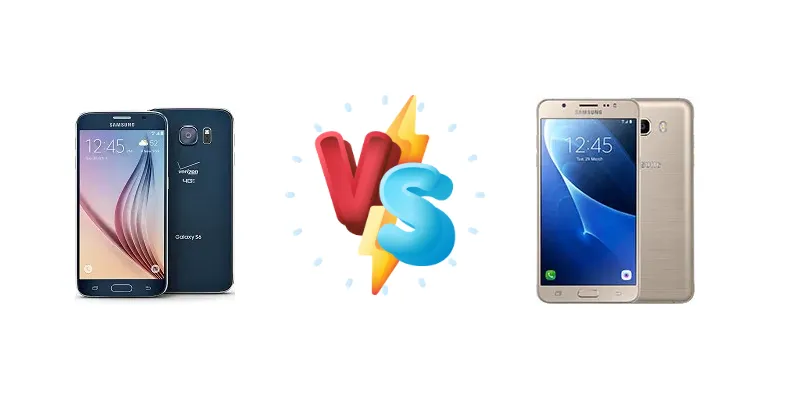
The Samsung Galaxy S6 was a flagship powerhouse when it launched, while the Galaxy J7 (2016) aimed for affordability and long battery life. But which phone holds up better today? We'll break down their specs, performance, and features to help you decide.
🏆 Quick Verdict
The Galaxy S6 wins overall thanks to its significantly faster processor, superior camera, and premium design. However, the J7 (2016) offers exceptional battery life and a lower price point, making it a viable option for budget-conscious users prioritizing endurance.
| Network |
|---|
| 2G bands | GSM 850 / 900 / 1800 / 1900 - G920V, G920P | GSM 850 / 900 / 1800 / 1900 - SIM 1 & SIM 2 (dual-SIM model only) |
| 3G bands | HSDPA 850 / 900 / 1900 / 2100 - G920V | HSDPA 850 / 900 / 1900 / 2100 |
| 4G bands | 2, 3, 4, 5, 7, 13 - G920V | 1, 3, 5, 7, 8, 20, 40 |
| Speed | HSPA 42.2/5.76 Mbps, LTE Cat6 300/50 Mbps, EV-DO Rev.A 3.1 Mbps | HSPA, LTE Cat4 150/50 Mbps |
| Technology | GSM / CDMA / HSPA / EVDO / LTE | GSM / HSPA / LTE |
| | 2, 4, 5, 12, 13, 17, 25 - G920R | - |
| Launch |
|---|
| Announced | 2015, March. Released 2015, April | 2016, March 29. Released 2016, April |
| Status | Discontinued | Discontinued |
| Body |
|---|
| Build | Glass front (Gorilla Glass 4), glass back (Gorilla Glass 4), aluminum frame | Glass front, plastic back, aluminum frame |
| Dimensions | 143.5 x 70.6 x 6.9 mm (5.65 x 2.78 x 0.27 in) | 151.7 x 76 x 7.8 mm (5.97 x 2.99 x 0.31 in) |
| SIM | Nano-SIM | Single SIM (Micro-SIM) or Dual SIM (Micro-SIM, dual stand-by) |
| Weight | 140 g (4.94 oz) | 170 g (6.00 oz) |
| Display |
|---|
| Protection | Corning Gorilla Glass 4 | - |
| Resolution | 1440 x 2560 pixels, 16:9 ratio (~576 ppi density) | 720 x 1280 pixels, 16:9 ratio (~267 ppi density) |
| Size | 5.1 inches, 71.7 cm2 (~70.8% screen-to-body ratio) | 5.5 inches, 83.4 cm2 (~72.3% screen-to-body ratio) |
| Type | Super AMOLED | Super AMOLED |
| Platform |
|---|
| CPU | Octa-core (4x2.1 GHz Cortex-A57 & 4x1.5 GHz Cortex-A53) | Octa-core (4x1.6 GHz Cortex-A53 & 4x1.0 GHz Cortex-A53)Octa-core 1.6 GHz Cortex-A53 |
| Chipset | Exynos 7420 Octa (14 nm) | Qualcomm MSM8952 Snapdragon 617 (28 nm)Exynos 7870 Octa (14 nm) |
| GPU | Mali-T760MP8 | Adreno 405Mali-T830 MP1 |
| OS | Android 5.0.2 (Lollipop), upgradable to 5.1 (Lollipop), TouchWiz UI | Android 6.0.1 (Marshmallow), upgradable to Android 8.1 (Oreo) |
| Memory |
|---|
| Card slot | No | microSDXC (dedicated slot) |
| Internal | 32GB 3GB RAM, 64GB 3GB RAM, 128GB 3GB RAM | 16GB 2GB RAM |
| | UFS 2.0 | eMMC 5.1 |
| Main Camera |
|---|
| Features | LED flash, auto-HDR, panorama | LED flash, panorama, HDR |
| Single | 16 MP, f/1.9, 28mm (wide), 1/2.6", 1.12µm, AF, OIS | 13 MP, f/1.9, 28mm (wide), AF |
| Video | 4K@30fps, 1080p@30/60fps, 720p@120fps, HDR, stereo sound rec., OIS, gyro-EIS | 1080p@30fps |
| Selfie camera |
|---|
| Features | HDR | LED flash |
| Single | 5 MP, f/1.9, 22mm (wide) | 5 MP, f/1.9 |
| Video | 1440p@30fps | - |
| Sound |
|---|
| 3.5mm jack | Yes | Yes |
| 35mm jack | Yes | Yes |
| Loudspeaker | Yes | Yes |
| | 24-bit/192kHz audio
| - |
| Comms |
|---|
| Bluetooth | 4.1, A2DP, LE, aptX | 4.1, A2DP |
| Infrared port | Yes | - |
| NFC | Yes | Yes (market dependent for dual-SIM model) |
| Positioning | GPS, GLONASS | GPS, GLONASS, BDS |
| Radio | No | FM radio, RDS, recording |
| USB | microUSB 2.0, OTG | microUSB 2.0, OTG |
| WLAN | Wi-Fi 802.11 a/b/g/n/ac, dual-band, Wi-Fi Direct, hotspot | Wi-Fi 802.11 b/g/n, Wi-Fi Direct |
| Features |
|---|
| Sensors | Fingerprint (front-mounted), accelerometer, gyro, proximity, compass, barometer, heart rate, SpO2 | Accelerometer, proximity |
| | ANT+
S-Voice natural language commands and dictation
Samsung Pay (Visa, MasterCard certified) | ANT+ |
| Battery |
|---|
| Charging | 15W wired
Wireless | - |
| Music play | Up to 57 h | Up to 96 h |
| Stand-by | Up to 700 h (2G) / Up to 650 h (3G) | - |
| Talk time | Up to 23 h (3G) | Up to 23 h (3G) |
| Type | Li-Ion 2550 mAh, non-removable | Li-Ion 3300 mAh, removable |
| Misc |
|---|
| Colors | White Pearl, Black Sapphire, Gold Platinum | White, Black, Gold, Rose Gold |
| Models | SM-G920P, SM-G920V, SM-G920R, SM-G920W8, SM-G920R4, SM-G920T1, SM-G920AZ, SM-S907VL | SM-J710FN, SM-J710F, SM-J710H, SM-J710M, SM-J710GN, SM-J710MN, SM-J710K, SM-J7108, SM-J710FQ |
| Price | About 410 EUR | About 230 EUR |
| SAR | 1.09 W/kg (head) 1.13 W/kg (body) | 1.10 W/kg (head) 1.01 W/kg (body) |
| SAR EU | 0.22 W/kg (head) 0.66 W/kg (body) | 0.35 W/kg (head) 1.39 W/kg (body) |
| Tests |
|---|
| Audio quality | - |
Noise -92.4dB / Crosstalk -92.3dB |
| Battery life | - |
Endurance rating 101h
|
| Camera | - |
Photo / Video |
| Display | - |
Contrast ratio: Infinite (nominal), 3.902 (sunlight) |
| Loudspeaker | - |
Voice 64dB / Noise 71dB / Ring 68dB
|
| Performance | - |
Basemark OS II 2.0: 1007Basemark X: 11199 |
Samsung Galaxy S6 (USA)
- Faster Processor
- Superior Camera
- Premium Design
- QHD Display
- Fast Charging
- Shorter Battery Life
- Older Device
- Higher Price (if found used)
Samsung Galaxy J7 (2016)
- Exceptional Battery Life
- Larger Display
- Affordable
- Good Sunlight Visibility
- Slower Performance
- Lower Resolution Display
- Less Premium Build
- Older Camera Technology
Display Comparison
The Galaxy S6 boasts a vibrant 5.1-inch Super AMOLED display with QHD resolution (2560 x 1440), offering sharper visuals and richer colors. The J7 (2016) has a larger 5.5-inch display, but with lower resolution (1080 x 1920) and a less impressive color reproduction. Both have good sunlight visibility (3.902 contrast ratio).
Camera Comparison
The Galaxy S6's camera is a clear winner. It features a 16MP rear camera with optical image stabilization (OIS) and a brighter aperture, capturing sharper and more detailed photos, especially in low light. The J7 (2016) has a decent camera, but it lacks the S6's advanced features and image quality.
Performance
The S6's Exynos 7420 chipset and octa-core processor (4x2.1 GHz Cortex-A57 & 4x1.5 GHz Cortex-A53) provides a substantial performance advantage over the J7's Snapdragon 617/Exynos 7870. Expect smoother multitasking, faster app loading, and better gaming performance on the S6.
Battery Life
The J7 (2016) shines in battery life, boasting an impressive endurance rating of 101 hours. The S6's battery is smaller and doesn't last nearly as long, though it supports 15W fast charging.
Buying Guide
Who should buy the Samsung Galaxy S6 (USA)? Users seeking a faster phone with a great camera and premium feel. Who should buy the Samsung Galaxy J7 (2016)? Those prioritizing long battery life and affordability, and who don't need top-tier performance.
Frequently Asked Questions
❓ Is the Galaxy S6 still worth buying?
If you can find one in good condition at a reasonable price, the S6 is still a capable phone, especially for everyday tasks. However, consider its age and limited software updates.
❓ Which phone is better for gaming?
The Galaxy S6 is significantly better for gaming due to its more powerful processor and GPU.
❓ Does the J7 (2016) receive software updates?
Software updates for the J7 (2016) are likely discontinued by Samsung. It's running an older version of Android.