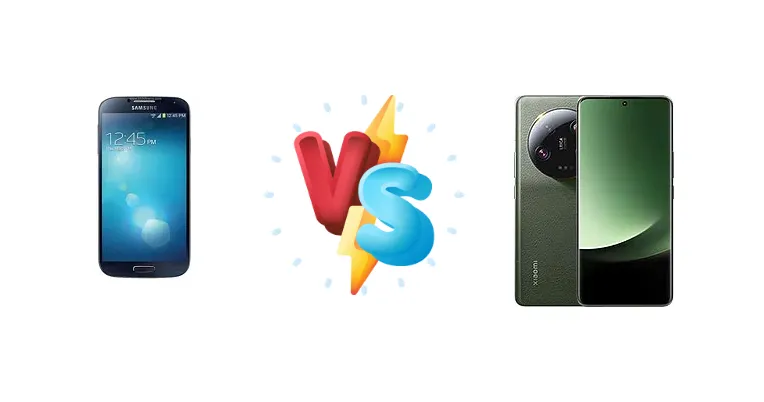
The Samsung Galaxy S4 was a revolutionary phone in its time, setting new standards for Android devices. Now, facing off against the Xiaomi 13 Ultra, a modern flagship packed with cutting-edge technology, it's a David vs. Goliath battle. Let's see how these two phones stack up.
🏆 Quick Verdict
The Xiaomi 13 Ultra utterly dominates this comparison. While the S4 holds nostalgic value, the 13 Ultra’s superior performance, camera, display, and battery life make it the clear winner for anyone seeking a modern smartphone experience. It's a generational leap.
| Network |
|---|
| 2G bands | GSM 850 / 900 / 1800 / 1900 | GSM 850 / 900 / 1800 / 1900 |
| 3G bands | HSDPA 850 / 900 / 1900 / 2100 | HSDPA 800 / 850 / 900 / 1700(AWS) / 1900 / 2100 |
| 4G bands | 4, 13 | 1, 2, 3, 4, 5, 7, 8, 18, 19, 20, 26, 28, 38, 40, 41, 66 - International |
| 5G bands | - | 1, 3, 5, 7, 8, 20, 28, 38, 40, 41, 77, 78, 79 SA/NSA - International |
| Speed | HSPA 42.2/5.76 Mbps, LTE Cat3 100/50 Mbps, EV-DO Rev.A 3.1 Mbps | HSPA, LTE, 5G |
| Technology | GSM / CDMA / HSPA / EVDO / LTE | GSM / CDMA / HSPA / EVDO / LTE / 5G |
| | CDMA2000 1xEV-DO | CDMA2000 1xEV-DO |
| Launch |
|---|
| Announced | 2013, May. Released 2013, May | 2023, April 18 |
| Status | Discontinued | Available. Released 2023, April 21 |
| Body |
|---|
| Build | - | Glass front (Gorilla Glass Victus), eco leather back, aluminum frame |
| Dimensions | 136.7 x 69.6 x 7.9 mm (5.38 x 2.74 x 0.31 in) | 163.2 x 74.6 x 9.1 mm (6.43 x 2.94 x 0.36 in) |
| SIM | Micro-SIM | Nano-SIM + Nano-SIM |
| Weight | 130.1 g (4.59 oz) | 227 g (8.01 oz) |
| | - | IP68 dust/water resistant (up to 1.5m for 30 min) |
| Display |
|---|
| Protection | Corning Gorilla Glass 3 | Corning Gorilla Glass Victus |
| Resolution | 1080 x 1920 pixels, 16:9 ratio (~441 ppi density) | 1440 x 3200 pixels, 20:9 ratio (~522 ppi density) |
| Size | 5.0 inches, 68.9 cm2 (~72.4% screen-to-body ratio) | 6.73 inches, 108.9 cm2 (~89.5% screen-to-body ratio) |
| Type | Super AMOLED | LTPO AMOLED, 68B colors, 120Hz, Dolby Vision, HDR10+, 1300 nits (HBM), 2600 nits (peak) |
| Platform |
|---|
| CPU | Quad-core 1.9 GHz Krait 300 | Octa-core (1x3.2 GHz Cortex-X3 & 2x2.8 GHz Cortex-A715 & 2x2.8 GHz Cortex-A710 & 3x2.0 GHz Cortex-A510) |
| Chipset | Qualcomm APQ8064T Snapdragon 600 | Qualcomm SM8550-AB Snapdragon 8 Gen 2 (4 nm) |
| GPU | Adreno 320 | Adreno 740 |
| OS | Android 4.2.2 (Jelly Bean), upgradable to 5.0.1 (Lollipop), TouchWiz UI | Android 13, upgradable to Android 14, HyperOS |
| Memory |
|---|
| Card slot | microSDXC (dedicated slot) | No |
| Internal | 16GB 2GB RAM | 256GB 12GB RAM, 512GB 12GB RAM, 512GB 16GB RAM, 1TB 16GB RAM |
| | - | UFS 4.0 |
| Main Camera |
|---|
| Features | LED flash, HDR | Laser AF, color spectrum sensor, Leica lenses, Dual-LED flash, HDR, panorama, 67mm filter ring holder (optional) |
| Quad | - | 50 MP, f/1.9 or f/4.0, 23mm (wide), 1.0"-type, 1.6µm, dual pixel PDAF, OIS
50 MP, f/1.8, 75mm (telephoto), 1/2.51", 0.7µm, dual pixel PDAF, OIS, 3.2x optical zoom
50 MP, f/3.0, 120mm (periscope telephoto), 1/2.51", 0.7µm, dual pixel PDAF, OIS, 5x optical zoom
50 MP, f/1.8, 12mm, 122˚ (ultrawide), 1/2.51", 0.7µm, dual pixel PDAF
TOF 3D, (depth) |
| Single | 13 MP, f/2.2, 31mm (standard), 1/3.1", 1.14µm, AF | - |
| Video | 1080p@30fps | 8K@24fps, 4K@24/30/60fps, 1080p@30/60/120/240/480/960/1920fps, gyro-EIS, Dolby Vision HDR 10-bit rec. (4K@60fps, 1080p) |
| Selfie camera |
|---|
| Features | Dual video call | HDR, panorama |
| Single | 2 MP, f/2.4, 31mm (standard) | 32 MP, f/2.0, 22mm (wide), 1/3.14", 0.7µm |
| Video | 1080p@30fps | 1080p@30/60fps, gyro-EIS |
| Sound |
|---|
| 3.5mm jack | Yes | No |
| 35mm jack | Yes | No |
| Loudspeaker | Yes | Yes, with stereo speakers |
| | - | 24-bit/192kHz audio |
| Comms |
|---|
| Bluetooth | 4.0, A2DP, EDR, LE, aptX | 5.3, A2DP, LE, aptX HD, aptX Adaptive |
| Infrared port | Yes | Yes |
| NFC | Yes | Yes |
| Positioning | GPS, GLONASS | GPS (L1+L5), GLONASS (L1), BDS (B1I+B1c+B2a), GALILEO (E1+E5a), QZSS (L1+L5), NavIC (L5) |
| Radio | No | No |
| USB | microUSB 2.0 (MHL 2 TV-out), OTG | USB Type-C 3.2, DisplayPort, OTG |
| WLAN | Wi-Fi 802.11 a/b/g/n/ac, dual-band, Wi-Fi Direct, DLNA, hotspot | Wi-Fi 802.11 a/b/g/n/ac/6e/7, tri-band, Wi-Fi Direct |
| Features |
|---|
| Sensors | Accelerometer, gyro, proximity, compass, barometer, temperature, humidity, gesture | Fingerprint (under display, optical), accelerometer, proximity, gyro, compass, barometer |
| | S-Voice natural language commands and dictation
Air gestures | Virtual proximity sensing |
| Battery |
|---|
| Charging | Wireless | 90W wired, PD3.0, QC4, 100% in 35 min
50W wireless, 100% in 49 min
10W reverse wireless |
| Music play | Up to 69 h | - |
| Stand-by | Up to 350 h (3G) | - |
| Talk time | Up to 11 h (3G) | - |
| Type | Li-Ion 2600 mAh, removable | Li-Po 5000 mAh |
| Misc |
|---|
| Colors | White Frost, Black Mist | Black, Olive Green, White, Orange, Yellow, Blue |
| Models | SCH-I545, SGH-I337 | 2304FPN6DC, 2304FPN6DG |
| Price | About 440 EUR | € 797.98 / $ 389.69 |
| SAR | 0.75 W/kg (head) 1.43 W/kg (body) | - |
| SAR EU | 0.18 W/kg (head) | 0.99 W/kg (head) 1.00 W/kg (body) |
Samsung Galaxy S4 CDMA
- Wireless Charging
- Nostalgic Value
- Compact Size (for some)
- Outdated Performance
- Poor Camera
- Short Battery Life
- Low Resolution Display
- Limited App Compatibility
Xiaomi 13 Ultra
- Exceptional Camera
- Blazing-Fast Performance
- Long Battery Life
- Bright & Vibrant Display
- Fast Charging
- Modern Features
- Large Size
- Premium Price
- MIUI Software (can be divisive)
Display Comparison
The Xiaomi 13 Ultra boasts a stunning 1207 nits max brightness display, offering vibrant colors and excellent visibility even in direct sunlight. The S4's display, while decent for its time, pales in comparison in terms of brightness, resolution, and overall visual quality. The 13 Ultra's likely AMOLED technology also provides superior contrast and color accuracy.
Camera Comparison
The Xiaomi 13 Ultra's camera system is a major highlight, featuring advanced sensors and image processing capabilities. It excels in both photo and video quality, offering impressive detail, dynamic range, and low-light performance. The S4's camera, while good for its time, is simply outdated by today's standards.
Performance
The Snapdragon 8 Gen 2 in the Xiaomi 13 Ultra is a beast, offering significantly faster processing speeds and smoother multitasking than the Snapdragon 600 in the S4. The 13 Ultra's octa-core CPU and modern architecture handle demanding games and applications with ease, while the S4 struggles with modern software.
Battery Life
The Xiaomi 13 Ultra offers exceptional battery life, with active use lasting over 10 hours and an endurance rating of 108 hours. Its fast charging capabilities (90W wired, 50W wireless) ensure quick top-ups. The S4's battery life is significantly shorter, and its charging speeds are considerably slower.
Buying Guide
Who should buy the Samsung Galaxy S4 CDMA? Primarily collectors or those seeking a retro Android experience. Who should buy the Xiaomi 13 Ultra? Anyone looking for a top-tier smartphone with exceptional camera capabilities, blazing-fast performance, and all-day battery life.
Frequently Asked Questions
❓ Is the Samsung Galaxy S4 still usable in 2024?
Yes, but with significant limitations. It can still make calls and browse the web, but app compatibility and performance are major issues. It's best suited for nostalgia or very basic tasks.
❓ What are the key differences between the Snapdragon 600 and Snapdragon 8 Gen 2?
The Snapdragon 8 Gen 2 is significantly more powerful, efficient, and modern than the Snapdragon 600. It offers vastly improved CPU and GPU performance, as well as advanced features like AI processing and 5G connectivity.