
Samsung Galaxy S25+ vs Sony Xperia 1 VII: A Deep Dive into Snapdragon 8 Elite Flagships
| Phones Images | |||||
|---|---|---|---|---|---|
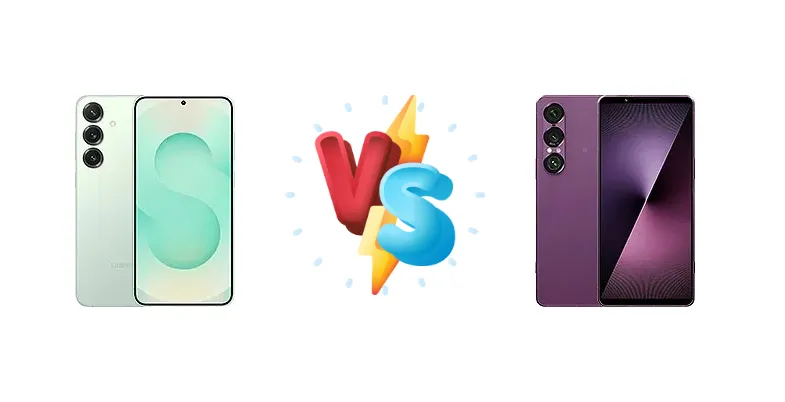
|
🏆 Quick Verdict
For the average user, the Samsung Galaxy S25+ emerges as the slightly more practical choice. Its superior battery endurance (43:38h vs 43:30h) and faster 45W charging, coupled with a higher battery cycle count (2000 vs 1400), offer greater peace of mind. However, the Xperia 1 VII’s brighter display is a compelling advantage for media consumption.
| PHONES | ||
|---|---|---|
| Phone Names | Samsung Galaxy S25+ | Sony Xperia 1 VII |
| Network | ||
|---|---|---|
| 2G bands | GSM 850 / 900 / 1800 / 1900 | GSM 850 / 900 / 1800 / 1900 |
| 3G bands | HSDPA 850 / 900 / 1700(AWS) / 1900 / 2100 | HSDPA 800 / 850 / 900 / 1700(AWS) / 1900 / 2100 |
| 4G bands | 1, 2, 3, 4, 5, 7, 8, 12, 13, 17, 18, 19, 20, 25, 26, 28, 32, 38, 39, 40, 41, 66 - International | 1, 2, 3, 4, 5, 7, 8, 12, 13, 17, 19, 20, 25, 26, 28, 32, 34, 38, 39, 40, 41, 66 - Europe |
| 5G bands | 1, 2, 3, 5, 7, 8, 12, 20, 25, 26, 28, 38, 40, 41, 66, 75, 77, 78 SA/NSA/Sub6 - International | 1, 3, 5, 7, 8, 20, 28, 38, 40, 41, 75, 77, 78 SA/NSA/Sub6 - Europe |
| Speed | HSPA, LTE (up to 7CA), 5G | HSPA, LTE, 5G |
| Technology | GSM / CDMA / HSPA / EVDO / LTE / 5G | GSM / HSPA / LTE / 5G |
| Launch | ||
|---|---|---|
| Announced | 2025, January 22 | 2025, May 13 |
| Status | Available. Released 2025, February 03 | Available. Released 2025, June 04 |
| Body | ||
|---|---|---|
| Build | Glass front (Gorilla Glass Victus 2), glass back (Gorilla Glass Victus 2), aluminum frame | Glass front (Gorilla Glass Victus 2), glass back (Gorilla Glass Victus), aluminum frame |
| Dimensions | 158.4 x 75.8 x 7.3 mm (6.24 x 2.98 x 0.29 in) | 162 x 74 x 8.2 mm (6.38 x 2.91 x 0.32 in) |
| SIM | · Nano-SIM + Nano-SIM + eSIM + eSIM (max 2 at a time) - INT· Nano-SIM + eSIM + eSIM (max 2 at a time) - USA· Nano-SIM + Nano-SIM - CN | · Nano-SIM + eSIM· Nano-SIM + Nano-SIM |
| Weight | 190 g (6.70 oz) | 197 g (6.95 oz) |
| Display | ||
|---|---|---|
| Protection | Corning Gorilla Glass Victus 2, Mohs level 5 | Corning Gorilla Glass Victus 2, Mohs level 5 |
| Resolution | 1440 x 3120 pixels, 19.5:9 ratio (~513 ppi density) | 1080 x 2340 pixels, 19.5:9 ratio (~396 ppi density) |
| Size | 6.7 inches, 110.2 cm2 (~91.8% screen-to-body ratio) | 6.5 inches, 103.7 cm2 (~86.5% screen-to-body ratio) |
| Type | Dynamic LTPO AMOLED 2X, 120Hz, HDR10+, 2600 nits (peak) | LTPO OLED, 1B colors, 120Hz, HDR BT.2020 |
| Platform | ||
|---|---|---|
| CPU | Octa-core (2x4.47 GHz Oryon V2 Phoenix L + 6x3.53 GHz Oryon V2 Phoenix M) | Octa-core (2x4.32 GHz Oryon V2 Phoenix L + 6x3.53 GHz Oryon V2 Phoenix M) |
| Chipset | Qualcomm SM8750-AC Snapdragon 8 Elite (3 nm) | Qualcomm SM8750-AB Snapdragon 8 Elite (3 nm) |
| GPU | Adreno 830 (1200 MHz) | Adreno 830 |
| OS | Android 15, up to 7 major Android upgrades, One UI 7 | Android 15, up to 4 major Android upgrades |
| Memory | ||
|---|---|---|
| Card slot | No | microSDXC (uses shared SIM slot) |
| Internal | 256GB 12GB RAM, 512GB 12GB RAM | 256GB 12GB RAM, 512GB 12GB RAM |
| Main Camera | ||
|---|---|---|
| Features | Best Face, LED flash, auto-HDR, panorama | Zeiss optics, Zeiss T* lens coating, color spectrum sensor, LED flash, panorama, HDR, eye tracking |
| Triple | 50 MP, f/1.8, 24mm (wide), 1/1.56", 1.0µm, dual pixel PDAF, OIS 10 MP, f/2.4, 67mm (telephoto), 1/3.94", 1.0µm, PDAF, OIS, 3x optical zoom 12 MP, f/2.2, 13mm, 120˚ (ultrawide), 1/2.55" 1.4µm, Super Steady video | 48 MP, f/1.9, 24mm (wide), 1/1.35", 1.12µm, dual pixel PDAF, OIS 12 MP, f/2.3, 85mm (telephoto), f/3.5, 170mm (telephoto), 1/3.5", 1.0µm, dual pixel PDAF, 3.5x-7.1x continuous optical zoom, OIS, 4cm macro @ 120mm, no AF 48 MP, f/2.0, 16mm (ultrawide), 1/1.56", 1.0µm, PDAF |
| Video | 8K@24/30fps, 4K@30/60fps, 1080p@30/60/120/240fps, 10-bit HDR, HDR10+, stereo sound rec., gyro-EIS | 4K@24/30/60/120fps HDR, 1080p@30/60/120fps; 5-axis gyro-EIS, OIS |
| Selfie camera | ||
|---|---|---|
| Features | HDR, HDR10+ | HDR |
| Single | 12 MP, f/2.2, 26mm (wide), 1/3.2", 1.12µm, dual pixel PDAF | 12 MP, f/2.0, 24mm (wide), 1/2.9", 1.22µm |
| Video | 4K@30/60fps, 1080p@30fps | 4K@30/60fps, 1080p@30/60fps, 5-axis gyro-EIS |
| Sound | ||
|---|---|---|
| 35mm jack | No | Yes |
| Loudspeaker | Yes, with stereo speakers | Yes, with stereo speakers |
| Comms | ||
|---|---|---|
| Bluetooth | 5.4, A2DP, LE | 6.0, A2DP, LE Audio, aptX HD, aptX Adaptive, aptX Lossless |
| NFC | Yes | Yes |
| Positioning | GPS, GLONASS, BDS, GALILEO, QZSS | GPS, GLONASS, BDS, GALILEO, QZSS |
| Radio | No | No |
| USB | USB Type-C 3.2, DisplayPort 1.2, OTG | USB Type-C 3.2, OTG, video output |
| WLAN | Wi-Fi 802.11 a/b/g/n/ac/6e/7, tri-band, Wi-Fi Direct | Wi-Fi 802.11 a/b/g/n/ac/6e/7, tri-band, Wi-Fi Direct, DLNA |
| Features | ||
|---|---|---|
| Sensors | Fingerprint (under display, ultrasonic), accelerometer, gyro, proximity, compass, barometer | Fingerprint (side-mounted), accelerometer, gyro, proximity, barometer, compass |
| Battery | ||
|---|---|---|
| Charging | 45W wired, PD3.0, 65% in 30 min 15W wireless (Qi2 Ready) 4.5W reverse wireless | 30W wired, PD3.0, PPS, 50% in 30 min 15W wireless Reverse wireless |
| Type | Li-Ion 4900 mAh | 5000 mAh |
| Misc | ||
|---|---|---|
| Colors | Icy Blue, Mint, Navy, Silver Shadow, Pink Gold, Coral Red, Blue Black | Moss Green, Orchid Purple, Slate Black |
| Models | SM-S936B, SM-S936B/DS, SM-S936U, SM-S936U1, SM-S936W, SM-S936N, SM-S9360, SM-S936E, SM-S936E/DS | XQ-FS54, XQFS54EUKCG.GC, XQFS54EUKCV.GC, XQFS54EUKCB.GC, PDX256 |
| Price | $ 999.99 / C$ 956.75 / £ 999.00 / € 799.00 | € 1,338.99 / $ 1,394.99 / £ 1,149.94 |
| SAR | 1.16 W/kg (head) 0.81 W/kg (body) | - |
| SAR EU | 1.26 W/kg (head) 1.26 W/kg (body) | - |
| EU LABEL | ||
|---|---|---|
| Battery | 43:38h endurance, 2000 cycles | 43:30h endurance, 1400 cycles |
| Energy | Class B | Class B |
| Free fall | Class A (270 falls) | Class B (181 falls) |
| Repairability | Class C | Class D |
Samsung Galaxy S25+
- Superior battery endurance (43:38h)
- Faster 45W wired charging
- Higher battery cycle count (2000 cycles)
- Slightly lower peak display brightness
- Samsung’s One UI can be feature-heavy for some
Sony Xperia 1 VII
- Brighter display (1475 nits)
- Sony’s streamlined software experience
- Potential for superior color accuracy in camera
- Lower battery cycle count (1400 cycles)
- Slower 30W wired charging
Display Comparison
Both devices boast exceptional displays, leveraging the capabilities of the Snapdragon 8 Elite’s ISP. However, the Sony Xperia 1 VII takes a slight lead with a measured peak brightness of 1475 nits, compared to the Samsung Galaxy S25+'s 1449 nits. This difference, while subtle, will be noticeable in direct sunlight. Both are likely to employ LTPO technology for adaptive refresh rates, though this isn't specified. The Xperia 1 VII’s emphasis on display quality aligns with Sony’s history in the television and entertainment space, while Samsung balances brightness with power efficiency.
Camera Comparison
While detailed camera specs are absent, both devices will undoubtedly feature advanced camera systems leveraging the Snapdragon 8 Elite’s image signal processor. The focus will likely be on computational photography and low-light performance. Given Sony’s expertise in image sensors, the Xperia 1 VII may prioritize color accuracy and dynamic range, while Samsung typically leans towards more vibrant, saturated images. The absence of information on sensor sizes and lens apertures makes a direct comparison impossible, but we can expect both to offer flagship-level image quality.
Performance
At the heart of both phones lies the Qualcomm SM8750-AC/AB Snapdragon 8 Elite (3nm), featuring an octa-core CPU configuration with 2x Oryon V2 Phoenix L cores at 4.47 GHz (S25+) vs 4.32 GHz (Xperia 1 VII) and 6x Oryon V2 Phoenix M cores at 3.53 GHz on both. The slight clock speed advantage of the S25+’s prime cores *may* translate to marginally faster single-core performance, but real-world differences will likely be minimal. Both utilize LPDDR5x RAM, and thermal management will be crucial to sustaining peak performance. The 3nm process node should contribute to improved efficiency, reducing throttling during extended gaming sessions. The difference in CPU clock speed is unlikely to be a deciding factor for most users.
Battery Life
Battery endurance is remarkably similar, with the Samsung Galaxy S25+ achieving 43:38h and the Sony Xperia 1 VII at 43:30h. However, the S25+ boasts a significantly higher battery cycle count of 2000, indicating greater long-term battery health compared to the Xperia 1 VII’s 1400 cycles. Charging speeds differ considerably: the S25+ supports 45W wired charging (65% in 30 minutes) and 15W wireless (Qi2 Ready), while the Xperia 1 VII is limited to 30W wired (50% in 30 minutes) and 15W wireless. The S25+’s faster charging and higher cycle count provide a clear advantage for users who prioritize convenience and longevity.
Buying Guide
Buy the Samsung Galaxy S25+ if you need all-day battery life, rapid charging, and a phone built to withstand years of use thanks to its impressive 2000 battery cycles. Buy the Sony Xperia 1 VII if you prioritize the brightest possible display for outdoor visibility and content creation, and prefer a more minimalist software approach with a focus on audio and visual quality.