
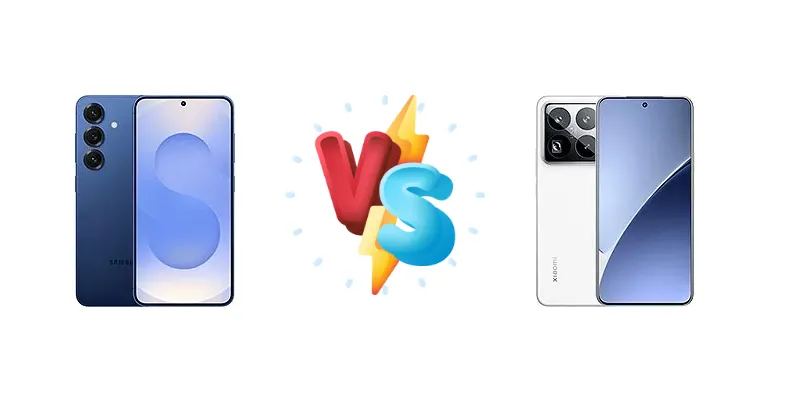
Samsung Galaxy S25 vs Xiaomi 15 Pro: A Deep Dive into Snapdragon 8 Elite Flagships
| Phones Images | |||||
|---|---|---|---|---|---|
|
🏆 Quick Verdict
For the average user prioritizing longevity and a balanced experience, the Samsung Galaxy S25 emerges as the winner. Its superior 37:16h battery endurance and 2000 charge cycles offer peace of mind, while the Xiaomi 15 Pro excels in raw charging speed but sacrifices some overall battery life.
| PHONES | ||
|---|---|---|
| Phone Names | Samsung Galaxy S25 | Xiaomi 15 Pro |
| Network | ||
|---|---|---|
| 2G bands | GSM 850 / 900 / 1800 / 1900 | GSM 850 / 900 / 1800 / 1900 |
| 3G bands | HSDPA 850 / 900 / 1700(AWS) / 1900 / 2100 | HSDPA 800 / 850 / 900 / 1700(AWS) / 1900 / 2100 |
| 4G bands | 1, 2, 3, 4, 5, 7, 8, 12, 13, 17, 18, 19, 20, 25, 26, 28, 32, 38, 39, 40, 41, 66 - International | 1, 2, 3, 4, 5, 7, 8, 12, 17, 18, 19, 20, 26, 28, 34, 38, 39, 40, 41, 42, 48, 66 - China |
| 5G bands | 1, 2, 3, 5, 7, 8, 12, 20, 25, 26, 28, 38, 40, 41, 66, 75, 77, 78 SA/NSA/Sub6 - International | 1, 2, 3, 5, 7, 8, 12, 20, 26, 28, 38, 40, 41, 48, 66, 77, 78, 79, 80, 81, 83, 84, 89 SA/NSA - China |
| Speed | HSPA, LTE (up to 7CA), 5G | HSPA, LTE, 5G |
| Technology | GSM / CDMA / HSPA / EVDO / LTE / 5G | GSM / HSPA / LTE / 5G |
| Launch | ||
|---|---|---|
| Announced | 2025, January 22 | 2024, October 29 |
| Status | Available. Released 2025, February 03 | Available. Released 2024, October 29 |
| Body | ||
|---|---|---|
| Build | Glass front (Gorilla Glass Victus 2), glass back (Gorilla Glass Victus 2), aluminum frame | - |
| Dimensions | 146.9 x 70.5 x 7.2 mm (5.78 x 2.78 x 0.28 in) | 161.3 x 75.3 x 8.4 mm or 8.7 mm |
| SIM | · Nano-SIM + Nano-SIM + eSIM + eSIM (max 2 at a time) - INT· Nano-SIM + eSIM + eSIM (max 2 at a time) - USA· Nano-SIM + Nano-SIM - CN | Nano-SIM + Nano-SIM |
| Weight | 162 g (5.71 oz) | 213 g or 219 g (7.51 oz) |
| Display | ||
|---|---|---|
| Protection | Corning Gorilla Glass Victus 2, Mohs level 5 | Shatterproof glass (2024 gen) |
| Resolution | 1080 x 2340 pixels, 19.5:9 ratio (~416 ppi density) | 1440 x 3200 pixels, 20:9 ratio (~522 ppi density) |
| Size | 6.2 inches, 94.4 cm2 (~91.1% screen-to-body ratio) | 6.73 inches, 108.9 cm2 (~89.7% screen-to-body ratio) |
| Type | Dynamic LTPO AMOLED 2X, 120Hz, HDR10+, 2600 nits (peak) | LTPO AMOLED, 68B colors, 120Hz, 1920Hz PWM, Dolby Vision, HDR10+, 3200 nits (peak) |
| Platform | ||
|---|---|---|
| CPU | Octa-core (2x4.47 GHz Oryon V2 Phoenix L + 6x3.53 GHz Oryon V2 Phoenix M) | Octa-core (2x4.32 GHz Oryon V2 Phoenix L + 6x3.53 GHz Oryon V2 Phoenix M) |
| Chipset | Qualcomm SM8750-AC Snapdragon 8 Elite (3 nm) | Qualcomm SM8750-AB Snapdragon 8 Elite (3 nm) |
| GPU | Adreno 830 (1200 MHz) | Adreno 830 |
| OS | Android 15, up to 7 major Android upgrades, One UI 7 | Android 15, HyperOS 2 |
| Memory | ||
|---|---|---|
| Card slot | No | No |
| Internal | 128GB 12GB RAM, 256GB 12GB RAM, 512GB 12GB RAM | 256GB 12GB RAM, 512GB 16GB RAM, 1TB 16GB RAM |
| Main Camera | ||
|---|---|---|
| Features | Best Face, LED flash, auto-HDR, panorama | Laser AF, color spectrum sensor, Leica lens, Dual-LED dual-tone flash, HDR, panorama |
| Triple | 50 MP, f/1.8, 24mm (wide), 1/1.56", 1.0µm, dual pixel PDAF, OIS 10 MP, f/2.4, 67mm (telephoto), 1/3.94", 1.0µm, PDAF, OIS, 3x optical zoom 12 MP, f/2.2, 13mm, 120˚ (ultrawide), 1/2.55" 1.4µm, Super Steady video | 50 MP, f/1.4, 23mm (wide), 1/1.31", 1.2µm, dual pixel PDAF, OIS 50 MP, f/2.5, 120mm (periscope telephoto), PDAF (30cm - ∞), OIS, 5x optical zoom 50 MP, f/2.2, 14mm, 115˚ (ultrawide), AF |
| Video | 8K@24/30fps, 4K@30/60fps, 1080p@30/60/120/240fps, 10-bit HDR, HDR10+, stereo sound rec., gyro-EIS | 8K@24/30fps (HDR), 4K@24/30/60fps (HDR10+, 10-bit Dolby Vision HDR, 10-bit LOG), 1080p@30/60/120/240/960fps, 720p@1920fps, gyro-EIS |
| Selfie camera | ||
|---|---|---|
| Features | HDR, HDR10+ | HDR, panorama |
| Single | 12 MP, f/2.2, 26mm (wide), 1/3.2", 1.12µm, dual pixel PDAF | 32 MP, f/2.0, 22mm (wide), 0.7µm |
| Video | 4K@30/60fps, 1080p@30fps | 4K@30/60fps, 1080p@30/60fps, gyro-EIS |
| Sound | ||
|---|---|---|
| 35mm jack | No | No |
| Loudspeaker | Yes, with stereo speakers | Yes, with stereo speakers |
| Comms | ||
|---|---|---|
| Bluetooth | 5.4, A2DP, LE | 5.4, A2DP, LE, aptX HD, aptX Adaptive, LHDC 5 |
| Infrared port | - | Yes |
| NFC | Yes | Yes |
| Positioning | GPS, GLONASS, BDS, GALILEO, QZSS | GPS (L1+L5), GLONASS (G1), BDS (B1I+B1c+B2a), GALILEO (E1+E5a), QZSS (L1+L5) |
| Radio | No | No |
| USB | USB Type-C 3.2, DisplayPort 1.2, OTG | USB Type-C 3.2 Gen2, Display Port, OTG |
| WLAN | Wi-Fi 802.11 a/b/g/n/ac/6e/7, tri-band, Wi-Fi Direct | Wi-Fi 802.11 a/b/g/n/ac/6e/7, dual-band or tri-band, Wi-Fi Direct |
| Features | ||
|---|---|---|
| Sensors | Fingerprint (under display, ultrasonic), accelerometer, gyro, proximity, compass, barometer | Fingerprint (under display, ultrasonic), accelerometer, proximity, gyro, compass, barometer |
| Battery | ||
|---|---|---|
| Charging | 25W wired, PD3.0, 50% in 30 min 15W wireless (Qi2 Ready) 4.5W reverse wireless | 90W wired, PD3.0, QC3+ 50W wireless 10W reverse wireless |
| Type | Li-Ion 4000 mAh | Si/C Li-Ion 6100 mAh |
| Misc | ||
|---|---|---|
| Colors | Icy Blue, Mint, Navy, Silver Shadow, Pink Gold, Coral Red, Blue Black | Black, White, Silver, Green |
| Models | SM-S931B, SM-S931B/DS, SM-S931U, SM-S931U1, SM-S931W, SM-S931N, SM-S9310, SM-S931E, SM-S931E/DS | 24101PNB7C, 2410DPN6CC |
| Price | $ 674.99 / C$ 689.00 / £ 435.99 / € 548.13 / ₹ 80,999 | About 690 EUR |
| SAR | 1.13 W/kg (head) 0.92 W/kg (body) | - |
| SAR EU | 1.29 W/kg (head) 1.36 W/kg (body) | - |
| EU LABEL | ||
|---|---|---|
| Battery | 37:16h endurance, 2000 cycles | - |
| Energy | Class B | - |
| Free fall | Class A (270 falls) | - |
| Repairability | Class C | - |
Samsung Galaxy S25
- Exceptional battery endurance (37:16h)
- Long battery lifespan (2000 charge cycles)
- High peak display brightness (1395 nits)
- Slower wired charging (25W)
- Slower wireless charging (15W)
Xiaomi 15 Pro
- Ultra-fast wired charging (90W)
- Fast wireless charging (50W)
- Potentially more vibrant display (based on brand history)
- Likely shorter battery endurance
- Unknown battery charge cycle lifespan
Display Comparison
The Samsung Galaxy S25 boasts a peak brightness of 1395 nits, ensuring excellent visibility even under direct sunlight. While both devices utilize high-end panels, Samsung’s brightness advantage is a tangible benefit for outdoor users. Details regarding panel technology (LTPO, refresh rate) are missing, but given Samsung’s history, we anticipate a variable refresh rate for power efficiency. Xiaomi’s display specs are currently unavailable, making a direct comparison of color accuracy and other key metrics impossible at this time. However, Xiaomi typically focuses on vibrant, saturated colors, while Samsung aims for more natural calibration.
Camera Comparison
Camera details are currently limited. However, the focus should be on the main sensor and image processing. Without sensor size or aperture information, it’s difficult to assess image quality. Both brands are known for their computational photography prowess, but Samsung typically leans towards more vibrant, saturated images, while Xiaomi often aims for a more natural look. The absence of details regarding OIS (Optical Image Stabilization) is a significant omission, as this is crucial for low-light performance and video stabilization.
Performance
Both the Galaxy S25 and Xiaomi 15 Pro are equipped with the Qualcomm SM8750-AC/AB Snapdragon 8 Elite (3nm), featuring an octa-core CPU configuration with 2x4.47 GHz (S25) vs 2x4.32 GHz (Xiaomi) Oryon V2 Phoenix L cores and 6x3.53 GHz Oryon V2 Phoenix M cores. The slight clock speed difference in the S25’s prime cores suggests a marginal performance edge in CPU-intensive tasks. Both utilize the same architecture, meaning the real-world difference will be minimal. The 3nm process node promises improved thermal efficiency compared to previous generations, reducing throttling during sustained workloads. RAM specifications are currently unknown, but both are expected to utilize LPDDR5x for fast memory access.
Battery Life
The Samsung Galaxy S25’s 37:16h endurance is a standout feature, significantly exceeding what most flagships offer. This translates to a real-world active use score of 13:09h. The Xiaomi 15 Pro, while not providing endurance data, compensates with incredibly fast charging: 90W wired, capable of reaching 100% in under 40 minutes, and 50W wireless charging. The S25 offers 25W wired (PD3.0, 50% in 30 min) and 15W wireless (Qi2 Ready). The S25’s 2000 charge cycles also indicate a longer lifespan for the battery itself, a crucial factor for long-term ownership. The Xiaomi 15 Pro’s 10W reverse wireless charging is less powerful than the S25’s 4.5W offering, but still useful for topping up accessories.
Buying Guide
Buy the Samsung Galaxy S25 if you need exceptional battery life, long-term reliability with its 2000 charge cycle battery, and a consistently bright display for outdoor visibility. Buy the Xiaomi 15 Pro if you prioritize the fastest possible charging speeds – getting from 0 to 100% in the shortest time – and value the convenience of 50W wireless charging, even at the cost of slightly reduced endurance.