
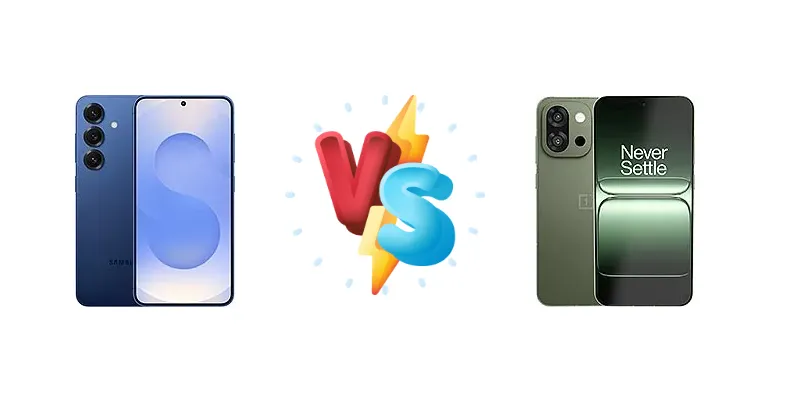
Samsung Galaxy S25 vs OnePlus 13s: A Deep Dive into Snapdragon 8 Elite Flagships
| Phones Images | |||||
|---|---|---|---|---|---|
|
🏆 Quick Verdict
For the average user, the OnePlus 13s emerges as the winner. Its significantly faster 80W wired charging, combined with a comparable Snapdragon 8 Elite processor, offers a more convenient and time-saving experience. While the Galaxy S25 boasts superior battery endurance, the charging speed difference is substantial enough to sway the decision for most.
| PHONES | ||
|---|---|---|
| Phone Names | Samsung Galaxy S25 | OnePlus 13s |
| Network | ||
|---|---|---|
| 2G bands | GSM 850 / 900 / 1800 / 1900 | GSM 850 / 900 / 1800 / 1900 |
| 3G bands | HSDPA 850 / 900 / 1700(AWS) / 1900 / 2100 | HSDPA 850 / 900 / 1900 / 2100 |
| 4G bands | 1, 2, 3, 4, 5, 7, 8, 12, 13, 17, 18, 19, 20, 25, 26, 28, 32, 38, 39, 40, 41, 66 - International | 1, 3, 4, 5, 8, 18, 19, 26, 28, 34, 38, 39, 40, 41, 42, 48, 66 |
| 5G bands | 1, 2, 3, 5, 7, 8, 12, 20, 25, 26, 28, 38, 40, 41, 66, 75, 77, 78 SA/NSA/Sub6 - International | 1, 3, 5, 8, 26, 28, 38, 40, 41, 48, 66, 77, 78 SA/NSA |
| Speed | HSPA, LTE (up to 7CA), 5G | HSPA, LTE, 5G |
| Technology | GSM / CDMA / HSPA / EVDO / LTE / 5G | GSM / HSPA / LTE / 5G |
| Launch | ||
|---|---|---|
| Announced | 2025, January 22 | 2025, June 05 |
| Status | Available. Released 2025, February 03 | Available. Released 2025, June 12 |
| Body | ||
|---|---|---|
| Build | Glass front (Gorilla Glass Victus 2), glass back (Gorilla Glass Victus 2), aluminum frame | Glass front, aluminum alloy frame |
| Dimensions | 146.9 x 70.5 x 7.2 mm (5.78 x 2.78 x 0.28 in) | 150.8 x 71.7 x 8.2 mm (5.94 x 2.82 x 0.32 in) |
| SIM | · Nano-SIM + Nano-SIM + eSIM + eSIM (max 2 at a time) - INT· Nano-SIM + eSIM + eSIM (max 2 at a time) - USA· Nano-SIM + Nano-SIM - CN | Nano-SIM + Nano-SIM + eSIM (max 2 at a time) |
| Weight | 162 g (5.71 oz) | 185 g (6.53 oz) |
| Display | ||
|---|---|---|
| Protection | Corning Gorilla Glass Victus 2, Mohs level 5 | Crystal Shield Glass |
| Resolution | 1080 x 2340 pixels, 19.5:9 ratio (~416 ppi density) | 1216 x 2640 pixels, 19.5:9 ratio (~460 ppi density) |
| Size | 6.2 inches, 94.4 cm2 (~91.1% screen-to-body ratio) | 6.32 inches, 97.9 cm2 (~90.6% screen-to-body ratio) |
| Type | Dynamic LTPO AMOLED 2X, 120Hz, HDR10+, 2600 nits (peak) | LTPO AMOLED, 1B colors, 120Hz, 2160Hz PWM, Dolby Vision, HDR10+, HDR Vivid, 1600 nits (HBM) |
| Platform | ||
|---|---|---|
| CPU | Octa-core (2x4.47 GHz Oryon V2 Phoenix L + 6x3.53 GHz Oryon V2 Phoenix M) | Octa-core (2x4.32 GHz Oryon V2 Phoenix L + 6x3.53 GHz Oryon V2 Phoenix M) |
| Chipset | Qualcomm SM8750-AC Snapdragon 8 Elite (3 nm) | Qualcomm SM8750-AB Snapdragon 8 Elite (3 nm) |
| GPU | Adreno 830 (1200 MHz) | Adreno 830 |
| OS | Android 15, up to 7 major Android upgrades, One UI 7 | Android 15, OxygenOS 15 |
| Memory | ||
|---|---|---|
| Card slot | No | No |
| Internal | 128GB 12GB RAM, 256GB 12GB RAM, 512GB 12GB RAM | 256GB 12GB RAM, 512GB 12GB RAM |
| Main Camera | ||
|---|---|---|
| Dual | - | 50 MP, f/1.8, 24mm (wide), 1/1.56", 1.0µm, multi-directional PDAF, OIS 50 MP, f/2.0, (telephoto), 1/2.75", 0.64µm, 2x optical zoom, PDAF |
| Features | Best Face, LED flash, auto-HDR, panorama | Color spectrum sensor, LED flash, HDR, panorama |
| Triple | 50 MP, f/1.8, 24mm (wide), 1/1.56", 1.0µm, dual pixel PDAF, OIS 10 MP, f/2.4, 67mm (telephoto), 1/3.94", 1.0µm, PDAF, OIS, 3x optical zoom 12 MP, f/2.2, 13mm, 120˚ (ultrawide), 1/2.55" 1.4µm, Super Steady video | - |
| Video | 8K@24/30fps, 4K@30/60fps, 1080p@30/60/120/240fps, 10-bit HDR, HDR10+, stereo sound rec., gyro-EIS | 4K@30/60fps, 1080p@30/60/240fps, gyro-EIS, OIS, Dolby Vision HDR |
| Selfie camera | ||
|---|---|---|
| Features | HDR, HDR10+ | HDR, panorama |
| Single | 12 MP, f/2.2, 26mm (wide), 1/3.2", 1.12µm, dual pixel PDAF | 32 MP, f/2.0, 21mm (wide), 1/3.1", 0.7µm, AF |
| Video | 4K@30/60fps, 1080p@30fps | 4K@30fps, 1080p@30fps, gyro-EIS |
| Sound | ||
|---|---|---|
| 35mm jack | No | No |
| Loudspeaker | Yes, with stereo speakers | Yes, with stereo speakers |
| Comms | ||
|---|---|---|
| Bluetooth | 5.4, A2DP, LE | 6.0, A2DP, LE, aptX HD, LHDC 5 |
| Infrared port | - | Yes |
| NFC | Yes | Yes |
| Positioning | GPS, GLONASS, BDS, GALILEO, QZSS | GPS (L1+L5), BDS (B1I+B1C+B2a), GALILEO (E1+E5a), QZSS (L1+L5), NavIC (L5), GLONASS |
| Radio | No | No |
| USB | USB Type-C 3.2, DisplayPort 1.2, OTG | USB Type-C 2.0, OTG |
| WLAN | Wi-Fi 802.11 a/b/g/n/ac/6e/7, tri-band, Wi-Fi Direct | Wi-Fi 802.11 a/b/g/n/ac/6/7, dual-band, Wi-Fi Direct |
| Features | ||
|---|---|---|
| Sensors | Fingerprint (under display, ultrasonic), accelerometer, gyro, proximity, compass, barometer | Fingerprint (under display, optical), accelerometer, gyro, proximity, compass |
| Battery | ||
|---|---|---|
| Charging | 25W wired, PD3.0, 50% in 30 min 15W wireless (Qi2 Ready) 4.5W reverse wireless | 80W wired, 33W PPS, 18W PD, 18W QC 5W reverse wired |
| Type | Li-Ion 4000 mAh | 5850 mAh |
| Misc | ||
|---|---|---|
| Colors | Icy Blue, Mint, Navy, Silver Shadow, Pink Gold, Coral Red, Blue Black | Green Silk, Black Velvet, Pink Satin |
| Models | SM-S931B, SM-S931B/DS, SM-S931U, SM-S931U1, SM-S931W, SM-S931N, SM-S9310, SM-S931E, SM-S931E/DS | CPH2723 |
| Price | $ 674.99 / C$ 689.00 / £ 435.99 / € 548.13 / ₹ 80,999 | ₹ 52,999 |
| SAR | 1.13 W/kg (head) 0.92 W/kg (body) | - |
| SAR EU | 1.29 W/kg (head) 1.36 W/kg (body) | - |
| EU LABEL | ||
|---|---|---|
| Battery | 37:16h endurance, 2000 cycles | - |
| Energy | Class B | - |
| Free fall | Class A (270 falls) | - |
| Repairability | Class C | - |
Samsung Galaxy S25
- Exceptional battery endurance (37:16h)
- Industry-leading 2000 charge cycle battery lifespan
- High peak display brightness (1395 nits)
- Slower 25W wired charging
- Limited information on display technology beyond brightness
OnePlus 13s
- Ultra-fast 80W wired charging
- Versatile charging standards (PPS, PD, QC)
- Potentially superior thermal management
- Battery endurance figures unavailable
- Limited camera specifications
Display Comparison
The Samsung Galaxy S25 boasts a measured peak brightness of 1395 nits, suggesting a vibrant and easily viewable display even in direct sunlight. While the OnePlus 13s’ display specifications aren’t provided, Samsung’s history suggests a focus on color accuracy and potentially a higher PWM dimming rate, benefiting users sensitive to flicker. The lack of detailed display specs for the OnePlus 13s makes a direct comparison difficult, but Samsung’s track record in display technology gives it a slight edge in this category.
Camera Comparison
Without detailed camera specifications, a direct comparison is limited. However, given Samsung’s focus on camera technology, the S25 likely features a more sophisticated image processing pipeline and potentially larger sensor sizes. The absence of camera details for the OnePlus 13s suggests a more pragmatic approach, focusing on delivering solid image quality without pushing the boundaries of mobile photography. It's reasonable to assume both phones will offer excellent image quality in good lighting conditions, but Samsung may have an advantage in low-light scenarios.
Performance
Both the Galaxy S25 and OnePlus 13s are equipped with the Qualcomm SM8750-AC/AB Snapdragon 8 Elite (3nm) chipset, featuring an octa-core CPU configuration with 2x4.47/4.32 GHz Oryon V2 Phoenix L cores and 6x3.53 GHz Oryon V2 Phoenix M cores. The minimal CPU clock speed difference (0.15 GHz) is unlikely to translate to a noticeable real-world performance gap. The key difference lies in thermal management, which isn’t specified. However, OnePlus historically prioritizes aggressive cooling solutions, potentially allowing the 13s to sustain peak performance for longer durations during demanding tasks. Both utilize LPDDR5x RAM, ensuring fast memory access.
Battery Life
The Samsung Galaxy S25 shines with a remarkable 37:16h battery endurance and a 2000-cycle battery lifespan, indicating exceptional longevity. In active use, it achieves 13:09h. The OnePlus 13s, while lacking endurance figures, compensates with significantly faster charging: 80W wired (with PPS, PD, and QC support) versus the S25’s 25W. This translates to a 50% charge in just 30 minutes for the S25, but a much faster full charge for the 13s. The 13s also offers 5W reverse wired charging, while the S25 provides 4.5W reverse wireless, offering a slight convenience advantage.
Buying Guide
Buy the Samsung Galaxy S25 if you prioritize long-term battery health and absolute endurance, needing a phone that can reliably last through a full day and beyond with minimal charging concerns. The 2000 charge cycle rating is a significant advantage for longevity. Buy the OnePlus 13s if you value speed and convenience, wanting a phone that can rapidly replenish its battery, getting you back to full power in under an hour, even if it means slightly less overall battery lifespan.