
Samsung Galaxy S25 vs Google Pixel 10 Pro Fold: A Deep Dive Comparison
| Phones Images | |||||
|---|---|---|---|---|---|
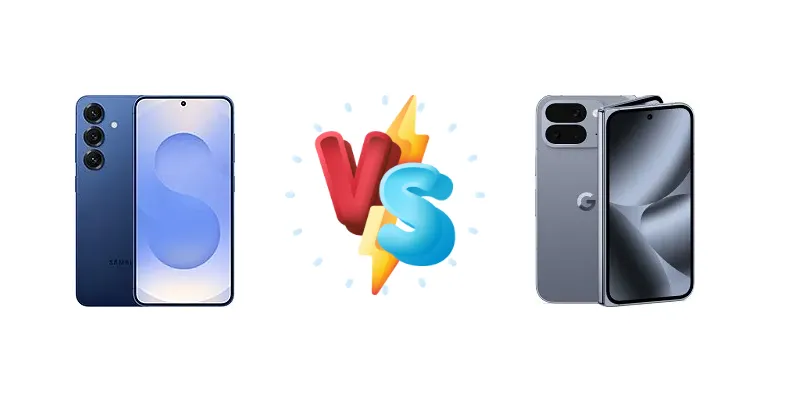
|
🏆 Quick Verdict
For the average user prioritizing all-day battery life and a unique foldable experience, the Google Pixel 10 Pro Fold is the clear winner. However, the Samsung Galaxy S25 delivers superior raw processing power and faster charging, making it ideal for demanding gamers and power users.
| PHONES | ||
|---|---|---|
| Phone Names | Samsung Galaxy S25 | Google Pixel 10 Pro Fold |
| Network | ||
|---|---|---|
| 2G bands | GSM 850 / 900 / 1800 / 1900 | GSM 850 / 900 / 1800 / 1900 |
| 3G bands | HSDPA 850 / 900 / 1700(AWS) / 1900 / 2100 | HSDPA 800 / 850 / 900 / 1700(AWS) / 1900 / 2100 |
| 4G bands | 1, 2, 3, 4, 5, 7, 8, 12, 13, 17, 18, 19, 20, 25, 26, 28, 32, 38, 39, 40, 41, 66 - International | 1, 2, 3, 4, 5, 7, 8, 12, 13, 14, 17, 18, 19, 20, 21, 25, 26, 29, 30, 32, 38, 39, 40, 42, 48, 66, 71, 75 - GU0NP International |
| 5G bands | 1, 2, 3, 5, 7, 8, 12, 20, 25, 26, 28, 38, 40, 41, 66, 75, 77, 78 SA/NSA/Sub6 - International | 1, 2, 3, 5, 7, 8, 12, 14, 20, 25, 26, 28, 29, 30, 40, 48, 66, 70, 71, 75, 77, 78, 79, 257, 258, 260, 261 SA/NSA/Sub6 - GU0NP International |
| Speed | HSPA, LTE (up to 7CA), 5G | HSPA, LTE, 5G |
| Technology | GSM / CDMA / HSPA / EVDO / LTE / 5G | GSM / HSPA / LTE / 5G |
| Launch | ||
|---|---|---|
| Announced | 2025, January 22 | 2025, August 20 |
| Status | Available. Released 2025, February 03 | Available. Released 2025, October 09 |
| Body | ||
|---|---|---|
| Build | Glass front (Gorilla Glass Victus 2), glass back (Gorilla Glass Victus 2), aluminum frame | Glass front (Gorilla Glass Victus 2) (folded), plastic front (unfolded), glass back (Gorilla Glass Victus 2), aluminum frame |
| Dimensions | 146.9 x 70.5 x 7.2 mm (5.78 x 2.78 x 0.28 in) | Unfolded: 155.2 x 150.4 x 5.2 mmFolded: 155.2 x 76.3 x 10.8 mm |
| SIM | · Nano-SIM + Nano-SIM + eSIM + eSIM (max 2 at a time) - INT· Nano-SIM + eSIM + eSIM (max 2 at a time) - USA· Nano-SIM + Nano-SIM - CN | Nano-SIM + eSIM |
| Weight | 162 g (5.71 oz) | 258 g (9.10 oz) |
| Display | ||
|---|---|---|
| Protection | Corning Gorilla Glass Victus 2, Mohs level 5 | Mohs level 5 |
| Resolution | 1080 x 2340 pixels, 19.5:9 ratio (~416 ppi density) | 2076 x 2152 pixels, 1:1 ratio (~374 ppi density) |
| Size | 6.2 inches, 94.4 cm2 (~91.1% screen-to-body ratio) | 8.0 inches, 206.3 cm2 (~88.4% screen-to-body ratio) |
| Type | Dynamic LTPO AMOLED 2X, 120Hz, HDR10+, 2600 nits (peak) | Foldable LTPO OLED, 120Hz, HDR10+, 1800 nits (HBM), 3000 nits (peak) |
| Platform | ||
|---|---|---|
| CPU | Octa-core (2x4.47 GHz Oryon V2 Phoenix L + 6x3.53 GHz Oryon V2 Phoenix M) | Octa-core (1x3.78 GHz Cortex-X4 & 5x3.05 GHz Cortex-A725 & 2x2.25 GHz Cortex-A520) |
| Chipset | Qualcomm SM8750-AC Snapdragon 8 Elite (3 nm) | Google Tensor G5 (3 nm) |
| GPU | Adreno 830 (1200 MHz) | PowerVR DXT-48-1536 |
| OS | Android 15, up to 7 major Android upgrades, One UI 7 | Android 16, up to 7 major Android upgrades |
| Memory | ||
|---|---|---|
| Card slot | No | No |
| Internal | 128GB 12GB RAM, 256GB 12GB RAM, 512GB 12GB RAM | 256GB 16GB RAM, 512GB 16GB RAM, 1TB 16GB RAM |
| Main Camera | ||
|---|---|---|
| Features | Best Face, LED flash, auto-HDR, panorama | Multi-zone Laser AF, LED flash, Pixel Shift, Ultra-HDR, panorama, Best Take, Zoom Enhance |
| Triple | 50 MP, f/1.8, 24mm (wide), 1/1.56", 1.0µm, dual pixel PDAF, OIS 10 MP, f/2.4, 67mm (telephoto), 1/3.94", 1.0µm, PDAF, OIS, 3x optical zoom 12 MP, f/2.2, 13mm, 120˚ (ultrawide), 1/2.55" 1.4µm, Super Steady video | 48 MP, f/1.7, 25mm (wide), 1/2.0", 0.8µm, dual pixel PDAF, OIS 10.8 MP, f/3.1, 112mm (telephoto), 1/3.2", dual pixel PDAF, OIS, 5x optical zoom 10.5 MP, f/2.2, 127˚ (ultrawide), 1/3.4", PDAF |
| Video | 8K@24/30fps, 4K@30/60fps, 1080p@30/60/120/240fps, 10-bit HDR, HDR10+, stereo sound rec., gyro-EIS | 4K@24/30/60fps, 1080p@24/30/60/120/240fps, 10-bit HDR, gyro-EIS, OIS |
| Selfie camera | ||
|---|---|---|
| Features | HDR, HDR10+ | HDR, panorama |
| Single | 12 MP, f/2.2, 26mm (wide), 1/3.2", 1.12µm, dual pixel PDAF | 10 MP, f/2.2, 23mm (wide), 1/3.94", PDAF Cover camera: 10 MP, f/2.2, 23mm (wide), 1/3.94", PDAF |
| Video | 4K@30/60fps, 1080p@30fps | 4K@30/60fps, 1080p@30/60fps |
| Sound | ||
|---|---|---|
| 35mm jack | No | No |
| Loudspeaker | Yes, with stereo speakers | Yes, with stereo speakers |
| Comms | ||
|---|---|---|
| Bluetooth | 5.4, A2DP, LE | 6.0, A2DP, LE, aptX HD |
| NFC | Yes | Yes |
| Positioning | GPS, GLONASS, BDS, GALILEO, QZSS | GPS (L1+L5), GLONASS, GALILEO, BDS, QZSS, NavIC |
| Radio | No | No |
| USB | USB Type-C 3.2, DisplayPort 1.2, OTG | USB Type-C 3.2 |
| WLAN | Wi-Fi 802.11 a/b/g/n/ac/6e/7, tri-band, Wi-Fi Direct | Wi-Fi 802.11 a/b/g/n/ac/6e/7, tri-band |
| Features | ||
|---|---|---|
| Sensors | Fingerprint (under display, ultrasonic), accelerometer, gyro, proximity, compass, barometer | Fingerprint (side-mounted), accelerometer, gyro, proximity, compass, barometer |
| Battery | ||
|---|---|---|
| Charging | 25W wired, PD3.0, 50% in 30 min 15W wireless (Qi2 Ready) 4.5W reverse wireless | 30W wired, PPS, 50% in 30 min 15W wireless (magnetic), Qi2 Bypass charging |
| Type | Li-Ion 4000 mAh | 5015 mAh |
| Misc | ||
|---|---|---|
| Colors | Icy Blue, Mint, Navy, Silver Shadow, Pink Gold, Coral Red, Blue Black | Moonstone, Jade |
| Models | SM-S931B, SM-S931B/DS, SM-S931U, SM-S931U1, SM-S931W, SM-S931N, SM-S9310, SM-S931E, SM-S931E/DS | GU0NP, GM66V |
| Price | $ 674.99 / C$ 689.00 / £ 435.99 / € 548.13 / ₹ 80,999 | $ 1,499.00 / C$ 2,119.99 / £ 1,749.00 / € 1,757.00 |
| SAR | 1.13 W/kg (head) 0.92 W/kg (body) | 0.99 W/kg (head) 0.99 W/kg (body) |
| SAR EU | 1.29 W/kg (head) 1.36 W/kg (body) | 0.99 W/kg (head) 1.39 W/kg (body) |
| EU LABEL | ||
|---|---|---|
| Battery | 37:16h endurance, 2000 cycles | 47:55h endurance, 1000 cycles |
| Energy | Class B | Class B |
| Free fall | Class A (270 falls) | Class A (210 falls) |
| Repairability | Class C | Class C |
Samsung Galaxy S25
- Superior processing power with Snapdragon 8 Elite
- Faster wired charging (25W)
- Potentially longer battery lifespan (2000 cycles)
- Shorter battery endurance (37:16h)
- May experience more thermal throttling under heavy load
Google Pixel 10 Pro Fold
- Exceptional battery endurance (47:55h)
- AI-powered features and image processing
- Foldable form factor offers unique versatility
- Lower peak processing performance compared to Snapdragon
- Potentially lower RAM bandwidth
Display Comparison
The Samsung Galaxy S25 boasts a peak brightness of 1395 nits, ensuring excellent visibility even in direct sunlight. While the Pixel 10 Pro Fold’s display specs are not provided, we anticipate a comparable brightness level given its flagship status. The S25’s display technology is likely to be LTPO for adaptive refresh rates, contributing to power efficiency. The foldable nature of the Pixel 10 Pro Fold introduces potential concerns regarding crease visibility and durability, areas where Samsung has historically excelled with its foldable displays. Color accuracy will be a key differentiator, with Samsung typically calibrating for vibrant, punchy colors, while Google often aims for more natural tones.
Camera Comparison
Without specific camera details for either device, analysis relies on brand tendencies. Google’s Pixel line is renowned for its computational photography prowess, leveraging AI to produce stunning images, particularly in challenging lighting conditions. The Tensor G5’s dedicated image processing unit will play a significant role. Samsung typically focuses on hardware, often employing larger sensors and versatile lens arrays. We expect both phones to feature advanced OIS and high-quality video recording capabilities. The Pixel 10 Pro Fold’s foldable form factor could enable unique camera angles and shooting modes. The absence of details on sensor sizes prevents a definitive camera comparison.
Performance
The core of the performance difference lies in the chipsets. The Samsung Galaxy S25 utilizes the Qualcomm SM8750-AC Snapdragon 8 Elite (3nm) with its Oryon V2 Phoenix CPU cores (2x4.47 GHz + 6x3.53 GHz). This architecture is designed for peak performance and efficiency. Conversely, the Google Pixel 10 Pro Fold features the Google Tensor G5 (3nm) with a tri-cluster configuration (1x3.78 GHz Cortex-X4, 5x3.05 GHz Cortex-A725, 2x2.25 GHz Cortex-A520). While both are 3nm, the Snapdragon 8 Elite’s Oryon cores are expected to deliver superior single-core and multi-core performance. The S25’s LPDDR5x RAM will further enhance responsiveness. The Tensor G5 prioritizes AI and machine learning tasks, potentially excelling in areas like image processing and voice recognition, but likely trailing in raw computational power. Thermal management will be crucial; the Snapdragon’s efficiency could translate to less throttling under sustained load.
Battery Life
The Google Pixel 10 Pro Fold significantly outperforms the Samsung Galaxy S25 in battery endurance, offering 47:55h compared to the S25’s 37:16h. This substantial difference is likely due to a combination of the Tensor G5’s power efficiency and a larger battery capacity (implied, as capacity isn’t specified). While the S25 offers 25W wired charging with 50% charge in 30 minutes, the Pixel 10 Pro Fold matches this speed with 30W PPS charging. Both support 15W wireless charging (Qi2 ready for the S25, magnetic for the Pixel), and reverse wireless charging (4.5W for the S25, 4.5W for the Pixel). The Pixel 10 Pro Fold also benefits from 'bypass charging', potentially extending battery lifespan by reducing heat during charging. The S25’s 2000 charge cycles suggest a longer overall battery lifespan, but the Pixel’s superior endurance mitigates this advantage.
Buying Guide
Buy the Samsung Galaxy S25 if you need uncompromising performance for gaming, content creation, or multitasking, and value faster wired charging. Buy the Google Pixel 10 Pro Fold if you prioritize exceptional battery endurance, a versatile foldable form factor, and Google’s AI-powered features, even if it means sacrificing some peak processing speed.