
Samsung Galaxy S25 vs. Asus Zenfone 12 Ultra: Which Flagship Reigns Supreme?
| Phones Images | |||||
|---|---|---|---|---|---|
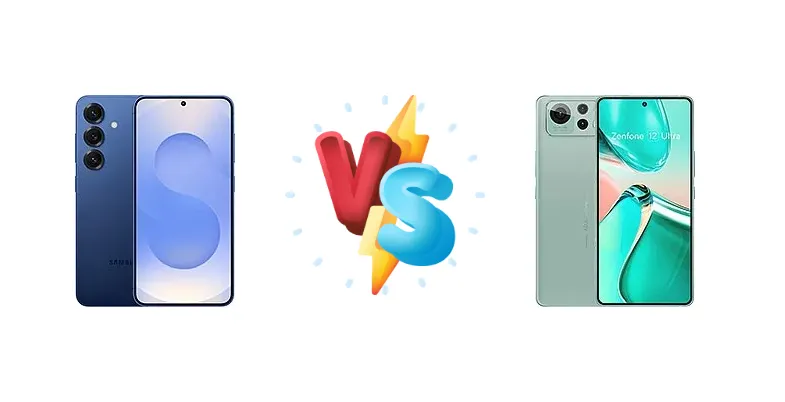
|
🏆 Quick Verdict
For the average user prioritizing all-day battery life and incredibly fast charging, the Asus Zenfone 12 Ultra is the clear winner. Its 61-hour endurance and 65W charging significantly outperform the S25. However, the S25’s brighter display and established ecosystem may appeal to Samsung loyalists.
| PHONES | ||
|---|---|---|
| Phone Names | Samsung Galaxy S25 | Asus Zenfone 12 Ultra |
| Network | ||
|---|---|---|
| 2G bands | GSM 850 / 900 / 1800 / 1900 | GSM 850 / 900 / 1800 / 1900 |
| 3G bands | HSDPA 850 / 900 / 1700(AWS) / 1900 / 2100 | HSDPA 800 / 850 / 900 / 1700(AWS) / 1900 / 2100 |
| 4G bands | 1, 2, 3, 4, 5, 7, 8, 12, 13, 17, 18, 19, 20, 25, 26, 28, 32, 38, 39, 40, 41, 66 - International | 1, 2, 3, 4, 5, 7, 8, 12, 17, 18, 19, 20, 25, 26, 28, 32, 34, 38, 39, 40, 41, 42, 43, 48, 66 |
| 5G bands | 1, 2, 3, 5, 7, 8, 12, 20, 25, 26, 28, 38, 40, 41, 66, 75, 77, 78 SA/NSA/Sub6 - International | 1, 2, 3, 5, 7, 8, 12, 18, 20, 25, 26, 28, 38, 40, 41, 48, 66, 77, 78, 79 SA/NSA |
| Speed | HSPA, LTE (up to 7CA), 5G | HSPA, LTE, 5G |
| Technology | GSM / CDMA / HSPA / EVDO / LTE / 5G | GSM / HSPA / LTE / 5G |
| Launch | ||
|---|---|---|
| Announced | 2025, January 22 | 2025, February 06 |
| Status | Available. Released 2025, February 03 | Available. Released 2025, February 28 |
| Body | ||
|---|---|---|
| Build | Glass front (Gorilla Glass Victus 2), glass back (Gorilla Glass Victus 2), aluminum frame | Glass front (Gorilla Glass Victus 2), aluminum frame, glass back |
| Dimensions | 146.9 x 70.5 x 7.2 mm (5.78 x 2.78 x 0.28 in) | 163.8 x 77 x 8.9 mm (6.45 x 3.03 x 0.35 in) |
| SIM | · Nano-SIM + Nano-SIM + eSIM + eSIM (max 2 at a time) - INT· Nano-SIM + eSIM + eSIM (max 2 at a time) - USA· Nano-SIM + Nano-SIM - CN | Nano-SIM + Nano-SIM + eSIM (max 2 at a time) |
| Weight | 162 g (5.71 oz) | 220 g (7.76 oz) |
| Display | ||
|---|---|---|
| Protection | Corning Gorilla Glass Victus 2, Mohs level 5 | Corning Gorilla Glass Victus 2, Mohs level 6 |
| Resolution | 1080 x 2340 pixels, 19.5:9 ratio (~416 ppi density) | 1080 x 2400 pixels, 20:9 ratio (~388 ppi density) |
| Size | 6.2 inches, 94.4 cm2 (~91.1% screen-to-body ratio) | 6.78 inches, 111.0 cm2 (~88.0% screen-to-body ratio) |
| Type | Dynamic LTPO AMOLED 2X, 120Hz, HDR10+, 2600 nits (peak) | LTPO AMOLED, 144Hz, HDR10, 1600 nits (HBM), 2500 nits (peak) |
| Platform | ||
|---|---|---|
| CPU | Octa-core (2x4.47 GHz Oryon V2 Phoenix L + 6x3.53 GHz Oryon V2 Phoenix M) | Octa-core (2x4.32 GHz Oryon V2 Phoenix L + 6x3.53 GHz Oryon V2 Phoenix M) |
| Chipset | Qualcomm SM8750-AC Snapdragon 8 Elite (3 nm) | Qualcomm SM8750-AB Snapdragon 8 Elite (3 nm) |
| GPU | Adreno 830 (1200 MHz) | Adreno 830 |
| OS | Android 15, up to 7 major Android upgrades, One UI 7 | Android 15, upgradable to Android 16, up to 2 major Android upgrades |
| Memory | ||
|---|---|---|
| Card slot | No | No |
| Internal | 128GB 12GB RAM, 256GB 12GB RAM, 512GB 12GB RAM | 256GB 12GB RAM, 512GB 16GB RAM |
| Main Camera | ||
|---|---|---|
| Features | Best Face, LED flash, auto-HDR, panorama | LED flash, HDR, panorama |
| Triple | 50 MP, f/1.8, 24mm (wide), 1/1.56", 1.0µm, dual pixel PDAF, OIS 10 MP, f/2.4, 67mm (telephoto), 1/3.94", 1.0µm, PDAF, OIS, 3x optical zoom 12 MP, f/2.2, 13mm, 120˚ (ultrawide), 1/2.55" 1.4µm, Super Steady video | 50 MP, f/1.9, 24mm (wide), 1/1.56", 1.0µm, PDAF, gimbal OIS 32 MP, f/2.4, 65mm (telephoto), 1/3.2", 0.7µm, PDAF, OIS, 3x optical zoom 13 MP, f/2.2, 13mm, 120˚ (ultrawide), 1/3.0", 1.12µm |
| Video | 8K@24/30fps, 4K@30/60fps, 1080p@30/60/120/240fps, 10-bit HDR, HDR10+, stereo sound rec., gyro-EIS | 8K@24fps, 4K@30/60fps, 1080p@30/60/120/240fps, 720p@480fps; gyro-EIS, HDR10+ |
| Selfie camera | ||
|---|---|---|
| Features | HDR, HDR10+ | Panorama, HDR |
| Single | 12 MP, f/2.2, 26mm (wide), 1/3.2", 1.12µm, dual pixel PDAF | 32 MP, f/2.5, 22mm (wide), 1/3.2", 0.7µm |
| Video | 4K@30/60fps, 1080p@30fps | 1080p@30fps |
| Sound | ||
|---|---|---|
| 35mm jack | No | Yes |
| Loudspeaker | Yes, with stereo speakers | Yes, with stereo speakers |
| Comms | ||
|---|---|---|
| Bluetooth | 5.4, A2DP, LE | 5.4, A2DP, LE, aptX HD, aptX Adaptive, aptX Lossless |
| NFC | Yes | Yes |
| Positioning | GPS, GLONASS, BDS, GALILEO, QZSS | GPS (L1+L5), BDS (B1I+B1c+B2a), GALILEO (E1+E5a), QZSS (L1+L5), NavIC, GLONASS |
| Radio | No | No |
| USB | USB Type-C 3.2, DisplayPort 1.2, OTG | USB Type-C |
| WLAN | Wi-Fi 802.11 a/b/g/n/ac/6e/7, tri-band, Wi-Fi Direct | Wi-Fi 802.11 a/b/g/n/ac/6e/7, tri-band, Wi-Fi Direct |
| Features | ||
|---|---|---|
| Sensors | Fingerprint (under display, ultrasonic), accelerometer, gyro, proximity, compass, barometer | Fingerprint (under display, optical), accelerometer, gyro, proximity, compass |
| Battery | ||
|---|---|---|
| Charging | 25W wired, PD3.0, 50% in 30 min 15W wireless (Qi2 Ready) 4.5W reverse wireless | 65W wired, PD3.0, PPS, QC5, 100% in 39 min 15W wireless (Qi) 10W reverse wired |
| Type | Li-Ion 4000 mAh | 5500 mAh |
| Misc | ||
|---|---|---|
| Colors | Icy Blue, Mint, Navy, Silver Shadow, Pink Gold, Coral Red, Blue Black | Ebony Black, Sakura White, Sage Green |
| Models | SM-S931B, SM-S931B/DS, SM-S931U, SM-S931U1, SM-S931W, SM-S931N, SM-S9310, SM-S931E, SM-S931E/DS | AI2501, AI2501H, I2501C, AI2501B |
| Price | $ 674.99 / C$ 689.00 / £ 435.99 / € 548.13 / ₹ 80,999 | € 955.55 |
| SAR | 1.13 W/kg (head) 0.92 W/kg (body) | - |
| SAR EU | 1.29 W/kg (head) 1.36 W/kg (body) | - |
| EU LABEL | ||
|---|---|---|
| Battery | 37:16h endurance, 2000 cycles | 61:00h endurance, 1200 cycles |
| Energy | Class B | Class A |
| Free fall | Class A (270 falls) | Class D (45 falls) |
| Repairability | Class C | Class C |
Samsung Galaxy S25
- Brighter display for outdoor visibility.
- Potentially slightly faster CPU performance.
- Established Samsung ecosystem integration.
- Significantly shorter battery life.
- Slower charging speed.
- Lower reverse wireless charging power.
Asus Zenfone 12 Ultra
- Exceptional battery endurance.
- Ultra-fast 65W charging.
- Higher peak display brightness.
- Slightly lower CPU clock speed.
- Less established brand recognition in some markets.
- May require adapting to Asus’s software experience.
Display Comparison
The Asus Zenfone 12 Ultra immediately distinguishes itself with a measured peak brightness of 1965 nits, significantly exceeding the Samsung Galaxy S25’s 1395 nits. This translates to superior visibility in direct sunlight. While both likely employ LTPO technology for adaptive refresh rates (inferred from flagship positioning), the Zenfone’s higher brightness is a tangible advantage. The S25 may benefit from Samsung’s established color calibration expertise, but the Zenfone’s raw luminance is a compelling factor for outdoor use.
Camera Comparison
Context data lacks camera specifics, but given the flagship positioning, both devices will likely feature multi-camera systems. The Zenfone’s brand history suggests a focus on computational photography, while Samsung typically emphasizes vibrant, saturated image processing. Without sensor size or aperture information, it’s difficult to make a definitive judgment. However, the absence of mention of a high-resolution main sensor on either device suggests a focus on image quality over megapixel count, which is a positive trend.
Performance
Both the S25 and Zenfone 12 Ultra are powered by the Qualcomm SM8750-AC/AB Snapdragon 8 Elite (3nm), featuring an octa-core CPU configuration with 2x Oryon V2 Phoenix L cores at 4.47 GHz (S25) vs 4.32 GHz (Zenfone) and 6x Oryon V2 Phoenix M cores at 3.53 GHz on both. The slight clock speed difference in the S25’s prime cores suggests a marginal performance edge in CPU-intensive tasks, but real-world differences will likely be minimal. Both utilize LPDDR5x RAM (spec not provided, but standard for this tier). Thermal management will be crucial; the 3nm process should improve efficiency, but sustained loads will reveal which device handles heat more effectively.
Battery Life
The Asus Zenfone 12 Ultra dominates in battery endurance, offering a remarkable 61:00h rating compared to the S25’s 37:16h. This is coupled with an active use score of 15:50h for the Zenfone versus 13:09h for the S25. The Zenfone also boasts significantly faster charging at 65W (100% in 39 minutes) utilizing PD3.0, PPS, and QC5, while the S25 is limited to 25W (50% in 30 minutes) with PD3.0. The Zenfone’s 10W reverse wired charging also surpasses the S25’s 4.5W reverse wireless capability, offering more practical utility for topping up accessories.
Buying Guide
Buy the Samsung Galaxy S25 if you prioritize a vibrant, exceptionally bright display and seamless integration within the Samsung ecosystem. It’s ideal for media consumption and users heavily invested in Samsung services. Buy the Asus Zenfone 12 Ultra if you demand maximum battery life, lightning-fast charging, and a more aggressive value proposition, making it perfect for travelers, power users, and those who dislike frequent charging.