
Samsung Galaxy S25 FE vs. Sony Xperia 1 VII: A Head-to-Head Flagship Battle
| Phones Images | |||||
|---|---|---|---|---|---|
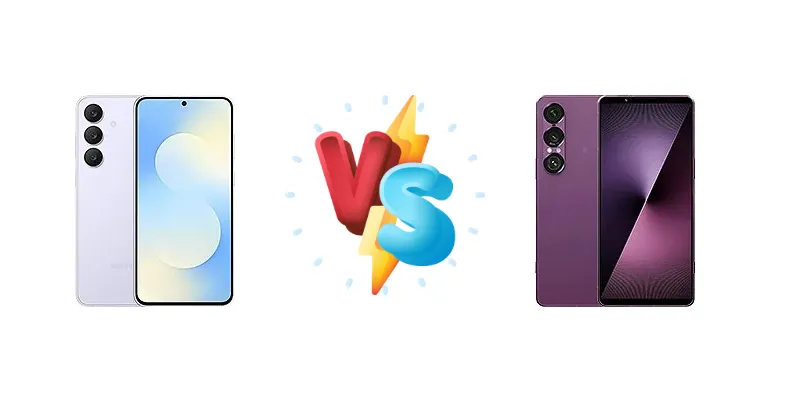
|
🏆 Quick Verdict
For the average user prioritizing all-day battery and fast charging, the Sony Xperia 1 VII emerges as the winner. Its Snapdragon 8 Elite chipset and superior active use battery score (15:32h) outweigh the S25 FE’s lower price, offering a smoother, more sustained experience.
| PHONES | ||
|---|---|---|
| Phone Names | Samsung Galaxy S25 FE | Sony Xperia 1 VII |
| Network | ||
|---|---|---|
| 2G bands | GSM 850 / 900 / 1800 / 1900 | GSM 850 / 900 / 1800 / 1900 |
| 3G bands | HSDPA 850 / 900 / 1700(AWS) / 1900 / 2100 | HSDPA 800 / 850 / 900 / 1700(AWS) / 1900 / 2100 |
| 4G bands | LTE | 1, 2, 3, 4, 5, 7, 8, 12, 13, 17, 19, 20, 25, 26, 28, 32, 34, 38, 39, 40, 41, 66 - Europe |
| 5G bands | SA/NSA/Sub6 | 1, 3, 5, 7, 8, 20, 28, 38, 40, 41, 75, 77, 78 SA/NSA/Sub6 - Europe |
| Speed | HSPA, LTE, 5G | HSPA, LTE, 5G |
| Technology | GSM / HSPA / LTE / 5G | GSM / HSPA / LTE / 5G |
| Launch | ||
|---|---|---|
| Announced | 2025, September 04 | 2025, May 13 |
| Status | Available. Released 2025, September 04 | Available. Released 2025, June 04 |
| Body | ||
|---|---|---|
| Build | Glass front (Gorilla Glass Victus+), glass back (Gorilla Glass Victus+), aluminum frame | Glass front (Gorilla Glass Victus 2), glass back (Gorilla Glass Victus), aluminum frame |
| Dimensions | 161.3 x 76.6 x 7.4 mm (6.35 x 3.02 x 0.29 in) | 162 x 74 x 8.2 mm (6.38 x 2.91 x 0.32 in) |
| SIM | · Nano-SIM· Nano-SIM + Nano-SIM· Nano-SIM + eSIM· eSIM + eSIM | · Nano-SIM + eSIM· Nano-SIM + Nano-SIM |
| Weight | 190 g (6.70 oz) | 197 g (6.95 oz) |
| Display | ||
|---|---|---|
| Protection | Corning Gorilla Glass Victus+, Mohs level 5 | Corning Gorilla Glass Victus 2, Mohs level 5 |
| Resolution | 1080 x 2340 pixels, 19.5:9 ratio (~385 ppi density) | 1080 x 2340 pixels, 19.5:9 ratio (~396 ppi density) |
| Size | 6.7 inches, 110.2 cm2 (~89.2% screen-to-body ratio) | 6.5 inches, 103.7 cm2 (~86.5% screen-to-body ratio) |
| Type | Dynamic LTPO AMOLED 2X, 120Hz, HDR10+, 1900 nits (peak) | LTPO OLED, 1B colors, 120Hz, HDR BT.2020 |
| Platform | ||
|---|---|---|
| CPU | 10-core (1x3.2GHz Cortex-X4 & 2x2.9GHz Cortex-A720 & 3x2.6GHz Cortex-A720 & 4x1.95GHz Cortex-A520) | Octa-core (2x4.32 GHz Oryon V2 Phoenix L + 6x3.53 GHz Oryon V2 Phoenix M) |
| Chipset | Exynos 2400 (4 nm) | Qualcomm SM8750-AB Snapdragon 8 Elite (3 nm) |
| GPU | Xclipse 940 | Adreno 830 |
| OS | Android 16, up to 7 major Android upgrades, One UI 8 | Android 15, up to 4 major Android upgrades |
| Memory | ||
|---|---|---|
| Card slot | No | microSDXC (uses shared SIM slot) |
| Internal | 128GB 8GB RAM, 256GB 8GB RAM, 512GB 8GB RAM | 256GB 12GB RAM, 512GB 12GB RAM |
| Main Camera | ||
|---|---|---|
| Features | LED flash, HDR, panorama, Best Face | Zeiss optics, Zeiss T* lens coating, color spectrum sensor, LED flash, panorama, HDR, eye tracking |
| Triple | 50 MP, f/1.8, 24mm (wide), 1/1.57", 1.0µm, dual pixel PDAF, OIS 8 MP, f/2.4, 75mm (telephoto), 1/4.4", 1.0µm, PDAF, OIS, 3x optical zoom 12 MP, f/2.2, 13mm, 123˚ (ultrawide), 1/3.0", 1.12µm | 48 MP, f/1.9, 24mm (wide), 1/1.35", 1.12µm, dual pixel PDAF, OIS 12 MP, f/2.3, 85mm (telephoto), f/3.5, 170mm (telephoto), 1/3.5", 1.0µm, dual pixel PDAF, 3.5x-7.1x continuous optical zoom, OIS, 4cm macro @ 120mm, no AF 48 MP, f/2.0, 16mm (ultrawide), 1/1.56", 1.0µm, PDAF |
| Video | 8K@24/30fps, 4K@30/60/120fps, 1080p@30/60/120/240fps; gyro-EIS, HDR10+ | 4K@24/30/60/120fps HDR, 1080p@30/60/120fps; 5-axis gyro-EIS, OIS |
| Selfie camera | ||
|---|---|---|
| Features | - | HDR |
| Single | 12 MP, f/2.2, 26mm (wide), 1/3.2", 1.12µm | 12 MP, f/2.0, 24mm (wide), 1/2.9", 1.22µm |
| Video | 4K@30/60fps, 1080p@30/60fps; gyro-EIS, HDR10+ | 4K@30/60fps, 1080p@30/60fps, 5-axis gyro-EIS |
| Sound | ||
|---|---|---|
| 35mm jack | No | Yes |
| Loudspeaker | Yes, with stereo speakers | Yes, with stereo speakers |
| Comms | ||
|---|---|---|
| Bluetooth | 5.4, A2DP, LE | 6.0, A2DP, LE Audio, aptX HD, aptX Adaptive, aptX Lossless |
| NFC | Yes | Yes |
| Positioning | GPS, GLONASS, GALILEO, BDS | GPS, GLONASS, BDS, GALILEO, QZSS |
| Radio | No | No |
| USB | USB Type-C 3.2, OTG | USB Type-C 3.2, OTG, video output |
| WLAN | Wi-Fi 802.11 a/b/g/n/ac/6e, dual-band or tri-band (market/region dependent), Wi-Fi Direct | Wi-Fi 802.11 a/b/g/n/ac/6e/7, tri-band, Wi-Fi Direct, DLNA |
| Features | ||
|---|---|---|
| Sensors | Fingerprint (under display, optical), accelerometer, gyro, proximity, compass, barometer | Fingerprint (side-mounted), accelerometer, gyro, proximity, barometer, compass |
| Battery | ||
|---|---|---|
| Charging | 45W wired, PD, QC2, 65% in 30 min 15W wireless, Qi2 compatible Reverse wireless | 30W wired, PD3.0, PPS, 50% in 30 min 15W wireless Reverse wireless |
| Type | 4900 mAh | 5000 mAh |
| Misc | ||
|---|---|---|
| Colors | Icyblue, Jetblack, Navy, White | Moss Green, Orchid Purple, Slate Black |
| Models | SM-S731B, SM-S731B/DS | XQ-FS54, XQFS54EUKCG.GC, XQFS54EUKCV.GC, XQFS54EUKCB.GC, PDX256 |
| Price | $ 474.99 / C$ 664.75 / € 493.00 | € 1,338.99 / $ 1,394.99 / £ 1,149.94 |
| SAR EU | 0.54 W/kg (head) 1.57 W/kg (body) | - |
| EU LABEL | ||
|---|---|---|
| Battery | 42:37h endurance, 2000 cycles | 43:30h endurance, 1400 cycles |
| Energy | Class B | Class B |
| Free fall | Class A (270 falls) | Class B (181 falls) |
| Repairability | Class C | Class D |
Samsung Galaxy S25 FE
- Faster wired charging (45W)
- More affordable price point
- Qi2 wireless charging compatibility
- Lower battery endurance (42:37h)
- Exynos 2400 prone to throttling
- Less bright display (1247 nits)
Sony Xperia 1 VII
- Superior battery life (43:30h, 15:32h active use)
- More powerful Snapdragon 8 Elite chipset
- Brighter, more color-accurate display (1475 nits)
- Slower wired charging (30W)
- Higher price tag
- Fewer battery charge cycles (1400 vs 2000)
Display Comparison
The Sony Xperia 1 VII boasts a significantly brighter display, reaching 1475 nits compared to the Samsung Galaxy S25 FE’s 1247 nits. This translates to superior visibility in direct sunlight. While both support advanced display technologies, the Xperia 1 VII’s higher peak brightness and likely wider color gamut (based on Sony’s history) will appeal to content creators and media consumers. The S25 FE’s display, while excellent, is outshined by the Xperia’s luminance.
Camera Comparison
Without detailed camera specs, a direct comparison is limited. However, Sony’s Xperia line traditionally emphasizes image processing geared towards natural colors and detail, appealing to photography enthusiasts. The S25 FE, while capable, typically leans towards more saturated and processed images. The Xperia 1 VII’s chipset likely provides more headroom for advanced computational photography features. The absence of specific sensor details makes a definitive judgment impossible, but Sony’s focus on image quality suggests a potential edge.
Performance
The core performance difference lies in the chipsets. The Sony Xperia 1 VII utilizes the Qualcomm SM8750-AB Snapdragon 8 Elite (3nm), featuring Oryon V2 Phoenix cores, while the Samsung Galaxy S25 FE is powered by the Exynos 2400 (4nm). The 3nm process node of the Snapdragon 8 Elite offers superior power efficiency and thermal management compared to the Exynos 2400’s 4nm node. This means the Xperia 1 VII is likely to sustain peak performance for longer periods, minimizing throttling during demanding tasks like gaming or video editing. The Xperia’s octa-core configuration (2x4.32GHz + 6x3.53GHz) also provides a performance advantage over the S25 FE’s 10-core setup (1x3.2GHz + 2x2.9GHz + 3x2.6GHz + 4x1.95GHz), particularly in single-core workloads.
Battery Life
The Sony Xperia 1 VII delivers superior battery endurance with a measured 43:30h compared to the Samsung Galaxy S25 FE’s 42:37h. More importantly, the Xperia 1 VII’s active use score of 15:32h significantly surpasses the S25 FE’s 11:57h. While both support 15W wireless charging and reverse wireless charging, the Xperia 1 VII’s more efficient chipset contributes to its longer battery life. The S25 FE charges slightly faster with 45W wired, reaching 65% in 30 minutes, while the Xperia 1 VII hits 50% in the same timeframe with its 30W charger. However, the Xperia’s overall endurance mitigates the slower charging speed.
Buying Guide
Buy the Samsung Galaxy S25 FE if you need a well-rounded flagship experience with a focus on value and a vibrant display, and are comfortable with potentially managing thermal throttling during extended intensive tasks. Buy the Sony Xperia 1 VII if you prioritize ultimate performance, exceptional battery endurance, and a brighter, more color-accurate display, and are willing to pay a premium for a refined, creator-centric smartphone.