
Samsung Galaxy S25 FE vs S24 FE: Which Fan Edition Reigns Supreme?
| Phones Images | |||||
|---|---|---|---|---|---|
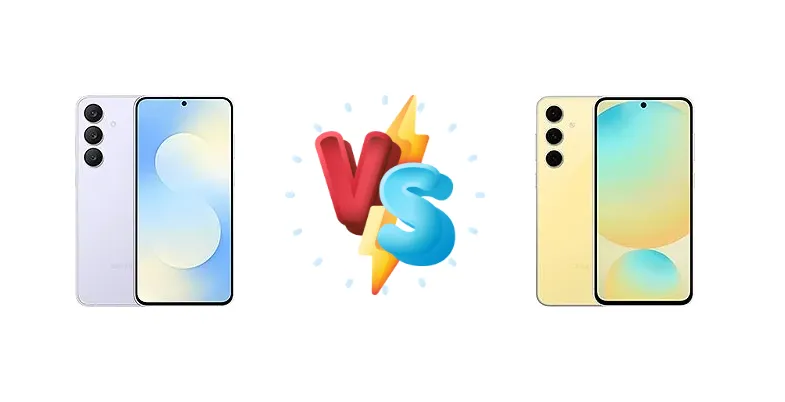
|
🏆 Quick Verdict
For most users, the Samsung Galaxy S25 FE offers a slight but noticeable advantage, primarily due to its marginally better battery endurance and potentially more sustained performance from the full Exynos 2400. However, the S24 FE remains a compelling option, especially if found at a significant discount.
| PHONES | ||
|---|---|---|
| Phone Names | Samsung Galaxy S25 FE | Samsung Galaxy S24 FE |
| Network | ||
|---|---|---|
| 2G bands | GSM 850 / 900 / 1800 / 1900 | GSM 850 / 900 / 1800 / 1900 |
| 3G bands | HSDPA 850 / 900 / 1700(AWS) / 1900 / 2100 | HSDPA 850 / 900 / 1700(AWS) / 1900 / 2100 |
| 4G bands | LTE | 1, 2, 3, 4, 5, 7, 8, 12, 17, 18, 19, 20, 25, 26, 28, 32, 38, 40, 41, 66 - International |
| 5G bands | SA/NSA/Sub6 | 1, 2, 3, 5, 7, 8, 12, 20, 25, 26, 28, 38, 40, 41, 66, 75, 77, 78 SA/NSA/Sub6 - International |
| Speed | HSPA, LTE, 5G | HSPA, LTE, 5G |
| Technology | GSM / HSPA / LTE / 5G | GSM / HSPA / LTE / 5G |
| Launch | ||
|---|---|---|
| Announced | 2025, September 04 | 2024, September 26 |
| Status | Available. Released 2025, September 04 | Available. Released 2024, October 03 |
| Body | ||
|---|---|---|
| Build | Glass front (Gorilla Glass Victus+), glass back (Gorilla Glass Victus+), aluminum frame | Glass front (Gorilla Glass Victus+), glass back (Gorilla Glass Victus+), aluminum frame |
| Dimensions | 161.3 x 76.6 x 7.4 mm (6.35 x 3.02 x 0.29 in) | 162 x 77.3 x 8 mm (6.38 x 3.04 x 0.31 in) |
| SIM | · Nano-SIM· Nano-SIM + Nano-SIM· Nano-SIM + eSIM· eSIM + eSIM | · Nano-SIM· Nano-SIM + Nano-SIM· Nano-SIM + eSIM· eSIM + eSIM |
| Weight | 190 g (6.70 oz) | 213 g (7.51 oz) |
| Display | ||
|---|---|---|
| Protection | Corning Gorilla Glass Victus+, Mohs level 5 | Corning Gorilla Glass Victus+, Mohs level 5 |
| Resolution | 1080 x 2340 pixels, 19.5:9 ratio (~385 ppi density) | 1080 x 2340 pixels, 19.5:9 ratio (~385 ppi density) |
| Size | 6.7 inches, 110.2 cm2 (~89.2% screen-to-body ratio) | 6.7 inches, 110.2 cm2 (~88.0% screen-to-body ratio) |
| Type | Dynamic LTPO AMOLED 2X, 120Hz, HDR10+, 1900 nits (peak) | Dynamic AMOLED 2X, 120Hz, HDR10+, 1900 nits (peak) |
| Platform | ||
|---|---|---|
| CPU | 10-core (1x3.2GHz Cortex-X4 & 2x2.9GHz Cortex-A720 & 3x2.6GHz Cortex-A720 & 4x1.95GHz Cortex-A520) | 10-core (1x3.1 GHz + 2x2.9 GHz + 3x2.6 GHz + 4x1.95 GHz) |
| Chipset | Exynos 2400 (4 nm) | Exynos 2400e (4 nm) |
| GPU | Xclipse 940 | Xclipse 940 |
| OS | Android 16, up to 7 major Android upgrades, One UI 8 | Android 14, up to 7 major Android upgrades, One UI 8.0 |
| Memory | ||
|---|---|---|
| Card slot | No | No |
| Internal | 128GB 8GB RAM, 256GB 8GB RAM, 512GB 8GB RAM | 128GB 8GB RAM, 256GB 8GB RAM, 512GB 8GB RAM |
| Main Camera | ||
|---|---|---|
| Features | LED flash, HDR, panorama, Best Face | LED flash, HDR, panorama |
| Triple | 50 MP, f/1.8, 24mm (wide), 1/1.57", 1.0µm, dual pixel PDAF, OIS 8 MP, f/2.4, 75mm (telephoto), 1/4.4", 1.0µm, PDAF, OIS, 3x optical zoom 12 MP, f/2.2, 13mm, 123˚ (ultrawide), 1/3.0", 1.12µm | 50 MP, f/1.8, 24mm (wide), 1/1.57", 1.0µm, dual pixel PDAF, OIS 8 MP, f/2.4, 75mm (telephoto), 1/4.4", 1.0µm, PDAF, OIS, 3x optical zoom 12 MP, f/2.2, 13mm, 123˚ (ultrawide), 1/3.0", 1.12µm |
| Video | 8K@24/30fps, 4K@30/60/120fps, 1080p@30/60/120/240fps; gyro-EIS, HDR10+ | 8K@30fps, 4K@30/60/120fps, 1080p@30/60/120/240fps |
| Selfie camera | ||
|---|---|---|
| Single | 12 MP, f/2.2, 26mm (wide), 1/3.2", 1.12µm | 10 MP, f/2.4, 26mm (wide), 1/3.0", 1.22µm |
| Video | 4K@30/60fps, 1080p@30/60fps; gyro-EIS, HDR10+ | 4K@30/60fps, 1080p@30/60fps; gyro-EIS |
| Sound | ||
|---|---|---|
| 35mm jack | No | No |
| Loudspeaker | Yes, with stereo speakers | Yes, with stereo speakers |
| Comms | ||
|---|---|---|
| Bluetooth | 5.4, A2DP, LE | 5.3, A2DP, LE |
| NFC | Yes | Yes |
| Positioning | GPS, GLONASS, GALILEO, BDS | GPS, GLONASS, GALILEO, BDS |
| Radio | No | Unspecified |
| USB | USB Type-C 3.2, OTG | USB Type-C 3.2, OTG |
| WLAN | Wi-Fi 802.11 a/b/g/n/ac/6e, dual-band or tri-band (market/region dependent), Wi-Fi Direct | Wi-Fi 802.11 a/b/g/n/ac/6e, dual-band or tri-band (market/region dependent), Wi-Fi Direct |
| Features | ||
|---|---|---|
| Sensors | Fingerprint (under display, optical), accelerometer, gyro, proximity, compass, barometer | Fingerprint (under display, optical), accelerometer, gyro, compass |
| Battery | ||
|---|---|---|
| Charging | 45W wired, PD, QC2, 65% in 30 min 15W wireless, Qi2 compatible Reverse wireless | 25W wired, PD, QC2, 50% in 30 min 15W wireless Reverse wireless |
| Type | 4900 mAh | 4700 mAh |
| Misc | ||
|---|---|---|
| Colors | Icyblue, Jetblack, Navy, White | Blue, Graphite, Gray, Mint, Yellow |
| Models | SM-S731B, SM-S731B/DS | SM-S721B, SM-S721B/DS, SM-S721U1, SM-S721U, SM-S721W, SM-S7210, SM-S721N |
| Price | $ 474.99 / C$ 664.75 / € 493.00 | $ 249.74 / C$ 498.99 / £ 335.00 / € 387.00 / ₹ 34,180 |
| SAR | - | 0.94 W/kg (head) 0.71 W/kg (body) |
| SAR EU | 0.54 W/kg (head) 1.57 W/kg (body) | 0.86 W/kg (head) 1.29 W/kg (body) |
| EU LABEL | ||
|---|---|---|
| Battery | 42:37h endurance, 2000 cycles | 42:00h endurance, 2000 cycles |
| Energy | Class B | Class B |
| Free fall | Class A (270 falls) | Class A (270 falls) |
| Repairability | Class C | Class C |
Samsung Galaxy S25 FE
- Slightly longer battery life
- Faster 45W wired charging
- Potentially better sustained performance with full Exynos 2400
- Slightly dimmer display
- May command a higher price
Samsung Galaxy S24 FE
- Brighter display for outdoor use
- Potentially lower price
- Similar core functionality to the S25 FE
- Slower 25W wired charging
- Potentially lower sustained performance with Exynos 2400e
Display Comparison
The S24 FE boasts a brighter display, reaching a measured 1372 nits compared to the S25 FE’s 1247 nits. This difference will be most apparent outdoors under direct sunlight, giving the S24 FE an edge in readability. Both displays likely utilize AMOLED technology, but Samsung doesn't specify panel type. While the S25 FE's brightness is lower, it's important to note that both are excellent, and the difference isn't massive. Color accuracy is expected to be similar, given Samsung’s track record, but independent testing would be needed to confirm.
Camera Comparison
Without detailed camera specs, it's difficult to make a definitive comparison. However, both phones likely share a similar camera system architecture. The image processing style will likely be consistent across both devices, leaning towards Samsung’s vibrant and saturated look. The absence of detailed sensor information makes it hard to assess low-light performance differences. The usefulness of the 2MP macro camera on both devices is questionable, serving more as a marketing feature than a genuinely useful tool.
Performance
Both the S25 FE and S24 FE are powered by the Exynos 2400, but the S24 FE uses the 'e' variant. The key difference lies in clock speeds; the S25 FE’s Cortex-X4 core runs at 3.2GHz, while the S24 FE’s is clocked at 3.1GHz. While seemingly minor, this, combined with potentially less aggressive power limiting on the S25 FE, could translate to slightly faster performance in CPU-intensive tasks. Both devices feature the same GPU configuration, but the S25 FE’s sustained performance is likely higher due to the full Exynos 2400. Both utilize LPDDR5x RAM, ensuring fast memory access.
Battery Life
The S25 FE edges out the S24 FE in battery endurance with 42:37 hours compared to 42:00 hours. While the difference is minimal, it’s a measurable advantage. Active use scores are also slightly better on the S25 FE (11:57h vs 11:48h). Both support 15W wireless charging and reverse wireless charging. The S25 FE’s 45W wired charging is significantly faster than the S24 FE’s 25W, achieving 65% charge in 30 minutes versus 50% for the S24 FE. This faster charging is a significant convenience factor for S25 FE users.
Buying Guide
Buy the Samsung Galaxy S25 FE if you prioritize maximizing battery life and demand the highest possible sustained performance for demanding tasks like gaming or video editing. Buy the Samsung Galaxy S24 FE if you value a brighter display for outdoor visibility and are looking for the best possible value, particularly if you can find it on sale. Both phones offer a similar core experience, but these are the key differentiators.