
Samsung Galaxy S25 FE vs. OnePlus 12R: A Deep Dive into Performance and Value
| Phones Images | |||||
|---|---|---|---|---|---|
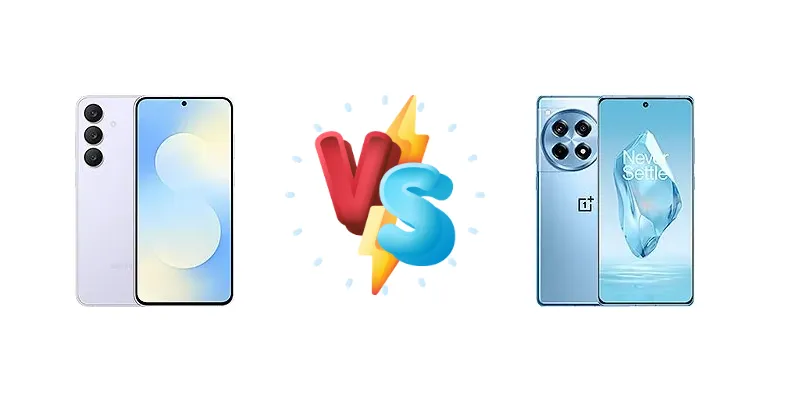
|
🏆 Quick Verdict
For the average user prioritizing all-around usability and features like wireless charging, the Samsung Galaxy S25 FE is the better choice. However, the OnePlus 12R’s superior battery endurance and significantly faster charging make it the clear winner for power users and gamers who demand maximum uptime.
| PHONES | ||
|---|---|---|
| Phone Names | Samsung Galaxy S25 FE | OnePlus 12R |
| Network | ||
|---|---|---|
| 2G bands | GSM 850 / 900 / 1800 / 1900 | GSM 850 / 900 / 1800 / 1900 |
| 3G bands | HSDPA 850 / 900 / 1700(AWS) / 1900 / 2100 | HSDPA 850 / 900 / 1700(AWS) / 1900 / 2100 |
| 4G bands | LTE | 1, 2, 3, 4, 5, 7, 8, 12, 17, 18, 19, 20, 26, 28, 32, 38, 39, 40, 41, 66 |
| 5G bands | SA/NSA/Sub6 | 1, 2, 3, 5, 7, 8, 12, 20, 28, 38, 40, 41, 66, 77, 78 SA/NSA |
| Speed | HSPA, LTE, 5G | HSPA, LTE, 5G |
| Technology | GSM / HSPA / LTE / 5G | GSM / CDMA / HSPA / LTE / 5G |
| Launch | ||
|---|---|---|
| Announced | 2025, September 04 | 2024, January 23 |
| Status | Available. Released 2025, September 04 | Available. Released 2024, February 06 |
| Body | ||
|---|---|---|
| Build | Glass front (Gorilla Glass Victus+), glass back (Gorilla Glass Victus+), aluminum frame | Glass front (Gorilla Glass Victus 2), aluminum frame, glass back |
| Dimensions | 161.3 x 76.6 x 7.4 mm (6.35 x 3.02 x 0.29 in) | 163.3 x 75.3 x 8.8 mm (6.43 x 2.96 x 0.35 in) |
| SIM | · Nano-SIM· Nano-SIM + Nano-SIM· Nano-SIM + eSIM· eSIM + eSIM | · Nano-SIM + Nano-SIM + eSIM (max 2 at a time)· Nano-SIM + Nano-SIM |
| Weight | 190 g (6.70 oz) | 207 g (7.30 oz) |
| Display | ||
|---|---|---|
| Protection | Corning Gorilla Glass Victus+, Mohs level 5 | Corning Gorilla Glass Victus 2 |
| Resolution | 1080 x 2340 pixels, 19.5:9 ratio (~385 ppi density) | 1264 x 2780 pixels (~450 ppi density) |
| Size | 6.7 inches, 110.2 cm2 (~89.2% screen-to-body ratio) | 6.78 inches, 111.7 cm2 (~90.9% screen-to-body ratio) |
| Type | Dynamic LTPO AMOLED 2X, 120Hz, HDR10+, 1900 nits (peak) | LTPO4 AMOLED, 1B colors, 120Hz, HDR10+, Dolby Vision, 1600 nits (HBM), 4500 nits (peak) |
| Platform | ||
|---|---|---|
| CPU | 10-core (1x3.2GHz Cortex-X4 & 2x2.9GHz Cortex-A720 & 3x2.6GHz Cortex-A720 & 4x1.95GHz Cortex-A520) | Octa-core (1x3.2 GHz Cortex-X3 & 2x2.8 GHz Cortex-A715 & 2x2.8 GHz Cortex-A710 & 3x2.0 GHz Cortex-A510) |
| Chipset | Exynos 2400 (4 nm) | Qualcomm SM8550-AB Snapdragon 8 Gen 2 (4 nm) |
| GPU | Xclipse 940 | Adreno 740 |
| OS | Android 16, up to 7 major Android upgrades, One UI 8 | Android 14, up to 3 major Android upgrades, OxygenOS 15 |
| Memory | ||
|---|---|---|
| Card slot | No | No |
| Internal | 128GB 8GB RAM, 256GB 8GB RAM, 512GB 8GB RAM | 128GB 8GB RAM, 256GB 8GB RAM, 256GB 12GB RAM, 256GB 16GB RAM |
| Main Camera | ||
|---|---|---|
| Features | LED flash, HDR, panorama, Best Face | Laser AF, color spectrum sensor, LED flash, HDR, panorama |
| Triple | 50 MP, f/1.8, 24mm (wide), 1/1.57", 1.0µm, dual pixel PDAF, OIS 8 MP, f/2.4, 75mm (telephoto), 1/4.4", 1.0µm, PDAF, OIS, 3x optical zoom 12 MP, f/2.2, 13mm, 123˚ (ultrawide), 1/3.0", 1.12µm | 50 MP, f/1.8, 24mm (wide), 1/1.56", 1.0µm, multi-directional PDAF, OIS 8 MP, f/2.2, 16mm, 112˚ (ultrawide), 1/4.0", 1.12µm 2 MP (macro) |
| Video | 8K@24/30fps, 4K@30/60/120fps, 1080p@30/60/120/240fps; gyro-EIS, HDR10+ | 4K@30/60fps, 1080p@30/60/120/240fps, gyro-EIS, OIS |
| Selfie camera | ||
|---|---|---|
| Features | - | HDR, panorama |
| Single | 12 MP, f/2.2, 26mm (wide), 1/3.2", 1.12µm | 16 MP, f/2.4, 26mm (wide), 1/3", 1.0µm |
| Video | 4K@30/60fps, 1080p@30/60fps; gyro-EIS, HDR10+ | 1080p@30fps, gyro-EIS |
| Sound | ||
|---|---|---|
| 35mm jack | No | No |
| Loudspeaker | Yes, with stereo speakers | Yes, with stereo speakers |
| Comms | ||
|---|---|---|
| Bluetooth | 5.4, A2DP, LE | 5.3, A2DP, LE, aptX HD |
| Infrared port | - | Yes |
| NFC | Yes | Yes |
| Positioning | GPS, GLONASS, GALILEO, BDS | GPS, GALILEO, GLONASS, BDS, QZSS |
| Radio | No | No |
| USB | USB Type-C 3.2, OTG | USB Type-C 2.0 |
| WLAN | Wi-Fi 802.11 a/b/g/n/ac/6e, dual-band or tri-band (market/region dependent), Wi-Fi Direct | Wi-Fi 802.11 a/b/g/n/ac/6/7, dual-band |
| Features | ||
|---|---|---|
| Sensors | Fingerprint (under display, optical), accelerometer, gyro, proximity, compass, barometer | Fingerprint (under display, optical), accelerometer, gyro, proximity, compass |
| Battery | ||
|---|---|---|
| Charging | 45W wired, PD, QC2, 65% in 30 min 15W wireless, Qi2 compatible Reverse wireless | 100W wired, 100% in 26 min |
| Type | 4900 mAh | Li-Ion 5500 mAh |
| Misc | ||
|---|---|---|
| Colors | Icyblue, Jetblack, Navy, White | Iron Gray, Cool Blue, Electric Violet, Sunset Dune |
| Models | SM-S731B, SM-S731B/DS | CPH2609, CPH2585, CPH2611 |
| Price | $ 474.99 / C$ 664.75 / € 493.00 | € 410.84 / $ 399.95 / £ 649.00 |
| SAR | - | 1.19 W/kg (head) 0.82 W/kg (body) |
| SAR EU | 0.54 W/kg (head) 1.57 W/kg (body) | - |
| EU LABEL | ||
|---|---|---|
| Battery | 42:37h endurance, 2000 cycles | - |
| Energy | Class B | - |
| Free fall | Class A (270 falls) | - |
| Repairability | Class C | - |
Samsung Galaxy S25 FE
- Brighter display for better outdoor visibility
- Wireless charging and reverse wireless charging support
- Samsung ecosystem integration and software features
- Slower charging speed compared to OnePlus 12R
- Potentially lower sustained performance due to Exynos chipset
OnePlus 12R
- Blazing-fast 100W wired charging
- Superior battery life for all-day use
- More efficient Snapdragon 8 Gen 2 processor
- Lacks wireless charging capabilities
- Potentially less refined software experience compared to Samsung
Display Comparison
Both devices feature displays capable of reaching high brightness levels, with the Samsung Galaxy S25 FE edging out the OnePlus 12R at 1247 nits versus 1181 nits. While the difference isn't massive, the S25 FE’s higher peak brightness will provide better visibility in direct sunlight. Neither specification details refresh rate or panel technology (LTPO), but given the FE series history, the S25 FE is likely to offer a variable refresh rate for improved efficiency. The OnePlus 12R’s display, while slightly dimmer, is still excellent and will provide a vibrant viewing experience.
Camera Comparison
Without detailed camera specifications, a direct comparison is limited. However, given the market positioning, it’s reasonable to expect both phones to feature capable camera systems. The OnePlus 12R likely prioritizes computational photography leveraging the Snapdragon’s ISP, while the S25 FE may focus on Samsung’s established image processing style. The absence of sensor size details makes it difficult to assess low-light performance, but a larger sensor generally equates to better image quality. We can assume both will include a main, ultrawide, and potentially a macro lens, though the usefulness of a 2MP macro lens on either device is questionable.
Performance
The core difference lies in the chipset: the Samsung Galaxy S25 FE utilizes the Exynos 2400, while the OnePlus 12R is powered by the Qualcomm Snapdragon 8 Gen 2. The Snapdragon 8 Gen 2, built on a 4nm process, is widely regarded as more efficient and delivers superior sustained performance due to better thermal management. The Exynos 2400’s 10-core configuration (1x3.2GHz Cortex-X4, 2x2.9GHz Cortex-A720, 3x2.6GHz Cortex-A720, 4x1.95GHz Cortex-A520) attempts to compensate with core count, but the architectural advantages of the Snapdragon 8 Gen 2 (1x3.2 GHz Cortex-X3, 2x2.8 GHz Cortex-A715, 2x2.8 GHz Cortex-A710, 3x2.0 GHz Cortex-A510) and its optimized GPU will likely translate to smoother gaming and faster processing speeds. Both utilize 4nm fabrication, but Qualcomm’s process optimization is generally more refined.
Battery Life
The OnePlus 12R dominates in charging speed with its 100W wired charging, achieving a full charge in just 26 minutes. The Samsung Galaxy S25 FE’s 45W wired charging, while respectable, takes considerably longer, reaching 65% in 30 minutes. Battery endurance is also significantly different; the OnePlus 12R boasts an active use score of 14:32h, compared to the S25 FE’s 11:57h. This suggests the Snapdragon 8 Gen 2’s efficiency and potentially a larger battery capacity (not specified) contribute to longer runtimes. The S25 FE compensates with 15W wireless charging and reverse wireless charging, features absent on the OnePlus 12R.
Buying Guide
Buy the Samsung Galaxy S25 FE if you need a well-rounded smartphone with a brighter display, wireless charging capabilities, and the broader ecosystem benefits of the Samsung brand. Buy the OnePlus 12R if you prioritize maximum battery life, incredibly fast wired charging, and raw processing power for demanding tasks like gaming, and are less concerned with wireless convenience.