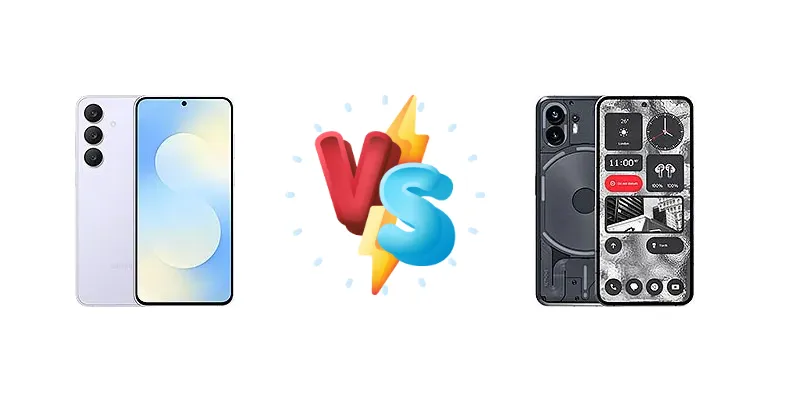
The Samsung Galaxy S25 FE aims to deliver a flagship experience at a more accessible price point, while the Nothing Phone (2) disrupts the market with its unique design and focus on software experience. This comparison dissects their core components to determine which phone offers the best value and performance for different user priorities.
🏆 Quick Verdict
For most users, the Nothing Phone (2) emerges as the stronger contender. Its Snapdragon 8+ Gen 1 provides consistently strong performance and superior battery efficiency, evidenced by its 14:21h active use score, compared to the S25 FE's 11:57h. While the S25 FE boasts a brighter display, the overall package of the Nothing Phone (2) is more compelling.
| Network |
|---|
| 2G bands | GSM 850 / 900 / 1800 / 1900 | GSM 850 / 900 / 1800 / 1900 |
| 3G bands | HSDPA 850 / 900 / 1700(AWS) / 1900 / 2100 | HSDPA 800 / 850 / 900 / 1700(AWS) / 1900 / 2100 |
| 4G bands | LTE | 1, 2, 3, 4, 5, 7, 8, 12, 17, 18, 19, 20, 25, 26, 28, 30, 32, 34, 38, 39, 40, 41, 42, 48, 66, 71 |
| 5G bands | SA/NSA/Sub6 | 1, 2, 3, 5, 7, 8, 12, 20, 25, 28, 30, 38, 40, 41, 66, 71, 75, 77, 78 SA/NSA |
| Speed | HSPA, LTE, 5G | HSPA, LTE, 5G |
| Technology | GSM / HSPA / LTE / 5G | GSM / HSPA / LTE / 5G |
| Launch |
|---|
| Announced | 2025, September 04 | 2023, July 11 |
| Status | Available. Released 2025, September 04 | Available. Released 2023, July 17 |
| Body |
|---|
| Build | Glass front (Gorilla Glass Victus+), glass back (Gorilla Glass Victus+), aluminum frame | Glass front (Gorilla Glass 5), glass back (Gorilla Glass 5), aluminum frame |
| Dimensions | 161.3 x 76.6 x 7.4 mm (6.35 x 3.02 x 0.29 in) | 162.1 x 76.4 x 8.6 mm (6.38 x 3.01 x 0.34 in) |
| SIM | · Nano-SIM· Nano-SIM + Nano-SIM· Nano-SIM + eSIM· eSIM + eSIM | Nano-SIM + Nano-SIM |
| Weight | 190 g (6.70 oz) | 201.2 g (7.09 oz) |
| Display |
|---|
| Protection | Corning Gorilla Glass Victus+, Mohs level 5 | Corning Gorilla Glass 5 |
| Resolution | 1080 x 2340 pixels, 19.5:9 ratio (~385 ppi density) | 1080 x 2412 pixels, 20:9 ratio (~394 ppi density) |
| Size | 6.7 inches, 110.2 cm2 (~89.2% screen-to-body ratio) | 6.7 inches, 108.0 cm2 (~87.2% screen-to-body ratio) |
| Type | Dynamic LTPO AMOLED 2X, 120Hz, HDR10+, 1900 nits (peak) | LTPO OLED, 1B colors, 120Hz, 1920Hz PWM, HDR10+, 1600 nits (HBM), 1600 nits (peak) |
| Platform |
|---|
| CPU | 10-core (1x3.2GHz Cortex-X4 & 2x2.9GHz Cortex-A720 & 3x2.6GHz Cortex-A720 & 4x1.95GHz Cortex-A520) | Octa-core (1x3.0 GHz Cortex-X2 & 3x2.5 GHz Cortex-A710 & 4x1.80 GHz Cortex-A510) |
| Chipset | Exynos 2400 (4 nm) | Qualcomm SM8475 Snapdragon 8+ Gen 1 (4 nm) |
| GPU | Xclipse 940 | Adreno 730 |
| OS | Android 16, up to 7 major Android upgrades, One UI 8 | Android 13, upgradable to Android 15, up to 3 major Android upgrades, Nothing OS 3.0 |
| Memory |
|---|
| Card slot | No | No |
| Internal | 128GB 8GB RAM, 256GB 8GB RAM, 512GB 8GB RAM | 128GB 8GB RAM, 256GB 12GB RAM, 512GB 12GB RAM |
| Main Camera |
|---|
| Dual | - | 50 MP, f/1.9, 24mm (wide), 1/1.56", 1.0µm, PDAF, OIS
50 MP, f/2.2, 114˚ (ultrawide), 1/2.76", 0.64µm, AF |
| Features | LED flash, HDR, panorama, Best Face | LED flash, panorama, HDR |
| Triple | 50 MP, f/1.8, 24mm (wide), 1/1.57", 1.0µm, dual pixel PDAF, OIS
8 MP, f/2.4, 75mm (telephoto), 1/4.4", 1.0µm, PDAF, OIS, 3x optical zoom
12 MP, f/2.2, 13mm, 123˚ (ultrawide), 1/3.0", 1.12µm | - |
| Video | 8K@24/30fps, 4K@30/60/120fps, 1080p@30/60/120/240fps; gyro-EIS, HDR10+ | 4K@30/60fps, 1080p@30/60fps, gyro-EIS, live HDR, OIS |
| Selfie camera |
|---|
| Features | - | HDR |
| Single | 12 MP, f/2.2, 26mm (wide), 1/3.2", 1.12µm | 32 MP, f/2.5, (wide), 1/2.74", 0.8µm |
| Video | 4K@30/60fps, 1080p@30/60fps; gyro-EIS, HDR10+ | 1080p@30fps |
| Sound |
|---|
| 35mm jack | No | No |
| Loudspeaker | Yes, with stereo speakers | Yes, with stereo speakers |
| Comms |
|---|
| Bluetooth | 5.4, A2DP, LE | 5.3, A2DP, LE, aptX HD, aptX Adaptive |
| NFC | Yes | Yes |
| Positioning | GPS, GLONASS, GALILEO, BDS | GPS (L1+L5), GLONASS (L1), BDS (B1I+B1c), GALILEO (E1), QZSS (L1), NavIC |
| Radio | No | No |
| USB | USB Type-C 3.2, OTG | USB Type-C 2.0, OTG |
| WLAN | Wi-Fi 802.11 a/b/g/n/ac/6e, dual-band or tri-band (market/region dependent), Wi-Fi Direct | Wi-Fi 802.11 a/b/g/n/ac/6, dual-band, Wi-Fi Direct |
| Features |
|---|
| Sensors | Fingerprint (under display, optical), accelerometer, gyro, proximity, compass, barometer | Fingerprint (under display, optical), accelerometer, proximity, gyro, compass |
| Battery |
|---|
| Charging | 45W wired, PD, QC2, 65% in 30 min
15W wireless, Qi2 compatible
Reverse wireless | 45W wired, PD3.0, PPS, QC4, 100% in 55 min
15W wireless, 100% in 130 min
5W reverse wireless |
| Type | 4900 mAh | Li-Ion 4700 mAh |
| Misc |
|---|
| Colors | Icyblue, Jetblack, Navy, White | White, Dark Gray |
| Models | SM-S731B, SM-S731B/DS | A065 |
| Price | $ 474.99 / C$ 664.75 / € 493.00 | $ 379.99 / £ 370.00 |
| SAR EU | 0.54 W/kg (head) 1.57 W/kg (body) | - |
| EU LABEL |
|---|
| Battery | 42:37h endurance, 2000 cycles | - |
| Energy | Class B | - |
| Free fall | Class A (270 falls) | - |
| Repairability | Class C | - |
Samsung Galaxy S25 FE
- Brighter display for outdoor visibility
- Qi2 wireless charging compatibility
- Samsung ecosystem integration
- Lower active use battery score
- Potential for Exynos throttling under heavy load
- Limited camera details provided
Nothing Phone (2)
- Superior battery life and active use score
- Snapdragon 8+ Gen 1 offers excellent performance
- Faster full charge time (55 minutes)
- Lower peak display brightness
- Unique design may not appeal to everyone
- Software experience is less mature than Samsung's One UI
Display Comparison
The Samsung Galaxy S25 FE features a display capable of reaching 1247 nits of peak brightness, offering excellent visibility in direct sunlight. However, the Nothing Phone (2) isn't far behind at 998 nits. While the S25 FE has a brightness advantage, the Nothing Phone (2)'s display quality is still very good. Neither specification details panel technology (LTPO, AMOLED), which would be a key differentiator. The S25 FE's higher peak brightness will benefit users who frequently consume HDR content outdoors.
Camera Comparison
The provided data lacks specific camera sensor details for both phones. However, the Nothing Phone (2) explicitly mentions 'Photo / Video' capabilities, suggesting a focus on overall camera performance. Without sensor size or aperture information, it's difficult to make a definitive judgment. The absence of details regarding the S25 FE's camera suggests it may not be a primary selling point. We can assume both phones will offer standard features like portrait mode and night mode, but image quality will depend heavily on the sensors and image processing algorithms.
Performance
The core difference lies in the chipsets. The Samsung Galaxy S25 FE utilizes the Exynos 2400, a 10-core processor built on a 4nm process. The Nothing Phone (2) employs the Qualcomm Snapdragon 8+ Gen 1, also 4nm. While the Exynos boasts more cores, the Snapdragon 8+ Gen 1's architecture (1x Cortex-X2, 3x Cortex-A710, 4x Cortex-A510) is optimized for sustained performance. The Snapdragon's thermal efficiency is a significant advantage, reducing the likelihood of throttling during extended gaming sessions. The S25 FE's core configuration, with a mix of Cortex-A720 and A520 cores, suggests a focus on balancing power and efficiency, but may not match the Snapdragon's peak performance.
Battery Life
The Nothing Phone (2) demonstrates superior battery performance with an active use score of 14:21h, significantly exceeding the Samsung Galaxy S25 FE's 11:57h. While the S25 FE boasts a longer endurance rating of 42:37h versus the Nothing Phone (2)'s 103h (older rating), the active use score provides a more realistic indication of real-world performance. Both support 45W wired charging, but the Nothing Phone (2) claims 100% in 55 minutes, while the S25 FE reaches 65% in 30 minutes. The Nothing Phone (2)'s faster full charge time, combined with its longer active use, makes it the clear winner in battery performance.
Buying Guide
Buy the Samsung Galaxy S25 FE if you prioritize maximum display brightness and are heavily invested in the Samsung ecosystem. The 45W charging and Qi2 compatibility are also strong points. Buy the Nothing Phone (2) if you value sustained performance, longer battery life, and a distinctive design with a clean software experience. Gamers and power users will appreciate the Snapdragon 8+ Gen 1's thermal efficiency.
Frequently Asked Questions
❓ Does the Exynos 2400 in the Galaxy S25 FE tend to overheat during prolonged gaming sessions?
While the Exynos 2400 is a powerful chip, its thermal management is a concern. The Snapdragon 8+ Gen 1 in the Nothing Phone (2) is known for its superior thermal efficiency, meaning it's less likely to throttle performance during extended gaming. Users prioritizing long gaming sessions should strongly consider the Nothing Phone (2).
❓ How does the charging speed of the Nothing Phone (2) compare to the Samsung Galaxy S25 FE in real-world usage?
The Nothing Phone (2) claims a full charge in 55 minutes with its 45W charger, while the S25 FE reaches 65% in 30 minutes. This means the Nothing Phone (2) will likely achieve a full charge faster, offering more convenience for users who need a quick top-up.
❓ Is the 2MP macro camera on either phone actually useful for taking detailed close-up photos?
Generally, 2MP macro cameras on smartphones are limited in quality. The low resolution often results in soft, grainy images. While they can be fun to experiment with, don't expect professional-level macro photography from either device. The main camera sensors are far more important for overall image quality.
❓ Does the Nothing Phone (2) support high frame rate gaming, like 90fps in PUBG Mobile?
The Snapdragon 8+ Gen 1 in the Nothing Phone (2) is capable of supporting high frame rates in demanding games like PUBG Mobile. However, achieving 90fps will depend on the game's settings and the phone's thermal conditions. The Nothing Phone (2)'s superior thermal management increases the likelihood of maintaining high frame rates for longer periods.