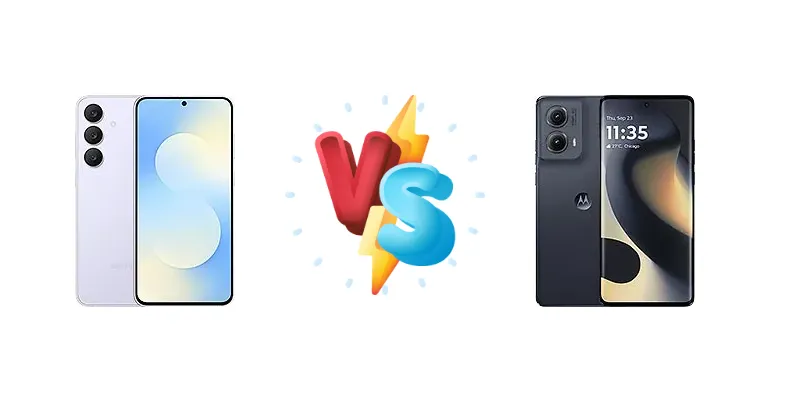
The Samsung Galaxy S25 FE aims to deliver a flagship-adjacent experience at a more accessible price point, while the Motorola Edge (2024) focuses on delivering a streamlined experience with fast charging and solid performance. This comparison dissects the core differences between these two 4nm-powered devices, focusing on where each excels and who will benefit most from their respective strengths.
🏆 Quick Verdict
For users prioritizing raw processing power and long-term battery health, the Samsung Galaxy S25 FE is the better choice. Its Exynos 2400 chipset and 2000-cycle battery promise sustained performance. However, the Motorola Edge (2024) offers a compelling alternative with significantly faster 68W charging for those who value convenience.
| Network |
|---|
| 2G bands | GSM 850 / 900 / 1800 / 1900 | GSM 850 / 900 / 1800 / 1900 |
| 3G bands | HSDPA 850 / 900 / 1700(AWS) / 1900 / 2100 | HSDPA 850 / 900 / 1700(AWS) / 1900 / 2100 |
| 4G bands | LTE | 1, 2, 3, 4, 5, 7, 8, 12, 13, 14, 17, 18, 19, 20, 25, 26, 29, 30, 38, 39, 40, 41, 48, 66, 71 |
| 5G bands | SA/NSA/Sub6 | 1, 2, 3, 5, 7, 12, 14, 20, 25, 26, 29, 30, 38, 40, 41, 48, 66, 70, 71, 77, 78 SA/NSA/Sub6 |
| Speed | HSPA, LTE, 5G | HSPA, LTE, 5G |
| Technology | GSM / HSPA / LTE / 5G | GSM / HSPA / LTE / 5G |
| Launch |
|---|
| Announced | 2025, September 04 | 2024, June 04 |
| Status | Available. Released 2025, September 04 | Available. Released 2024, June 20 |
| Body |
|---|
| Build | Glass front (Gorilla Glass Victus+), glass back (Gorilla Glass Victus+), aluminum frame | Glass front, aluminum frame, silicone polymer back (eco leather) |
| Dimensions | 161.3 x 76.6 x 7.4 mm (6.35 x 3.02 x 0.29 in) | 159.6 x 72 x 8.1 mm (6.28 x 2.83 x 0.32 in) |
| SIM | · Nano-SIM· Nano-SIM + Nano-SIM· Nano-SIM + eSIM· eSIM + eSIM | Nano-SIM + eSIM |
| Weight | 190 g (6.70 oz) | 174 g (6.14 oz) |
| Display |
|---|
| Protection | Corning Gorilla Glass Victus+, Mohs level 5 | Corning Gorilla Glass 3 |
| Resolution | 1080 x 2340 pixels, 19.5:9 ratio (~385 ppi density) | 1080 x 2400 pixels, 20:9 ratio (~402 ppi density) |
| Size | 6.7 inches, 110.2 cm2 (~89.2% screen-to-body ratio) | 6.6 inches, 103.6 cm2 (~90.2% screen-to-body ratio) |
| Type | Dynamic LTPO AMOLED 2X, 120Hz, HDR10+, 1900 nits (peak) | P-OLED, 1B colors, 144Hz, 1300 nits (peak) |
| Platform |
|---|
| CPU | 10-core (1x3.2GHz Cortex-X4 & 2x2.9GHz Cortex-A720 & 3x2.6GHz Cortex-A720 & 4x1.95GHz Cortex-A520) | Octa-core (4x2.40 GHz Cortex-A78 & 4x1.95 GHz Cortex-A55) |
| Chipset | Exynos 2400 (4 nm) | Qualcomm SM7435-AB Snapdragon 7s Gen 2 (4 nm) |
| GPU | Xclipse 940 | Adreno 710 |
| OS | Android 16, up to 7 major Android upgrades, One UI 8 | Android 14 |
| Memory |
|---|
| Card slot | No | No |
| Internal | 128GB 8GB RAM, 256GB 8GB RAM, 512GB 8GB RAM | 256GB 8GB RAM |
| Main Camera |
|---|
| Dual | - | 50 MP, f/1.8, (wide), 1/1.5", 1.0µm, multi-directional PDAF, OIS
13 MP, f/2.2, 120˚ (ultrawide), 1.12µm, AF |
| Features | LED flash, HDR, panorama, Best Face | Dual-LED flash, HDR, panorama |
| Triple | 50 MP, f/1.8, 24mm (wide), 1/1.57", 1.0µm, dual pixel PDAF, OIS
8 MP, f/2.4, 75mm (telephoto), 1/4.4", 1.0µm, PDAF, OIS, 3x optical zoom
12 MP, f/2.2, 13mm, 123˚ (ultrawide), 1/3.0", 1.12µm | - |
| Video | 8K@24/30fps, 4K@30/60/120fps, 1080p@30/60/120/240fps; gyro-EIS, HDR10+ | 4K@30fps, 1080p@30/60fps, HDR, gyro-EIS |
| Selfie camera |
|---|
| Features | - | HDR |
| Single | 12 MP, f/2.2, 26mm (wide), 1/3.2", 1.12µm | 32 MP, f/2.4, (wide), 0.7µm, AF |
| Video | 4K@30/60fps, 1080p@30/60fps; gyro-EIS, HDR10+ | 1080p@30fps |
| Sound |
|---|
| 35mm jack | No | No |
| Loudspeaker | Yes, with stereo speakers | Yes, with stereo speakers |
| Comms |
|---|
| Bluetooth | 5.4, A2DP, LE | 5.2, A2DP, LE |
| NFC | Yes | Yes |
| Positioning | GPS, GLONASS, GALILEO, BDS | GPS, GLONASS, GALILEO |
| Radio | No | No |
| USB | USB Type-C 3.2, OTG | USB Type-C 3.1, DisplayPort 1.4 |
| WLAN | Wi-Fi 802.11 a/b/g/n/ac/6e, dual-band or tri-band (market/region dependent), Wi-Fi Direct | Wi-Fi 802.11 a/b/g/n/ac/6e, tri-band, Wi-Fi Direct |
| Features |
|---|
| Sensors | Fingerprint (under display, optical), accelerometer, gyro, proximity, compass, barometer | Fingerprint (under display, optical), accelerometer, gyro, proximity, compass |
| Battery |
|---|
| Charging | 45W wired, PD, QC2, 65% in 30 min
15W wireless, Qi2 compatible
Reverse wireless | 68W wired
15W wireless |
| Type | 4900 mAh | 5000 mAh |
| Misc |
|---|
| Colors | Icyblue, Jetblack, Navy, White | Black |
| Models | SM-S731B, SM-S731B/DS | XT2405V, XT-2405V |
| Price | $ 474.99 / C$ 664.75 / € 493.00 | $ 186.72 / C$ 254.99 |
| SAR EU | 0.54 W/kg (head) 1.57 W/kg (body) | - |
| EU LABEL |
|---|
| Battery | 42:37h endurance, 2000 cycles | - |
| Energy | Class B | - |
| Free fall | Class A (270 falls) | - |
| Repairability | Class C | - |
Samsung Galaxy S25 FE
- Superior processing power with the Exynos 2400
- Exceptional battery endurance and longevity (2000 cycles)
- High peak display brightness (1247 nits)
- Slower wired charging (45W) compared to the Motorola Edge
- Samsung’s One UI can be feature-rich but also bloated for some users
Motorola Edge (2024)
- Ultra-fast 68W wired charging
- Potentially better thermal management with the Snapdragon 7s Gen 2
- Clean and streamlined Android experience
- Less powerful processor compared to the Exynos 2400
- Likely a less sophisticated camera system
Display Comparison
The Samsung Galaxy S25 FE boasts a peak brightness of 1247 nits, ensuring excellent visibility even in direct sunlight. While the Motorola Edge (2024)'s display specifications are not provided, Samsung’s history with its FE line suggests a high-quality panel. The S25 FE’s brightness advantage is significant, and the inclusion of Qi2 wireless charging adds convenience. The lack of LTPO technology in either device means refresh rate scaling will likely be less efficient than on higher-end flagships, but the S25 FE’s brightness is a clear win.
Camera Comparison
Without detailed camera specifications for either device, a direct comparison is difficult. However, given the Motorola Edge (2024)'s positioning, it's likely to feature a more modest camera system. The S25 FE, as a member of Samsung’s Galaxy S line, is expected to have a more sophisticated camera setup with features like optical image stabilization (OIS) and advanced image processing algorithms. The absence of details on the Motorola Edge (2024) suggests a focus on core functionality rather than camera innovation.
Performance
The core difference lies in the chipsets: Samsung’s Exynos 2400, a 10-core processor built on a 4nm process, versus the Motorola Edge (2024)’s Qualcomm Snapdragon 7s Gen 2. The Exynos 2400’s Cortex-X4 prime core, clocked at 3.2GHz, provides a substantial performance advantage in CPU-intensive tasks compared to the Snapdragon’s Cortex-A78 cores at 2.40 GHz. However, the Snapdragon 7s Gen 2 is known for its efficiency, potentially leading to better sustained performance under heavy load due to improved thermal management. The S25 FE’s LPDDR5x RAM (spec not provided, but expected) will further enhance multitasking capabilities.
Battery Life
The Samsung Galaxy S25 FE offers a compelling 42:37h endurance rating, backed by a battery capable of 2000 charge cycles, indicating long-term reliability. While the Motorola Edge (2024) doesn’t disclose endurance, its 68W wired charging significantly outperforms the S25 FE’s 45W charging, achieving a 65% charge in 30 minutes. This faster charging is a major advantage for users who frequently need to top up their battery. Both devices support 15W wireless charging, and the S25 FE adds reverse wireless charging for added versatility.
Buying Guide
Buy the Samsung Galaxy S25 FE if you need a phone capable of handling demanding tasks like video editing or gaming, and appreciate the longevity offered by a battery rated for 2000 charge cycles. Buy the Motorola Edge (2024) if you prioritize quick top-ups with its 68W charging and prefer a more straightforward Android experience without the extensive software features of Samsung’s One UI.
Frequently Asked Questions
❓ Does the Exynos 2400 in the Galaxy S25 FE tend to overheat during prolonged gaming sessions?
While the Exynos 2400 is a powerful chip, Samsung has made improvements to thermal management in recent generations. The 4nm process helps with efficiency, but sustained gaming will inevitably generate heat. The Motorola Edge (2024)'s Snapdragon 7s Gen 2 may exhibit less throttling due to its inherently lower power draw, but the S25 FE’s overall performance will likely remain higher even with some thermal throttling.
❓ How does the 68W charging on the Motorola Edge (2024) compare to real-world charging times?
Motorola claims a 65% charge in 30 minutes with the 68W charger. In practice, this translates to a full charge in approximately 45-60 minutes, significantly faster than the Samsung Galaxy S25 FE’s 45W charging, which will take closer to 75-90 minutes for a full charge. This makes the Edge (2024) ideal for users who need a quick power boost.
❓ Is the lack of detailed camera specs on the Motorola Edge (2024) a major drawback?
It suggests a more pragmatic approach to camera features. While it likely won't compete with flagship camera systems, the Edge (2024) will likely offer a capable camera for everyday photography. Users prioritizing advanced camera features and image quality should lean towards the Galaxy S25 FE.