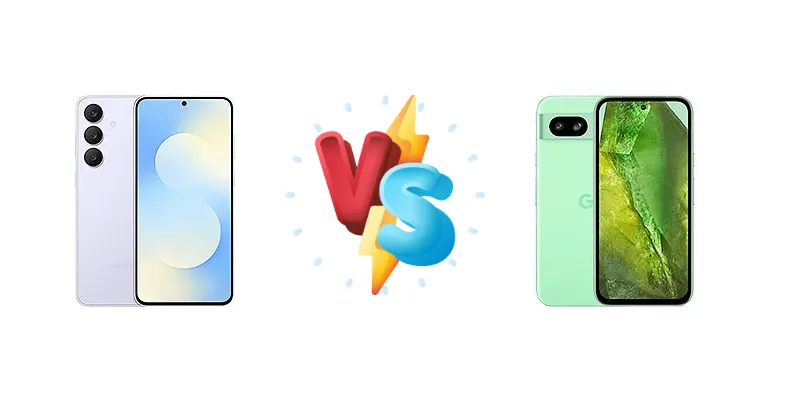
The Samsung Galaxy S25 FE and Google Pixel 8a represent compelling options in the increasingly competitive mid-range Android space. The S25 FE aims to deliver a flagship-adjacent experience with Samsung’s established hardware, while the Pixel 8a focuses on Google’s AI-powered software and camera prowess. This comparison dissects their key differences to determine which device offers the best value.
🏆 Quick Verdict
For the average user prioritizing all-around performance and longevity, the Samsung Galaxy S25 FE emerges as the winner. Its superior battery endurance (42:37h vs 40:06h) and 2000 charge cycles, coupled with the powerful Exynos 2400, provide a more robust and long-lasting experience, despite the Pixel 8a’s brighter display.
| Network |
|---|
| 2G bands | GSM 850 / 900 / 1800 / 1900 | GSM 850 / 900 / 1800 / 1900 |
| 3G bands | HSDPA 850 / 900 / 1700(AWS) / 1900 / 2100 | HSDPA 800 / 850 / 900 / 1700(AWS) / 1900 / 2100 |
| 4G bands | LTE | 1, 2, 3, 4, 5, 7, 8, 12, 17, 18, 19, 20, 26, 28, 32, 38, 40, 41, 42, 66 - G6GPR (International) |
| 5G bands | SA/NSA/Sub6 | 1, 2, 3, 5, 7, 8, 12, 20, 26, 28, 38, 40, 41, 66, 75, 76, 77, 78 SA/NSA/Sub6 - G6GPR (International) |
| Speed | HSPA, LTE, 5G | HSPA, LTE, 5G |
| Technology | GSM / HSPA / LTE / 5G | GSM / HSPA / LTE / 5G |
| Launch |
|---|
| Announced | 2025, September 04 | 2024, May 07 |
| Status | Available. Released 2025, September 04 | Available. Released 2024, May 14 |
| Body |
|---|
| Build | Glass front (Gorilla Glass Victus+), glass back (Gorilla Glass Victus+), aluminum frame | Glass front (Gorilla Glass 3), aluminum frame, plastic back |
| Dimensions | 161.3 x 76.6 x 7.4 mm (6.35 x 3.02 x 0.29 in) | 152.1 x 72.7 x 8.9 mm (5.99 x 2.86 x 0.35 in) |
| SIM | · Nano-SIM· Nano-SIM + Nano-SIM· Nano-SIM + eSIM· eSIM + eSIM | Nano-SIM + eSIM |
| Weight | 190 g (6.70 oz) | 188 g (6.63 oz) |
| Display |
|---|
| Protection | Corning Gorilla Glass Victus+, Mohs level 5 | Corning Gorilla Glass 3, Mohs level 5 |
| Resolution | 1080 x 2340 pixels, 19.5:9 ratio (~385 ppi density) | 1080 x 2400 pixels, 20:9 ratio (~430 ppi density) |
| Size | 6.7 inches, 110.2 cm2 (~89.2% screen-to-body ratio) | 6.1 inches, 90.3 cm2 (~81.6% screen-to-body ratio) |
| Type | Dynamic LTPO AMOLED 2X, 120Hz, HDR10+, 1900 nits (peak) | OLED, HDR, 120Hz, 2000 nits (peak) |
| Platform |
|---|
| CPU | 10-core (1x3.2GHz Cortex-X4 & 2x2.9GHz Cortex-A720 & 3x2.6GHz Cortex-A720 & 4x1.95GHz Cortex-A520) | Nona-core (1x3.0 GHz Cortex-X3 & 4x2.45 GHz Cortex-A715 & 4x2.15 GHz Cortex-A510) |
| Chipset | Exynos 2400 (4 nm) | Google Tensor G3 (4 nm) |
| GPU | Xclipse 940 | Immortalis-G715s MC10 |
| OS | Android 16, up to 7 major Android upgrades, One UI 8 | Android 14, upgradable to Android 16, up to 7 major Android upgrades |
| Memory |
|---|
| Card slot | No | No |
| Internal | 128GB 8GB RAM, 256GB 8GB RAM, 512GB 8GB RAM | 128GB 8GB RAM, 256GB 8GB RAM |
| Main Camera |
|---|
| Dual | - | 64 MP (16 MP eff.), f/1.9, 26mm (wide), 1/1.73", 0.8µm, dual pixel PDAF, OIS
13 MP, f/2.2, 120˚ (ultrawide), 1.12µm |
| Features | LED flash, HDR, panorama, Best Face | Dual-LED flash, Pixel Shift, Ultra HDR, panorama, Best Take |
| Triple | 50 MP, f/1.8, 24mm (wide), 1/1.57", 1.0µm, dual pixel PDAF, OIS
8 MP, f/2.4, 75mm (telephoto), 1/4.4", 1.0µm, PDAF, OIS, 3x optical zoom
12 MP, f/2.2, 13mm, 123˚ (ultrawide), 1/3.0", 1.12µm | - |
| Video | 8K@24/30fps, 4K@30/60/120fps, 1080p@30/60/120/240fps; gyro-EIS, HDR10+ | 4K@30/60fps, 1080p@30/60/120/240fps, OIS |
| Selfie camera |
|---|
| Features | - | HDR, panorama |
| Single | 12 MP, f/2.2, 26mm (wide), 1/3.2", 1.12µm | 13 MP, f/2.2, 20mm (ultrawide), 1.12µm |
| Video | 4K@30/60fps, 1080p@30/60fps; gyro-EIS, HDR10+ | 4K@30fps, 1080p@30/60fps |
| Sound |
|---|
| 35mm jack | No | No |
| Loudspeaker | Yes, with stereo speakers | Yes, with stereo speakers |
| Comms |
|---|
| Bluetooth | 5.4, A2DP, LE | 5.3, A2DP, LE |
| NFC | Yes | Yes |
| Positioning | GPS, GLONASS, GALILEO, BDS | GPS, GLONASS, GALILEO, BDS, QZSS, NavIC |
| Radio | No | No |
| USB | USB Type-C 3.2, OTG | USB Type-C 3.2 |
| WLAN | Wi-Fi 802.11 a/b/g/n/ac/6e, dual-band or tri-band (market/region dependent), Wi-Fi Direct | Wi-Fi 802.11 a/b/g/n/ac/6e, dual/tri-band (market/region dependent) |
| Features |
|---|
| Sensors | Fingerprint (under display, optical), accelerometer, gyro, proximity, compass, barometer | Fingerprint (under display, optical), accelerometer, gyro, proximity, compass, barometer |
| Battery |
|---|
| Charging | 45W wired, PD, QC2, 65% in 30 min
15W wireless, Qi2 compatible
Reverse wireless | 18W wired, PD3.0
7.5W wireless
Bypass charging |
| Type | 4900 mAh | Li-Po 4492 mAh |
| Misc |
|---|
| Colors | Icyblue, Jetblack, Navy, White | Obsidian, Porcelain, Bay, Aloe |
| Models | SM-S731B, SM-S731B/DS | GKV4X, G6GPR, G8HHN, G576D |
| Price | $ 474.99 / C$ 664.75 / € 493.00 | $ 229.98 / C$ 417.99 / £ 279.00 / € 299.99 / ₹ 33,300 |
| SAR EU | 0.54 W/kg (head) 1.57 W/kg (body) | - |
| EU LABEL |
|---|
| Battery | 42:37h endurance, 2000 cycles | 40:06h endurance, 1000 cycles |
| Energy | Class B | Class B |
| Free fall | Class A (270 falls) | Class A (270 falls) |
| Repairability | Class C | Class B |
Samsung Galaxy S25 FE
- Longer battery life and superior battery health (2000 cycles)
- Faster wired and wireless charging speeds
- Potentially better sustained performance with Exynos 2400
- Reverse wireless charging
- Lower peak display brightness
- Potential for Exynos 2400 throttling under heavy load
Google Pixel 8a
- Brighter display for outdoor visibility
- Superior computational photography and AI features
- Clean and streamlined Android experience
- Bypass charging feature
- Shorter battery life and fewer charge cycles
- Slower charging speeds
- Tensor G3 may struggle with demanding games
Display Comparison
The Pixel 8a boasts a significantly brighter display, reaching 1508 nits compared to the S25 FE’s 1247 nits. This translates to better visibility under direct sunlight. However, the S25 FE’s display technology isn’t specified, but given Samsung’s history, it likely incorporates LTPO for adaptive refresh rates, potentially improving power efficiency. While the Pixel 8a’s brightness is a clear advantage, the S25 FE’s potential for smoother scrolling and lower power consumption in certain scenarios shouldn’t be overlooked. Both devices lack information regarding PWM dimming rates, a crucial factor for users sensitive to flicker.
Camera Comparison
Both phones lack detailed camera specifications, making a direct comparison challenging. However, the Pixel 8a’s strength lies in Google’s computational photography, leveraging the Tensor G3’s AI capabilities for exceptional image processing. The S25 FE will likely rely on Samsung’s image processing algorithms, which tend to produce more vibrant, but sometimes less natural-looking, photos. Without sensor size or aperture information, it’s difficult to assess low-light performance. The absence of details regarding optical image stabilization (OIS) on either device is a significant omission. The Pixel’s software advantages are likely to be more impactful than raw hardware specs in most shooting scenarios.
Performance
The Samsung Galaxy S25 FE is powered by the Exynos 2400, a 4nm 10-core processor featuring a Cortex-X4 prime core clocked at 3.2GHz. This contrasts with the Google Pixel 8a’s Tensor G3, a 4nm nona-core chip with a Cortex-X3 prime core at 3.0GHz. While core count isn’t everything, the Exynos 2400’s architecture suggests a potential edge in sustained performance, particularly in multi-threaded tasks. The Tensor G3 excels in AI and machine learning tasks, powering features like Magic Eraser and real-time translation. However, the Exynos 2400’s more traditional CPU configuration may offer better compatibility with a wider range of applications and games. Thermal management will be key; the Exynos 2400 has historically been prone to throttling under sustained load, a potential drawback.
Battery Life
The Google Pixel 8a delivers a respectable 40:06h endurance, but the Samsung Galaxy S25 FE significantly surpasses it with 42:37h. This difference, while not massive, is noticeable in real-world usage. The S25 FE also boasts an impressive 2000 charge cycles, indicating superior long-term battery health compared to the Pixel 8a’s 1000 cycles. Charging speeds differ considerably: the S25 FE supports 45W wired charging (65% in 30 minutes) and 15W wireless charging with Qi2 compatibility, while the Pixel 8a is limited to 18W wired and 7.5W wireless. The S25 FE’s faster charging and reverse wireless capabilities provide greater convenience. The Pixel 8a’s ‘bypass charging’ feature, while useful, doesn’t compensate for the slower overall charging speed.
Buying Guide
Buy the Samsung Galaxy S25 FE if you need a phone that can handle demanding tasks, extended gaming sessions, and offers a longer lifespan with its superior battery health. Buy the Google Pixel 8a if you prioritize computational photography, a cleaner Android experience, and a brighter display for outdoor visibility, and are comfortable with a potentially shorter battery lifespan.
Frequently Asked Questions
❓ Does the Exynos 2400 chip in the S25 FE overheat during prolonged gaming sessions?
The Exynos 2400 has a history of thermal throttling under sustained load. While the 4nm process helps, demanding games may still cause performance dips after extended play. The S25 FE’s thermal management system will be crucial in mitigating this issue, but it remains a potential concern for hardcore mobile gamers.
❓ How useful is the Pixel 8a’s 7.5W wireless charging compared to the S25 FE’s 15W?
7.5W wireless charging on the Pixel 8a is significantly slower than the S25 FE’s 15W. Expect a much longer charging time wirelessly on the Pixel 8a. While convenient, wireless charging is primarily for topping up, and the S25 FE offers a more practical wireless charging experience.
❓ What is 'bypass charging' on the Pixel 8a and how does it benefit battery health?
Bypass charging on the Pixel 8a directly powers the phone when plugged in, bypassing the battery and reducing heat generation. This can theoretically help prolong battery lifespan by minimizing the amount of time the battery is exposed to heat while charging, especially during extended use.
❓ Given the lack of detailed camera specs, how do the image processing styles differ between the S25 FE and Pixel 8a?
Samsung typically produces images with more saturated colors and increased contrast, aiming for a visually appealing look. Google’s Pixel phones prioritize natural-looking images with accurate colors and excellent dynamic range, leveraging computational photography to enhance detail and reduce noise. The Pixel 8a will likely continue this trend.