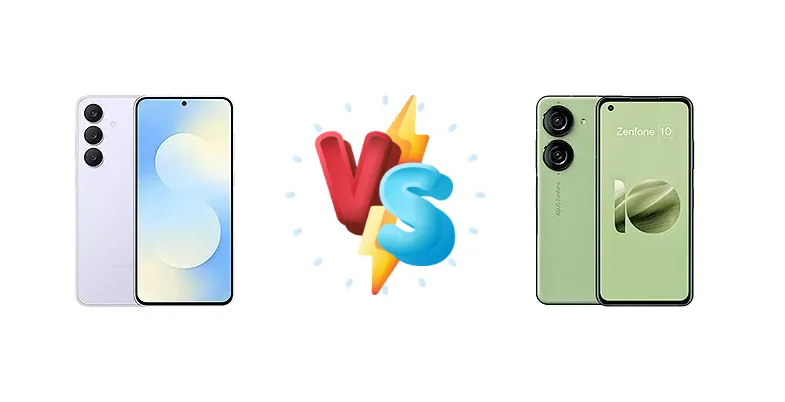
The Samsung Galaxy S25 FE aims to deliver a flagship experience at a more accessible price point, while the Asus Zenfone 10 champions a compact form factor without compromising on performance. This comparison dissects these two 4nm-based devices, focusing on where each excels and who will benefit most from their distinct approaches.
🏆 Quick Verdict
For the average user prioritizing battery life and efficient performance, the Asus Zenfone 10 is the stronger choice. Its Snapdragon 8 Gen 2 chipset delivers a superior active use score (13:05h) and likely better sustained performance, despite the S25 FE’s larger battery and faster charging.
| Network |
|---|
| 2G bands | GSM 850 / 900 / 1800 / 1900 | GSM 850 / 900 / 1800 / 1900 |
| 3G bands | HSDPA 850 / 900 / 1700(AWS) / 1900 / 2100 | HSDPA 850 / 900 / 1700(AWS) / 1800 / 1900 / 2100 |
| 4G bands | LTE | 1, 2, 3, 4, 5, 7, 8, 12, 17, 18, 19, 20, 26, 28, 34, 38, 39, 40, 41, 42 |
| 5G bands | SA/NSA/Sub6 | 1, 2, 3, 5, 7, 8, 12, 20, 28, 38, 41, 77, 78 SA/NSA |
| Speed | HSPA, LTE, 5G | HSPA, LTE, 5G |
| Technology | GSM / HSPA / LTE / 5G | GSM / HSPA / LTE / 5G |
| Launch |
|---|
| Announced | 2025, September 04 | 2023, June 29 |
| Status | Available. Released 2025, September 04 | Available. Released 2023, July 10 |
| Body |
|---|
| Build | Glass front (Gorilla Glass Victus+), glass back (Gorilla Glass Victus+), aluminum frame | Glass front, aluminum frame, plastic back |
| Dimensions | 161.3 x 76.6 x 7.4 mm (6.35 x 3.02 x 0.29 in) | 146.5 x 68.1 x 9.4 mm (5.77 x 2.68 x 0.37 in) |
| SIM | · Nano-SIM· Nano-SIM + Nano-SIM· Nano-SIM + eSIM· eSIM + eSIM | Nano-SIM + Nano-SIM |
| Weight | 190 g (6.70 oz) | 172 g (6.07 oz) |
| Display |
|---|
| Protection | Corning Gorilla Glass Victus+, Mohs level 5 | Corning Gorilla Glass Victus |
| Resolution | 1080 x 2340 pixels, 19.5:9 ratio (~385 ppi density) | 1080 x 2400 pixels, 20:9 ratio (~445 ppi density) |
| Size | 6.7 inches, 110.2 cm2 (~89.2% screen-to-body ratio) | 5.92 inches, 84.6 cm2 (~84.8% screen-to-body ratio) |
| Type | Dynamic LTPO AMOLED 2X, 120Hz, HDR10+, 1900 nits (peak) | Super AMOLED, 144Hz, HDR10+, 800 nits (HBM), 1100 nits (peak) |
| Platform |
|---|
| CPU | 10-core (1x3.2GHz Cortex-X4 & 2x2.9GHz Cortex-A720 & 3x2.6GHz Cortex-A720 & 4x1.95GHz Cortex-A520) | Octa-core (1x3.2 GHz Cortex-X3 & 2x2.8 GHz Cortex-A715 & 2x2.8 GHz Cortex-A710 & 3x2.0 GHz Cortex-A510) |
| Chipset | Exynos 2400 (4 nm) | Qualcomm SM8550-AB Snapdragon 8 Gen 2 (4 nm) |
| GPU | Xclipse 940 | Adreno 740 |
| OS | Android 16, up to 7 major Android upgrades, One UI 8 | Android 13, up to 2 major Android upgrades |
| Memory |
|---|
| Card slot | No | No |
| Internal | 128GB 8GB RAM, 256GB 8GB RAM, 512GB 8GB RAM | 128GB 8GB RAM, 256GB 8GB RAM, 256GB 16GB RAM, 512GB 16GB RAM |
| Main Camera |
|---|
| Dual | - | 50 MP, f/1.9, 24mm (wide), 1/1.56", 1.0µm, multi-directional PDAF, gimbal OIS
13 MP, f/2.2, 120° (ultrawide), 1/3.06", 1.12µm |
| Features | LED flash, HDR, panorama, Best Face | LED flash, HDR, panorama |
| Triple | 50 MP, f/1.8, 24mm (wide), 1/1.57", 1.0µm, dual pixel PDAF, OIS
8 MP, f/2.4, 75mm (telephoto), 1/4.4", 1.0µm, PDAF, OIS, 3x optical zoom
12 MP, f/2.2, 13mm, 123˚ (ultrawide), 1/3.0", 1.12µm | - |
| Video | 8K@24/30fps, 4K@30/60/120fps, 1080p@30/60/120/240fps; gyro-EIS, HDR10+ | 8K@24fps, 4K@30/60fps, 1080p@30/60fps; gyro-EIS, HDR |
| Selfie camera |
|---|
| Single | 12 MP, f/2.2, 26mm (wide), 1/3.2", 1.12µm | 32 MP, f/2.5, (wide), 1/3.2", 0.7µm |
| Video | 4K@30/60fps, 1080p@30/60fps; gyro-EIS, HDR10+ | 1080p@30fps |
| Sound |
|---|
| 35mm jack | No | Yes |
| Loudspeaker | Yes, with stereo speakers | Yes, with stereo speakers |
| Comms |
|---|
| Bluetooth | 5.4, A2DP, LE | 5.3, A2DP, LE, aptX HD, aptX Adaptive, aptX Lossless |
| NFC | Yes | Yes |
| Positioning | GPS, GLONASS, GALILEO, BDS | GPS (L1+L5), GLONASS (L1), BDS (B1I+B2a), GALILEO (E1+E5a), QZSS (L1+L5), NavIC (L5) |
| Radio | No | No |
| USB | USB Type-C 3.2, OTG | USB Type-C 2.0, OTG |
| WLAN | Wi-Fi 802.11 a/b/g/n/ac/6e, dual-band or tri-band (market/region dependent), Wi-Fi Direct | Wi-Fi 802.11 a/b/g/n/ac/6e/7, tri-band, Wi-Fi Direct |
| Features |
|---|
| Sensors | Fingerprint (under display, optical), accelerometer, gyro, proximity, compass, barometer | Fingerprint (side-mounted), accelerometer, gyro, proximity, compass |
| Battery |
|---|
| Charging | 45W wired, PD, QC2, 65% in 30 min
15W wireless, Qi2 compatible
Reverse wireless | 30W wired, PD3.0, PPS, QC4
15W wireless
5W reverse wired |
| Type | 4900 mAh | Li-Po 4300 mAh |
| Misc |
|---|
| Colors | Icyblue, Jetblack, Navy, White | Starry Blue, Midnight Black, Aurora Green, Eclipse Red, Comet White |
| Models | SM-S731B, SM-S731B/DS | AI2302 |
| Price | $ 474.99 / C$ 664.75 / € 493.00 | About 2300 EUR |
| SAR EU | 0.54 W/kg (head) 1.57 W/kg (body) | - |
| EU LABEL |
|---|
| Battery | 42:37h endurance, 2000 cycles | - |
| Energy | Class B | - |
| Free fall | Class A (270 falls) | - |
| Repairability | Class C | - |
Samsung Galaxy S25 FE
- Brighter Display (1247 nits)
- Faster Wired Charging (45W)
- Longer Battery Cycle Life (2000 cycles)
- Potentially More Thermal Throttling (Exynos 2400)
- Larger Form Factor, Less Pocketable
Asus Zenfone 10
- Superior Battery Efficiency (Snapdragon 8 Gen 2)
- Compact and Pocketable Design
- Clean Android Experience
- Dimmer Display (807 nits)
- Slower Wired Charging (30W)
Display Comparison
The Samsung Galaxy S25 FE boasts a significantly brighter display, reaching a measured 1247 nits compared to the Zenfone 10’s 807 nits. This makes the S25 FE more usable in direct sunlight. While both utilize 4nm chipsets, the Zenfone 10’s smaller screen likely contributes to its better battery endurance. We lack panel technology details (LTPO, refresh rate) for the S25 FE, but given its 'FE' positioning, it may not match the Zenfone 10 in smoothness or power efficiency. Bezels are expected to be similar, but the Zenfone 10’s compact size inherently means a higher pixel density.
Camera Comparison
Context data is limited regarding camera specifics. However, the Zenfone 10’s reputation suggests a focus on computational photography and image quality despite potentially smaller sensor sizes. The S25 FE, being a Samsung device, will likely prioritize vibrant colors and strong contrast. We can assume both will offer capable main cameras, but the Zenfone 10’s video capabilities are often highly praised. The presence of a 2MP macro camera on either device is largely irrelevant; image quality will be limited. The absence of detailed camera specs makes a definitive comparison difficult, but the Zenfone 10’s software processing is a key differentiator.
Performance
The core difference lies in the chipset: Samsung’s Exynos 2400 (10-core) versus Qualcomm’s Snapdragon 8 Gen 2 (8-core). While the Exynos has more cores, the Snapdragon 8 Gen 2’s architecture (Cortex-X3, A715, A710) is generally considered more efficient and powerful. The Zenfone 10’s active use score of 13:05h suggests superior power management. The Exynos 2400, while capable, may exhibit more thermal throttling under sustained load. Both devices likely utilize LPDDR5x RAM, but the Zenfone 10’s optimized software and chipset integration give it an edge in real-world responsiveness.
Battery Life
The Samsung Galaxy S25 FE has a larger battery, resulting in a 42:37h endurance rating. However, the Asus Zenfone 10’s Snapdragon 8 Gen 2 chipset and smaller display contribute to a surprisingly competitive active use score of 13:05h. The S25 FE offers faster 45W wired charging (65% in 30 minutes) and 15W wireless charging with Qi2 compatibility, while the Zenfone 10 tops out at 30W wired and 15W wireless. The S25 FE’s 2000 charge cycles suggest a focus on long-term battery health.
Buying Guide
Buy the Samsung Galaxy S25 FE if you prioritize a larger display, faster wired charging (45W vs 30W), and the broader ecosystem of Samsung features. Buy the Asus Zenfone 10 if you prefer a truly pocketable flagship, exceptional battery efficiency, and a clean, bloatware-free Android experience. The Zenfone 10 is ideal for one-handed use and those who value portability.
Frequently Asked Questions
❓ Does the Exynos 2400 in the S25 FE overheat during extended gaming sessions?
The Exynos 2400, while powerful, is known to generate more heat than the Snapdragon 8 Gen 2. Expect some thermal throttling during prolonged, graphically intensive gaming. The Zenfone 10’s Snapdragon 8 Gen 2 is likely to maintain higher sustained performance.
❓ Is the 15W wireless charging on both phones significantly slower than the wired options?
Yes, 15W wireless charging is considerably slower than the 45W wired charging on the S25 FE and the 30W wired charging on the Zenfone 10. Expect a full wireless charge to take several hours. Wired charging is recommended for faster top-ups.
❓ How does the Zenfone 10's smaller size impact usability for media consumption?
The Zenfone 10’s compact size may make it less ideal for extended video watching or gaming. The smaller screen requires more frequent zooming and scrolling. The S25 FE’s larger display offers a more immersive media experience.
❓ Does the Samsung Galaxy S25 FE support DeX mode for desktop-like functionality?
Given Samsung's history with the FE series, it's highly probable the S25 FE will support DeX mode, allowing you to connect the phone to a monitor and use it with a keyboard and mouse for a desktop-like experience. The Zenfone 10 does not offer a comparable feature.