
Samsung Galaxy S25 Edge vs. Sony Xperia 1 VII: A Deep Dive into Snapdragon 8 Elite Power
| Phones Images | |||||
|---|---|---|---|---|---|
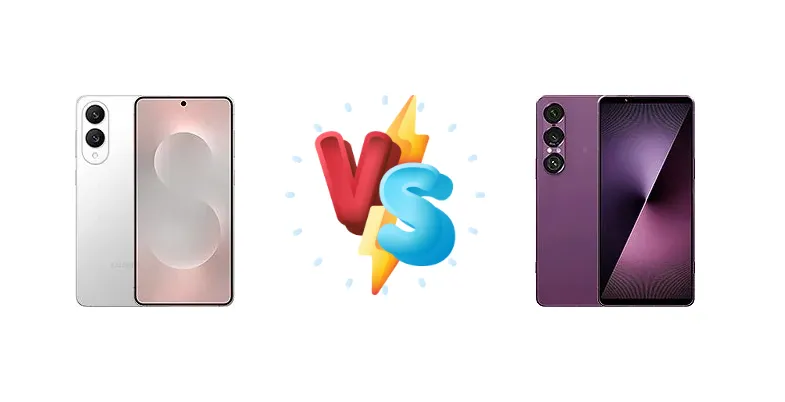
|
🏆 Quick Verdict
For the average user prioritizing responsiveness and a brighter screen, the Samsung Galaxy S25 Edge is the better choice. Its faster active use score and higher peak brightness deliver a more engaging experience. However, the Sony Xperia 1 VII’s superior battery endurance makes it ideal for power users and travelers.
| PHONES | ||
|---|---|---|
| Phone Names | Samsung Galaxy S25 Edge | Sony Xperia 1 VII |
| Network | ||
|---|---|---|
| 2G bands | GSM 850 / 900 / 1800 / 1900 | GSM 850 / 900 / 1800 / 1900 |
| 3G bands | HSDPA 850 / 900 / 1700(AWS) / 1900 / 2100 | HSDPA 800 / 850 / 900 / 1700(AWS) / 1900 / 2100 |
| 4G bands | 1, 2, 3, 4, 5, 7, 8, 12, 13, 17, 18, 19, 20, 25, 26, 28, 32, 38, 39, 40, 41, 66 - International | 1, 2, 3, 4, 5, 7, 8, 12, 13, 17, 19, 20, 25, 26, 28, 32, 34, 38, 39, 40, 41, 66 - Europe |
| 5G bands | 1, 2, 3, 5, 7, 8, 12, 20, 25, 26, 28, 38, 40, 41, 66, 75, 77, 78 SA/NSA/Sub6 - International | 1, 3, 5, 7, 8, 20, 28, 38, 40, 41, 75, 77, 78 SA/NSA/Sub6 - Europe |
| Speed | HSPA, LTE, 5G | HSPA, LTE, 5G |
| Technology | GSM / HSPA / LTE / 5G | GSM / HSPA / LTE / 5G |
| Launch | ||
|---|---|---|
| Announced | 2025, May 13 | 2025, May 13 |
| Status | Available. Released 2025, May 29 | Available. Released 2025, June 04 |
| Body | ||
|---|---|---|
| Build | Glass front (Gorilla Glass Ceramic 2), titanium frame, glass back (Gorilla Glass Victus 2) | Glass front (Gorilla Glass Victus 2), glass back (Gorilla Glass Victus), aluminum frame |
| Dimensions | 158.2 x 75.6 x 5.8 mm (6.23 x 2.98 x 0.23 in) | 162 x 74 x 8.2 mm (6.38 x 2.91 x 0.32 in) |
| SIM | · Nano-SIM + eSIM· Nano-SIM + Nano-SIM + eSIM (max 2 at a time) | · Nano-SIM + eSIM· Nano-SIM + Nano-SIM |
| Weight | 163 g (5.75 oz) | 197 g (6.95 oz) |
| Display | ||
|---|---|---|
| Protection | Corning Gorilla Glass Ceramic 2, Mohs level 5 | Corning Gorilla Glass Victus 2, Mohs level 5 |
| Resolution | 1440 x 3120 pixels, 19.5:9 ratio (~513 ppi density) | 1080 x 2340 pixels, 19.5:9 ratio (~396 ppi density) |
| Size | 6.7 inches, 110.2 cm2 (~92.1% screen-to-body ratio) | 6.5 inches, 103.7 cm2 (~86.5% screen-to-body ratio) |
| Type | LTPO AMOLED 2X, 120Hz, HDR10+ | LTPO OLED, 1B colors, 120Hz, HDR BT.2020 |
| Platform | ||
|---|---|---|
| CPU | Octa-core (2x4.47 GHz Oryon V2 Phoenix L + 6x3.53 GHz Oryon V2 Phoenix M) | Octa-core (2x4.32 GHz Oryon V2 Phoenix L + 6x3.53 GHz Oryon V2 Phoenix M) |
| Chipset | Qualcomm SM8750-AC Snapdragon 8 Elite (3 nm) | Qualcomm SM8750-AB Snapdragon 8 Elite (3 nm) |
| GPU | Adreno 830 (1200 MHz) | Adreno 830 |
| OS | Android 15, up to 7 major Android upgrades, One UI 7 | Android 15, up to 4 major Android upgrades |
| Memory | ||
|---|---|---|
| Card slot | No | microSDXC (uses shared SIM slot) |
| Internal | 256GB 12GB RAM, 512GB 12GB RAM | 256GB 12GB RAM, 512GB 12GB RAM |
| Main Camera | ||
|---|---|---|
| Dual | 200 MP, f/1.7, 24mm (wide), 1/1.3", 0.6µm, multi-directional PDAF, OIS 12 MP, f/2.2, 13mm (ultrawide), 1/2.55", 1.4µm, PDAF | - |
| Features | Best Face, LED flash, HDR, panorama | Zeiss optics, Zeiss T* lens coating, color spectrum sensor, LED flash, panorama, HDR, eye tracking |
| Triple | - | 48 MP, f/1.9, 24mm (wide), 1/1.35", 1.12µm, dual pixel PDAF, OIS 12 MP, f/2.3, 85mm (telephoto), f/3.5, 170mm (telephoto), 1/3.5", 1.0µm, dual pixel PDAF, 3.5x-7.1x continuous optical zoom, OIS, 4cm macro @ 120mm, no AF 48 MP, f/2.0, 16mm (ultrawide), 1/1.56", 1.0µm, PDAF |
| Video | 8K@30fps, 4K@30/60/120fps, 1080p@30/60/120/240fps, 10-bit HDR | 4K@24/30/60/120fps HDR, 1080p@30/60/120fps; 5-axis gyro-EIS, OIS |
| Selfie camera | ||
|---|---|---|
| Features | - | HDR |
| Single | 12 MP, f/2.2, 26mm (wide), 1/3.2", 1.12µm, dual pixel PDAF | 12 MP, f/2.0, 24mm (wide), 1/2.9", 1.22µm |
| Video | 4K@30/60fps, 1080p@30/60fps | 4K@30/60fps, 1080p@30/60fps, 5-axis gyro-EIS |
| Sound | ||
|---|---|---|
| 35mm jack | No | Yes |
| Loudspeaker | Yes, with stereo speakers | Yes, with stereo speakers |
| Comms | ||
|---|---|---|
| Bluetooth | 5.4, A2DP, LE | 6.0, A2DP, LE Audio, aptX HD, aptX Adaptive, aptX Lossless |
| NFC | Yes | Yes |
| Positioning | GPS, GLONASS, GALILEO, BDS | GPS, GLONASS, BDS, GALILEO, QZSS |
| Radio | Unspecified | No |
| USB | USB Type-C 3.2 | USB Type-C 3.2, OTG, video output |
| WLAN | Wi-Fi 802.11 a/b/g/n/ac/6/7, tri-band, Wi-Fi Direct | Wi-Fi 802.11 a/b/g/n/ac/6e/7, tri-band, Wi-Fi Direct, DLNA |
| Features | ||
|---|---|---|
| Sensors | Fingerprint (under display, ultrasonic), accelerometer, proximity, gyro, compass, barometer | Fingerprint (side-mounted), accelerometer, gyro, proximity, barometer, compass |
| Battery | ||
|---|---|---|
| Charging | 25W wired, PD, QC2.0, 55% in 30 min 15W wireless (Qi2 Ready) | 30W wired, PD3.0, PPS, 50% in 30 min 15W wireless Reverse wireless |
| Type | Li-Ion 3900 mAh | 5000 mAh |
| Misc | ||
|---|---|---|
| Colors | Titanium Icyblue, Titanium Silver, Titanium Jetblack | Moss Green, Orchid Purple, Slate Black |
| Models | SM-S937U, SM-S937U1, SM-S937B, SM-S937B/DS, SM-S9370 | XQ-FS54, XQFS54EUKCG.GC, XQFS54EUKCV.GC, XQFS54EUKCB.GC, PDX256 |
| Price | € 637.90 / $ 1,099.99 / £ 699.99 / ₹ 101,999 | € 1,338.99 / $ 1,394.99 / £ 1,149.94 |
| SAR | 1.21 W/kg (head) 1.23 W/kg (body) | - |
| SAR EU | 1.24 W/kg (head) 1.25 W/kg (body) | - |
| EU LABEL | ||
|---|---|---|
| Battery | 40:05h endurance, 2000 cycles | 43:30h endurance, 1400 cycles |
| Energy | Class A | Class B |
| Free fall | Class A (270 falls) | Class B (181 falls) |
| Repairability | Class C | Class D |
Samsung Galaxy S25 Edge
- Faster active use performance
- Brighter display for outdoor visibility
- Qi2 wireless charging support
- Shorter battery endurance
- Potentially more aggressive image processing
Sony Xperia 1 VII
- Exceptional battery endurance
- Reverse wireless charging capability
- Potentially more natural color reproduction
- Slightly slower active use performance
- Slower wired charging speed
Display Comparison
Both the S25 Edge and Xperia 1 VII boast impressive displays, achieving 1416 nits and 1475 nits peak brightness respectively. The Xperia 1 VII’s marginally brighter panel will be more visible under direct sunlight. While both likely utilize LTPO technology for adaptive refresh rates (not specified in the data, but standard for this class), the S25 Edge’s brightness advantage suggests a potentially more aggressive peak brightness curve. Color accuracy is not specified, but Sony traditionally aims for a more natural, cinematic look, while Samsung often leans towards vibrant, saturated colors.
Camera Comparison
Camera details are absent, but we can infer based on brand history. Sony typically focuses on natural color reproduction and excellent dynamic range, leveraging its expertise in image sensors. Samsung often employs more aggressive image processing, resulting in vibrant, shareable photos. The absence of sensor size data makes a direct comparison difficult, but the Xperia 1 VII’s emphasis on photography suggests a potentially larger main sensor. The lack of mention of telephoto lenses on either device is notable, suggesting a focus on primary and ultrawide capabilities.
Performance
Both devices are powered by the Qualcomm SM8750-AC/AB Snapdragon 8 Elite (3nm), featuring an octa-core CPU configuration with 2x Oryon V2 Phoenix L cores at 4.47 GHz (S25 Edge) vs 4.32 GHz (Xperia 1 VII) and 6x Oryon V2 Phoenix M cores at 3.53 GHz on both. The slightly higher clock speed on the S25 Edge’s prime cores suggests a marginal performance advantage in CPU-intensive tasks. However, the real-world difference will likely be minimal. Both devices will benefit from the 3nm process node, offering improved thermal efficiency compared to previous generations. RAM specifications are not provided, but both are expected to utilize LPDDR5x for fast memory access.
Battery Life
The Xperia 1 VII significantly outperforms the S25 Edge in battery endurance, offering 43:30h compared to the S25 Edge’s 40:05h. This translates to a substantial difference in real-world usage. The Xperia 1 VII also boasts a superior active use score of 15:32h versus 12:06h for the S25 Edge. While the S25 Edge charges faster at 25W wired (55% in 30 minutes) compared to the Xperia 1 VII’s 30W (50% in 30 minutes), the Xperia 1 VII’s larger endurance advantage likely outweighs the slightly faster charging speed for most users. The inclusion of reverse wireless charging on the Xperia 1 VII is a bonus for accessory users.
Buying Guide
Buy the Samsung Galaxy S25 Edge if you need a phone that feels incredibly fast in everyday tasks, benefits from a brighter display for outdoor visibility, and values the convenience of Qi2 wireless charging. Buy the Sony Xperia 1 VII if you prioritize all-day battery life, appreciate a more neutral color profile for media consumption, and require reverse wireless charging for accessories.