
Samsung Galaxy S25 Edge vs Oppo Find X9 Pro: A Deep Dive into Flagship Performance
| Phones Images | |||||
|---|---|---|---|---|---|
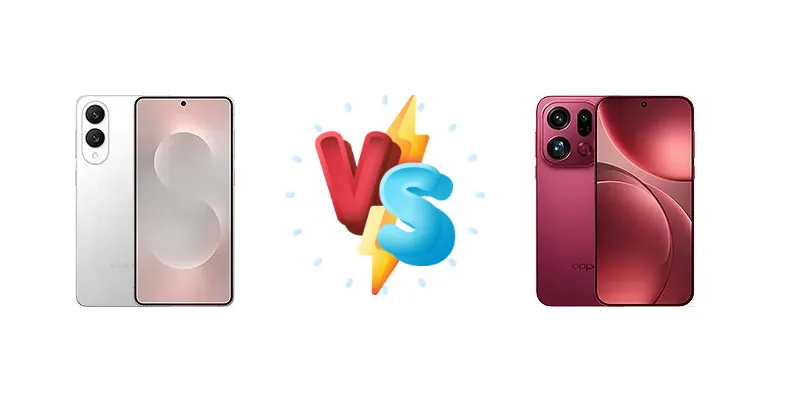
|
🏆 Quick Verdict
For the average user prioritizing all-day battery life and a balanced experience, the Oppo Find X9 Pro emerges as the winner. Its significantly longer active use score (21:57h vs 12:06h) and rapid 80W charging outweigh the S25 Edge’s slightly brighter display and Snapdragon 8 Elite’s theoretical CPU advantage.
| PHONES | ||
|---|---|---|
| Phone Names | Samsung Galaxy S25 Edge | Oppo Find X9 Pro |
| Network | ||
|---|---|---|
| 2G bands | GSM 850 / 900 / 1800 / 1900 | GSM 850 / 900 / 1800 / 1900 |
| 3G bands | HSDPA 850 / 900 / 1700(AWS) / 1900 / 2100 | HSDPA 800 / 850 / 900 / 1700(AWS) / 1900 / 2100 - International, China |
| 4G bands | 1, 2, 3, 4, 5, 7, 8, 12, 13, 17, 18, 19, 20, 25, 26, 28, 32, 38, 39, 40, 41, 66 - International | 1, 2, 3, 4, 5, 7, 8, 12, 13, 17, 18, 19, 20, 25, 26, 28, 32, 38, 39, 40, 41, 42, 48, 66, 71 - International |
| 5G bands | 1, 2, 3, 5, 7, 8, 12, 20, 25, 26, 28, 38, 40, 41, 66, 75, 77, 78 SA/NSA/Sub6 - International | 1, 2, 3, 5, 7, 8, 12, 20, 25, 26, 28, 38, 40, 41, 48, 66, 71, 75, 76, 77, 78, 79 SA/NSA - International |
| Speed | HSPA, LTE, 5G | HSPA, LTE, 5G |
| Technology | GSM / HSPA / LTE / 5G | GSM / HSPA / LTE / 5G |
| Launch | ||
|---|---|---|
| Announced | 2025, May 13 | 2025, October 16 |
| Status | Available. Released 2025, May 29 | Available. Released 2025, October 22 |
| Body | ||
|---|---|---|
| Build | Glass front (Gorilla Glass Ceramic 2), titanium frame, glass back (Gorilla Glass Victus 2) | Glass front (Gorilla Glass Victus 2), glass back, aluminum frame |
| Dimensions | 158.2 x 75.6 x 5.8 mm (6.23 x 2.98 x 0.23 in) | 161.3 x 76.5 x 8.3 mm (6.35 x 3.01 x 0.33 in) |
| SIM | · Nano-SIM + eSIM· Nano-SIM + Nano-SIM + eSIM (max 2 at a time) | · Nano-SIM + eSIM· Nano-SIM + Nano-SIM |
| Weight | 163 g (5.75 oz) | 224 g (7.90 oz) |
| Display | ||
|---|---|---|
| Protection | Corning Gorilla Glass Ceramic 2, Mohs level 5 | Corning Gorilla Glass Victus 2 |
| Resolution | 1440 x 3120 pixels, 19.5:9 ratio (~513 ppi density) | 1272 x 2772 pixels, 19.5:9 ratio (~450 ppi density) |
| Size | 6.7 inches, 110.2 cm2 (~92.1% screen-to-body ratio) | 6.78 inches, 112.4 cm2 (~91.1% screen-to-body ratio) |
| Type | LTPO AMOLED 2X, 120Hz, HDR10+ | LTPO AMOLED, 1B colors, 120Hz, 2160Hz PWM, Dolby Vision, HDR10+, HDR Vivid, 800 nits (typ), 1800 nits (HBM), 3600 nits (peak) |
| Platform | ||
|---|---|---|
| CPU | Octa-core (2x4.47 GHz Oryon V2 Phoenix L + 6x3.53 GHz Oryon V2 Phoenix M) | Octa-core (1x4.21 GHz C1-Ultra & 3x3.5 GHz C1-Premium & 4x2.7 GHz C1-Pro) |
| Chipset | Qualcomm SM8750-AC Snapdragon 8 Elite (3 nm) | Mediatek Dimensity 9500 (3 nm) |
| GPU | Adreno 830 (1200 MHz) | Arm G1-Ultra |
| OS | Android 15, up to 7 major Android upgrades, One UI 7 | Android 16, up to 5 major Android upgrades, ColorOS 16 |
| Memory | ||
|---|---|---|
| Card slot | No | No |
| Internal | 256GB 12GB RAM, 512GB 12GB RAM | 256GB 12GB RAM, 512GB 12GB RAM, 512GB 16GB RAM, 1TB 16GB RAM |
| Main Camera | ||
|---|---|---|
| Dual | 200 MP, f/1.7, 24mm (wide), 1/1.3", 0.6µm, multi-directional PDAF, OIS 12 MP, f/2.2, 13mm (ultrawide), 1/2.55", 1.4µm, PDAF | - |
| Features | Best Face, LED flash, HDR, panorama | Laser AF, color spectrum sensor, Hasselblad Color Calibration, LED flash, HDR, panorama, LUT preview |
| Triple | - | 50 MP, f/1.5, 23mm (wide), 1/1.28", 1.22µm, multi-directional PDAF, OIS 200 MP, f/2.1, 70mm (periscope telephoto), 1/1.56", 0.5µm, 3x optical zoom, multi-directional PDAF, OIS 50 MP, f/2.0, 15mm, 120˚ (ultrawide), 1/2.76", 0.64µm, multi-directional PDAF |
| Video | 8K@30fps, 4K@30/60/120fps, 1080p@30/60/120/240fps, 10-bit HDR | 4K@30/60/120fps, 1080p@30/60/240fps; gyro-EIS; HDR, 10‑bit video, Dolby Vision, LOG |
| Selfie camera | ||
|---|---|---|
| Features | - | Panorama |
| Single | 12 MP, f/2.2, 26mm (wide), 1/3.2", 1.12µm, dual pixel PDAF | 50 MP, f/2.0, 21mm (wide), 1/2.76", 0.64µm, PDAF |
| Video | 4K@30/60fps, 1080p@30/60fps | 4K@30/60fps, 1080p@30/60fps, gyro-EIS |
| Sound | ||
|---|---|---|
| 35mm jack | No | No |
| Loudspeaker | Yes, with stereo speakers | Yes, with stereo speakers |
| Comms | ||
|---|---|---|
| Bluetooth | 5.4, A2DP, LE | 6.0, A2DP, LE, aptX HD, LHDC 5 |
| Infrared port | - | Yes |
| NFC | Yes | Yes |
| Positioning | GPS, GLONASS, GALILEO, BDS | GPS (L1+L5), BDS (B1I+B1c+B2a+B2b), GALILEO (E1+E5a+E5b), QZSS (L1+L5), GLONASS, NavIC (L5) |
| Radio | Unspecified | No |
| USB | USB Type-C 3.2 | USB Type-C 3.2, OTG |
| WLAN | Wi-Fi 802.11 a/b/g/n/ac/6/7, tri-band, Wi-Fi Direct | Wi-Fi 802.11 a/b/g/n/ac/6/7, dual-band or tri-band, Wi-Fi Direct |
| Features | ||
|---|---|---|
| Sensors | Fingerprint (under display, ultrasonic), accelerometer, proximity, gyro, compass, barometer | Fingerprint (under display, ultrasonic), accelerometer, gyro, proximity, compass, barometer |
| Battery | ||
|---|---|---|
| Charging | 25W wired, PD, QC2.0, 55% in 30 min 15W wireless (Qi2 Ready) | 80W wired, 80W UFCS, 55W PPS, 11.7W PD 50W wireless 10W reverse wireless |
| Type | Li-Ion 3900 mAh | Si/C Li-Ion 7500 mAh |
| Misc | ||
|---|---|---|
| Colors | Titanium Icyblue, Titanium Silver, Titanium Jetblack | Silk White, Titanium Charcoal, Velvet Red |
| Models | SM-S937U, SM-S937U1, SM-S937B, SM-S937B/DS, SM-S9370 | CPH2791, PLG110 |
| Price | € 637.90 / $ 1,099.99 / £ 699.99 / ₹ 101,999 | $ 1,184.51 / £ 1,149.00 / ₹ 109,999 |
| SAR | 1.21 W/kg (head) 1.23 W/kg (body) | - |
| SAR EU | 1.24 W/kg (head) 1.25 W/kg (body) | - |
| EU LABEL | ||
|---|---|---|
| Battery | 40:05h endurance, 2000 cycles | - |
| Energy | Class A | - |
| Free fall | Class A (270 falls) | - |
| Repairability | Class C | - |
Samsung Galaxy S25 Edge
- Potentially higher peak CPU performance with Oryon V2 cores
- Brighter display for outdoor visibility (1416 nits)
- Qi2 wireless charging support
- Significantly shorter active use battery life (12:06h)
- Slower charging speeds (25W wired, 15W wireless)
Oppo Find X9 Pro
- Exceptional battery life (21:57h active use)
- Ultra-fast 80W wired and 50W wireless charging
- Potentially better sustained performance due to Dimensity 9500 architecture
- Lower peak display brightness (1175 nits)
- Less emphasis on raw CPU power compared to Snapdragon
Display Comparison
The Samsung Galaxy S25 Edge boasts a brighter display, reaching a measured 1416 nits, providing superior visibility in direct sunlight. However, the Oppo Find X9 Pro’s 1175 nits is still excellent. While both are likely to employ LTPO technology for adaptive refresh rates (not specified in the data), the S25 Edge’s higher peak brightness is a clear advantage for outdoor users. The absence of refresh rate data prevents a full assessment of display smoothness.
Camera Comparison
Without camera specifications, a direct comparison is limited. However, given Oppo’s history, the Find X9 Pro is likely to emphasize computational photography and AI-powered image enhancement. Samsung typically focuses on color accuracy and detail preservation. The absence of sensor size or aperture data makes it impossible to determine which device will excel in low-light conditions. We can assume both will feature advanced image stabilization (OIS) given their flagship status.
Performance
Both the Snapdragon 8 Elite in the S25 Edge and the Dimensity 9500 in the Find X9 Pro are built on a 3nm process, promising efficiency gains. However, their architectural approaches differ. The S25 Edge utilizes Qualcomm’s Oryon V2 Phoenix cores (2x4.47 GHz + 6x3.53 GHz), focusing on raw CPU power. The Find X9 Pro’s Dimensity 9500 employs a tri-cluster configuration (1x4.21 GHz + 3x3.5 GHz + 4x2.7 GHz) potentially optimizing for sustained performance and power efficiency. The S25 Edge’s Oryon cores *should* deliver higher single-core performance, but the Dimensity 9500’s architecture may excel in multi-threaded workloads and thermal management. The lack of GPU details prevents a complete performance picture.
Battery Life
The Oppo Find X9 Pro dominates in battery performance, achieving an active use score of 21:57h compared to the S25 Edge’s 12:06h. While the S25 Edge offers a respectable 40:05h endurance, this is likely a talk-time metric, and the active use score is more indicative of real-world performance. The Find X9 Pro’s charging capabilities are also significantly faster, supporting 80W wired (UFCS and PPS) and 50W wireless, compared to the S25 Edge’s 25W wired and 15W wireless (Qi2). The Find X9 Pro can reach 55% charge in 30 minutes with its wired charging, while the S25 Edge’s 25W charging will take considerably longer.
Buying Guide
Buy the Samsung Galaxy S25 Edge if you demand the absolute highest CPU performance for demanding tasks like video editing or emulation, and value a peak display brightness of 1416 nits for outdoor visibility. Buy the Oppo Find X9 Pro if you prioritize exceptional battery endurance, incredibly fast charging (80W wired, 50W wireless), and a more efficient overall power profile for everyday use.