
Samsung Galaxy S25 Edge vs. Apple iPhone 16 Pro Max: A Deep Dive Comparison
| Phones Images | |||||
|---|---|---|---|---|---|
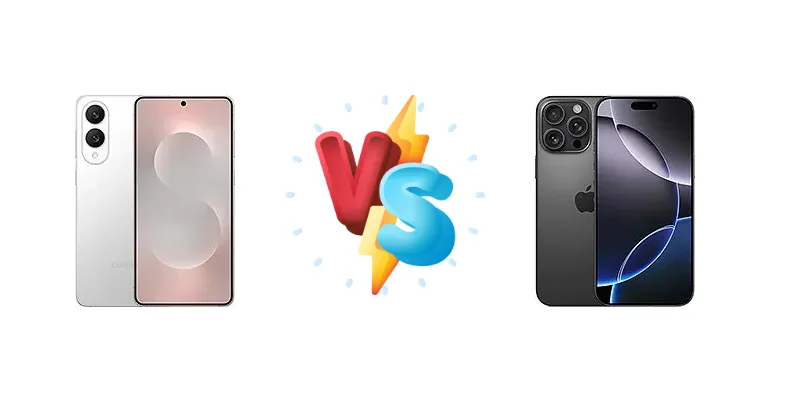
|
🏆 Quick Verdict
For the average user prioritizing longevity and a seamless ecosystem, the Apple iPhone 16 Pro Max emerges as the winner. Its significantly superior battery endurance (48:00h vs 40:05h) and active use score (17:18h vs 12:06h) outweigh the S25 Edge’s brighter display and faster 30-minute charging.
| PHONES | ||
|---|---|---|
| Phone Names | Samsung Galaxy S25 Edge | Apple iPhone 16 Pro Max |
| Network | ||
|---|---|---|
| 2G bands | GSM 850 / 900 / 1800 / 1900 | GSM 850 / 900 / 1800 / 1900 |
| 3G bands | HSDPA 850 / 900 / 1700(AWS) / 1900 / 2100 | HSDPA 850 / 900 / 1700(AWS) / 1900 / 2100 |
| 4G bands | 1, 2, 3, 4, 5, 7, 8, 12, 13, 17, 18, 19, 20, 25, 26, 28, 32, 38, 39, 40, 41, 66 - International | 1, 2, 3, 4, 5, 7, 8, 12, 13, 17, 18, 19, 20, 25, 26, 28, 30, 32, 34, 38, 39, 40, 41, 42, 48, 53, 66 - A3296 |
| 5G bands | 1, 2, 3, 5, 7, 8, 12, 20, 25, 26, 28, 38, 40, 41, 66, 75, 77, 78 SA/NSA/Sub6 - International | 1, 2, 3, 5, 7, 8, 12, 20, 25, 26, 28, 30, 38, 40, 41, 48, 53, 66, 70, 75, 76, 77, 78, 79 SA/NSA/Sub6 - A3296 |
| Speed | HSPA, LTE, 5G | HSPA, LTE, 5G, EV-DO Rev.A 3.1 Mbps |
| Technology | GSM / HSPA / LTE / 5G | GSM / CDMA / HSPA / EVDO / LTE / 5G |
| Launch | ||
|---|---|---|
| Announced | 2025, May 13 | 2024, September 09 |
| Status | Available. Released 2025, May 29 | Available. Released 2024, September 20 |
| Body | ||
|---|---|---|
| Build | Glass front (Gorilla Glass Ceramic 2), titanium frame, glass back (Gorilla Glass Victus 2) | Glass front (Ceramic Shield), glass back, titanium frame (grade 5) |
| Dimensions | 158.2 x 75.6 x 5.8 mm (6.23 x 2.98 x 0.23 in) | 163 x 77.6 x 8.3 mm (6.42 x 3.06 x 0.33 in) |
| SIM | · Nano-SIM + eSIM· Nano-SIM + Nano-SIM + eSIM (max 2 at a time) | · Nano-SIM + eSIM + eSIM (max 2 at a time; International)· eSIM + eSIM (8 or more, max 2 at a time; USA)· Nano-SIM + Nano-SIM (China) |
| Weight | 163 g (5.75 oz) | 227 g (8.01 oz) |
| Display | ||
|---|---|---|
| Protection | Corning Gorilla Glass Ceramic 2, Mohs level 5 | Ceramic Shield glass (2024 gen), Mohs level 4 |
| Resolution | 1440 x 3120 pixels, 19.5:9 ratio (~513 ppi density) | 1320 x 2868 pixels, 19.5:9 ratio (~460 ppi density) |
| Size | 6.7 inches, 110.2 cm2 (~92.1% screen-to-body ratio) | 6.9 inches, 115.6 cm2 (~91.4% screen-to-body ratio) |
| Type | LTPO AMOLED 2X, 120Hz, HDR10+ | LTPO Super Retina XDR OLED, 120Hz, HDR10, Dolby Vision, 1000 nits (typ), 2000 nits (HBM) |
| Platform | ||
|---|---|---|
| CPU | Octa-core (2x4.47 GHz Oryon V2 Phoenix L + 6x3.53 GHz Oryon V2 Phoenix M) | Hexa-core (2x4.05 GHz + 4x2.42 GHz) |
| Chipset | Qualcomm SM8750-AC Snapdragon 8 Elite (3 nm) | Apple A18 Pro (3 nm) |
| GPU | Adreno 830 (1200 MHz) | Apple GPU (6-core graphics) |
| OS | Android 15, up to 7 major Android upgrades, One UI 7 | iOS 18, upgradable to iOS 26.1 |
| Memory | ||
|---|---|---|
| Card slot | No | No |
| Internal | 256GB 12GB RAM, 512GB 12GB RAM | 256GB 8GB RAM, 512GB 8GB RAM, 1TB 8GB RAM |
| Main Camera | ||
|---|---|---|
| Dual | 200 MP, f/1.7, 24mm (wide), 1/1.3", 0.6µm, multi-directional PDAF, OIS 12 MP, f/2.2, 13mm (ultrawide), 1/2.55", 1.4µm, PDAF | - |
| Features | Best Face, LED flash, HDR, panorama | Dual-LED dual-tone flash, HDR (photo/panorama) |
| Triple | - | 48 MP, f/1.8, 24mm (wide), 1/1.28", 1.22µm, dual pixel PDAF, sensor-shift OIS 12 MP, f/2.8, 120mm (periscope telephoto), 1/3.06", 1.12µm, dual pixel PDAF, 3D sensor‑shift OIS, 5x optical zoom 48 MP, f/2.2, 13mm (ultrawide), 1/2.55", 0.7µm, PDAF TOF 3D LiDAR scanner (depth) |
| Video | 8K@30fps, 4K@30/60/120fps, 1080p@30/60/120/240fps, 10-bit HDR | 4K@24/25/30/60/100/120fps, 1080p@25/30/60/120/240fps, 10-bit HDR, Dolby Vision HDR (up to 60fps), ProRes, 3D (spatial) video/audio, stereo sound rec. |
| Selfie camera | ||
|---|---|---|
| Features | - | HDR, Dolby Vision HDR, 3D (spatial) audio, stereo sound rec. |
| Single | 12 MP, f/2.2, 26mm (wide), 1/3.2", 1.12µm, dual pixel PDAF | 12 MP, f/1.9, 23mm (wide), 1/3.6", 1.0µm, PDAF, OIS SL 3D, (depth/biometrics sensor) |
| Video | 4K@30/60fps, 1080p@30/60fps | 4K@24/25/30/60fps, 1080p@25/30/60/120fps, gyro-EIS |
| Sound | ||
|---|---|---|
| 35mm jack | No | No |
| Loudspeaker | Yes, with stereo speakers | Yes, with stereo speakers |
| Comms | ||
|---|---|---|
| Bluetooth | 5.4, A2DP, LE | 5.3, A2DP, LE |
| NFC | Yes | Yes |
| Positioning | GPS, GLONASS, GALILEO, BDS | GPS (L1+L5), GLONASS, GALILEO, BDS, QZSS, NavIC |
| Radio | Unspecified | No |
| USB | USB Type-C 3.2 | USB Type-C 3.2 Gen 2, DisplayPort |
| WLAN | Wi-Fi 802.11 a/b/g/n/ac/6/7, tri-band, Wi-Fi Direct | Wi-Fi 802.11 a/b/g/n/ac/6e/7, tri-band, hotspot |
| Features | ||
|---|---|---|
| Sensors | Fingerprint (under display, ultrasonic), accelerometer, proximity, gyro, compass, barometer | Face ID, accelerometer, gyro, proximity, compass, barometer |
| Battery | ||
|---|---|---|
| Charging | 25W wired, PD, QC2.0, 55% in 30 min 15W wireless (Qi2 Ready) | Wired, PD2.0, 50% in 30 min 25W wireless (MagSafe), 15W wireless (China only) 15W wireless (Qi2) 4.5W reverse wired |
| Type | Li-Ion 3900 mAh | Li-Ion 4685 mAh |
| Misc | ||
|---|---|---|
| Colors | Titanium Icyblue, Titanium Silver, Titanium Jetblack | Black Titanium, White Titanium, Natural Titanium, Desert Titanium |
| Models | SM-S937U, SM-S937U1, SM-S937B, SM-S937B/DS, SM-S9370 | A3296, A3084, A3295, A3297, iPhone17,2 |
| Price | € 637.90 / $ 1,099.99 / £ 699.99 / ₹ 101,999 | $ 724.88 / C$ 1,405.46 / £ 864.49 / € 955.00 |
| SAR | 1.21 W/kg (head) 1.23 W/kg (body) | 1.01 W/kg (head) 1.15 W/kg (body) |
| SAR EU | 1.24 W/kg (head) 1.25 W/kg (body) | 1.22 W/kg (head) 1.45 W/kg (body) |
| EU LABEL | ||
|---|---|---|
| Battery | 40:05h endurance, 2000 cycles | 48:00h endurance, 1000 cycles |
| Energy | Class A | Class B |
| Free fall | Class A (270 falls) | Class C (90 falls) |
| Repairability | Class C | Class C |
Samsung Galaxy S25 Edge
- Brighter display for outdoor use
- Faster wired charging (25W)
- Android OS flexibility and customization
- Shorter battery life and endurance
- Potential for accidental touches with curved screen
- Software updates may be less consistent than iOS
Apple iPhone 16 Pro Max
- Exceptional battery life and endurance
- Seamless iOS ecosystem integration
- Optimized performance and software synergy
- Less flexible operating system (iOS)
- Slower wired charging compared to S25 Edge
- MagSafe charging is proprietary
Display Comparison
The iPhone 16 Pro Max boasts a significantly brighter display, reaching 1796 nits measured, compared to the Galaxy S25 Edge’s 1416 nits. This difference is immediately noticeable in direct sunlight. While both support Qi2 wireless charging, the iPhone’s display technology likely leverages advancements in OLED efficiency to contribute to its superior battery life. We expect both to utilize LTPO technology for adaptive refresh rates, but Apple’s calibration and color accuracy are historically more consistent. The Edge display on the Samsung, while visually striking, may introduce accidental touches, a common drawback of curved screens.
Camera Comparison
Without specific camera specs, we can infer that both flagships will feature advanced camera systems. However, Apple typically focuses on computational photography and consistent image processing, while Samsung often emphasizes hardware specifications like sensor size and resolution. The iPhone 16 Pro Max will likely continue to excel in video recording, leveraging Apple’s ProRes codec. The S25 Edge may offer more versatility with features like Space Zoom, but image quality will depend heavily on software optimization. We anticipate both will feature robust optical image stabilization (OIS) systems.
Performance
Both devices are powered by 3nm chipsets, but their architectures differ significantly. The Samsung Galaxy S25 Edge utilizes the Qualcomm SM8750-AC Snapdragon 8 Elite with an octa-core CPU configuration (2x4.47 GHz Oryon V2 Phoenix L + 6x3.53 GHz Oryon V2 Phoenix M), emphasizing a split core design for performance and efficiency. Apple’s A18 Pro, a hexa-core processor (2x4.05 GHz + 4x2.42 GHz), prioritizes single-core performance, a metric where Apple traditionally excels. While core count isn’t everything, the A18 Pro’s optimized architecture and tight software integration will likely translate to smoother performance in demanding tasks. The Snapdragon 8 Elite’s thermal management will be crucial, as sustained performance depends on efficient heat dissipation.
Battery Life
The iPhone 16 Pro Max delivers a substantial advantage in battery endurance, offering 48:00h compared to the Galaxy S25 Edge’s 40:05h. This translates to a 17:18h active use score for the iPhone versus 12:06h for the Samsung. While the S25 Edge supports faster 25W wired charging (reaching 55% in 30 minutes), the iPhone 16 Pro Max achieves 50% charge in the same timeframe. The iPhone also offers 25W MagSafe wireless charging, a convenient feature, and 15W Qi2 wireless charging. The S25 Edge also supports 15W Qi2, but the iPhone’s superior battery capacity and efficiency provide a more significant real-world benefit.
Buying Guide
Buy the Samsung Galaxy S25 Edge if you need maximum display brightness for outdoor visibility, prefer the flexibility of the Android operating system, and value faster wired charging speeds. Buy the Apple iPhone 16 Pro Max if you prioritize all-day battery life, a tightly integrated ecosystem, and consistently optimized performance through Apple’s silicon and software synergy.