
Samsung Galaxy S24 vs. Xiaomi 14T Pro: A Deep Dive into Flagship Performance and Value
| Phones Images | |||||
|---|---|---|---|---|---|
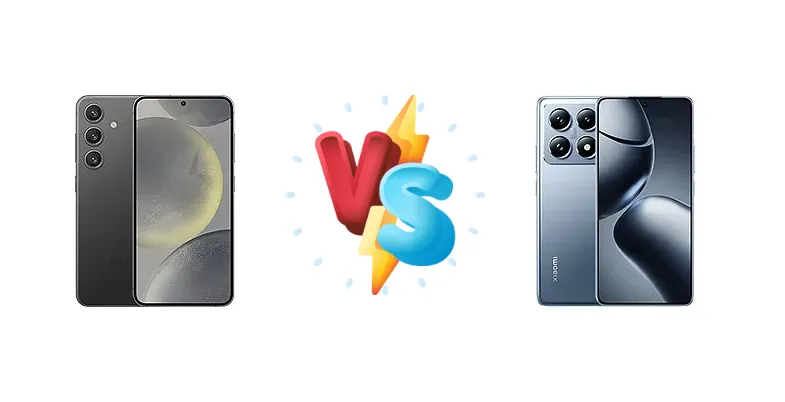
|
🏆 Quick Verdict
For most users, the Xiaomi 14T Pro offers a compelling package with faster charging (120W vs 25W) and slightly better battery life (12:32h vs 12:06h) at a potentially lower price point. However, the Galaxy S24’s brand recognition and potentially more refined software experience may appeal to some.
| PHONES | ||
|---|---|---|
| Phone Names | Samsung Galaxy S24 | Xiaomi 14T Pro |
| Network | ||
|---|---|---|
| 2G bands | GSM 850 / 900 / 1800 / 1900 | GSM 850 / 900 / 1800 / 1900 |
| 3G bands | HSDPA 850 / 900 / 1700(AWS) / 1900 / 2100 | HSDPA 800 / 850 / 900 / 1700(AWS) / 1900 / 2100 |
| 4G bands | 1, 2, 3, 4, 5, 7, 8, 12, 13, 17, 18, 19, 20, 25, 26, 28, 32, 38, 39, 40, 41, 66 - International | 1, 2, 3, 4, 5, 7, 8, 12, 13, 17, 18, 19, 20, 25, 26, 28, 32, 38, 39, 40, 41, 42, 48, 66 |
| 5G bands | 1, 2, 3, 5, 7, 8, 12, 20, 25, 26, 28, 38, 40, 41, 66, 75, 77, 78 SA/NSA/Sub6 - International | 1, 2, 3, 5, 7, 8, 12, 20, 25, 26, 28, 38, 40, 41, 48, 66, 75, 77, 78 SA/NSA |
| Speed | HSPA, LTE (up to 7CA), 5G | HSPA, LTE, 5G |
| Technology | GSM / CDMA / HSPA / EVDO / LTE / 5G | GSM / HSPA / LTE / 5G |
| Launch | ||
|---|---|---|
| Announced | 2024, January 17 | 2024, September 26 |
| Status | Available. Released 2024, January 24 | Available. Released 2024, September 26 |
| Body | ||
|---|---|---|
| Build | Glass front (Gorilla Glass Victus 2), glass back (Gorilla Glass Victus 2), aluminum frame | Glass front (Gorilla Glass 5), aluminum frame, glass back (Panda X) |
| Dimensions | 147 x 70.6 x 7.6 mm (5.79 x 2.78 x 0.30 in) | 160.4 x 75.1 x 8.4 mm (6.31 x 2.96 x 0.33 in) |
| SIM | · Nano-SIM + Nano-SIM + eSIM + eSIM (max 2 at a time) - INT· Nano-SIM + eSIM + eSIM (max 2 at a time) - USA· Nano-SIM + Nano-SIM - CN | · Nano-SIM + eSIM· eSIM + eSIM· Nano-SIM + Nano-SIM |
| Weight | 167 g or 168 g (5.89 oz) | 209 g (7.37 oz) |
| Display | ||
|---|---|---|
| Protection | Corning Gorilla Glass Victus 2 | Corning Gorilla Glass 5 |
| Resolution | 1080 x 2340 pixels, 19.5:9 ratio (~416 ppi density) | 1220 x 2712 pixels, 20:9 ratio (~446 ppi density) |
| Size | 6.2 inches, 94.4 cm2 (~90.9% screen-to-body ratio) | 6.67 inches, 107.4 cm2 (~89.1% screen-to-body ratio) |
| Type | Dynamic LTPO AMOLED 2X, 120Hz, HDR10+, 2600 nits (peak) | AMOLED, 68B colors, 144Hz, 3840Hz PWM, Dolby Vision, HDR10+, 1600 nits (HBM), 4000 nits (peak) |
| Platform | ||
|---|---|---|
| CPU | 8-core (1x3.39GHz Cortex-X4 & 3x3.1GHz Cortex-A720 & 2x2.9GHz Cortex-A720 & 2x2.2GHz Cortex-A520)10-core (1x3.2GHz Cortex-X4 & 2x2.9GHz Cortex-A720 & 3x2.6GHz Cortex-A720 & 4x1.95GHz Cortex-A520) | Octa-core (1x3.4 GHz Cortex-X4 & 3x2.85 GHz Cortex-X4 & 4x2.0 GHz Cortex-A720) |
| Chipset | Qualcomm SM8650-AC Snapdragon 8 Gen 3 (4 nm) - USA/Canada/ChinaExynos 2400 (4 nm) - International | Mediatek Dimensity 9300+ (4 nm) |
| GPU | Adreno 750 (1 GHz) - USA/Canada/ChinaXclipse 940 - International | Immortalis-G720 MC12 |
| OS | Android 14, up to 7 major Android upgrades, One UI 8.0 | Android 14, HyperOS |
| Memory | ||
|---|---|---|
| Card slot | No | No |
| Internal | 128GB 8GB RAM, 256GB 8GB RAM, 256GB 12GB RAM, 512GB 8GB RAM | 256GB 12GB RAM, 512GB 12GB RAM, 512GB 16GB RAM, 1TB 12GB RAM |
| Main Camera | ||
|---|---|---|
| Features | LED flash, auto-HDR, panorama | Leica lens, Ultra HDR, LED flash, HDR, panorama |
| Triple | 50 MP, f/1.8, 24mm (wide), 1/1.56", 1.0µm, dual pixel PDAF, OIS 10 MP, f/2.4, 67mm (telephoto), 1/3.94", 1.0µm, PDAF, OIS, 3x optical zoom 12 MP, f/2.2, 13mm, 120˚ (ultrawide), 1/2.55" 1.4µm, Super Steady video | 50 MP, f/1.6, 23mm (wide), 1/1.31", 1.2µm, PDAF, OIS 50 MP, f/2.0, 60mm (telephoto), 1/2.88", 0.61µm, PDAF, 2.6x optical zoom 12 MP, f/2.2, 15mm (ultrawide), 1/3.06", 1.12µm |
| Video | 8K@24/30fps, 4K@30/60fps, 1080p@30/60/120/240fps, HDR10+, stereo sound rec., gyro-EIS | 8K@24/30fps, 4K@24/30/60fps, 1080p@30/60/120/240/960fps, gyro-EIS, 10-bit Rec. 2020, HDR10+ |
| Selfie camera | ||
|---|---|---|
| Features | HDR, HDR10+ | HDR |
| Single | 12 MP, f/2.2, 26mm (wide), 1/3.2", 1.12µm, dual pixel PDAF | 32 MP, f/2.0, 25mm (wide), 1/3.44", 0.64µm |
| Video | 4K@30/60fps, 1080p@30fps | 4K@30fps, 1080p@30/60fps, HDR10+ |
| Sound | ||
|---|---|---|
| 35mm jack | No | No |
| Loudspeaker | Yes, with stereo speakers | Yes, with stereo speakers |
| Comms | ||
|---|---|---|
| Bluetooth | 5.3, A2DP, LE | 5.4, A2DP, LE, LHDC |
| Infrared port | - | Yes |
| NFC | Yes | Yes (market/region dependent) |
| Positioning | GPS, GLONASS, BDS, GALILEO, QZSS | GPS (L1+L5), BDS (B1I+B1C+B2a+B2b), GALILEO (E1+E5a+E5b), QZSS (L1+L5), NavIC (L5), GLONASS |
| Radio | No | No |
| USB | USB Type-C 3.2, DisplayPort 1.2, OTG | USB Type-C 2.0, OTG |
| WLAN | Wi-Fi 802.11 a/b/g/n/ac/6e, tri-band, Wi-Fi Direct | Wi-Fi 802.11 a/b/g/n/ac/6e/7, dual-band, Wi-Fi Direct |
| Features | ||
|---|---|---|
| Sensors | Fingerprint (under display, ultrasonic), accelerometer, gyro, proximity, compass, barometer | Fingerprint (under display, optical), accelerometer, gyro, proximity, compass |
| Battery | ||
|---|---|---|
| Charging | 25W wired, PD3.0, 50% in 30 min 15W wireless (Qi) 4.5W reverse wireless | 120W wired, PD3.0, QC4, 100% in 19 min 50W wireless, 100% in 45 min |
| Type | Li-Ion 4000 mAh | Li-Po 5000 mAh |
| Misc | ||
|---|---|---|
| Colors | Onyx Black, Marble Grey, Cobalt Violet, Amber Yellow, Jade Green, Sandstone Orange, Sapphire Blue | Titan Gray, Titan Blue, Titan Black |
| Models | SM-S921B, SM-S921B/DS, SM-S921U, SM-S921U1, SM-S921W, SM-S921N, SM-S9210, SM-S921E, SM-S921E/DS | 2407FPN8EG |
| Price | € 454.76 / $ 299.99 / £ 340.99 / ₹ 39,999 | $ 550.00 / £ 498.00 / € 539.99 |
| SAR | 1.23 W/kg (head) 1.10 W/kg (body) | - |
| SAR EU | 0.87 W/kg (head) 1.35 W/kg (body) | 0.99 W/kg (head) 1.00 W/kg (body) |
Samsung Galaxy S24
- Brighter display for outdoor visibility (1401 nits)
- Potentially more refined software experience (One UI)
- Compact form factor (implied)
- Significantly slower charging (25W)
- Potential for Exynos throttling (International models)
- Likely higher price
Xiaomi 14T Pro
- Blazing-fast 120W wired charging (100% in 19 min)
- Slightly longer battery life (12:32h active use)
- Potentially better raw performance (Dimensity 9300+)
- Lower peak display brightness (1228 nits)
- MIUI software may not appeal to all users
- Camera performance potentially less consistent
Display Comparison
Both devices feature excellent displays, but with key differences. The Galaxy S24 reaches a measured peak brightness of 1401 nits, surpassing the Xiaomi 14T Pro’s 1228 nits, making it more visible outdoors in direct sunlight. While both are 4nm, the S24's display tech is likely LTPO, enabling variable refresh rates for improved efficiency. The Xiaomi 14T Pro doesn't explicitly state LTPO, potentially leading to slightly higher power consumption. The S24's smaller size (not specified in data, but known) also contributes to a higher pixel density, resulting in a sharper image.
Camera Comparison
Detailed camera analysis is limited by the provided data. Both phones are described as having 'Photo / Video' capabilities, lacking specifics on sensor size or megapixel count. However, the Xiaomi 14T Pro’s aggressive pricing suggests a potential compromise in camera hardware compared to the S24. The S24, being a flagship, likely benefits from more advanced image processing algorithms and potentially larger sensors for improved low-light performance. The absence of details on OIS (Optical Image Stabilization) makes it difficult to assess video stabilization capabilities. We can assume both phones will offer a range of shooting modes, but the S24 is likely to deliver more consistent results across various conditions.
Performance
The performance battle is nuanced. The Xiaomi 14T Pro utilizes the MediaTek Dimensity 9300+, featuring a unique core configuration with multiple Cortex-X4 cores (1x3.4 GHz & 3x2.85 GHz). This contrasts with the Galaxy S24’s chipset options: the Snapdragon 8 Gen 3 (USA/Canada/China) and the Exynos 2400 (International). The Dimensity 9300+’s architecture prioritizes peak performance, while the Snapdragon 8 Gen 3 is known for its balance of power and efficiency. The Exynos 2400, historically, has lagged behind the Snapdragon in thermal management, potentially leading to more throttling under sustained load. Both phones utilize 4nm fabrication, but the core design and implementation dictate real-world performance differences. The S24's CPU has a more varied core setup (8-core vs 8-core) which may affect multi-tasking.
Battery Life
The Xiaomi 14T Pro boasts a significant advantage in charging speed with its 120W wired charging, achieving a full charge in just 19 minutes. The Galaxy S24’s 25W charging takes approximately 30 minutes to reach 50% and considerably longer for a full charge. Despite a slightly lower active use battery score (12:06h vs 12:32h), the 14T Pro’s faster charging mitigates range anxiety. The 14T Pro also offers 50W wireless charging, significantly faster than the S24’s 15W wireless charging. The S24 includes 4.5W reverse wireless charging, a niche feature for charging accessories, while the 14T Pro lacks this capability.
Buying Guide
Buy the Samsung Galaxy S24 if you prioritize a well-established ecosystem, guaranteed software updates, and a more compact form factor. You'll benefit from Samsung's DeX mode and potentially a more polished camera experience. Buy the Xiaomi 14T Pro if you value raw performance, incredibly fast charging, and a longer-lasting battery, and are comfortable with Xiaomi’s MIUI software.