
Samsung Galaxy S24 vs. Sony Xperia 1 VII: The Ultimate Android Flagship Battle
| Phones Images | |||||
|---|---|---|---|---|---|
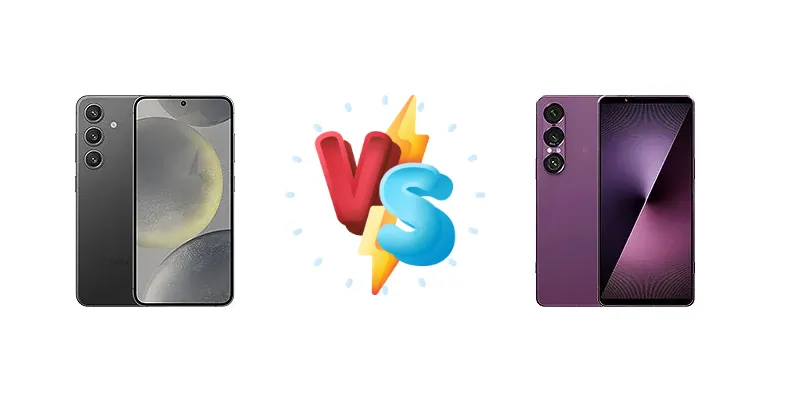
|
🏆 Quick Verdict
For the average user prioritizing a compact form factor, AI integration, and widespread availability, the Samsung Galaxy S24 is the better choice. However, the Sony Xperia 1 VII’s exceptional battery life and cutting-edge Snapdragon 8 Elite chipset make it the clear winner for power users and content creators.
| PHONES | ||
|---|---|---|
| Phone Names | Samsung Galaxy S24 | Sony Xperia 1 VII |
| Network | ||
|---|---|---|
| 2G bands | GSM 850 / 900 / 1800 / 1900 | GSM 850 / 900 / 1800 / 1900 |
| 3G bands | HSDPA 850 / 900 / 1700(AWS) / 1900 / 2100 | HSDPA 800 / 850 / 900 / 1700(AWS) / 1900 / 2100 |
| 4G bands | 1, 2, 3, 4, 5, 7, 8, 12, 13, 17, 18, 19, 20, 25, 26, 28, 32, 38, 39, 40, 41, 66 - International | 1, 2, 3, 4, 5, 7, 8, 12, 13, 17, 19, 20, 25, 26, 28, 32, 34, 38, 39, 40, 41, 66 - Europe |
| 5G bands | 1, 2, 3, 5, 7, 8, 12, 20, 25, 26, 28, 38, 40, 41, 66, 75, 77, 78 SA/NSA/Sub6 - International | 1, 3, 5, 7, 8, 20, 28, 38, 40, 41, 75, 77, 78 SA/NSA/Sub6 - Europe |
| Speed | HSPA, LTE (up to 7CA), 5G | HSPA, LTE, 5G |
| Technology | GSM / CDMA / HSPA / EVDO / LTE / 5G | GSM / HSPA / LTE / 5G |
| Launch | ||
|---|---|---|
| Announced | 2024, January 17 | 2025, May 13 |
| Status | Available. Released 2024, January 24 | Available. Released 2025, June 04 |
| Body | ||
|---|---|---|
| Build | Glass front (Gorilla Glass Victus 2), glass back (Gorilla Glass Victus 2), aluminum frame | Glass front (Gorilla Glass Victus 2), glass back (Gorilla Glass Victus), aluminum frame |
| Dimensions | 147 x 70.6 x 7.6 mm (5.79 x 2.78 x 0.30 in) | 162 x 74 x 8.2 mm (6.38 x 2.91 x 0.32 in) |
| SIM | · Nano-SIM + Nano-SIM + eSIM + eSIM (max 2 at a time) - INT· Nano-SIM + eSIM + eSIM (max 2 at a time) - USA· Nano-SIM + Nano-SIM - CN | · Nano-SIM + eSIM· Nano-SIM + Nano-SIM |
| Weight | 167 g or 168 g (5.89 oz) | 197 g (6.95 oz) |
| Display | ||
|---|---|---|
| Protection | Corning Gorilla Glass Victus 2 | Corning Gorilla Glass Victus 2, Mohs level 5 |
| Resolution | 1080 x 2340 pixels, 19.5:9 ratio (~416 ppi density) | 1080 x 2340 pixels, 19.5:9 ratio (~396 ppi density) |
| Size | 6.2 inches, 94.4 cm2 (~90.9% screen-to-body ratio) | 6.5 inches, 103.7 cm2 (~86.5% screen-to-body ratio) |
| Type | Dynamic LTPO AMOLED 2X, 120Hz, HDR10+, 2600 nits (peak) | LTPO OLED, 1B colors, 120Hz, HDR BT.2020 |
| Platform | ||
|---|---|---|
| CPU | 8-core (1x3.39GHz Cortex-X4 & 3x3.1GHz Cortex-A720 & 2x2.9GHz Cortex-A720 & 2x2.2GHz Cortex-A520)10-core (1x3.2GHz Cortex-X4 & 2x2.9GHz Cortex-A720 & 3x2.6GHz Cortex-A720 & 4x1.95GHz Cortex-A520) | Octa-core (2x4.32 GHz Oryon V2 Phoenix L + 6x3.53 GHz Oryon V2 Phoenix M) |
| Chipset | Qualcomm SM8650-AC Snapdragon 8 Gen 3 (4 nm) - USA/Canada/ChinaExynos 2400 (4 nm) - International | Qualcomm SM8750-AB Snapdragon 8 Elite (3 nm) |
| GPU | Adreno 750 (1 GHz) - USA/Canada/ChinaXclipse 940 - International | Adreno 830 |
| OS | Android 14, up to 7 major Android upgrades, One UI 8.0 | Android 15, up to 4 major Android upgrades |
| Memory | ||
|---|---|---|
| Card slot | No | microSDXC (uses shared SIM slot) |
| Internal | 128GB 8GB RAM, 256GB 8GB RAM, 256GB 12GB RAM, 512GB 8GB RAM | 256GB 12GB RAM, 512GB 12GB RAM |
| Main Camera | ||
|---|---|---|
| Features | LED flash, auto-HDR, panorama | Zeiss optics, Zeiss T* lens coating, color spectrum sensor, LED flash, panorama, HDR, eye tracking |
| Triple | 50 MP, f/1.8, 24mm (wide), 1/1.56", 1.0µm, dual pixel PDAF, OIS 10 MP, f/2.4, 67mm (telephoto), 1/3.94", 1.0µm, PDAF, OIS, 3x optical zoom 12 MP, f/2.2, 13mm, 120˚ (ultrawide), 1/2.55" 1.4µm, Super Steady video | 48 MP, f/1.9, 24mm (wide), 1/1.35", 1.12µm, dual pixel PDAF, OIS 12 MP, f/2.3, 85mm (telephoto), f/3.5, 170mm (telephoto), 1/3.5", 1.0µm, dual pixel PDAF, 3.5x-7.1x continuous optical zoom, OIS, 4cm macro @ 120mm, no AF 48 MP, f/2.0, 16mm (ultrawide), 1/1.56", 1.0µm, PDAF |
| Video | 8K@24/30fps, 4K@30/60fps, 1080p@30/60/120/240fps, HDR10+, stereo sound rec., gyro-EIS | 4K@24/30/60/120fps HDR, 1080p@30/60/120fps; 5-axis gyro-EIS, OIS |
| Selfie camera | ||
|---|---|---|
| Features | HDR, HDR10+ | HDR |
| Single | 12 MP, f/2.2, 26mm (wide), 1/3.2", 1.12µm, dual pixel PDAF | 12 MP, f/2.0, 24mm (wide), 1/2.9", 1.22µm |
| Video | 4K@30/60fps, 1080p@30fps | 4K@30/60fps, 1080p@30/60fps, 5-axis gyro-EIS |
| Sound | ||
|---|---|---|
| 35mm jack | No | Yes |
| Loudspeaker | Yes, with stereo speakers | Yes, with stereo speakers |
| Comms | ||
|---|---|---|
| Bluetooth | 5.3, A2DP, LE | 6.0, A2DP, LE Audio, aptX HD, aptX Adaptive, aptX Lossless |
| NFC | Yes | Yes |
| Positioning | GPS, GLONASS, BDS, GALILEO, QZSS | GPS, GLONASS, BDS, GALILEO, QZSS |
| Radio | No | No |
| USB | USB Type-C 3.2, DisplayPort 1.2, OTG | USB Type-C 3.2, OTG, video output |
| WLAN | Wi-Fi 802.11 a/b/g/n/ac/6e, tri-band, Wi-Fi Direct | Wi-Fi 802.11 a/b/g/n/ac/6e/7, tri-band, Wi-Fi Direct, DLNA |
| Features | ||
|---|---|---|
| Sensors | Fingerprint (under display, ultrasonic), accelerometer, gyro, proximity, compass, barometer | Fingerprint (side-mounted), accelerometer, gyro, proximity, barometer, compass |
| Battery | ||
|---|---|---|
| Charging | 25W wired, PD3.0, 50% in 30 min 15W wireless (Qi) 4.5W reverse wireless | 30W wired, PD3.0, PPS, 50% in 30 min 15W wireless Reverse wireless |
| Type | Li-Ion 4000 mAh | 5000 mAh |
| Misc | ||
|---|---|---|
| Colors | Onyx Black, Marble Grey, Cobalt Violet, Amber Yellow, Jade Green, Sandstone Orange, Sapphire Blue | Moss Green, Orchid Purple, Slate Black |
| Models | SM-S921B, SM-S921B/DS, SM-S921U, SM-S921U1, SM-S921W, SM-S921N, SM-S9210, SM-S921E, SM-S921E/DS | XQ-FS54, XQFS54EUKCG.GC, XQFS54EUKCV.GC, XQFS54EUKCB.GC, PDX256 |
| Price | € 454.76 / $ 299.99 / £ 340.99 / ₹ 39,999 | € 1,338.99 / $ 1,394.99 / £ 1,149.94 |
| SAR | 1.23 W/kg (head) 1.10 W/kg (body) | - |
| SAR EU | 0.87 W/kg (head) 1.35 W/kg (body) | - |
| EU LABEL | ||
|---|---|---|
| Battery | - | 43:30h endurance, 1400 cycles |
| Energy | - | Class B |
| Free fall | - | Class B (181 falls) |
| Repairability | - | Class D |
Samsung Galaxy S24
- Compact and pocketable design
- AI-powered features and software
- Wider availability and support network
- Inferior battery life compared to Xperia 1 VII
- Potential for thermal throttling with Exynos variant
- Less focus on professional-grade camera features
Sony Xperia 1 VII
- Exceptional battery life and longevity
- Cutting-edge Snapdragon 8 Elite chipset
- Focus on professional photography and videography
- Higher price point
- Less mainstream appeal
- Potentially less refined software experience
Display Comparison
Both devices boast impressive displays, with the Sony Xperia 1 VII edging out the Samsung Galaxy S24 in peak brightness at 1475 nits versus 1401 nits. While the difference is subtle, it translates to slightly better visibility in direct sunlight. Both likely utilize LTPO technology for adaptive refresh rates, though this isn't explicitly stated. Sony’s focus on color accuracy, a hallmark of their displays, will appeal to professionals, while Samsung’s display is known for its vibrant, punchy colors. Bezels appear comparable, contributing to a modern aesthetic on both devices.
Camera Comparison
While both phones are expected to deliver excellent image quality, Sony’s approach centers on professional-grade features and natural color reproduction. The Xperia 1 VII’s camera system, while details are limited in the provided data, likely features a larger main sensor and advanced image processing algorithms. Samsung’s camera leans towards vibrant, shareable images with extensive software enhancements. The absence of specific sensor details prevents a definitive comparison, but Sony’s history suggests a focus on optical quality and manual control. The 2MP macro camera on the S24 is likely a marketing feature with limited practical benefit, while Sony typically avoids such low-resolution sensors.
Performance
The performance gap is significant. The Sony Xperia 1 VII leverages the Qualcomm SM8750-AB Snapdragon 8 Elite (3nm), featuring a custom Oryon V2 Phoenix CPU architecture with a peak clock speed of 4.32 GHz. This contrasts with the Samsung Galaxy S24’s chipset options: the Snapdragon 8 Gen 3 (4nm) in the US/Canada/China, and the Exynos 2400 (4nm) internationally. The 3nm process of the Snapdragon 8 Elite offers superior power efficiency and thermal performance, allowing for sustained peak performance. The Oryon cores are designed for higher single-core performance, benefiting demanding applications. The S24’s Exynos variant may exhibit more thermal throttling under prolonged load, impacting gaming and video editing. Both devices utilize LPDDR5x RAM, but the superior chipset in the Xperia 1 VII will maximize its potential.
Battery Life
Battery life is where the Sony Xperia 1 VII truly shines. Its active use score of 15:32h dramatically surpasses the Samsung Galaxy S24’s 12:06h. This difference is further amplified by the Xperia 1 VII’s impressive 43:30h endurance and 1400 battery cycles, indicating exceptional longevity. Both phones support 30W wired charging with 50% charge in 30 minutes, and 15W wireless charging. However, the Xperia 1 VII’s larger battery capacity and more efficient chipset translate to significantly longer real-world usage between charges.
Buying Guide
Buy the Samsung Galaxy S24 if you need a versatile, pocketable phone with a vibrant display and seamless integration with the Samsung ecosystem. Its AI features and readily available support network are significant advantages. Buy the Sony Xperia 1 VII if you prioritize exceptional battery life, raw processing power for demanding tasks, and a dedicated focus on photography and videography, even if it means a higher price point and less mainstream appeal.