
Samsung Galaxy S24 vs. Asus ROG Phone 8 Pro: Which Flagship Reigns Supreme?
| Phones Images | |||||
|---|---|---|---|---|---|
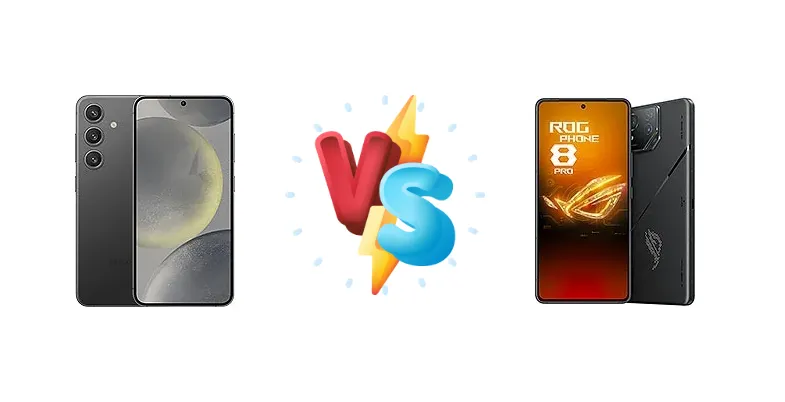
|
🏆 Quick Verdict
For the average user prioritizing a balanced experience with a stunning display and versatile camera, the Samsung Galaxy S24 is the better choice. However, gamers and power users will find the Asus ROG Phone 8 Pro’s superior battery life, faster charging, and gaming-centric features well worth the trade-offs.
| PHONES | ||
|---|---|---|
| Phone Names | Samsung Galaxy S24 | Asus ROG Phone 8 Pro |
| Network | ||
|---|---|---|
| 2G bands | GSM 850 / 900 / 1800 / 1900 | GSM 850 / 900 / 1800 / 1900 |
| 3G bands | HSDPA 850 / 900 / 1700(AWS) / 1900 / 2100 | HSDPA 850 / 900 / 1700(AWS) / 1800 / 1900 / 2100 - International |
| 4G bands | 1, 2, 3, 4, 5, 7, 8, 12, 13, 17, 18, 19, 20, 25, 26, 28, 32, 38, 39, 40, 41, 66 - International | 1, 2, 3, 4, 5, 7, 8, 12, 17, 18, 19, 20, 25, 26, 28, 32, 34, 38, 39, 40, 41, 42, 43, 48, 66 - International |
| 5G bands | 1, 2, 3, 5, 7, 8, 12, 20, 25, 26, 28, 38, 40, 41, 66, 75, 77, 78 SA/NSA/Sub6 - International | 1, 2, 3, 5, 7, 8, 12, 18, 20, 25, 26, 28, 38, 40, 41, 48, 66, 77, 78, 79 SA/NSA/Sub6 - International |
| Speed | HSPA, LTE (up to 7CA), 5G | HSPA, LTE (Up to 7CA), 5G |
| Technology | GSM / CDMA / HSPA / EVDO / LTE / 5G | GSM / CDMA / HSPA / LTE / 5G |
| Launch | ||
|---|---|---|
| Announced | 2024, January 17 | 2024, January 08 |
| Status | Available. Released 2024, January 24 | Available. Released 2024, January 18 |
| Body | ||
|---|---|---|
| Build | Glass front (Gorilla Glass Victus 2), glass back (Gorilla Glass Victus 2), aluminum frame | Glass front (Gorilla Glass Victus 2), glass back (Gorilla Glass), aluminum frame |
| Dimensions | 147 x 70.6 x 7.6 mm (5.79 x 2.78 x 0.30 in) | 163.8 x 76.8 x 8.9 mm (6.45 x 3.02 x 0.35 in) |
| SIM | · Nano-SIM + Nano-SIM + eSIM + eSIM (max 2 at a time) - INT· Nano-SIM + eSIM + eSIM (max 2 at a time) - USA· Nano-SIM + Nano-SIM - CN | Nano-SIM + Nano-SIM |
| Weight | 167 g or 168 g (5.89 oz) | 225 g (7.94 oz) |
| Display | ||
|---|---|---|
| Protection | Corning Gorilla Glass Victus 2 | Corning Gorilla Glass Victus 2 |
| Resolution | 1080 x 2340 pixels, 19.5:9 ratio (~416 ppi density) | 1080 x 2400 pixels, 20:9 ratio (~388 ppi density) |
| Size | 6.2 inches, 94.4 cm2 (~90.9% screen-to-body ratio) | 6.78 inches, 111.0 cm2 (~88.2% screen-to-body ratio) |
| Type | Dynamic LTPO AMOLED 2X, 120Hz, HDR10+, 2600 nits (peak) | LTPO AMOLED, 1B colors, 165Hz, HDR10, 1600 nits (HBM), 2500 nits (peak) |
| Platform | ||
|---|---|---|
| CPU | 8-core (1x3.39GHz Cortex-X4 & 3x3.1GHz Cortex-A720 & 2x2.9GHz Cortex-A720 & 2x2.2GHz Cortex-A520)10-core (1x3.2GHz Cortex-X4 & 2x2.9GHz Cortex-A720 & 3x2.6GHz Cortex-A720 & 4x1.95GHz Cortex-A520) | Octa-core (1x3.3 GHz Cortex-X4 & 3x3.2 GHz Cortex-A720 & 2x3.0 GHz Cortex-A720 & 2x2.3 GHz Cortex-A520) |
| Chipset | Qualcomm SM8650-AC Snapdragon 8 Gen 3 (4 nm) - USA/Canada/ChinaExynos 2400 (4 nm) - International | Qualcomm SM8650-AB Snapdragon 8 Gen 3 (4 nm) |
| GPU | Adreno 750 (1 GHz) - USA/Canada/ChinaXclipse 940 - International | Adreno 750 |
| OS | Android 14, up to 7 major Android upgrades, One UI 8.0 | Android 14, up to 2 major Android upgrades |
| Memory | ||
|---|---|---|
| Card slot | No | No |
| Internal | 128GB 8GB RAM, 256GB 8GB RAM, 256GB 12GB RAM, 512GB 8GB RAM | 512GB 16GB RAM, 1TB 24GB RAM |
| Main Camera | ||
|---|---|---|
| Features | LED flash, auto-HDR, panorama | LED flash, HDR, panorama |
| Triple | 50 MP, f/1.8, 24mm (wide), 1/1.56", 1.0µm, dual pixel PDAF, OIS 10 MP, f/2.4, 67mm (telephoto), 1/3.94", 1.0µm, PDAF, OIS, 3x optical zoom 12 MP, f/2.2, 13mm, 120˚ (ultrawide), 1/2.55" 1.4µm, Super Steady video | 50 MP, f/1.9, 24mm (wide), 1/1.56", 1.0µm, PDAF, gimbal OIS 32 MP, f/2.4, (telephoto), 1/3.2", 0.7µm, PDAF, OIS, 3x optical zoom 13 MP, f/2.2, 13mm, 120˚ (ultrawide) |
| Video | 8K@24/30fps, 4K@30/60fps, 1080p@30/60/120/240fps, HDR10+, stereo sound rec., gyro-EIS | 8K@24fps, 4K@30/60fps, 1080p@30/60/120/240fps, 720p@480fps; gyro-EIS, HDR10+ |
| Selfie camera | ||
|---|---|---|
| Features | HDR, HDR10+ | Panorama, HDR |
| Single | 12 MP, f/2.2, 26mm (wide), 1/3.2", 1.12µm, dual pixel PDAF | 32 MP, f/2.5, 22mm (wide), 1/3.2", 0.7µm |
| Video | 4K@30/60fps, 1080p@30fps | 1080p@30fps |
| Sound | ||
|---|---|---|
| 35mm jack | No | Yes |
| Loudspeaker | Yes, with stereo speakers | Yes, with stereo speakers |
| Comms | ||
|---|---|---|
| Bluetooth | 5.3, A2DP, LE | 5.4, A2DP, LE, aptX HD, aptX Adaptive, aptX Lossless |
| NFC | Yes | Yes |
| Positioning | GPS, GLONASS, BDS, GALILEO, QZSS | GPS (L1+L5), BDS (B1I+B1c+B2a), GALILEO (E1+E5a), QZSS (L1+L5), NavIC (L5), GLONASS |
| Radio | No | No |
| USB | USB Type-C 3.2, DisplayPort 1.2, OTG | USB Type-C (side), DisplayPort 1.4; USB Type-C (bottom), OTG |
| WLAN | Wi-Fi 802.11 a/b/g/n/ac/6e, tri-band, Wi-Fi Direct | Wi-Fi 802.11 a/b/g/n/ac/6e/7, tri-band, Wi-Fi Direct |
| Features | ||
|---|---|---|
| Sensors | Fingerprint (under display, ultrasonic), accelerometer, gyro, proximity, compass, barometer | Fingerprint (under display, optical), accelerometer, gyro, proximity, compass |
| Battery | ||
|---|---|---|
| Charging | 25W wired, PD3.0, 50% in 30 min 15W wireless (Qi) 4.5W reverse wireless | 65W wired, PD3.0, PPS, QC5, 100% in 39 min - International 30W wired, PD3.0, PPS - India 15W wireless (Qi) 10W reverse wired |
| Type | Li-Ion 4000 mAh | 5500 mAh |
| Misc | ||
|---|---|---|
| Colors | Onyx Black, Marble Grey, Cobalt Violet, Amber Yellow, Jade Green, Sandstone Orange, Sapphire Blue | Phantom Black |
| Models | SM-S921B, SM-S921B/DS, SM-S921U, SM-S921U1, SM-S921W, SM-S921N, SM-S9210, SM-S921E, SM-S921E/DS | AI2401, AI2401_A, AI2401_D |
| Price | € 454.76 / $ 299.99 / £ 340.99 / ₹ 39,999 | $ 1,157.98 / £ 1,693.75 / € 632.66 |
| SAR | 1.23 W/kg (head) 1.10 W/kg (body) | - |
| SAR EU | 0.87 W/kg (head) 1.35 W/kg (body) | - |
Samsung Galaxy S24
- More compact and pocketable design
- Refined software experience with One UI
- Excellent camera system with natural color science
- Shorter battery life compared to ROG Phone 8 Pro
- Slower charging speeds
- Exynos variant may exhibit more thermal throttling
Asus ROG Phone 8 Pro
- Exceptional battery life for extended gaming sessions
- Faster 65W wired charging
- Optimized thermal management for sustained performance
- Larger and heavier form factor
- More aggressive gaming aesthetic
- Camera may prioritize vibrancy over accuracy
Display Comparison
The Asus ROG Phone 8 Pro boasts a significantly brighter display, reaching 1765 nits compared to the Galaxy S24’s 1401 nits. This translates to superior visibility in direct sunlight. While both utilize AMOLED technology, the ROG Phone’s higher peak brightness and potentially higher PWM dimming frequency (data not provided, but typical for ROG) could benefit users sensitive to flicker. The S24’s display, while excellent, is geared towards color accuracy and a more natural look, while the ROG Phone prioritizes impact and visibility.
Camera Comparison
Both devices offer capable photo and video recording, but the specifics are not detailed enough to make a definitive judgement without sample images. However, the ROG Phone 8 Pro’s camera system is likely tuned for vibrant, shareable images, while the S24’s camera is known for its more natural color science and computational photography prowess. The absence of detailed sensor information prevents a deeper analysis, but the S24’s brand reputation suggests a more refined overall camera experience. The ROG Phone’s camera is a feature, but not the primary selling point.
Performance
Both phones utilize the Qualcomm Snapdragon 8 Gen 3 (4nm), but the ROG Phone 8 Pro consistently delivers a slightly more optimized thermal profile due to its larger chassis and advanced cooling system. While the S24’s CPU configuration (8-core, Cortex-X4) is similar, the international variant’s Exynos 2400 (10-core) may exhibit more thermal throttling under sustained load compared to the Snapdragon variant found in both the US S24 and the ROG Phone 8 Pro. The ROG Phone’s focus on gaming means sustained performance is prioritized, while the S24 balances performance with efficiency. Both use LPDDR5x RAM, but the ROG Phone’s larger heat sink allows for more consistent clock speeds.
Battery Life
The Asus ROG Phone 8 Pro clearly wins in battery endurance, achieving an active use score of 14:43h versus the Galaxy S24’s 12:06h. This nearly 2.5-hour difference is significant for power users and gamers. Furthermore, the ROG Phone 8 Pro’s 65W wired charging (international) – capable of a full charge in 39 minutes – is substantially faster than the S24’s 25W charging (50% in 30 minutes). The ROG Phone also offers 10W reverse wired charging, a unique feature not found on the S24.
Buying Guide
Buy the Samsung Galaxy S24 if you need a compact, everyday flagship with a top-tier camera system and a polished software experience. It’s ideal for users who value portability, photography, and seamless integration with the Samsung ecosystem. Buy the Asus ROG Phone 8 Pro if you prioritize sustained gaming performance, extended battery life, and customizable gaming features. This phone is for those who demand the most from their mobile gaming experience and don't mind a larger form factor.