
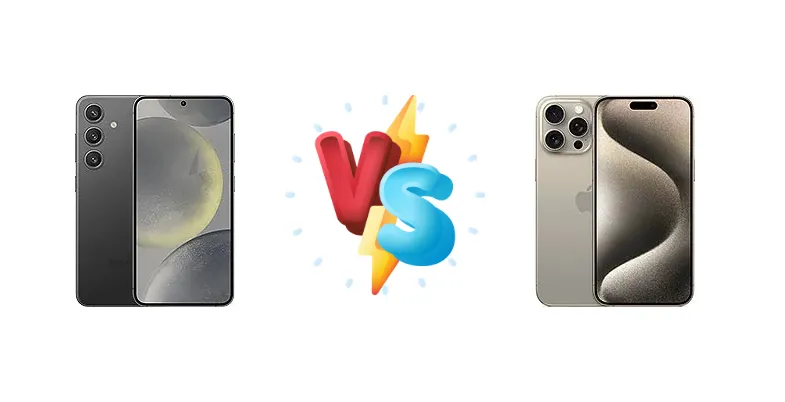
Samsung Galaxy S24 vs. iPhone 15 Pro Max: The Ultimate Flagship Showdown
| Phones Images | |||||
|---|---|---|---|---|---|
|
🏆 Quick Verdict
For the average user prioritizing longevity and consistent performance, the iPhone 15 Pro Max emerges as the winner. Its significantly superior battery life (16:01h active use) and the efficiency of the A17 Pro chipset outweigh the S24’s AI capabilities and potentially faster peak processing speeds in specific regions.
| PHONES | ||
|---|---|---|
| Phone Names | Samsung Galaxy S24 | Apple iPhone 15 Pro Max |
| Network | ||
|---|---|---|
| 2G bands | GSM 850 / 900 / 1800 / 1900 | GSM 850 / 900 / 1800 / 1900 |
| 3G bands | HSDPA 850 / 900 / 1700(AWS) / 1900 / 2100 | HSDPA 850 / 900 / 1700(AWS) / 1900 / 2100 |
| 4G bands | 1, 2, 3, 4, 5, 7, 8, 12, 13, 17, 18, 19, 20, 25, 26, 28, 32, 38, 39, 40, 41, 66 - International | 1, 2, 3, 4, 5, 7, 8, 12, 13, 17, 18, 19, 20, 25, 26, 28, 30, 32, 34, 38, 39, 40, 41, 42, 46, 48, 53, 66 - A3106 |
| 5G bands | 1, 2, 3, 5, 7, 8, 12, 20, 25, 26, 28, 38, 40, 41, 66, 75, 77, 78 SA/NSA/Sub6 - International | 1, 2, 3, 5, 7, 8, 12, 20, 25, 26, 28, 30, 38, 40, 41, 48, 53, 66, 70, 77, 78, 79 SA/NSA/Sub6 - A3106 |
| Speed | HSPA, LTE (up to 7CA), 5G | HSPA, LTE, 5G, EV-DO Rev.A 3.1 Mbps |
| Technology | GSM / CDMA / HSPA / EVDO / LTE / 5G | GSM / CDMA / HSPA / EVDO / LTE / 5G |
| Launch | ||
|---|---|---|
| Announced | 2024, January 17 | 2023, September 12 |
| Status | Available. Released 2024, January 24 | Available. Released 2023, September 22 |
| Body | ||
|---|---|---|
| Build | Glass front (Gorilla Glass Victus 2), glass back (Gorilla Glass Victus 2), aluminum frame | Glass front, glass back, titanium frame (grade 5) |
| Dimensions | 147 x 70.6 x 7.6 mm (5.79 x 2.78 x 0.30 in) | 159.9 x 76.7 x 8.3 mm (6.30 x 3.02 x 0.33 in) |
| SIM | · Nano-SIM + Nano-SIM + eSIM + eSIM (max 2 at a time) - INT· Nano-SIM + eSIM + eSIM (max 2 at a time) - USA· Nano-SIM + Nano-SIM - CN | · Nano-SIM + eSIM + eSIM (max 2 at a time; International)· eSIM + eSIM (8 or more, max 2 at a time; USA)· Nano-SIM + Nano-SIM (China) |
| Weight | 167 g or 168 g (5.89 oz) | 221 g (7.80 oz) |
| Display | ||
|---|---|---|
| Protection | Corning Gorilla Glass Victus 2 | Ceramic Shield glass |
| Resolution | 1080 x 2340 pixels, 19.5:9 ratio (~416 ppi density) | 1290 x 2796 pixels, 19.5:9 ratio (~460 ppi density) |
| Size | 6.2 inches, 94.4 cm2 (~90.9% screen-to-body ratio) | 6.7 inches, 110.2 cm2 (~89.8% screen-to-body ratio) |
| Type | Dynamic LTPO AMOLED 2X, 120Hz, HDR10+, 2600 nits (peak) | LTPO Super Retina XDR OLED, 120Hz, HDR10, Dolby Vision, 1000 nits (typ), 2000 nits (HBM) |
| Platform | ||
|---|---|---|
| CPU | 8-core (1x3.39GHz Cortex-X4 & 3x3.1GHz Cortex-A720 & 2x2.9GHz Cortex-A720 & 2x2.2GHz Cortex-A520)10-core (1x3.2GHz Cortex-X4 & 2x2.9GHz Cortex-A720 & 3x2.6GHz Cortex-A720 & 4x1.95GHz Cortex-A520) | Hexa-core (2x3.78 GHz + 4x2.11 GHz) |
| Chipset | Qualcomm SM8650-AC Snapdragon 8 Gen 3 (4 nm) - USA/Canada/ChinaExynos 2400 (4 nm) - International | Apple A17 Pro (3 nm) |
| GPU | Adreno 750 (1 GHz) - USA/Canada/ChinaXclipse 940 - International | Apple GPU (6-core graphics) |
| OS | Android 14, up to 7 major Android upgrades, One UI 8.0 | iOS 17, upgradable to iOS 26.1 |
| Memory | ||
|---|---|---|
| Card slot | No | No |
| Internal | 128GB 8GB RAM, 256GB 8GB RAM, 256GB 12GB RAM, 512GB 8GB RAM | 256GB 8GB RAM, 512GB 8GB RAM, 1TB 8GB RAM |
| Main Camera | ||
|---|---|---|
| Features | LED flash, auto-HDR, panorama | Dual-LED dual-tone flash, HDR (photo/panorama) |
| Triple | 50 MP, f/1.8, 24mm (wide), 1/1.56", 1.0µm, dual pixel PDAF, OIS 10 MP, f/2.4, 67mm (telephoto), 1/3.94", 1.0µm, PDAF, OIS, 3x optical zoom 12 MP, f/2.2, 13mm, 120˚ (ultrawide), 1/2.55" 1.4µm, Super Steady video | 48 MP, f/1.8, 24mm (wide), 1/1.28", 1.22µm, dual pixel PDAF, sensor-shift OIS 12 MP, f/2.8, 120mm (periscope telephoto), 1/3.06", 1.12µm, dual pixel PDAF, 3D sensor‑shift OIS, 5x optical zoom 12 MP, f/2.2, 13mm, 120˚ (ultrawide), 1/2.55", 1.4µm, dual pixel PDAF TOF 3D LiDAR scanner (depth) |
| Video | 8K@24/30fps, 4K@30/60fps, 1080p@30/60/120/240fps, HDR10+, stereo sound rec., gyro-EIS | 4K@24/25/30/60fps, 1080p@25/30/60/120/240fps, 10-bit HDR, Dolby Vision HDR (up to 60fps), ProRes, 3D (spatial) video, stereo sound rec. |
| Selfie camera | ||
|---|---|---|
| Features | HDR, HDR10+ | HDR, Dolby Vision HDR |
| Single | 12 MP, f/2.2, 26mm (wide), 1/3.2", 1.12µm, dual pixel PDAF | 12 MP, f/1.9, 23mm (wide), 1/3.6", 1.0µm, PDAF, OIS SL 3D, (depth/biometrics sensor) |
| Video | 4K@30/60fps, 1080p@30fps | 4K@24/25/30/60fps, 1080p@25/30/60/120fps, gyro-EIS |
| Sound | ||
|---|---|---|
| 35mm jack | No | No |
| Loudspeaker | Yes, with stereo speakers | Yes, with stereo speakers |
| Comms | ||
|---|---|---|
| Bluetooth | 5.3, A2DP, LE | 5.3, A2DP, LE |
| NFC | Yes | Yes |
| Positioning | GPS, GLONASS, BDS, GALILEO, QZSS | GPS (L1+L5), GLONASS, GALILEO, BDS, QZSS, NavIC |
| Radio | No | No |
| USB | USB Type-C 3.2, DisplayPort 1.2, OTG | USB Type-C 3.2 Gen 2, DisplayPort |
| WLAN | Wi-Fi 802.11 a/b/g/n/ac/6e, tri-band, Wi-Fi Direct | Wi-Fi 802.11 a/b/g/n/ac/6e, tri-band, hotspot |
| Features | ||
|---|---|---|
| Sensors | Fingerprint (under display, ultrasonic), accelerometer, gyro, proximity, compass, barometer | Face ID, accelerometer, gyro, proximity, compass, barometer |
| Battery | ||
|---|---|---|
| Charging | 25W wired, PD3.0, 50% in 30 min 15W wireless (Qi) 4.5W reverse wireless | Wired, PD2.0, 50% in 30 min 15W wireless (MagSafe) 15W wireless (Qi2) - requires iOS 17.2 update 4.5W reverse wired |
| Type | Li-Ion 4000 mAh | Li-Ion 4441 mAh |
| Misc | ||
|---|---|---|
| Colors | Onyx Black, Marble Grey, Cobalt Violet, Amber Yellow, Jade Green, Sandstone Orange, Sapphire Blue | Black Titanium, White Titanium, Blue Titanium, Natural Titanium |
| Models | SM-S921B, SM-S921B/DS, SM-S921U, SM-S921U1, SM-S921W, SM-S921N, SM-S9210, SM-S921E, SM-S921E/DS | A2849, A3105, A3106, A3108, iPhone16,2 |
| Price | € 454.76 / $ 299.99 / £ 340.99 / ₹ 39,999 | € 758.79 / $ 579.87 / £ 628.29 |
| SAR | 1.23 W/kg (head) 1.10 W/kg (body) | 1.07 W/kg (head) 1.11 W/kg (body) |
| SAR EU | 0.87 W/kg (head) 1.35 W/kg (body) | 0.98 W/kg (head) 0.98 W/kg (body) |
Samsung Galaxy S24
- Versatile Android ecosystem and customization options
- Cutting-edge AI features and software enhancements
- Potentially faster peak CPU performance (Snapdragon variant)
- Battery life significantly shorter than iPhone 15 Pro Max
- Chipset variability (Exynos vs. Snapdragon) impacts performance
- Software updates may be less consistent than iOS
Apple iPhone 15 Pro Max
- Exceptional battery life and power efficiency
- Industry-leading A17 Pro chipset for sustained performance
- Seamless iOS ecosystem integration and long-term software support
- Less customizable operating system compared to Android
- Ecosystem lock-in may be restrictive for some users
- Higher price point
Display Comparison
The iPhone 15 Pro Max boasts a significantly brighter display, reaching 1787 nits measured, compared to the Galaxy S24’s 1401 nits. This translates to superior visibility in direct sunlight. While both utilize advanced panel technology, the iPhone’s higher peak brightness and potentially better color calibration (based on Apple’s historical performance) provide a more vibrant and accurate visual experience. The S24’s display is still excellent, but the iPhone pulls ahead in raw luminance.
Camera Comparison
Both devices excel in photography and videography, but approach image processing differently. Without detailed sensor size data, it’s difficult to definitively declare a winner. However, Apple’s computational photography is renowned for its natural-looking results, while Samsung often leans towards more saturated and vibrant images. Both offer excellent stabilization and low-light performance. The absence of detailed camera specs for the S24 necessitates a focus on software processing, where Apple has a strong track record. The usefulness of a 2MP macro camera on either device is questionable, as image quality is often subpar.
Performance
The core of the performance difference lies in the chipsets. The iPhone 15 Pro Max’s A17 Pro, fabricated on a 3nm process, offers a clear architectural advantage in efficiency. While the Snapdragon 8 Gen 3 (4nm) in the US/Canada/China S24 models is a powerhouse, the Exynos 2400 (4nm) variant found in international models may exhibit slightly lower performance and potentially increased thermal throttling. The A17 Pro’s hexa-core configuration (2x3.78 GHz + 4x2.11 GHz) is optimized for sustained performance, while the S24’s 8/10-core CPUs, despite higher clock speeds on some cores, don’t necessarily translate to real-world gains due to architectural differences and potential thermal constraints. The iPhone’s GPU also benefits from the 3nm process, offering superior graphics performance.
Battery Life
Battery life is where the iPhone 15 Pro Max truly shines. The active use score of 16:01h is a substantial improvement over the Galaxy S24’s 12:06h. While both support 50% charging in 30 minutes, the iPhone’s superior efficiency allows it to stretch a full charge significantly further. The S24 offers 25W wired charging, while the iPhone supports PD2.0. Both offer 15W wireless charging, but the iPhone benefits from MagSafe and the upcoming Qi2 standard (requiring iOS 17.2), offering potentially faster and more reliable wireless charging. Both also offer 4.5W reverse wireless charging.
Buying Guide
Buy the Samsung Galaxy S24 if you need a versatile Android experience with cutting-edge AI features, prefer a more customizable interface, and are comfortable with the potential for chipset-dependent performance variations. Buy the Apple iPhone 15 Pro Max if you prioritize exceptional battery life, seamless ecosystem integration, consistently high performance, and a premium, refined user experience.