
Samsung Galaxy S23+ vs Xiaomi 13 Pro: A Deep Dive into Android Flagship Performance
| Phones Images | |||||
|---|---|---|---|---|---|
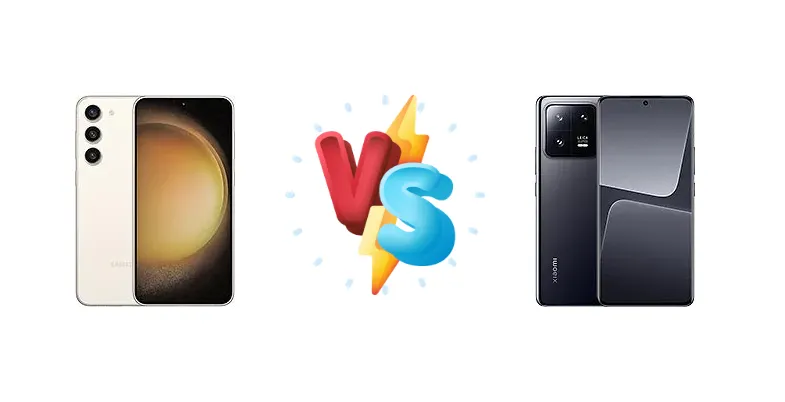
|
🏆 Quick Verdict
For most users, the Samsung Galaxy S23+ emerges as the more balanced choice. While the Xiaomi 13 Pro boasts significantly faster charging and a slightly brighter display, the S23+'s more efficient battery performance and refined software experience provide a smoother, more consistent daily usage.
| PHONES | ||
|---|---|---|
| Phone Names | Samsung Galaxy S23+ | Xiaomi 13 Pro |
| Network | ||
|---|---|---|
| 2G bands | GSM 850 / 900 / 1800 / 1900 | GSM 850 / 900 / 1800 / 1900 |
| 3G bands | HSDPA 850 / 900 / 1700(AWS) / 1900 / 2100 | HSDPA 800 / 850 / 900 / 1700(AWS) / 1900 / 2100 |
| 4G bands | 1, 2, 3, 4, 5, 7, 8, 12, 13, 17, 18, 19, 20, 25, 26, 28, 32, 38, 39, 40, 41, 66 - International | 1, 2, 3, 4, 5, 7, 8, 12, 13, 17, 18, 19, 20, 25, 26, 28, 32, 38, 39, 40, 41, 42, 48, 66 - International |
| 5G bands | 1, 2, 3, 5, 7, 8, 12, 20, 25, 28, 38, 40, 41, 66, 75, 77, 78 SA/NSA/Sub6 - International | 1, 3, 5, 7, 8, 20, 28, 38, 40, 41, 66, 71, 75, 77, 78 SA/NSA - International |
| Speed | HSPA, LTE (up to 7CA), 5G | HSPA, LTE, 5G |
| Technology | GSM / CDMA / HSPA / EVDO / LTE / 5G | GSM / CDMA / HSPA / CDMA2000 / LTE / 5G |
| - | 1, 3, 5, 8, 28, 38, 40, 41, 77, 78, 79 SA/NSA - China | |
| Launch | ||
|---|---|---|
| Announced | 2023, February 01 | 2022, December 11 |
| Status | Available. Released 2023, February 17 | Available. Released 2022, December 14 |
| Body | ||
|---|---|---|
| Build | Glass front (Gorilla Glass Victus 2), glass back (Gorilla Glass Victus 2), aluminum frame | Glass front (Gorilla Glass Victus), ceramic back or silicone polymer back, aluminum frame |
| Dimensions | 157.8 x 76.2 x 7.6 mm (6.21 x 3.00 x 0.30 in) | 162.9 x 74.6 x 8.4 mm or 8.7 mm |
| SIM | · Nano-SIM + eSIM· Nano-SIM + Nano-SIM + eSIM (max 2 at a time) | · Nano-SIM + eSIM· Nano-SIM + Nano-SIM |
| Weight | 196 g (6.91 oz) | 210 g or 229 g (7.41 oz) |
| - | IP68 dust/water resistant (up to 1.5m for 30 min) | |
| Display | ||
|---|---|---|
| Protection | Corning Gorilla Glass Victus 2 | Corning Gorilla Glass Victus |
| Resolution | 1080 x 2340 pixels, 19.5:9 ratio (~393 ppi density) | 1440 x 3200 pixels, 20:9 ratio (~522 ppi density) |
| Size | 6.6 inches, 105.3 cm2 (~87.6% screen-to-body ratio) | 6.73 inches, 108.9 cm2 (~89.6% screen-to-body ratio) |
| Type | Dynamic AMOLED 2X, 120Hz, HDR10+, 1200 nits (HBM), 1750 nits (peak) | LTPO AMOLED, 1B colors, 120Hz, Dolby Vision, HDR10+, 1200 nits (HBM), 1900 nits (peak) |
| Platform | ||
|---|---|---|
| CPU | Octa-core (1x3.36 GHz Cortex-X3 & 2x2.8 GHz Cortex-A715 & 2x2.8 GHz Cortex-A710 & 3x2.0 GHz Cortex-A510) | Octa-core (1x3.2 GHz Cortex-X3 & 2x2.8 GHz Cortex-A715 & 2x2.8 GHz Cortex-A710 & 3x2.0 GHz Cortex-A510) |
| Chipset | Qualcomm SM8550-AC Snapdragon 8 Gen 2 (4 nm) | Qualcomm SM8550-AB Snapdragon 8 Gen 2 (4 nm) |
| GPU | Adreno 740 | Adreno 740 |
| OS | Android 13, up to 4 major Android upgrades, One UI 8 | Android 13, upgradable to Android 14, HyperOS |
| Memory | ||
|---|---|---|
| Card slot | No | No |
| Internal | 256GB 8GB RAM, 512GB 8GB RAM | 128GB 8GB RAM, 256GB 8GB RAM, 256GB 12GB RAM, 512GB 12GB RAM |
| - | UFS 3.1 - 128GB UFS 4.0 - 256/512GB | |
| Main Camera | ||
|---|---|---|
| Features | LED flash, auto-HDR, panorama | Laser AF, color spectrum sensor, Leica lens, Dual-LED dual-tone flash, HDR, panorama |
| Triple | 50 MP, f/1.8, 24mm (wide), 1/1.56", 1.0µm, dual pixel PDAF, OIS 10 MP, f/2.4, 70mm (telephoto), 1/3.94", 1.0µm, PDAF, OIS, 3x optical zoom 12 MP, f/2.2, 13mm, 120˚ (ultrawide), 1/2.55" 1.4µm, Super Steady video | 50.3 MP, f/1.9, 23mm (wide), 1.0"-type, 1.6µm, dual pixel PDAF, OIS 50 MP, f/2.0, 75mm (telephoto), PDAF (10cm - ∞), 3.2x optical zoom 50 MP, f/2.2, 14mm, 115˚ (ultrawide), AF |
| Video | 8K@24/30fps, 4K@30/60fps, 1080p@30/60/120/240fps, HDR10+, stereo sound rec., gyro-EIS | 8K@24fps (HDR), 4K@24/30/60fps (HDR10+, 10-bit Dolby Vision HDR, 10-bit LOG), 1080p@30/120/240/960fps, 1080p@1920fps, gyro-EIS |
| Selfie camera | ||
|---|---|---|
| Features | HDR, HDR10+ | HDR, panorama |
| Single | 12 MP, f/2.2, 26mm (wide), 1/3.2", 1.12µm, dual pixel PDAF | 32 MP, f/2.0, 22mm (wide), 1/3.14", 0.7µm |
| Video | 4K@30/60fps, 1080p@30fps | 1080p@30fps |
| Sound | ||
|---|---|---|
| 3.5mm jack | - | No |
| 35mm jack | No | No |
| Loudspeaker | Yes, with stereo speakers | Yes, with stereo speakers |
| - | 24-bit/192kHz audio | |
| Comms | ||
|---|---|---|
| Bluetooth | 5.3, A2DP, LE | 5.3, A2DP, aptX HD, aptX Adaptive |
| Infrared port | - | Yes |
| NFC | Yes | Yes |
| Positioning | GPS, GLONASS, BDS, GALILEO | GPS (L1+L5), GLONASS (G1), BDS (B1I+B1c+B2a), GALILEO (E1+E5a), QZSS (L1+L5), NavIC (L5) |
| Radio | No | No |
| USB | USB Type-C 3.2, OTG | USB Type-C 2.0, OTG |
| WLAN | Wi-Fi 802.11 a/b/g/n/ac/6e, tri-band, Wi-Fi Direct | Wi-Fi 802.11 a/b/g/n/ac/6e, dual-band, Wi-Fi Direct |
| Features | ||
|---|---|---|
| Sensors | Fingerprint (under display, ultrasonic), accelerometer, gyro, proximity, compass, barometer | Fingerprint (under display, optical), accelerometer, proximity, gyro, compass, barometer |
| Battery | ||
|---|---|---|
| Charging | 45W wired, PD3.0, 65% in 30 min 15W wireless (Qi) 4.5W reverse wireless | 120W wired, PD3.0, QC4, 100% in 19 min 50W wireless, 100% in 36 min 10W reverse wireless |
| Type | Li-Ion 4700 mAh | Li-Po 4820 mAh |
| Misc | ||
|---|---|---|
| Colors | Phantom Black, Cream, Green, Lavender, Graphite, Lime | Ceramic White, Ceramic Black, Ceramic Flora Green, Mountain Blue |
| Models | SM-S916B, SM-S916B/DS, SM-S916U, SM-S916U1, SM-S916W, SM-S916N, SM-S9160, SM-S916E, SM-S916E/DS | 2210132G, 2210132C |
| Price | € 399.00 / $ 277.97 / £ 424.00 / ₹ 64,999 | About 750 EUR |
| SAR | 0.95 W/kg (head) 1.04 W/kg (body) | - |
| SAR EU | 0.77 W/kg (head) 1.45 W/kg (body) | - |
| Tests | ||
|---|---|---|
| Battery life | - | Endurance rating 115h |
| Camera | - | Photo / Video |
| Display | - | Contrast ratio: Infinite (nominal) |
| Loudspeaker | - | -25.6 LUFS (Very good) |
| Performance | - | AnTuTu: 1281666 (v9) GeekBench: 5087 (v5.1), 5323 (v6) GFXBench: 64fps (ES 3.1 onscreen) |
Samsung Galaxy S23+
- Longer battery life in real-world usage
- Refined and optimized software experience
- More compact and manageable size
- Slower wired charging speed
- Less vibrant display compared to Xiaomi 13 Pro
Xiaomi 13 Pro
- Blazing-fast 120W wired charging
- Slightly brighter display
- Potentially more customizable software (MIUI)
- Shorter battery life in active use
- MIUI can be polarizing due to bloatware and customization
Display Comparison
Both devices feature excellent displays, with the Xiaomi 13 Pro edging out the Galaxy S23+ in peak brightness at 1253 nits versus 1205 nits. However, this difference is often imperceptible in real-world use. Both likely utilize LTPO technology for adaptive refresh rates, conserving battery. The Xiaomi 13 Pro’s ‘Infinite’ contrast ratio suggests a superior OLED panel, but without detailed contrast ratio measurements for the S23+, it’s difficult to quantify. The S23+’s display is known for its color accuracy, a key benefit for content creators.
Camera Comparison
Both devices excel in photography and videography, but their approaches differ. While both are equipped with flagship-level camera systems, the context data doesn’t provide enough detail to make a definitive judgment. We can assume both offer excellent image stabilization and low-light performance. The Xiaomi 13 Pro’s camera system is known for its vibrant, sometimes oversaturated, image processing, appealing to users who prefer punchy colors. Samsung typically aims for more natural color reproduction. Without detailed sensor size and aperture information, it’s difficult to assess low-light capabilities definitively.
Performance
Both phones are powered by the Qualcomm SM8550-AC/AB Snapdragon 8 Gen 2 (4nm), but a subtle clock speed difference exists: the S23+ features a 3.36 GHz Cortex-X3 prime core, while the 13 Pro has a 3.2 GHz core. This slight difference, combined with Samsung’s optimization, likely contributes to marginally better sustained performance in demanding tasks. Both utilize LPDDR5x RAM, ensuring fast data access. Thermal management will be crucial; the 4nm process helps, but prolonged gaming will test both devices’ cooling solutions. The S23+’s software optimization may provide a slight edge in preventing throttling.
Battery Life
The Xiaomi 13 Pro’s 120W wired charging is a game-changer, achieving a full charge in just 19 minutes, compared to the S23+'s 45W charging which takes 30 minutes to reach 65%. This is a significant advantage for users who frequently need to top up their battery. However, the S23+ demonstrates superior battery endurance with an active use score of 13:51h versus the 13 Pro’s 10:55h. Despite the 13 Pro’s slightly higher endurance rating (115h vs 111h), the real-world active use test reveals a clear advantage for the S23+. The 50W wireless charging on the 13 Pro is also faster than the S23+'s 15W wireless charging.
Buying Guide
Buy the Samsung Galaxy S23+ if you prioritize all-day battery life, a polished software experience, and a more compact form factor. It’s ideal for users who value reliability and a seamless user interface. Buy the Xiaomi 13 Pro if you demand the absolute fastest charging speeds, a marginally brighter display, and are comfortable with Xiaomi’s MIUI software, potentially benefiting from its customization options.