
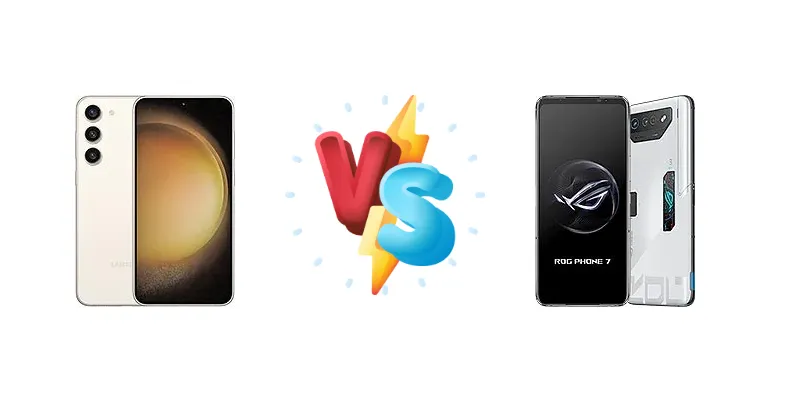
Samsung Galaxy S23+ vs. Asus ROG Phone 7 Ultimate: A Deep Dive Comparison
| Phones Images | |||||
|---|---|---|---|---|---|
|
🏆 Quick Verdict
For the average user prioritizing a balanced experience with a superb camera and compact form factor, the Samsung Galaxy S23+ is the better choice. However, dedicated mobile gamers will find the ROG Phone 7 Ultimate’s superior cooling, faster charging, and gaming-centric features worth the trade-offs.
| PHONES | ||
|---|---|---|
| Phone Names | Samsung Galaxy S23+ | Asus ROG Phone 7 Ultimate |
| Network | ||
|---|---|---|
| 2G bands | GSM 850 / 900 / 1800 / 1900 | GSM 850 / 900 / 1800 / 1900 |
| 3G bands | HSDPA 850 / 900 / 1700(AWS) / 1900 / 2100 | HSDPA 800 / 850 / 900 / 1700(AWS) / 1900 / 2100 |
| 4G bands | 1, 2, 3, 4, 5, 7, 8, 12, 13, 17, 18, 19, 20, 25, 26, 28, 32, 38, 39, 40, 41, 66 - International | 1, 2, 3, 4, 5, 7, 8, 12, 17, 18, 19, 20, 25, 26, 28, 32, 34, 38, 39, 40, 41, 42, 43, 48, 66 - International |
| 5G bands | 1, 2, 3, 5, 7, 8, 12, 20, 25, 28, 38, 40, 41, 66, 75, 77, 78 SA/NSA/Sub6 - International | 1, 2, 3, 5, 7, 8, 12, 18, 20, 25, 26, 28, 38, 40, 41, 48, 66, 77, 78, 79 SA/NSA/Sub6 - International |
| Speed | HSPA, LTE (up to 7CA), 5G | HSPA, LTE (Up to 7CA), 5G |
| Technology | GSM / CDMA / HSPA / EVDO / LTE / 5G | GSM / CDMA / HSPA / LTE / 5G |
| - | 1, 3, 5, 8, 28, 41, 77, 78, 79 SA/NSA/Sub6 - China | |
| Launch | ||
|---|---|---|
| Announced | 2023, February 01 | 2023, April 13 |
| Status | Available. Released 2023, February 17 | Available. Released 2023, May |
| Body | ||
|---|---|---|
| Build | Glass front (Gorilla Glass Victus 2), glass back (Gorilla Glass Victus 2), aluminum frame | Glass front (Gorilla Glass Victus), glass back (Gorilla Glass 3), aluminum frame |
| Dimensions | 157.8 x 76.2 x 7.6 mm (6.21 x 3.00 x 0.30 in) | 173 x 77 x 10.3 mm (6.81 x 3.03 x 0.41 in) |
| SIM | · Nano-SIM + eSIM· Nano-SIM + Nano-SIM + eSIM (max 2 at a time) | Nano-SIM + Nano-SIM |
| Weight | 196 g (6.91 oz) | 239 g (8.43 oz) |
| - | Built-in motorized cooling air vent (AeroActive Portal) IP54 water resistant 2" OLED display (on the back) Pressure sensitive zones (Gaming triggers) | |
| Display | ||
|---|---|---|
| Protection | Corning Gorilla Glass Victus 2 | Corning Gorilla Glass Victus |
| Resolution | 1080 x 2340 pixels, 19.5:9 ratio (~393 ppi density) | 1080 x 2448 pixels (~395 ppi density) |
| Size | 6.6 inches, 105.3 cm2 (~87.6% screen-to-body ratio) | 6.78 inches, 109.5 cm2 (~82.2% screen-to-body ratio) |
| Type | Dynamic AMOLED 2X, 120Hz, HDR10+, 1200 nits (HBM), 1750 nits (peak) | AMOLED, 1B colors, 165Hz, HDR10+, 1000 nits (HBM), 1500 nits (peak) |
| Platform | ||
|---|---|---|
| CPU | Octa-core (1x3.36 GHz Cortex-X3 & 2x2.8 GHz Cortex-A715 & 2x2.8 GHz Cortex-A710 & 3x2.0 GHz Cortex-A510) | Octa-core (1x3.2 GHz Cortex-X3 & 2x2.8 GHz Cortex-A715 & 2x2.8 GHz Cortex-A710 & 3x2.0 GHz Cortex-A510) |
| Chipset | Qualcomm SM8550-AC Snapdragon 8 Gen 2 (4 nm) | Qualcomm SM8550-AB Snapdragon 8 Gen 2 (4 nm) |
| GPU | Adreno 740 | Adreno 740 |
| OS | Android 13, up to 4 major Android upgrades, One UI 8 | Android 13, up to 2 major Android upgrades |
| Memory | ||
|---|---|---|
| Card slot | No | No |
| Internal | 256GB 8GB RAM, 512GB 8GB RAM | 512GB 16GB RAM |
| - | UFS 4.0 NTFS support for external storage | |
| Main Camera | ||
|---|---|---|
| Features | LED flash, auto-HDR, panorama | LED flash, HDR, panorama |
| Triple | 50 MP, f/1.8, 24mm (wide), 1/1.56", 1.0µm, dual pixel PDAF, OIS 10 MP, f/2.4, 70mm (telephoto), 1/3.94", 1.0µm, PDAF, OIS, 3x optical zoom 12 MP, f/2.2, 13mm, 120˚ (ultrawide), 1/2.55" 1.4µm, Super Steady video | 50 MP, f/1.9, 24mm (wide), 1/1.56", 1.0µm, PDAF 13 MP, f/2.2, 13mm, 120˚ (ultrawide) 5 MP (macro) |
| Video | 8K@24/30fps, 4K@30/60fps, 1080p@30/60/120/240fps, HDR10+, stereo sound rec., gyro-EIS | 8K@24fps, 4K@30/60fps, 1080p@30/60/120/240fps, 720p@480fps; gyro-EIS, HDR10+ |
| Selfie camera | ||
|---|---|---|
| Features | HDR, HDR10+ | Panorama, HDR |
| Single | 12 MP, f/2.2, 26mm (wide), 1/3.2", 1.12µm, dual pixel PDAF | 32 MP, f/2.5, 29mm (wide), 1/3.2", 0.7µm |
| Video | 4K@30/60fps, 1080p@30fps | 1080p@30fps |
| Sound | ||
|---|---|---|
| 3.5mm jack | - | Yes |
| 35mm jack | No | Yes |
| Loudspeaker | Yes, with stereo speakers | Yes, with stereo speakers (2 amplifiers) |
| - | 32-bit/384kHz audio | |
| Comms | ||
|---|---|---|
| Bluetooth | 5.3, A2DP, LE | 5.3, A2DP, LE, aptX HD, aptX Adaptive, aptX Lossless |
| NFC | Yes | Yes |
| Positioning | GPS, GLONASS, BDS, GALILEO | GPS (L1+L5), GLONASS (L1), BDS (B1I+B1c+B2a), GALILEO (E1+E5a), QZSS (L1+L5), NavIC (L5) |
| Radio | No | No |
| USB | USB Type-C 3.2, OTG | USB Type-C 3.1 (side), DisplayPort 1.4; USB Type-C 2.0 (bottom), OTG, accessory connector |
| WLAN | Wi-Fi 802.11 a/b/g/n/ac/6e, tri-band, Wi-Fi Direct | Wi-Fi 802.11 a/b/g/n/ac/6e/7, tri-band, Wi-Fi Direct |
| Features | ||
|---|---|---|
| Sensors | Fingerprint (under display, ultrasonic), accelerometer, gyro, proximity, compass, barometer | Fingerprint (under display, optical), accelerometer, gyro, proximity, compass |
| Battery | ||
|---|---|---|
| Charging | 45W wired, PD3.0, 65% in 30 min 15W wireless (Qi) 4.5W reverse wireless | 65W wired, PD3.0, QC5, 100% in 42 min 10W reverse wired |
| Type | Li-Ion 4700 mAh | Li-Po 6000 mAh |
| Misc | ||
|---|---|---|
| Colors | Phantom Black, Cream, Green, Lavender, Graphite, Lime | Storm White |
| Models | SM-S916B, SM-S916B/DS, SM-S916U, SM-S916U1, SM-S916W, SM-S916N, SM-S9160, SM-S916E, SM-S916E/DS | - |
| Price | € 399.00 / $ 277.97 / £ 424.00 / ₹ 64,999 | About 780 EUR |
| SAR | 0.95 W/kg (head) 1.04 W/kg (body) | - |
| SAR EU | 0.77 W/kg (head) 1.45 W/kg (body) | - |
| Tests | ||
|---|---|---|
| Battery life | - | Endurance rating 131h |
| Camera | - | Photo / Video |
| Display | - | Contrast ratio: Infinite (nominal) |
| Loudspeaker | - | -25.5 LUFS (Very good) |
| Performance | - | AnTuTu: 1325105 (v9) GeekBench: 5139 (v5.5), 5567 (v6) GFXBench: 107fps (ES 3.1 onscreen) |
Samsung Galaxy S23+
- Brighter display for outdoor visibility
- More compact and pocketable design
- Refined software experience and wider ecosystem
- Slower charging speed
- Less focused on gaming-specific features
- Potentially lower sustained performance under extreme load
Asus ROG Phone 7 Ultimate
- Faster 65W charging for quick top-ups
- Superior cooling system for sustained gaming
- Gaming-centric features like AirTriggers and customizable settings
- Larger and heavier design
- Lower peak display brightness
- Camera likely not as refined as the S23+
Display Comparison
Both devices utilize the Snapdragon 8 Gen 2, but their displays differ. The S23+ boasts a measured peak brightness of 1205 nits, exceeding the ROG Phone 7 Ultimate’s 1095 nits, making it more visible outdoors. While the ROG Phone 7 Ultimate claims an infinite contrast ratio, the S23+’s display technology likely offers comparable performance. The S23+’s smaller size (data not provided) contributes to a higher pixel density, potentially resulting in a sharper image. Neither device specifies PWM dimming rates, a crucial factor for users sensitive to flicker.
Camera Comparison
Both devices offer photo and video capabilities, but detailed camera specs are absent. Given Samsung’s history, the S23+ likely prioritizes image processing for vibrant, shareable photos, while Asus may lean towards a more natural look. Without sensor size or aperture information, a direct comparison is difficult. However, the ROG Phone 7 Ultimate’s gaming focus suggests camera quality is secondary to other features. The inclusion of a 2MP macro camera on either device is likely a marketing tactic with limited practical benefit.
Performance
Both phones are powered by the Qualcomm Snapdragon 8 Gen 2 (4nm), but with slight CPU clock speed variations. The S23+ features a 3.36 GHz Cortex-X3, while the ROG Phone 7 Ultimate clocks in at 3.2 GHz. This difference, while measurable, is unlikely to be noticeable in most real-world scenarios. Both utilize the same core configuration for A715, A710, and A510 cores. The ROG Phone 7 Ultimate’s cooling system, a hallmark of the ROG series, is expected to provide superior sustained performance under heavy load, mitigating thermal throttling during extended gaming sessions. Both utilize LPDDR5x RAM (spec not provided, but standard for this tier).
Battery Life
The Asus ROG Phone 7 Ultimate boasts an endurance rating of 131 hours, slightly exceeding the Samsung Galaxy S23+'s 111-hour rating. However, the S23+ delivers a solid 13:51h of active use. The ROG Phone 7 Ultimate’s 65W wired charging, completing a full charge in 42 minutes, is significantly faster than the S23+'s 45W charging (65% in 30 minutes). The ROG Phone 7 Ultimate also offers 10W reverse wired charging, a unique feature absent on the S23+, which provides 4.5W reverse wireless charging. The ROG Phone 7 Ultimate’s faster charging is a significant advantage for gamers who need to quickly top up their battery between matches.
Buying Guide
Buy the Samsung Galaxy S23+ if you need a premium smartphone with a versatile camera system, a more manageable size for one-handed use, and a polished software experience. Buy the Asus ROG Phone 7 Ultimate if you prioritize maximum gaming performance, extended play sessions thanks to its advanced cooling, and don't mind a larger, more specialized device.