
Samsung Galaxy S23+ vs. iPhone 14 Pro Max: The Ultimate Flagship Face-Off
| Phones Images | |||||
|---|---|---|---|---|---|
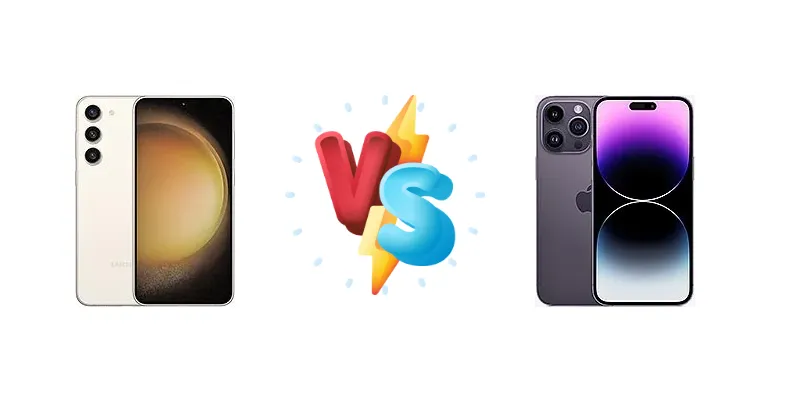
|
🏆 Quick Verdict
For the average user prioritizing raw processing power and a brighter, more vibrant display, the iPhone 14 Pro Max takes a slight edge. However, the Samsung Galaxy S23+ offers a compelling alternative with faster charging, a more open ecosystem, and a competitive price point, making it a strong contender.
| PHONES | ||
|---|---|---|
| Phone Names | Samsung Galaxy S23+ | Apple iPhone 14 Pro Max |
| Network | ||
|---|---|---|
| 2G bands | GSM 850 / 900 / 1800 / 1900 | GSM 850 / 900 / 1800 / 1900 |
| 3G bands | HSDPA 850 / 900 / 1700(AWS) / 1900 / 2100 | HSDPA 850 / 900 / 1700(AWS) / 1900 / 2100 |
| 4G bands | 1, 2, 3, 4, 5, 7, 8, 12, 13, 17, 18, 19, 20, 25, 26, 28, 32, 38, 39, 40, 41, 66 - International | 1, 2, 3, 4, 5, 7, 8, 12, 13, 17, 18, 19, 20, 25, 26, 28, 30, 32, 34, 38, 39, 40, 41, 42, 46, 48, 66 - A2894, A2896 |
| 5G bands | 1, 2, 3, 5, 7, 8, 12, 20, 25, 28, 38, 40, 41, 66, 75, 77, 78 SA/NSA/Sub6 - International | 1, 2, 3, 5, 7, 8, 12, 20, 25, 26, 28, 30, 38, 40, 41, 48, 66, 70, 77, 78, 79 SA/NSA/Sub6 - A2894, A2896 |
| Speed | HSPA, LTE (up to 7CA), 5G | HSPA, LTE, 5G, EV-DO Rev.A 3.1 Mbps |
| Technology | GSM / CDMA / HSPA / EVDO / LTE / 5G | GSM / CDMA / HSPA / EVDO / LTE / 5G |
| - | 1, 2, 3, 5, 7, 8, 12, 20, 25, 26, 28, 30, 38, 40, 41, 48, 66, 70, 77, 78, 79 SA/NSA/Sub6 - A2895 | |
| Launch | ||
|---|---|---|
| Announced | 2023, February 01 | 2022, September 07 |
| Status | Available. Released 2023, February 17 | Available. Released 2022, September 16 |
| Body | ||
|---|---|---|
| Build | Glass front (Gorilla Glass Victus 2), glass back (Gorilla Glass Victus 2), aluminum frame | Glass front, glass back, stainless steel frame |
| Dimensions | 157.8 x 76.2 x 7.6 mm (6.21 x 3.00 x 0.30 in) | 160.7 x 77.6 x 7.9 mm (6.33 x 3.06 x 0.31 in) |
| SIM | · Nano-SIM + eSIM· Nano-SIM + Nano-SIM + eSIM (max 2 at a time) | · Nano-SIM + eSIM + eSIM (max 2 at a time; International)· eSIM + eSIM (8 or more, max 2 at a time; USA)· Nano-SIM + Nano-SIM (China) |
| Weight | 196 g (6.91 oz) | 240 g (8.47 oz) |
| - | IP68 dust/water resistant (up to 6m for 30 min) Apple Pay (Visa, MasterCard, AMEX certified) | |
| Display | ||
|---|---|---|
| Protection | Corning Gorilla Glass Victus 2 | Ceramic Shield glass |
| Resolution | 1080 x 2340 pixels, 19.5:9 ratio (~393 ppi density) | 1290 x 2796 pixels, 19.5:9 ratio (~460 ppi density) |
| Size | 6.6 inches, 105.3 cm2 (~87.6% screen-to-body ratio) | 6.7 inches, 110.2 cm2 (~88.3% screen-to-body ratio) |
| Type | Dynamic AMOLED 2X, 120Hz, HDR10+, 1200 nits (HBM), 1750 nits (peak) | LTPO Super Retina XDR OLED, 120Hz, HDR10, Dolby Vision, 1000 nits (typ), 2000 nits (HBM) |
| - | Always-On display | |
| Platform | ||
|---|---|---|
| CPU | Octa-core (1x3.36 GHz Cortex-X3 & 2x2.8 GHz Cortex-A715 & 2x2.8 GHz Cortex-A710 & 3x2.0 GHz Cortex-A510) | Hexa-core (2x3.46 GHz Everest + 4x2.02 GHz Sawtooth) |
| Chipset | Qualcomm SM8550-AC Snapdragon 8 Gen 2 (4 nm) | Apple A16 Bionic (4 nm) |
| GPU | Adreno 740 | Apple GPU (5-core graphics) |
| OS | Android 13, up to 4 major Android upgrades, One UI 8 | iOS 16, upgradable to iOS 26.1 |
| Memory | ||
|---|---|---|
| Card slot | No | No |
| Internal | 256GB 8GB RAM, 512GB 8GB RAM | 128GB 6GB RAM, 256GB 6GB RAM, 512GB 6GB RAM, 1TB 6GB RAM |
| - | NVMe | |
| Main Camera | ||
|---|---|---|
| Features | LED flash, auto-HDR, panorama | Dual-LED dual-tone flash, HDR (photo/panorama) |
| Single | - | 12 MP, f/1.9, 23mm (wide), 1/3.6", PDAF, OIS (unconfirmed) SL 3D, (depth/biometrics sensor) |
| Triple | 50 MP, f/1.8, 24mm (wide), 1/1.56", 1.0µm, dual pixel PDAF, OIS 10 MP, f/2.4, 70mm (telephoto), 1/3.94", 1.0µm, PDAF, OIS, 3x optical zoom 12 MP, f/2.2, 13mm, 120˚ (ultrawide), 1/2.55" 1.4µm, Super Steady video | 48 MP, f/1.8, 24mm (wide), 1/1.28", 1.22µm, dual pixel PDAF, sensor-shift OIS 12 MP, f/2.8, 77mm (telephoto), 1/3.5", 1.0µm, PDAF, OIS, 3x optical zoom 12 MP, f/2.2, 13mm, 120˚ (ultrawide), 1/2.55", 1.4µm, dual pixel PDAF TOF 3D LiDAR scanner (depth) |
| Video | 8K@24/30fps, 4K@30/60fps, 1080p@30/60/120/240fps, HDR10+, stereo sound rec., gyro-EIS | 4K@24/25/30/60fps, 1080p@25/30/60/120/240fps, 10-bit HDR, Dolby Vision HDR (up to 60fps), ProRes, stereo sound rec. |
| Selfie camera | ||
|---|---|---|
| Features | HDR, HDR10+ | HDR |
| Single | 12 MP, f/2.2, 26mm (wide), 1/3.2", 1.12µm, dual pixel PDAF | 12 MP, f/1.9, 23mm (wide), 1/3.6", 1.0µm, PDAF, OIS SL 3D, (depth/biometrics sensor) |
| Video | 4K@30/60fps, 1080p@30fps | 4K@24/25/30/60fps, 1080p@25/30/60/120fps, gyro-EIS |
| Sound | ||
|---|---|---|
| 3.5mm jack | - | No |
| 35mm jack | No | No |
| Loudspeaker | Yes, with stereo speakers | Yes, with stereo speakers |
| Comms | ||
|---|---|---|
| Bluetooth | 5.3, A2DP, LE | 5.3, A2DP, LE |
| NFC | Yes | Yes |
| Positioning | GPS, GLONASS, BDS, GALILEO | GPS (L1+L5), GLONASS, GALILEO, BDS, QZSS |
| Radio | No | No |
| USB | USB Type-C 3.2, OTG | Lightning, USB 2.0 |
| WLAN | Wi-Fi 802.11 a/b/g/n/ac/6e, tri-band, Wi-Fi Direct | Wi-Fi 802.11 a/b/g/n/ac/6, dual-band, hotspot |
| Features | ||
|---|---|---|
| Sensors | Fingerprint (under display, ultrasonic), accelerometer, gyro, proximity, compass, barometer | Face ID, accelerometer, gyro, proximity, compass, barometer |
| - | Ultra Wideband (UWB) support Emergency SOS via satellite (SMS sending/receiving) | |
| Battery | ||
|---|---|---|
| Charging | 45W wired, PD3.0, 65% in 30 min 15W wireless (Qi) 4.5W reverse wireless | Wired, PD2.0, 50% in 30 min 15W wireless (MagSafe) 15W wireless (Qi2) - requires iOS 17.2 update |
| Type | Li-Ion 4700 mAh | Li-Ion 4323 mAh (16.68 Wh) |
| Misc | ||
|---|---|---|
| Colors | Phantom Black, Cream, Green, Lavender, Graphite, Lime | Space Black, Silver, Gold, Deep Purple |
| Models | SM-S916B, SM-S916B/DS, SM-S916U, SM-S916U1, SM-S916W, SM-S916N, SM-S9160, SM-S916E, SM-S916E/DS | A2894, A2651, A2893, A2895, A2896, iphone15,3 |
| Price | € 399.00 / $ 277.97 / £ 424.00 / ₹ 64,999 | € 530.79 / $ 489.81 / £ 446.75 |
| SAR | 0.95 W/kg (head) 1.04 W/kg (body) | 1.15 W/kg (head) 1.07 W/kg (body) |
| SAR EU | 0.77 W/kg (head) 1.45 W/kg (body) | 0.99 W/kg (head) 0.98 W/kg (body) |
| Tests | ||
|---|---|---|
| Battery life | - | Endurance rating 121h |
| Camera | - | Photo / Video |
| Display | - | Contrast ratio: Infinite (nominal) |
| Loudspeaker | - | -24.3 LUFS (Very good) |
| Performance | - | AnTuTu: 955884 (v9) GeekBench: 5423 (v5.1) GFXBench: 54fps (ES 3.1 onscreen) |
Samsung Galaxy S23+
- Faster 45W wired charging
- More customizable Android OS
- Reverse wireless charging capability
- Lower peak display brightness
- Slightly lower battery endurance rating
Apple iPhone 14 Pro Max
- Significantly brighter display
- Superior single-core performance
- MagSafe wireless charging
- Slower wired charging
- Less flexible iOS ecosystem
Display Comparison
The iPhone 14 Pro Max boasts a substantially brighter display, reaching a measured 1760 nits compared to the S23+'s 1205 nits. This difference is particularly noticeable outdoors under direct sunlight. Both feature 120Hz refresh rates for smooth scrolling, but the iPhone’s ‘infinite’ contrast ratio (typical of OLED) delivers deeper blacks. While both are excellent, the iPhone’s display is demonstrably superior for HDR content and outdoor use. The S23+ benefits from a potentially lower risk of burn-in due to Samsung’s pixel shifting technology, though both utilize OLED panels.
Camera Comparison
Both devices excel in photography and videography, but approach image processing differently. While both offer excellent dynamic range and detail, the iPhone 14 Pro Max leans towards more natural color reproduction, while the S23+ tends to boost saturation. The context data doesn't provide sensor size details, but both likely employ large sensors for improved low-light performance. The iPhone’s Cinematic mode for video remains a standout feature, while Samsung’s enhanced night mode capabilities are noteworthy. The absence of detailed camera specs necessitates a focus on software processing, where Apple’s computational photography is highly refined.
Performance
Under the hood, the iPhone 14 Pro Max’s Apple A16 Bionic (4nm) and the S23+'s Qualcomm Snapdragon 8 Gen 2 (4nm) represent cutting-edge mobile silicon. The A16’s hexa-core architecture, with its two high-performance Everest cores clocked at 3.46 GHz, delivers exceptional single-core performance. The Snapdragon 8 Gen 2’s octa-core configuration, while offering more cores, focuses on a balance of performance and efficiency. While benchmarks often show the A16 leading in single-core tasks, the Snapdragon 8 Gen 2 excels in sustained multi-core workloads due to its superior thermal management. The S23+’s 4nm process node contributes to better efficiency, potentially mitigating throttling during extended gaming sessions.
Battery Life
The iPhone 14 Pro Max achieves an endurance rating of 121 hours, slightly edging out the S23+'s 111-hour rating. However, the S23+ compensates with significantly faster charging – 65% in 30 minutes with 45W wired charging, compared to the iPhone’s 50% in 30 minutes with PD2.0. Both support 15W wireless charging, but the iPhone 14 Pro Max benefits from MagSafe, offering a more secure and efficient wireless charging experience. The S23+ also includes 4.5W reverse wireless charging, a feature absent on the iPhone.
Buying Guide
Buy the Samsung Galaxy S23+ if you need the flexibility of Android, prioritize faster charging speeds (45W vs. 50% in 30 min for iPhone), and appreciate a more customizable user experience. Buy the Apple iPhone 14 Pro Max if you prefer the seamless integration of the Apple ecosystem, demand the absolute best sustained performance, and value a significantly brighter display for outdoor visibility.