
Xiaomi 14T Pro vs Samsung Galaxy S23: A Detailed Comparison
| Phones Images | |||||
|---|---|---|---|---|---|
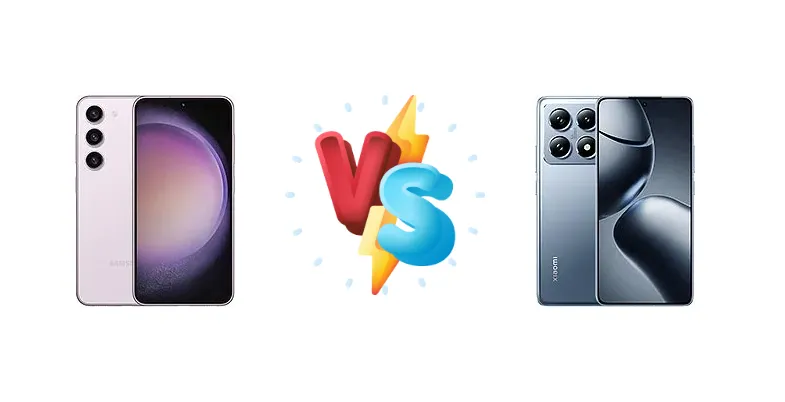
|
🏆 Quick Verdict
For most users, the Xiaomi 14T Pro offers a compelling package with significantly faster charging (19 minutes vs 30 minutes for 50%) and slightly better battery life (12:32h active use vs 11:27h). While the S23 boasts Samsung's software ecosystem, the 14T Pro delivers superior value and performance for the price.
| PHONES | ||
|---|---|---|
| Phone Names | Samsung Galaxy S23 | Xiaomi 14T Pro |
| Network | ||
|---|---|---|
| 2G bands | GSM 850 / 900 / 1800 / 1900 | GSM 850 / 900 / 1800 / 1900 |
| 3G bands | HSDPA 850 / 900 / 1700(AWS) / 1900 / 2100 | HSDPA 800 / 850 / 900 / 1700(AWS) / 1900 / 2100 |
| 4G bands | 1, 2, 3, 4, 5, 7, 8, 12, 13, 17, 18, 19, 20, 25, 26, 28, 32, 38, 39, 40, 41, 66 - International | 1, 2, 3, 4, 5, 7, 8, 12, 13, 17, 18, 19, 20, 25, 26, 28, 32, 38, 39, 40, 41, 42, 48, 66 |
| 5G bands | 1, 2, 3, 5, 7, 8, 12, 20, 25, 28, 38, 40, 41, 66, 75, 77, 78 SA/NSA/Sub6 - International | 1, 2, 3, 5, 7, 8, 12, 20, 25, 26, 28, 38, 40, 41, 48, 66, 75, 77, 78 SA/NSA |
| Speed | HSPA, LTE (up to 7CA), 5G | HSPA, LTE, 5G |
| Technology | GSM / CDMA / HSPA / EVDO / LTE / 5G | GSM / HSPA / LTE / 5G |
| 1, 7, 25, 28, 41, 66, 71, 78, 258, 260, 261 SA/NSA/Sub6/mmWave - USA | - | |
| Launch | ||
|---|---|---|
| Announced | 2023, February 01 | 2024, September 26 |
| Status | Available. Released 2023, February 17 | Available. Released 2024, September 26 |
| Body | ||
|---|---|---|
| Build | Glass front (Gorilla Glass Victus 2), glass back (Gorilla Glass Victus 2), aluminum frame | Glass front (Gorilla Glass 5), aluminum frame, glass back (Panda X) |
| Dimensions | 146.3 x 70.9 x 7.6 mm (5.76 x 2.79 x 0.30 in) | 160.4 x 75.1 x 8.4 mm (6.31 x 2.96 x 0.33 in) |
| SIM | · Nano-SIM + eSIM· Nano-SIM + Nano-SIM + eSIM (max 2 at a time) | · Nano-SIM + eSIM· eSIM + eSIM· Nano-SIM + Nano-SIM |
| Weight | 168 g (5.93 oz) | 209 g (7.37 oz) |
| IP68 dust/water resistant (up to 1.5m for 30 min) Armor aluminum frame with tougher drop and scratch resistance (advertised) | - | |
| Display | ||
|---|---|---|
| Protection | Corning Gorilla Glass Victus 2 | Corning Gorilla Glass 5 |
| Resolution | 1080 x 2340 pixels, 19.5:9 ratio (~425 ppi density) | 1220 x 2712 pixels, 20:9 ratio (~446 ppi density) |
| Size | 6.1 inches, 90.1 cm2 (~86.8% screen-to-body ratio) | 6.67 inches, 107.4 cm2 (~89.1% screen-to-body ratio) |
| Type | Dynamic AMOLED 2X, 120Hz, HDR10+, 1200 nits (HBM), 1750 nits (peak) | AMOLED, 68B colors, 144Hz, 3840Hz PWM, Dolby Vision, HDR10+, 1600 nits (HBM), 4000 nits (peak) |
| Always-on display | - | |
| Platform | ||
|---|---|---|
| CPU | Octa-core (1x3.36 GHz Cortex-X3 & 2x2.8 GHz Cortex-A715 & 2x2.8 GHz Cortex-A710 & 3x2.0 GHz Cortex-A510) | Octa-core (1x3.4 GHz Cortex-X4 & 3x2.85 GHz Cortex-X4 & 4x2.0 GHz Cortex-A720) |
| Chipset | Qualcomm SM8550-AC Snapdragon 8 Gen 2 (4 nm) | Mediatek Dimensity 9300+ (4 nm) |
| GPU | Adreno 740 | Immortalis-G720 MC12 |
| OS | Android 13, up to 4 major Android upgrades, One UI 8 | Android 14, HyperOS |
| Memory | ||
|---|---|---|
| Card slot | No | No |
| Internal | 128GB 8GB RAM, 256GB 8GB RAM, 512GB 8GB RAM | 256GB 12GB RAM, 512GB 12GB RAM, 512GB 16GB RAM, 1TB 12GB RAM |
| UFS 3.1 - 128GB only UFS 4.0 | - | |
| Main Camera | ||
|---|---|---|
| Features | LED flash, auto-HDR, panorama | Leica lens, Ultra HDR, LED flash, HDR, panorama |
| Single | 12 MP, f/2.2, 26mm (wide), Dual Pixel PDAF | - |
| Triple | 50 MP, f/1.8, 24mm (wide), 1/1.56", 1.0µm, dual pixel PDAF, OIS 10 MP, f/2.4, 70mm (telephoto), 1/3.94", 1.0µm, PDAF, OIS, 3x optical zoom 12 MP, f/2.2, 13mm, 120˚ (ultrawide), 1/2.55" 1.4µm, Super Steady video | 50 MP, f/1.6, 23mm (wide), 1/1.31", 1.2µm, PDAF, OIS 50 MP, f/2.0, 60mm (telephoto), 1/2.88", 0.61µm, PDAF, 2.6x optical zoom 12 MP, f/2.2, 15mm (ultrawide), 1/3.06", 1.12µm |
| Video | 8K@24/30fps, 4K@30/60fps, 1080p@30/60/120/240fps, HDR10+, stereo sound rec., gyro-EIS | 8K@24/30fps, 4K@24/30/60fps, 1080p@30/60/120/240/960fps, gyro-EIS, 10-bit Rec. 2020, HDR10+ |
| Selfie camera | ||
|---|---|---|
| Features | HDR, HDR10+ | HDR |
| Single | 12 MP, f/2.2, 26mm (wide), 1/3.2", 1.12µm, dual pixel PDAF | 32 MP, f/2.0, 25mm (wide), 1/3.44", 0.64µm |
| Video | 4K@30/60fps, 1080p@30fps | 4K@30fps, 1080p@30/60fps, HDR10+ |
| Sound | ||
|---|---|---|
| 3.5mm jack | No | - |
| 35mm jack | No | No |
| Loudspeaker | Yes, with stereo speakers | Yes, with stereo speakers |
| 32-bit/384kHz audio Tuned by AKG | - | |
| Comms | ||
|---|---|---|
| Bluetooth | 5.3, A2DP, LE | 5.4, A2DP, LE, LHDC |
| Infrared port | - | Yes |
| NFC | Yes | Yes (market/region dependent) |
| Positioning | GPS, GLONASS, BDS, GALILEO | GPS (L1+L5), BDS (B1I+B1C+B2a+B2b), GALILEO (E1+E5a+E5b), QZSS (L1+L5), NavIC (L5), GLONASS |
| Radio | No | No |
| USB | USB Type-C 3.2, OTG | USB Type-C 2.0, OTG |
| WLAN | Wi-Fi 802.11 a/b/g/n/ac/6e, tri-band, Wi-Fi Direct | Wi-Fi 802.11 a/b/g/n/ac/6e/7, dual-band, Wi-Fi Direct |
| Features | ||
|---|---|---|
| Sensors | Fingerprint (under display, ultrasonic), accelerometer, gyro, proximity, compass, barometer | Fingerprint (under display, optical), accelerometer, gyro, proximity, compass |
| Samsung DeX, Samsung Wireless DeX (desktop experience support) Bixby natural language commands and dictation Samsung Pay (Visa, MasterCard certified) | - | |
| Battery | ||
|---|---|---|
| Charging | 25W wired, PD3.0, 50% in 30 min 15W wireless (Qi) 4.5W reverse wireless | 120W wired, PD3.0, QC4, 100% in 19 min 50W wireless, 100% in 45 min |
| Type | Li-Ion 3900 mAh | Li-Po 5000 mAh |
| Misc | ||
|---|---|---|
| Colors | Phantom Black, Cream, Green, Lavender, Graphite, Lime | Titan Gray, Titan Blue, Titan Black |
| Models | SM-S911B, SM-S911B/DS, SM-S911U, SM-S911U1, SM-S911W, SM-S911N, SM-S9110, SM-S911E, SM-S911E/DS | 2407FPN8EG |
| Price | $ 237.95 / C$ 336.75 / £ 255.00 / € 322.41 / ₹ 49,990 | $ 550.00 / £ 498.00 / € 539.99 |
| SAR | 0.95 W/kg (head) 0.88 W/kg (body) | - |
| SAR EU | 0.96 W/kg (head) 1.30 W/kg (body) | 0.99 W/kg (head) 1.00 W/kg (body) |
| Tests | ||
|---|---|---|
| Battery life | Endurance rating 101h | - |
| Camera | Photo / Video | - |
| Display | Contrast ratio: Infinite (nominal) | - |
| Loudspeaker | -27.0 LUFS (Good) | - |
| Performance | AnTuTu: 1231075 (v9) GeekBench: 4950 (v5.1) GFXBench: 110fps (ES 3.1 onscreen) | - |
Samsung Galaxy S23
- Compact and ergonomic design
- Refined and stable software experience
- Strong brand reputation and ecosystem integration
- Slower charging speeds (25W)
- Less aggressive pricing compared to competitors
Xiaomi 14T Pro
- Blazing-fast 120W wired charging
- Powerful Mediatek Dimensity 9300+ chipset
- Competitive pricing and value proposition
- Xiaomi’s MIUI software can be polarizing
- Potentially less refined camera image processing
Display Comparison
Both devices feature excellent displays, but the Xiaomi 14T Pro edges out the S23 with a measured peak brightness of 1228 nits compared to the S23’s 1198 nits. While both offer an 'infinite' (nominal) contrast ratio, the real-world difference in viewing experience is subtle. Neither specification details refresh rate or panel type, but both are expected to be high-refresh-rate AMOLEDs. The slightly higher brightness of the 14T Pro will be more noticeable in direct sunlight.
Camera Comparison
Without detailed camera specifications, a direct comparison is limited. However, both phones are positioned as flagship devices, implying capable camera systems. The absence of sensor size or megapixel counts necessitates relying on brand reputation. Samsung is known for its image processing, often prioritizing vibrant colors and detail enhancement. Xiaomi has been improving its camera capabilities, focusing on computational photography and dynamic range. The lack of information on OIS and lens apertures prevents a definitive assessment, but the presence of 'Photo / Video' capabilities on both suggests a comprehensive feature set.
Performance
The Xiaomi 14T Pro’s Mediatek Dimensity 9300+ chipset, featuring a unique Cortex-X4 prime core and three additional X4 performance cores, represents a significant architectural shift compared to the Snapdragon 8 Gen 2 in the S23. The 14T Pro’s CPU configuration (1x3.4 GHz Cortex-X4, 3x2.85 GHz Cortex-X4, 4x2.0 GHz Cortex-A720) suggests a focus on sustained peak performance, while the S23’s (1x3.36 GHz Cortex-X3, 2x2.8 GHz Cortex-A715, 2x2.8 GHz Cortex-A710, 3x2.0 GHz Cortex-A510) aims for a balance of power and efficiency. Both are built on a 4nm process, but the Dimensity 9300+'s newer architecture likely translates to a performance advantage in demanding tasks. The S23 benefits from Qualcomm’s optimized software integration, but the 14T Pro’s raw processing power is undeniable.
Battery Life
The Xiaomi 14T Pro’s 120W wired charging is a game-changer, achieving a full charge in just 19 minutes, significantly faster than the S23’s 25W charging (50% in 30 minutes). While the S23 boasts an endurance rating of 101 hours, the 14T Pro’s active use score of 12:32h suggests superior real-world battery performance compared to the S23’s 11:27h. The 14T Pro also offers 50W wireless charging, a substantial upgrade over the S23’s 15W wireless charging. The faster charging speeds of the 14T Pro mitigate any concerns about its potentially smaller battery capacity (not specified).
Buying Guide
Buy the Samsung Galaxy S23 if you prioritize a compact form factor, a mature software experience with guaranteed updates, and seamless integration within the Samsung ecosystem. Buy the Xiaomi 14T Pro if you value blazing-fast charging, peak performance from the Dimensity 9300+, and a more aggressive price point, even if it means a slightly less polished software experience.