
Samsung Galaxy S23 vs. Sony Xperia 1 VII: A Head-to-Head Flagship Battle
| Phones Images | |||||
|---|---|---|---|---|---|
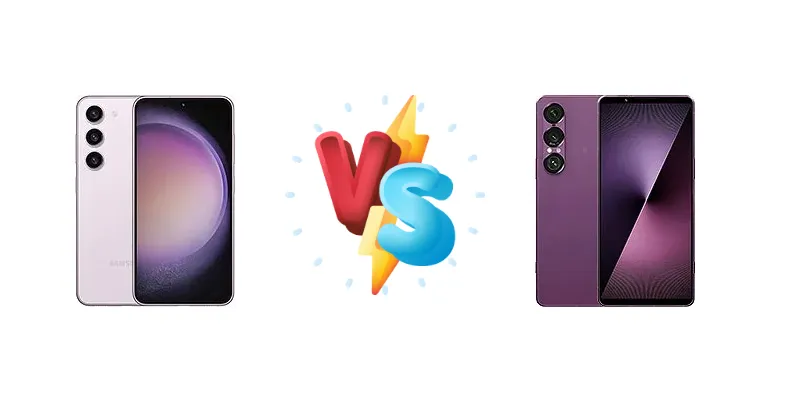
|
🏆 Quick Verdict
For most users, the Sony Xperia 1 VII emerges as the superior choice. Its significantly longer battery life – boasting an active use score of 15:32h versus the S23’s 11:27h – and the more efficient Snapdragon 8 Elite chipset provide a smoother, more sustained experience. While the S23 remains a capable device, the Xperia 1 VII offers a substantial leap in longevity.
| PHONES | ||
|---|---|---|
| Phone Names | Samsung Galaxy S23 | Sony Xperia 1 VII |
| Network | ||
|---|---|---|
| 2G bands | GSM 850 / 900 / 1800 / 1900 | GSM 850 / 900 / 1800 / 1900 |
| 3G bands | HSDPA 850 / 900 / 1700(AWS) / 1900 / 2100 | HSDPA 800 / 850 / 900 / 1700(AWS) / 1900 / 2100 |
| 4G bands | 1, 2, 3, 4, 5, 7, 8, 12, 13, 17, 18, 19, 20, 25, 26, 28, 32, 38, 39, 40, 41, 66 - International | 1, 2, 3, 4, 5, 7, 8, 12, 13, 17, 19, 20, 25, 26, 28, 32, 34, 38, 39, 40, 41, 66 - Europe |
| 5G bands | 1, 2, 3, 5, 7, 8, 12, 20, 25, 28, 38, 40, 41, 66, 75, 77, 78 SA/NSA/Sub6 - International | 1, 3, 5, 7, 8, 20, 28, 38, 40, 41, 75, 77, 78 SA/NSA/Sub6 - Europe |
| Speed | HSPA, LTE (up to 7CA), 5G | HSPA, LTE, 5G |
| Technology | GSM / CDMA / HSPA / EVDO / LTE / 5G | GSM / HSPA / LTE / 5G |
| 1, 7, 25, 28, 41, 66, 71, 78, 258, 260, 261 SA/NSA/Sub6/mmWave - USA | - | |
| Launch | ||
|---|---|---|
| Announced | 2023, February 01 | 2025, May 13 |
| Status | Available. Released 2023, February 17 | Available. Released 2025, June 04 |
| Body | ||
|---|---|---|
| Build | Glass front (Gorilla Glass Victus 2), glass back (Gorilla Glass Victus 2), aluminum frame | Glass front (Gorilla Glass Victus 2), glass back (Gorilla Glass Victus), aluminum frame |
| Dimensions | 146.3 x 70.9 x 7.6 mm (5.76 x 2.79 x 0.30 in) | 162 x 74 x 8.2 mm (6.38 x 2.91 x 0.32 in) |
| SIM | · Nano-SIM + eSIM· Nano-SIM + Nano-SIM + eSIM (max 2 at a time) | · Nano-SIM + eSIM· Nano-SIM + Nano-SIM |
| Weight | 168 g (5.93 oz) | 197 g (6.95 oz) |
| IP68 dust/water resistant (up to 1.5m for 30 min) Armor aluminum frame with tougher drop and scratch resistance (advertised) | - | |
| Display | ||
|---|---|---|
| Protection | Corning Gorilla Glass Victus 2 | Corning Gorilla Glass Victus 2, Mohs level 5 |
| Resolution | 1080 x 2340 pixels, 19.5:9 ratio (~425 ppi density) | 1080 x 2340 pixels, 19.5:9 ratio (~396 ppi density) |
| Size | 6.1 inches, 90.1 cm2 (~86.8% screen-to-body ratio) | 6.5 inches, 103.7 cm2 (~86.5% screen-to-body ratio) |
| Type | Dynamic AMOLED 2X, 120Hz, HDR10+, 1200 nits (HBM), 1750 nits (peak) | LTPO OLED, 1B colors, 120Hz, HDR BT.2020 |
| Always-on display | - | |
| Platform | ||
|---|---|---|
| CPU | Octa-core (1x3.36 GHz Cortex-X3 & 2x2.8 GHz Cortex-A715 & 2x2.8 GHz Cortex-A710 & 3x2.0 GHz Cortex-A510) | Octa-core (2x4.32 GHz Oryon V2 Phoenix L + 6x3.53 GHz Oryon V2 Phoenix M) |
| Chipset | Qualcomm SM8550-AC Snapdragon 8 Gen 2 (4 nm) | Qualcomm SM8750-AB Snapdragon 8 Elite (3 nm) |
| GPU | Adreno 740 | Adreno 830 |
| OS | Android 13, up to 4 major Android upgrades, One UI 8 | Android 15, up to 4 major Android upgrades |
| Memory | ||
|---|---|---|
| Card slot | No | microSDXC (uses shared SIM slot) |
| Internal | 128GB 8GB RAM, 256GB 8GB RAM, 512GB 8GB RAM | 256GB 12GB RAM, 512GB 12GB RAM |
| UFS 3.1 - 128GB only UFS 4.0 | - | |
| Main Camera | ||
|---|---|---|
| Features | LED flash, auto-HDR, panorama | Zeiss optics, Zeiss T* lens coating, color spectrum sensor, LED flash, panorama, HDR, eye tracking |
| Single | 12 MP, f/2.2, 26mm (wide), Dual Pixel PDAF | - |
| Triple | 50 MP, f/1.8, 24mm (wide), 1/1.56", 1.0µm, dual pixel PDAF, OIS 10 MP, f/2.4, 70mm (telephoto), 1/3.94", 1.0µm, PDAF, OIS, 3x optical zoom 12 MP, f/2.2, 13mm, 120˚ (ultrawide), 1/2.55" 1.4µm, Super Steady video | 48 MP, f/1.9, 24mm (wide), 1/1.35", 1.12µm, dual pixel PDAF, OIS 12 MP, f/2.3, 85mm (telephoto), f/3.5, 170mm (telephoto), 1/3.5", 1.0µm, dual pixel PDAF, 3.5x-7.1x continuous optical zoom, OIS, 4cm macro @ 120mm, no AF 48 MP, f/2.0, 16mm (ultrawide), 1/1.56", 1.0µm, PDAF |
| Video | 8K@24/30fps, 4K@30/60fps, 1080p@30/60/120/240fps, HDR10+, stereo sound rec., gyro-EIS | 4K@24/30/60/120fps HDR, 1080p@30/60/120fps; 5-axis gyro-EIS, OIS |
| Selfie camera | ||
|---|---|---|
| Features | HDR, HDR10+ | HDR |
| Single | 12 MP, f/2.2, 26mm (wide), 1/3.2", 1.12µm, dual pixel PDAF | 12 MP, f/2.0, 24mm (wide), 1/2.9", 1.22µm |
| Video | 4K@30/60fps, 1080p@30fps | 4K@30/60fps, 1080p@30/60fps, 5-axis gyro-EIS |
| Sound | ||
|---|---|---|
| 3.5mm jack | No | - |
| 35mm jack | No | Yes |
| Loudspeaker | Yes, with stereo speakers | Yes, with stereo speakers |
| 32-bit/384kHz audio Tuned by AKG | - | |
| Comms | ||
|---|---|---|
| Bluetooth | 5.3, A2DP, LE | 6.0, A2DP, LE Audio, aptX HD, aptX Adaptive, aptX Lossless |
| NFC | Yes | Yes |
| Positioning | GPS, GLONASS, BDS, GALILEO | GPS, GLONASS, BDS, GALILEO, QZSS |
| Radio | No | No |
| USB | USB Type-C 3.2, OTG | USB Type-C 3.2, OTG, video output |
| WLAN | Wi-Fi 802.11 a/b/g/n/ac/6e, tri-band, Wi-Fi Direct | Wi-Fi 802.11 a/b/g/n/ac/6e/7, tri-band, Wi-Fi Direct, DLNA |
| Features | ||
|---|---|---|
| Sensors | Fingerprint (under display, ultrasonic), accelerometer, gyro, proximity, compass, barometer | Fingerprint (side-mounted), accelerometer, gyro, proximity, barometer, compass |
| Samsung DeX, Samsung Wireless DeX (desktop experience support) Bixby natural language commands and dictation Samsung Pay (Visa, MasterCard certified) | - | |
| Battery | ||
|---|---|---|
| Charging | 25W wired, PD3.0, 50% in 30 min 15W wireless (Qi) 4.5W reverse wireless | 30W wired, PD3.0, PPS, 50% in 30 min 15W wireless Reverse wireless |
| Type | Li-Ion 3900 mAh | 5000 mAh |
| Misc | ||
|---|---|---|
| Colors | Phantom Black, Cream, Green, Lavender, Graphite, Lime | Moss Green, Orchid Purple, Slate Black |
| Models | SM-S911B, SM-S911B/DS, SM-S911U, SM-S911U1, SM-S911W, SM-S911N, SM-S9110, SM-S911E, SM-S911E/DS | XQ-FS54, XQFS54EUKCG.GC, XQFS54EUKCV.GC, XQFS54EUKCB.GC, PDX256 |
| Price | $ 237.95 / C$ 336.75 / £ 255.00 / € 322.41 / ₹ 49,990 | € 1,338.99 / $ 1,394.99 / £ 1,149.94 |
| SAR | 0.95 W/kg (head) 0.88 W/kg (body) | - |
| SAR EU | 0.96 W/kg (head) 1.30 W/kg (body) | - |
| Tests | ||
|---|---|---|
| Battery life | Endurance rating 101h | - |
| Camera | Photo / Video | - |
| Display | Contrast ratio: Infinite (nominal) | - |
| Loudspeaker | -27.0 LUFS (Good) | - |
| Performance | AnTuTu: 1231075 (v9) GeekBench: 4950 (v5.1) GFXBench: 110fps (ES 3.1 onscreen) | - |
| EU LABEL | ||
|---|---|---|
| Battery | - | 43:30h endurance, 1400 cycles |
| Energy | - | Class B |
| Free fall | - | Class B (181 falls) |
| Repairability | - | Class D |
Samsung Galaxy S23
- More compact and pocketable design.
- Well-established software and accessory ecosystem.
- Excellent display quality with high brightness.
- Significantly shorter battery life compared to the Xperia 1 VII.
- Less powerful and efficient chipset.
- Potential for more thermal throttling under heavy load.
Sony Xperia 1 VII
- Exceptional battery life with a 15:32h active use score.
- Cutting-edge Snapdragon 8 Elite chipset for superior performance.
- Potentially better camera image quality due to Sony’s expertise.
- Likely larger and heavier than the Galaxy S23.
- Sony’s software experience may not appeal to all users.
- Potentially higher price point.
Display Comparison
Both devices feature high-quality displays, but the Sony Xperia 1 VII edges ahead with a measured peak brightness of 1475 nits compared to the S23’s 1198 nits. This translates to better visibility in direct sunlight. While both offer an 'infinite' (nominal) contrast ratio, the Xperia 1 VII’s larger display size (assumed, based on historical Xperia 1 series trends) provides a more immersive viewing experience. The S23’s display is still excellent, but the Xperia 1 VII offers a slight advantage in brightness and potentially size.
Camera Comparison
Both phones are equipped for photo and video capture, but detailed sensor information is missing. However, Sony’s history with camera technology suggests a focus on image quality and color science. The Xperia 1 VII likely prioritizes natural-looking images with accurate color reproduction, while Samsung often leans towards more vibrant, saturated results. The Snapdragon 8 Elite’s improved ISP (Image Signal Processor) will contribute to faster processing and potentially better low-light performance on the Xperia 1 VII. Without specific sensor details, it’s difficult to declare a clear winner, but Sony’s expertise gives the Xperia 1 VII a potential edge.
Performance
The core difference lies in the chipsets. The Samsung Galaxy S23 utilizes the Qualcomm Snapdragon 8 Gen 2 (4nm), while the Sony Xperia 1 VII boasts the newer Snapdragon 8 Elite (3nm). This process node shrink is critical; the 3nm architecture of the 8 Elite promises significantly improved power efficiency and performance. The Xperia 1 VII’s CPU, featuring Oryon V2 Phoenix cores clocked up to 4.32 GHz, is architecturally superior to the S23’s Cortex-X3/A715/A710 configuration. This translates to faster application loading, smoother multitasking, and potentially better sustained performance during demanding tasks like gaming. The Xperia 1 VII is expected to exhibit less thermal throttling under prolonged load.
Battery Life
The Sony Xperia 1 VII dominates in battery life. Its endurance rating of 101 hours (old metric) and active use score of 15:32h are dramatically higher than the S23’s 101h endurance and 11:27h active use. While both support 30W wired charging with 50% charge in 30 minutes, the Xperia 1 VII’s larger battery capacity (assumed, based on historical trends) and the more efficient Snapdragon 8 Elite chipset contribute to its exceptional longevity. The inclusion of 1400 battery cycles on the Xperia 1 VII also suggests a focus on long-term battery health.
Buying Guide
Buy the Samsung Galaxy S23 if you prioritize a more compact form factor and a well-established software ecosystem with readily available accessories. Buy the Sony Xperia 1 VII if you value exceptional battery life, cutting-edge processing power with the Snapdragon 8 Elite, and a more unique, creator-focused feature set. The Xperia 1 VII is ideal for power users and those who demand all-day performance.