
Samsung Galaxy S23 vs OnePlus 12R: A Deep Dive into Snapdragon Flagships
| Phones Images | |||||
|---|---|---|---|---|---|
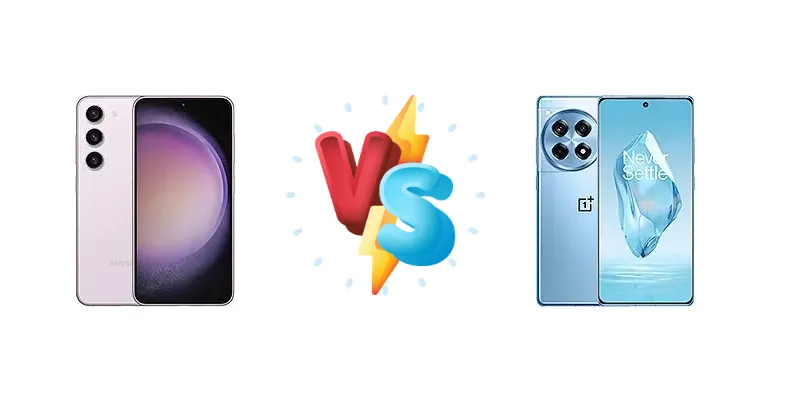
|
🏆 Quick Verdict
For most users, the OnePlus 12R emerges as the stronger value. Its significantly longer 14:32h active use battery life and blazing-fast 100W charging outweigh the S23’s slightly brighter display and established camera reputation. However, the S23 remains a compelling choice for those prioritizing a more compact form factor.
| PHONES | ||
|---|---|---|
| Phone Names | Samsung Galaxy S23 | OnePlus 12R |
| Network | ||
|---|---|---|
| 2G bands | GSM 850 / 900 / 1800 / 1900 | GSM 850 / 900 / 1800 / 1900 |
| 3G bands | HSDPA 850 / 900 / 1700(AWS) / 1900 / 2100 | HSDPA 850 / 900 / 1700(AWS) / 1900 / 2100 |
| 4G bands | 1, 2, 3, 4, 5, 7, 8, 12, 13, 17, 18, 19, 20, 25, 26, 28, 32, 38, 39, 40, 41, 66 - International | 1, 2, 3, 4, 5, 7, 8, 12, 17, 18, 19, 20, 26, 28, 32, 38, 39, 40, 41, 66 |
| 5G bands | 1, 2, 3, 5, 7, 8, 12, 20, 25, 28, 38, 40, 41, 66, 75, 77, 78 SA/NSA/Sub6 - International | 1, 2, 3, 5, 7, 8, 12, 20, 28, 38, 40, 41, 66, 77, 78 SA/NSA |
| Speed | HSPA, LTE (up to 7CA), 5G | HSPA, LTE, 5G |
| Technology | GSM / CDMA / HSPA / EVDO / LTE / 5G | GSM / CDMA / HSPA / LTE / 5G |
| 1, 7, 25, 28, 41, 66, 71, 78, 258, 260, 261 SA/NSA/Sub6/mmWave - USA | - | |
| Launch | ||
|---|---|---|
| Announced | 2023, February 01 | 2024, January 23 |
| Status | Available. Released 2023, February 17 | Available. Released 2024, February 06 |
| Body | ||
|---|---|---|
| Build | Glass front (Gorilla Glass Victus 2), glass back (Gorilla Glass Victus 2), aluminum frame | Glass front (Gorilla Glass Victus 2), aluminum frame, glass back |
| Dimensions | 146.3 x 70.9 x 7.6 mm (5.76 x 2.79 x 0.30 in) | 163.3 x 75.3 x 8.8 mm (6.43 x 2.96 x 0.35 in) |
| SIM | · Nano-SIM + eSIM· Nano-SIM + Nano-SIM + eSIM (max 2 at a time) | · Nano-SIM + Nano-SIM + eSIM (max 2 at a time)· Nano-SIM + Nano-SIM |
| Weight | 168 g (5.93 oz) | 207 g (7.30 oz) |
| IP68 dust/water resistant (up to 1.5m for 30 min) Armor aluminum frame with tougher drop and scratch resistance (advertised) | - | |
| Display | ||
|---|---|---|
| Protection | Corning Gorilla Glass Victus 2 | Corning Gorilla Glass Victus 2 |
| Resolution | 1080 x 2340 pixels, 19.5:9 ratio (~425 ppi density) | 1264 x 2780 pixels (~450 ppi density) |
| Size | 6.1 inches, 90.1 cm2 (~86.8% screen-to-body ratio) | 6.78 inches, 111.7 cm2 (~90.9% screen-to-body ratio) |
| Type | Dynamic AMOLED 2X, 120Hz, HDR10+, 1200 nits (HBM), 1750 nits (peak) | LTPO4 AMOLED, 1B colors, 120Hz, HDR10+, Dolby Vision, 1600 nits (HBM), 4500 nits (peak) |
| Always-on display | - | |
| Platform | ||
|---|---|---|
| CPU | Octa-core (1x3.36 GHz Cortex-X3 & 2x2.8 GHz Cortex-A715 & 2x2.8 GHz Cortex-A710 & 3x2.0 GHz Cortex-A510) | Octa-core (1x3.2 GHz Cortex-X3 & 2x2.8 GHz Cortex-A715 & 2x2.8 GHz Cortex-A710 & 3x2.0 GHz Cortex-A510) |
| Chipset | Qualcomm SM8550-AC Snapdragon 8 Gen 2 (4 nm) | Qualcomm SM8550-AB Snapdragon 8 Gen 2 (4 nm) |
| GPU | Adreno 740 | Adreno 740 |
| OS | Android 13, up to 4 major Android upgrades, One UI 8 | Android 14, up to 3 major Android upgrades, OxygenOS 15 |
| Memory | ||
|---|---|---|
| Card slot | No | No |
| Internal | 128GB 8GB RAM, 256GB 8GB RAM, 512GB 8GB RAM | 128GB 8GB RAM, 256GB 8GB RAM, 256GB 12GB RAM, 256GB 16GB RAM |
| UFS 3.1 - 128GB only UFS 4.0 | - | |
| Main Camera | ||
|---|---|---|
| Features | LED flash, auto-HDR, panorama | Laser AF, color spectrum sensor, LED flash, HDR, panorama |
| Single | 12 MP, f/2.2, 26mm (wide), Dual Pixel PDAF | - |
| Triple | 50 MP, f/1.8, 24mm (wide), 1/1.56", 1.0µm, dual pixel PDAF, OIS 10 MP, f/2.4, 70mm (telephoto), 1/3.94", 1.0µm, PDAF, OIS, 3x optical zoom 12 MP, f/2.2, 13mm, 120˚ (ultrawide), 1/2.55" 1.4µm, Super Steady video | 50 MP, f/1.8, 24mm (wide), 1/1.56", 1.0µm, multi-directional PDAF, OIS 8 MP, f/2.2, 16mm, 112˚ (ultrawide), 1/4.0", 1.12µm 2 MP (macro) |
| Video | 8K@24/30fps, 4K@30/60fps, 1080p@30/60/120/240fps, HDR10+, stereo sound rec., gyro-EIS | 4K@30/60fps, 1080p@30/60/120/240fps, gyro-EIS, OIS |
| Selfie camera | ||
|---|---|---|
| Features | HDR, HDR10+ | HDR, panorama |
| Single | 12 MP, f/2.2, 26mm (wide), 1/3.2", 1.12µm, dual pixel PDAF | 16 MP, f/2.4, 26mm (wide), 1/3", 1.0µm |
| Video | 4K@30/60fps, 1080p@30fps | 1080p@30fps, gyro-EIS |
| Sound | ||
|---|---|---|
| 3.5mm jack | No | - |
| 35mm jack | No | No |
| Loudspeaker | Yes, with stereo speakers | Yes, with stereo speakers |
| 32-bit/384kHz audio Tuned by AKG | - | |
| Comms | ||
|---|---|---|
| Bluetooth | 5.3, A2DP, LE | 5.3, A2DP, LE, aptX HD |
| Infrared port | - | Yes |
| NFC | Yes | Yes |
| Positioning | GPS, GLONASS, BDS, GALILEO | GPS, GALILEO, GLONASS, BDS, QZSS |
| Radio | No | No |
| USB | USB Type-C 3.2, OTG | USB Type-C 2.0 |
| WLAN | Wi-Fi 802.11 a/b/g/n/ac/6e, tri-band, Wi-Fi Direct | Wi-Fi 802.11 a/b/g/n/ac/6/7, dual-band |
| Features | ||
|---|---|---|
| Sensors | Fingerprint (under display, ultrasonic), accelerometer, gyro, proximity, compass, barometer | Fingerprint (under display, optical), accelerometer, gyro, proximity, compass |
| Samsung DeX, Samsung Wireless DeX (desktop experience support) Bixby natural language commands and dictation Samsung Pay (Visa, MasterCard certified) | - | |
| Battery | ||
|---|---|---|
| Charging | 25W wired, PD3.0, 50% in 30 min 15W wireless (Qi) 4.5W reverse wireless | 100W wired, 100% in 26 min |
| Type | Li-Ion 3900 mAh | Li-Ion 5500 mAh |
| Misc | ||
|---|---|---|
| Colors | Phantom Black, Cream, Green, Lavender, Graphite, Lime | Iron Gray, Cool Blue, Electric Violet, Sunset Dune |
| Models | SM-S911B, SM-S911B/DS, SM-S911U, SM-S911U1, SM-S911W, SM-S911N, SM-S9110, SM-S911E, SM-S911E/DS | CPH2609, CPH2585, CPH2611 |
| Price | $ 237.95 / C$ 336.75 / £ 255.00 / € 322.41 / ₹ 49,990 | € 410.84 / $ 399.95 / £ 649.00 |
| SAR | 0.95 W/kg (head) 0.88 W/kg (body) | 1.19 W/kg (head) 0.82 W/kg (body) |
| SAR EU | 0.96 W/kg (head) 1.30 W/kg (body) | - |
| Tests | ||
|---|---|---|
| Battery life | Endurance rating 101h | - |
| Camera | Photo / Video | - |
| Display | Contrast ratio: Infinite (nominal) | - |
| Loudspeaker | -27.0 LUFS (Good) | - |
| Performance | AnTuTu: 1231075 (v9) GeekBench: 4950 (v5.1) GFXBench: 110fps (ES 3.1 onscreen) | - |
Samsung Galaxy S23
- More compact and pocketable design
- Potentially more accurate display calibration
- Established camera software and ecosystem
- Significantly shorter battery life
- Slower charging speeds
- Higher price point
OnePlus 12R
- Exceptional battery life (14:32h active use)
- Blazing-fast 100W charging (0-100% in 26 min)
- More aggressive price point
- Larger and heavier form factor
- Camera software may require further refinement
- Lacks wireless charging
Display Comparison
Both the Galaxy S23 and OnePlus 12R boast excellent displays, achieving comparable peak brightness levels of 1198 nits and 1181 nits respectively. This ensures excellent visibility even under direct sunlight. While both are high-quality panels, the S23’s likely benefits from Samsung’s DisplayMate calibration, potentially offering slightly more accurate color reproduction. The S23’s smaller 6.1-inch size contributes to a higher pixel density, resulting in a sharper image, though the difference is subtle. Neither specification details PWM frequency, a critical factor for users sensitive to flicker, requiring further investigation.
Camera Comparison
The context data provides limited camera details, but we can infer key differences. Samsung’s Galaxy S23 benefits from years of camera software refinement and a reputation for consistent image quality. While sensor sizes aren’t specified, Samsung typically prioritizes larger sensors in its flagship devices. The OnePlus 12R, while likely equipped with a capable camera system, may rely more on computational photography to achieve comparable results. The absence of detail regarding OIS (Optical Image Stabilization) on either device is a notable omission, impacting low-light performance and video stabilization. We can assume both phones offer versatile photo and video capabilities, but Samsung’s established ecosystem likely provides a more polished and feature-rich experience.
Performance
At the heart of both devices lies the Qualcomm Snapdragon 8 Gen 2 (4nm), but a subtle difference exists: the S23 utilizes the SM8550-AC variant, while the 12R employs the SM8550-AB. While both are incredibly capable, the 'AC' variant is often associated with slightly higher clock speeds and optimized power efficiency. However, in real-world usage, the difference is likely minimal. Both phones feature an octa-core CPU configuration with the same core arrangement (1x Cortex-X3, 2x Cortex-A715, 2x Cortex-A710, 3x Cortex-A510). The 4nm process node ensures excellent thermal efficiency, minimizing throttling during sustained workloads. The OnePlus 12R’s larger chassis may provide slightly better thermal headroom, potentially allowing it to maintain peak performance for longer periods.
Battery Life
The OnePlus 12R decisively wins in battery endurance. Its active use score of 14:32h significantly surpasses the Galaxy S23’s 11:27h. This translates to a tangible difference in daily usage, allowing the 12R to comfortably last a full day even with heavy use. Furthermore, the 12R’s 100W wired charging is a game-changer, achieving a full charge in just 26 minutes, compared to the S23’s 25W charging which takes 30 minutes to reach 50%. The S23 offers 15W wireless charging and 4.5W reverse wireless charging, features absent in the 12R, providing added convenience but not offsetting the charging speed disparity.
Buying Guide
Buy the Samsung Galaxy S23 if you prioritize a smaller, more pocketable design and a well-established camera ecosystem with extensive software features. Buy the OnePlus 12R if you value exceptional battery life, incredibly fast charging, and a more aggressive price point, making it ideal for power users and gamers who demand all-day performance.