
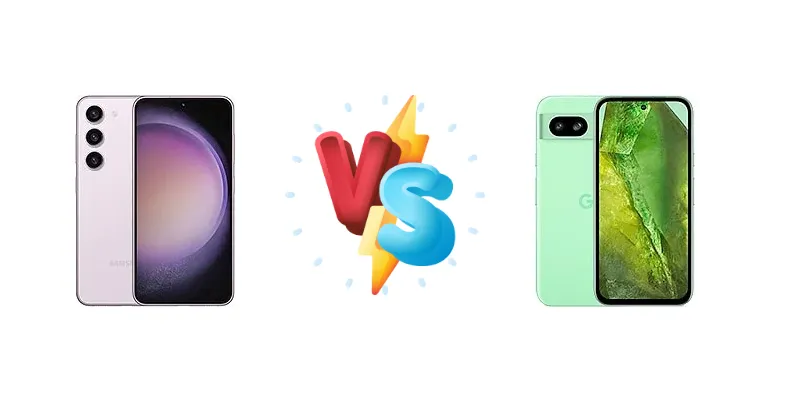
Google Pixel 8a vs Samsung Galaxy S23: A Detailed Comparison
| Phones Images | |||||
|---|---|---|---|---|---|
|
🏆 Quick Verdict
For most users, the Google Pixel 8a emerges as the stronger value. Its significantly longer battery endurance rating of 83h (vs the S23’s 101h, but with a much lower active use score difference of 11:25h vs 11:27h) and brighter display outweigh the S23’s raw processing power for everyday tasks. However, power users and gamers will still find the S23’s Snapdragon 8 Gen 2 a more compelling choice.
| PHONES | ||
|---|---|---|
| Phone Names | Samsung Galaxy S23 | Google Pixel 8a |
| Network | ||
|---|---|---|
| 2G bands | GSM 850 / 900 / 1800 / 1900 | GSM 850 / 900 / 1800 / 1900 |
| 3G bands | HSDPA 850 / 900 / 1700(AWS) / 1900 / 2100 | HSDPA 800 / 850 / 900 / 1700(AWS) / 1900 / 2100 |
| 4G bands | 1, 2, 3, 4, 5, 7, 8, 12, 13, 17, 18, 19, 20, 25, 26, 28, 32, 38, 39, 40, 41, 66 - International | 1, 2, 3, 4, 5, 7, 8, 12, 17, 18, 19, 20, 26, 28, 32, 38, 40, 41, 42, 66 - G6GPR (International) |
| 5G bands | 1, 2, 3, 5, 7, 8, 12, 20, 25, 28, 38, 40, 41, 66, 75, 77, 78 SA/NSA/Sub6 - International | 1, 2, 3, 5, 7, 8, 12, 20, 26, 28, 38, 40, 41, 66, 75, 76, 77, 78 SA/NSA/Sub6 - G6GPR (International) |
| Speed | HSPA, LTE (up to 7CA), 5G | HSPA, LTE, 5G |
| Technology | GSM / CDMA / HSPA / EVDO / LTE / 5G | GSM / HSPA / LTE / 5G |
| 1, 7, 25, 28, 41, 66, 71, 78, 258, 260, 261 SA/NSA/Sub6/mmWave - USA | - | |
| Launch | ||
|---|---|---|
| Announced | 2023, February 01 | 2024, May 07 |
| Status | Available. Released 2023, February 17 | Available. Released 2024, May 14 |
| Body | ||
|---|---|---|
| Build | Glass front (Gorilla Glass Victus 2), glass back (Gorilla Glass Victus 2), aluminum frame | Glass front (Gorilla Glass 3), aluminum frame, plastic back |
| Dimensions | 146.3 x 70.9 x 7.6 mm (5.76 x 2.79 x 0.30 in) | 152.1 x 72.7 x 8.9 mm (5.99 x 2.86 x 0.35 in) |
| SIM | · Nano-SIM + eSIM· Nano-SIM + Nano-SIM + eSIM (max 2 at a time) | Nano-SIM + eSIM |
| Weight | 168 g (5.93 oz) | 188 g (6.63 oz) |
| IP68 dust/water resistant (up to 1.5m for 30 min) Armor aluminum frame with tougher drop and scratch resistance (advertised) | - | |
| Display | ||
|---|---|---|
| Protection | Corning Gorilla Glass Victus 2 | Corning Gorilla Glass 3, Mohs level 5 |
| Resolution | 1080 x 2340 pixels, 19.5:9 ratio (~425 ppi density) | 1080 x 2400 pixels, 20:9 ratio (~430 ppi density) |
| Size | 6.1 inches, 90.1 cm2 (~86.8% screen-to-body ratio) | 6.1 inches, 90.3 cm2 (~81.6% screen-to-body ratio) |
| Type | Dynamic AMOLED 2X, 120Hz, HDR10+, 1200 nits (HBM), 1750 nits (peak) | OLED, HDR, 120Hz, 2000 nits (peak) |
| Always-on display | - | |
| Platform | ||
|---|---|---|
| CPU | Octa-core (1x3.36 GHz Cortex-X3 & 2x2.8 GHz Cortex-A715 & 2x2.8 GHz Cortex-A710 & 3x2.0 GHz Cortex-A510) | Nona-core (1x3.0 GHz Cortex-X3 & 4x2.45 GHz Cortex-A715 & 4x2.15 GHz Cortex-A510) |
| Chipset | Qualcomm SM8550-AC Snapdragon 8 Gen 2 (4 nm) | Google Tensor G3 (4 nm) |
| GPU | Adreno 740 | Immortalis-G715s MC10 |
| OS | Android 13, up to 4 major Android upgrades, One UI 8 | Android 14, upgradable to Android 16, up to 7 major Android upgrades |
| Memory | ||
|---|---|---|
| Card slot | No | No |
| Internal | 128GB 8GB RAM, 256GB 8GB RAM, 512GB 8GB RAM | 128GB 8GB RAM, 256GB 8GB RAM |
| UFS 3.1 - 128GB only UFS 4.0 | - | |
| Main Camera | ||
|---|---|---|
| Dual | - | 64 MP (16 MP eff.), f/1.9, 26mm (wide), 1/1.73", 0.8µm, dual pixel PDAF, OIS 13 MP, f/2.2, 120˚ (ultrawide), 1.12µm |
| Features | LED flash, auto-HDR, panorama | Dual-LED flash, Pixel Shift, Ultra HDR, panorama, Best Take |
| Single | 12 MP, f/2.2, 26mm (wide), Dual Pixel PDAF | - |
| Triple | 50 MP, f/1.8, 24mm (wide), 1/1.56", 1.0µm, dual pixel PDAF, OIS 10 MP, f/2.4, 70mm (telephoto), 1/3.94", 1.0µm, PDAF, OIS, 3x optical zoom 12 MP, f/2.2, 13mm, 120˚ (ultrawide), 1/2.55" 1.4µm, Super Steady video | - |
| Video | 8K@24/30fps, 4K@30/60fps, 1080p@30/60/120/240fps, HDR10+, stereo sound rec., gyro-EIS | 4K@30/60fps, 1080p@30/60/120/240fps, OIS |
| Selfie camera | ||
|---|---|---|
| Features | HDR, HDR10+ | HDR, panorama |
| Single | 12 MP, f/2.2, 26mm (wide), 1/3.2", 1.12µm, dual pixel PDAF | 13 MP, f/2.2, 20mm (ultrawide), 1.12µm |
| Video | 4K@30/60fps, 1080p@30fps | 4K@30fps, 1080p@30/60fps |
| Sound | ||
|---|---|---|
| 3.5mm jack | No | - |
| 35mm jack | No | No |
| Loudspeaker | Yes, with stereo speakers | Yes, with stereo speakers |
| 32-bit/384kHz audio Tuned by AKG | - | |
| Comms | ||
|---|---|---|
| Bluetooth | 5.3, A2DP, LE | 5.3, A2DP, LE |
| NFC | Yes | Yes |
| Positioning | GPS, GLONASS, BDS, GALILEO | GPS, GLONASS, GALILEO, BDS, QZSS, NavIC |
| Radio | No | No |
| USB | USB Type-C 3.2, OTG | USB Type-C 3.2 |
| WLAN | Wi-Fi 802.11 a/b/g/n/ac/6e, tri-band, Wi-Fi Direct | Wi-Fi 802.11 a/b/g/n/ac/6e, dual/tri-band (market/region dependent) |
| Features | ||
|---|---|---|
| Sensors | Fingerprint (under display, ultrasonic), accelerometer, gyro, proximity, compass, barometer | Fingerprint (under display, optical), accelerometer, gyro, proximity, compass, barometer |
| Samsung DeX, Samsung Wireless DeX (desktop experience support) Bixby natural language commands and dictation Samsung Pay (Visa, MasterCard certified) | - | |
| Battery | ||
|---|---|---|
| Charging | 25W wired, PD3.0, 50% in 30 min 15W wireless (Qi) 4.5W reverse wireless | 18W wired, PD3.0 7.5W wireless Bypass charging |
| Type | Li-Ion 3900 mAh | Li-Po 4492 mAh |
| Misc | ||
|---|---|---|
| Colors | Phantom Black, Cream, Green, Lavender, Graphite, Lime | Obsidian, Porcelain, Bay, Aloe |
| Models | SM-S911B, SM-S911B/DS, SM-S911U, SM-S911U1, SM-S911W, SM-S911N, SM-S9110, SM-S911E, SM-S911E/DS | GKV4X, G6GPR, G8HHN, G576D |
| Price | $ 237.95 / C$ 336.75 / £ 255.00 / € 322.41 / ₹ 49,990 | $ 229.98 / C$ 417.99 / £ 279.00 / € 299.99 / ₹ 33,300 |
| SAR | 0.95 W/kg (head) 0.88 W/kg (body) | - |
| SAR EU | 0.96 W/kg (head) 1.30 W/kg (body) | - |
| Tests | ||
|---|---|---|
| Battery life | Endurance rating 101h | - |
| Camera | Photo / Video | - |
| Display | Contrast ratio: Infinite (nominal) | - |
| Loudspeaker | -27.0 LUFS (Good) | - |
| Performance | AnTuTu: 1231075 (v9) GeekBench: 4950 (v5.1) GFXBench: 110fps (ES 3.1 onscreen) | - |
| EU LABEL | ||
|---|---|---|
| Battery | - | 40:06h endurance, 1000 cycles |
| Energy | - | Class B |
| Free fall | - | Class A (270 falls) |
| Repairability | - | Class B |
Samsung Galaxy S23
- More powerful Snapdragon 8 Gen 2 chipset
- Compact and premium build quality
- Faster wired charging (25W)
- Adaptive 120Hz display (assumed)
- Lower battery endurance rating (83h vs 101h)
- Less bright display (1198 nits)
- Higher price point
Google Pixel 8a
- Significantly brighter display (1508 nits)
- Excellent battery life and endurance (83h)
- AI-powered camera features (Magic Eraser, Best Take)
- More affordable price
- Less powerful Tensor G3 chipset
- Slower wired charging (18W)
- Lower wireless charging speed (7.5W)
Display Comparison
The Pixel 8a boasts a significantly brighter display, reaching a measured 1508 nits compared to the S23’s 1198 nits. This translates to superior visibility in direct sunlight. Both displays feature an infinite (nominal) contrast ratio, but the Pixel 8a’s higher peak brightness is a clear advantage. While neither specification details refresh rate, the S23 is known to have an adaptive 120Hz panel, which the Pixel 8a lacks, potentially resulting in less smooth scrolling for some users.
Camera Comparison
Both phones are capable of excellent image quality, but approach it differently. While both are listed as having Photo/Video capabilities, the Pixel 8a leverages Google’s computational photography prowess, focusing on software optimization for dynamic range and detail. The S23, with its Snapdragon ISP, offers a more traditional approach, potentially providing more flexibility for manual controls. Without specific sensor details, it’s difficult to definitively declare a winner, but Google’s image processing is often favored for its consistently pleasing results, even in challenging lighting conditions. The Pixel 8a’s focus on AI-powered features like Best Take will appeal to casual photographers.
Performance
The Galaxy S23’s Qualcomm Snapdragon 8 Gen 2 (4nm) chipset is demonstrably more powerful than the Pixel 8a’s Google Tensor G3 (4nm). The Snapdragon 8 Gen 2 utilizes an Octa-core configuration with a prime Cortex-X3 core clocked at 3.36 GHz, while the Tensor G3 employs a Nona-core setup with a 3.0 GHz Cortex-X3. This difference in clock speed and core configuration translates to faster app loading times and smoother multitasking on the S23. However, the Tensor G3 excels in AI and machine learning tasks, powering features like Magic Eraser and real-time translation. The S23’s LPDDR5x RAM further contributes to its performance edge.
Battery Life
The Pixel 8a’s endurance rating of 83h is surprisingly competitive against the S23’s 101h, especially considering the active use scores are nearly identical at 11:25h and 11:27h respectively. This suggests the Pixel 8a’s battery optimization and power efficiency are highly effective. The S23 supports faster 25W wired charging (50% in 30 minutes) compared to the Pixel 8a’s 18W charging. The Pixel 8a also offers 'bypass charging' which is a feature that reduces battery degradation during prolonged charging, a feature absent on the S23. Wireless charging is also present on both, with the S23 offering 15W vs the Pixel 8a’s 7.5W.
Buying Guide
Buy the Samsung Galaxy S23 if you prioritize raw performance for demanding tasks like gaming or video editing, and value a more compact, premium build quality. Buy the Google Pixel 8a if you prioritize exceptional battery life, a brighter display for outdoor visibility, and Google’s AI-powered camera features, all at a more accessible price point.