
Asus ROG Phone 8 Pro vs. Samsung Galaxy S23: A Deep Dive into Gaming and Everyday Performance
| Phones Images | |||||
|---|---|---|---|---|---|
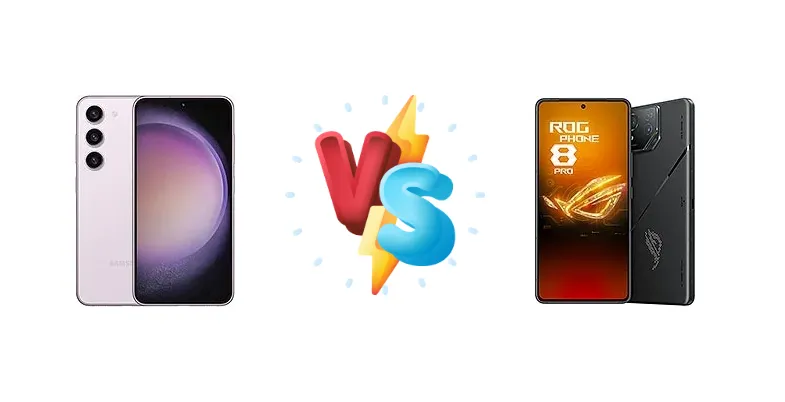
|
🏆 Quick Verdict
For the average user prioritizing a sleek design and all-around usability, the Samsung Galaxy S23 remains a strong contender. However, the Asus ROG Phone 8 Pro is the clear winner for gamers and power users, boasting significantly longer battery life and a more powerful processor.
| PHONES | ||
|---|---|---|
| Phone Names | Samsung Galaxy S23 | Asus ROG Phone 8 Pro |
| Network | ||
|---|---|---|
| 2G bands | GSM 850 / 900 / 1800 / 1900 | GSM 850 / 900 / 1800 / 1900 |
| 3G bands | HSDPA 850 / 900 / 1700(AWS) / 1900 / 2100 | HSDPA 850 / 900 / 1700(AWS) / 1800 / 1900 / 2100 - International |
| 4G bands | 1, 2, 3, 4, 5, 7, 8, 12, 13, 17, 18, 19, 20, 25, 26, 28, 32, 38, 39, 40, 41, 66 - International | 1, 2, 3, 4, 5, 7, 8, 12, 17, 18, 19, 20, 25, 26, 28, 32, 34, 38, 39, 40, 41, 42, 43, 48, 66 - International |
| 5G bands | 1, 2, 3, 5, 7, 8, 12, 20, 25, 28, 38, 40, 41, 66, 75, 77, 78 SA/NSA/Sub6 - International | 1, 2, 3, 5, 7, 8, 12, 18, 20, 25, 26, 28, 38, 40, 41, 48, 66, 77, 78, 79 SA/NSA/Sub6 - International |
| Speed | HSPA, LTE (up to 7CA), 5G | HSPA, LTE (Up to 7CA), 5G |
| Technology | GSM / CDMA / HSPA / EVDO / LTE / 5G | GSM / CDMA / HSPA / LTE / 5G |
| 1, 7, 25, 28, 41, 66, 71, 78, 258, 260, 261 SA/NSA/Sub6/mmWave - USA | - | |
| Launch | ||
|---|---|---|
| Announced | 2023, February 01 | 2024, January 08 |
| Status | Available. Released 2023, February 17 | Available. Released 2024, January 18 |
| Body | ||
|---|---|---|
| Build | Glass front (Gorilla Glass Victus 2), glass back (Gorilla Glass Victus 2), aluminum frame | Glass front (Gorilla Glass Victus 2), glass back (Gorilla Glass), aluminum frame |
| Dimensions | 146.3 x 70.9 x 7.6 mm (5.76 x 2.79 x 0.30 in) | 163.8 x 76.8 x 8.9 mm (6.45 x 3.02 x 0.35 in) |
| SIM | · Nano-SIM + eSIM· Nano-SIM + Nano-SIM + eSIM (max 2 at a time) | Nano-SIM + Nano-SIM |
| Weight | 168 g (5.93 oz) | 225 g (7.94 oz) |
| IP68 dust/water resistant (up to 1.5m for 30 min) Armor aluminum frame with tougher drop and scratch resistance (advertised) | - | |
| Display | ||
|---|---|---|
| Protection | Corning Gorilla Glass Victus 2 | Corning Gorilla Glass Victus 2 |
| Resolution | 1080 x 2340 pixels, 19.5:9 ratio (~425 ppi density) | 1080 x 2400 pixels, 20:9 ratio (~388 ppi density) |
| Size | 6.1 inches, 90.1 cm2 (~86.8% screen-to-body ratio) | 6.78 inches, 111.0 cm2 (~88.2% screen-to-body ratio) |
| Type | Dynamic AMOLED 2X, 120Hz, HDR10+, 1200 nits (HBM), 1750 nits (peak) | LTPO AMOLED, 1B colors, 165Hz, HDR10, 1600 nits (HBM), 2500 nits (peak) |
| Always-on display | - | |
| Platform | ||
|---|---|---|
| CPU | Octa-core (1x3.36 GHz Cortex-X3 & 2x2.8 GHz Cortex-A715 & 2x2.8 GHz Cortex-A710 & 3x2.0 GHz Cortex-A510) | Octa-core (1x3.3 GHz Cortex-X4 & 3x3.2 GHz Cortex-A720 & 2x3.0 GHz Cortex-A720 & 2x2.3 GHz Cortex-A520) |
| Chipset | Qualcomm SM8550-AC Snapdragon 8 Gen 2 (4 nm) | Qualcomm SM8650-AB Snapdragon 8 Gen 3 (4 nm) |
| GPU | Adreno 740 | Adreno 750 |
| OS | Android 13, up to 4 major Android upgrades, One UI 8 | Android 14, up to 2 major Android upgrades |
| Memory | ||
|---|---|---|
| Card slot | No | No |
| Internal | 128GB 8GB RAM, 256GB 8GB RAM, 512GB 8GB RAM | 512GB 16GB RAM, 1TB 24GB RAM |
| UFS 3.1 - 128GB only UFS 4.0 | - | |
| Main Camera | ||
|---|---|---|
| Features | LED flash, auto-HDR, panorama | LED flash, HDR, panorama |
| Single | 12 MP, f/2.2, 26mm (wide), Dual Pixel PDAF | - |
| Triple | 50 MP, f/1.8, 24mm (wide), 1/1.56", 1.0µm, dual pixel PDAF, OIS 10 MP, f/2.4, 70mm (telephoto), 1/3.94", 1.0µm, PDAF, OIS, 3x optical zoom 12 MP, f/2.2, 13mm, 120˚ (ultrawide), 1/2.55" 1.4µm, Super Steady video | 50 MP, f/1.9, 24mm (wide), 1/1.56", 1.0µm, PDAF, gimbal OIS 32 MP, f/2.4, (telephoto), 1/3.2", 0.7µm, PDAF, OIS, 3x optical zoom 13 MP, f/2.2, 13mm, 120˚ (ultrawide) |
| Video | 8K@24/30fps, 4K@30/60fps, 1080p@30/60/120/240fps, HDR10+, stereo sound rec., gyro-EIS | 8K@24fps, 4K@30/60fps, 1080p@30/60/120/240fps, 720p@480fps; gyro-EIS, HDR10+ |
| Selfie camera | ||
|---|---|---|
| Features | HDR, HDR10+ | Panorama, HDR |
| Single | 12 MP, f/2.2, 26mm (wide), 1/3.2", 1.12µm, dual pixel PDAF | 32 MP, f/2.5, 22mm (wide), 1/3.2", 0.7µm |
| Video | 4K@30/60fps, 1080p@30fps | 1080p@30fps |
| Sound | ||
|---|---|---|
| 3.5mm jack | No | - |
| 35mm jack | No | Yes |
| Loudspeaker | Yes, with stereo speakers | Yes, with stereo speakers |
| 32-bit/384kHz audio Tuned by AKG | - | |
| Comms | ||
|---|---|---|
| Bluetooth | 5.3, A2DP, LE | 5.4, A2DP, LE, aptX HD, aptX Adaptive, aptX Lossless |
| NFC | Yes | Yes |
| Positioning | GPS, GLONASS, BDS, GALILEO | GPS (L1+L5), BDS (B1I+B1c+B2a), GALILEO (E1+E5a), QZSS (L1+L5), NavIC (L5), GLONASS |
| Radio | No | No |
| USB | USB Type-C 3.2, OTG | USB Type-C (side), DisplayPort 1.4; USB Type-C (bottom), OTG |
| WLAN | Wi-Fi 802.11 a/b/g/n/ac/6e, tri-band, Wi-Fi Direct | Wi-Fi 802.11 a/b/g/n/ac/6e/7, tri-band, Wi-Fi Direct |
| Features | ||
|---|---|---|
| Sensors | Fingerprint (under display, ultrasonic), accelerometer, gyro, proximity, compass, barometer | Fingerprint (under display, optical), accelerometer, gyro, proximity, compass |
| Samsung DeX, Samsung Wireless DeX (desktop experience support) Bixby natural language commands and dictation Samsung Pay (Visa, MasterCard certified) | - | |
| Battery | ||
|---|---|---|
| Charging | 25W wired, PD3.0, 50% in 30 min 15W wireless (Qi) 4.5W reverse wireless | 65W wired, PD3.0, PPS, QC5, 100% in 39 min - International 30W wired, PD3.0, PPS - India 15W wireless (Qi) 10W reverse wired |
| Type | Li-Ion 3900 mAh | 5500 mAh |
| Misc | ||
|---|---|---|
| Colors | Phantom Black, Cream, Green, Lavender, Graphite, Lime | Phantom Black |
| Models | SM-S911B, SM-S911B/DS, SM-S911U, SM-S911U1, SM-S911W, SM-S911N, SM-S9110, SM-S911E, SM-S911E/DS | AI2401, AI2401_A, AI2401_D |
| Price | $ 237.95 / C$ 336.75 / £ 255.00 / € 322.41 / ₹ 49,990 | $ 1,157.98 / £ 1,693.75 / € 632.66 |
| SAR | 0.95 W/kg (head) 0.88 W/kg (body) | - |
| SAR EU | 0.96 W/kg (head) 1.30 W/kg (body) | - |
| Tests | ||
|---|---|---|
| Battery life | Endurance rating 101h | - |
| Camera | Photo / Video | - |
| Display | Contrast ratio: Infinite (nominal) | - |
| Loudspeaker | -27.0 LUFS (Good) | - |
| Performance | AnTuTu: 1231075 (v9) GeekBench: 4950 (v5.1) GFXBench: 110fps (ES 3.1 onscreen) | - |
Samsung Galaxy S23
- Compact and pocketable design
- Excellent all-around camera performance
- Refined software experience
- Shorter battery life compared to ROG Phone 8 Pro
- Slower charging speeds
Asus ROG Phone 8 Pro
- Exceptional battery life and fast charging
- Superior processing power with Snapdragon 8 Gen 3
- Larger, brighter display for immersive gaming
- Bulky and less comfortable to hold
- Gaming-focused design may not appeal to all users
Display Comparison
The Asus ROG Phone 8 Pro’s display significantly outshines the Galaxy S23 in peak brightness, reaching 1765 nits compared to the S23’s 1198 nits, making it far more usable in direct sunlight. While both utilize high-quality panels, the ROG Phone’s brightness advantage is substantial. Both devices offer excellent color reproduction, but the ROG Phone’s larger size caters to a more immersive gaming experience. The S23’s smaller display, while still vibrant, is geared towards portability.
Camera Comparison
Both phones offer capable camera systems, but their approaches differ. While both are listed as 'Photo / Video' capable, detailed sensor information is missing. Given Asus’s gaming focus, the ROG Phone 8 Pro’s camera is likely tuned for quick snapshots and social media sharing, while Samsung typically prioritizes image processing and versatility. The S23’s camera benefits from Samsung’s established image processing algorithms, potentially delivering more refined photos in various conditions. Without specific sensor details, it’s difficult to declare a clear winner, but the S23 likely holds an edge in overall image quality due to Samsung’s camera expertise.
Performance
The ROG Phone 8 Pro leverages the newer Qualcomm SM8650-AB Snapdragon 8 Gen 3 (4nm) chipset, featuring an octa-core CPU with the latest Cortex-X4 prime core clocked at 3.3 GHz. This represents a clear generational leap over the Galaxy S23’s Snapdragon 8 Gen 2 (4nm) and its 3.36 GHz Cortex-X3 core. The ROG Phone’s CPU architecture, with its three Cortex-A720 cores, offers improved efficiency and performance compared to the S23’s A715/A710 configuration. This translates to faster app loading, smoother multitasking, and higher sustained frame rates in demanding games. The ROG Phone’s superior thermal design, crucial for maintaining peak performance, further separates it from the S23.
Battery Life
The Asus ROG Phone 8 Pro delivers a substantial advantage in battery life, achieving an active use score of 14:43h versus the Galaxy S23’s 11:27h. This difference is further amplified by the ROG Phone’s significantly faster charging capabilities: 65W wired (international) versus the S23’s 25W. The ROG Phone can reach 100% charge in just 39 minutes, while the S23 takes 30 minutes to reach 50%. The ROG Phone also offers 10W reverse wired charging, a feature absent on the S23, adding to its versatility. The ROG Phone’s endurance rating of 101h is comparable to the S23’s, but the active use score demonstrates real-world superiority.
Buying Guide
Buy the Samsung Galaxy S23 if you need a premium smartphone that easily fits in your pocket, excels in everyday tasks, and offers a versatile camera system. Buy the Asus ROG Phone 8 Pro if you prioritize uninterrupted gaming sessions, demand the fastest possible performance, and value extended battery life even at the expense of a larger device.