
iPhone 15 Pro Max vs. Galaxy S23: A Deep Dive into Flagship Performance
| Phones Images | |||||
|---|---|---|---|---|---|
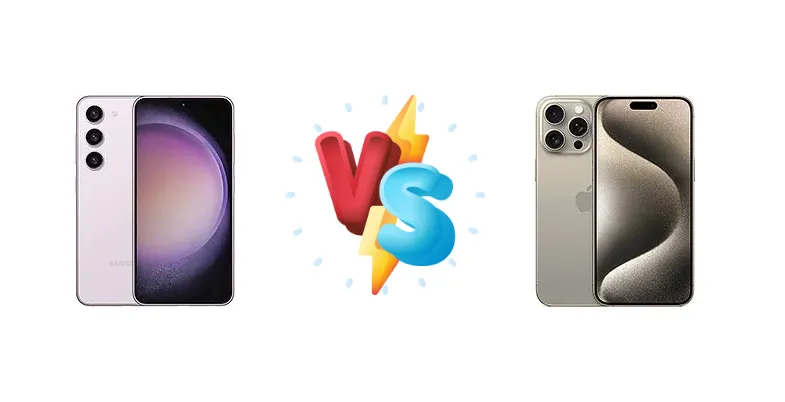
|
🏆 Quick Verdict
For the average user prioritizing longevity and a refined ecosystem, the iPhone 15 Pro Max emerges as the winner. Its significantly longer battery life (16:01h active use vs 11:27h) and the efficiency of the A17 Pro chip outweigh the S23’s strengths, despite the S23’s competitive price.
| PHONES | ||
|---|---|---|
| Phone Names | Samsung Galaxy S23 | Apple iPhone 15 Pro Max |
| Network | ||
|---|---|---|
| 2G bands | GSM 850 / 900 / 1800 / 1900 | GSM 850 / 900 / 1800 / 1900 |
| 3G bands | HSDPA 850 / 900 / 1700(AWS) / 1900 / 2100 | HSDPA 850 / 900 / 1700(AWS) / 1900 / 2100 |
| 4G bands | 1, 2, 3, 4, 5, 7, 8, 12, 13, 17, 18, 19, 20, 25, 26, 28, 32, 38, 39, 40, 41, 66 - International | 1, 2, 3, 4, 5, 7, 8, 12, 13, 17, 18, 19, 20, 25, 26, 28, 30, 32, 34, 38, 39, 40, 41, 42, 46, 48, 53, 66 - A3106 |
| 5G bands | 1, 2, 3, 5, 7, 8, 12, 20, 25, 28, 38, 40, 41, 66, 75, 77, 78 SA/NSA/Sub6 - International | 1, 2, 3, 5, 7, 8, 12, 20, 25, 26, 28, 30, 38, 40, 41, 48, 53, 66, 70, 77, 78, 79 SA/NSA/Sub6 - A3106 |
| Speed | HSPA, LTE (up to 7CA), 5G | HSPA, LTE, 5G, EV-DO Rev.A 3.1 Mbps |
| Technology | GSM / CDMA / HSPA / EVDO / LTE / 5G | GSM / CDMA / HSPA / EVDO / LTE / 5G |
| 1, 7, 25, 28, 41, 66, 71, 78, 258, 260, 261 SA/NSA/Sub6/mmWave - USA | - | |
| Launch | ||
|---|---|---|
| Announced | 2023, February 01 | 2023, September 12 |
| Status | Available. Released 2023, February 17 | Available. Released 2023, September 22 |
| Body | ||
|---|---|---|
| Build | Glass front (Gorilla Glass Victus 2), glass back (Gorilla Glass Victus 2), aluminum frame | Glass front, glass back, titanium frame (grade 5) |
| Dimensions | 146.3 x 70.9 x 7.6 mm (5.76 x 2.79 x 0.30 in) | 159.9 x 76.7 x 8.3 mm (6.30 x 3.02 x 0.33 in) |
| SIM | · Nano-SIM + eSIM· Nano-SIM + Nano-SIM + eSIM (max 2 at a time) | · Nano-SIM + eSIM + eSIM (max 2 at a time; International)· eSIM + eSIM (8 or more, max 2 at a time; USA)· Nano-SIM + Nano-SIM (China) |
| Weight | 168 g (5.93 oz) | 221 g (7.80 oz) |
| IP68 dust/water resistant (up to 1.5m for 30 min) Armor aluminum frame with tougher drop and scratch resistance (advertised) | - | |
| Display | ||
|---|---|---|
| Protection | Corning Gorilla Glass Victus 2 | Ceramic Shield glass |
| Resolution | 1080 x 2340 pixels, 19.5:9 ratio (~425 ppi density) | 1290 x 2796 pixels, 19.5:9 ratio (~460 ppi density) |
| Size | 6.1 inches, 90.1 cm2 (~86.8% screen-to-body ratio) | 6.7 inches, 110.2 cm2 (~89.8% screen-to-body ratio) |
| Type | Dynamic AMOLED 2X, 120Hz, HDR10+, 1200 nits (HBM), 1750 nits (peak) | LTPO Super Retina XDR OLED, 120Hz, HDR10, Dolby Vision, 1000 nits (typ), 2000 nits (HBM) |
| Always-on display | - | |
| Platform | ||
|---|---|---|
| CPU | Octa-core (1x3.36 GHz Cortex-X3 & 2x2.8 GHz Cortex-A715 & 2x2.8 GHz Cortex-A710 & 3x2.0 GHz Cortex-A510) | Hexa-core (2x3.78 GHz + 4x2.11 GHz) |
| Chipset | Qualcomm SM8550-AC Snapdragon 8 Gen 2 (4 nm) | Apple A17 Pro (3 nm) |
| GPU | Adreno 740 | Apple GPU (6-core graphics) |
| OS | Android 13, up to 4 major Android upgrades, One UI 8 | iOS 17, upgradable to iOS 26.1 |
| Memory | ||
|---|---|---|
| Card slot | No | No |
| Internal | 128GB 8GB RAM, 256GB 8GB RAM, 512GB 8GB RAM | 256GB 8GB RAM, 512GB 8GB RAM, 1TB 8GB RAM |
| UFS 3.1 - 128GB only UFS 4.0 | - | |
| Main Camera | ||
|---|---|---|
| Features | LED flash, auto-HDR, panorama | Dual-LED dual-tone flash, HDR (photo/panorama) |
| Single | 12 MP, f/2.2, 26mm (wide), Dual Pixel PDAF | - |
| Triple | 50 MP, f/1.8, 24mm (wide), 1/1.56", 1.0µm, dual pixel PDAF, OIS 10 MP, f/2.4, 70mm (telephoto), 1/3.94", 1.0µm, PDAF, OIS, 3x optical zoom 12 MP, f/2.2, 13mm, 120˚ (ultrawide), 1/2.55" 1.4µm, Super Steady video | 48 MP, f/1.8, 24mm (wide), 1/1.28", 1.22µm, dual pixel PDAF, sensor-shift OIS 12 MP, f/2.8, 120mm (periscope telephoto), 1/3.06", 1.12µm, dual pixel PDAF, 3D sensor‑shift OIS, 5x optical zoom 12 MP, f/2.2, 13mm, 120˚ (ultrawide), 1/2.55", 1.4µm, dual pixel PDAF TOF 3D LiDAR scanner (depth) |
| Video | 8K@24/30fps, 4K@30/60fps, 1080p@30/60/120/240fps, HDR10+, stereo sound rec., gyro-EIS | 4K@24/25/30/60fps, 1080p@25/30/60/120/240fps, 10-bit HDR, Dolby Vision HDR (up to 60fps), ProRes, 3D (spatial) video, stereo sound rec. |
| Selfie camera | ||
|---|---|---|
| Features | HDR, HDR10+ | HDR, Dolby Vision HDR |
| Single | 12 MP, f/2.2, 26mm (wide), 1/3.2", 1.12µm, dual pixel PDAF | 12 MP, f/1.9, 23mm (wide), 1/3.6", 1.0µm, PDAF, OIS SL 3D, (depth/biometrics sensor) |
| Video | 4K@30/60fps, 1080p@30fps | 4K@24/25/30/60fps, 1080p@25/30/60/120fps, gyro-EIS |
| Sound | ||
|---|---|---|
| 3.5mm jack | No | - |
| 35mm jack | No | No |
| Loudspeaker | Yes, with stereo speakers | Yes, with stereo speakers |
| 32-bit/384kHz audio Tuned by AKG | - | |
| Comms | ||
|---|---|---|
| Bluetooth | 5.3, A2DP, LE | 5.3, A2DP, LE |
| NFC | Yes | Yes |
| Positioning | GPS, GLONASS, BDS, GALILEO | GPS (L1+L5), GLONASS, GALILEO, BDS, QZSS, NavIC |
| Radio | No | No |
| USB | USB Type-C 3.2, OTG | USB Type-C 3.2 Gen 2, DisplayPort |
| WLAN | Wi-Fi 802.11 a/b/g/n/ac/6e, tri-band, Wi-Fi Direct | Wi-Fi 802.11 a/b/g/n/ac/6e, tri-band, hotspot |
| Features | ||
|---|---|---|
| Sensors | Fingerprint (under display, ultrasonic), accelerometer, gyro, proximity, compass, barometer | Face ID, accelerometer, gyro, proximity, compass, barometer |
| Samsung DeX, Samsung Wireless DeX (desktop experience support) Bixby natural language commands and dictation Samsung Pay (Visa, MasterCard certified) | - | |
| Battery | ||
|---|---|---|
| Charging | 25W wired, PD3.0, 50% in 30 min 15W wireless (Qi) 4.5W reverse wireless | Wired, PD2.0, 50% in 30 min 15W wireless (MagSafe) 15W wireless (Qi2) - requires iOS 17.2 update 4.5W reverse wired |
| Type | Li-Ion 3900 mAh | Li-Ion 4441 mAh |
| Misc | ||
|---|---|---|
| Colors | Phantom Black, Cream, Green, Lavender, Graphite, Lime | Black Titanium, White Titanium, Blue Titanium, Natural Titanium |
| Models | SM-S911B, SM-S911B/DS, SM-S911U, SM-S911U1, SM-S911W, SM-S911N, SM-S9110, SM-S911E, SM-S911E/DS | A2849, A3105, A3106, A3108, iPhone16,2 |
| Price | $ 237.95 / C$ 336.75 / £ 255.00 / € 322.41 / ₹ 49,990 | € 758.79 / $ 579.87 / £ 628.29 |
| SAR | 0.95 W/kg (head) 0.88 W/kg (body) | 1.07 W/kg (head) 1.11 W/kg (body) |
| SAR EU | 0.96 W/kg (head) 1.30 W/kg (body) | 0.98 W/kg (head) 0.98 W/kg (body) |
| Tests | ||
|---|---|---|
| Battery life | Endurance rating 101h | - |
| Camera | Photo / Video | - |
| Display | Contrast ratio: Infinite (nominal) | - |
| Loudspeaker | -27.0 LUFS (Good) | - |
| Performance | AnTuTu: 1231075 (v9) GeekBench: 4950 (v5.1) GFXBench: 110fps (ES 3.1 onscreen) | - |
Samsung Galaxy S23
- More affordable price point
- Android’s customization options
- Compact form factor
- Shorter battery life
- Less powerful processor
- Lower peak display brightness
Apple iPhone 15 Pro Max
- Exceptional battery life
- Industry-leading processor performance
- Brighter, more vibrant display
- Higher price
- iOS ecosystem lock-in
- Less customization options
Display Comparison
The iPhone 15 Pro Max boasts a significantly brighter display, reaching 1787 nits measured, compared to the Galaxy S23’s 1198 nits. This translates to superior visibility in direct sunlight. Both displays feature an infinite (nominal) contrast ratio, but the iPhone’s higher peak brightness is a clear advantage. While both are excellent, the iPhone’s display is demonstrably superior for outdoor use and HDR content consumption. The iPhone 15 Pro Max also benefits from the latest Qi2 wireless charging standard (with iOS 17.2), offering potentially faster and more efficient wireless charging.
Camera Comparison
Both phones excel in photography and videography, but approach image processing differently. While detailed sensor information is missing for the S23, Samsung typically emphasizes vibrant, saturated colors. The iPhone 15 Pro Max, leveraging Apple’s computational photography, aims for more natural, true-to-life tones. Both offer excellent video capabilities, but the iPhone’s ProRes video recording provides professional-grade options. The absence of detailed camera specs for the S23 makes a direct sensor comparison difficult, but the iPhone’s advanced image processing pipeline and ProRes support give it an edge for serious content creators.
Performance
Apple’s A17 Pro, fabricated on a 3nm process, represents a significant leap in efficiency compared to the Galaxy S23’s 4nm Snapdragon 8 Gen 2. While the Snapdragon 8 Gen 2 is a powerhouse with its Octa-core configuration (1x3.36 GHz Cortex-X3, etc.), the A17 Pro’s hexa-core design (2x3.78 GHz + 4x2.11 GHz) delivers superior single-core performance, crucial for responsiveness and app launch speeds. The A17 Pro’s neural engine also provides a substantial advantage in machine learning tasks. The Snapdragon 8 Gen 2’s thermal efficiency is good, but the A17 Pro’s 3nm node allows for sustained performance with less throttling under heavy load.
Battery Life
The iPhone 15 Pro Max dominates in battery life, achieving an impressive 16:01h of active use compared to the Galaxy S23’s 11:27h. This translates to a nearly 50% increase in real-world usage. While both phones support 50% charging in 30 minutes, the iPhone’s superior endurance rating of 118h versus the S23’s 101h highlights its efficiency. Both offer 15W wireless charging, but the iPhone’s adoption of Qi2 offers future-proofing and potential improvements in wireless charging speed and reliability.
Buying Guide
Buy the Samsung Galaxy S23 if you need a more compact flagship experience, prefer the Android operating system’s customization options, and value a potentially lower price point. Buy the Apple iPhone 15 Pro Max if you prioritize all-day battery life, seamless integration within the Apple ecosystem, and cutting-edge processing power for demanding tasks like video editing and gaming.