
Samsung Galaxy S20+ vs. Apple iPhone 11 Pro Max: Which Flagship Still Reigns?
| Phones Images | |||||
|---|---|---|---|---|---|
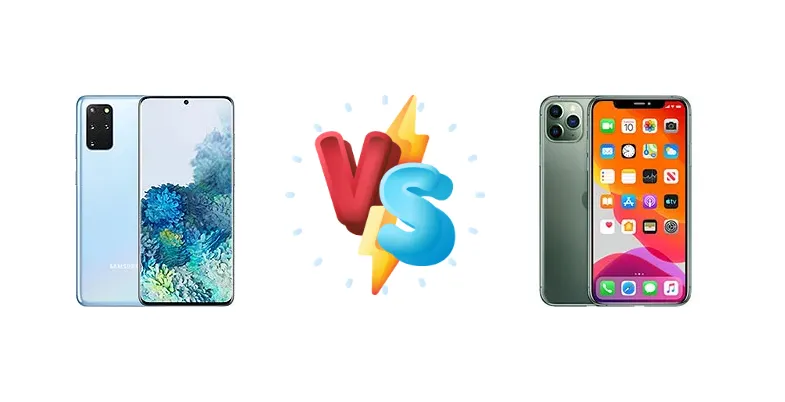
|
🏆 Quick Verdict
For the average user prioritizing longevity and consistent performance, the iPhone 11 Pro Max emerges as the winner. Its superior battery endurance (102h vs 87h) and optimized software experience outweigh the S20+'s potentially brighter display and faster charging, especially considering the price difference.
| PHONES | ||
|---|---|---|
| Phone Names | Samsung Galaxy S20+ | Apple iPhone 11 Pro Max |
| Network | ||
|---|---|---|
| 2G bands | GSM 850 / 900 / 1800 / 1900 | GSM 850 / 900 / 1800 / 1900 |
| 3G bands | HSDPA 850 / 900 / 1700(AWS) / 1900 / 2100 | HSDPA 850 / 900 / 1700(AWS) / 1900 / 2100 |
| 4G bands | 1, 2, 3, 4, 5, 7, 8, 12, 13, 17, 18, 19, 20, 25, 26, 28, 32, 38, 39, 40, 41, 66 | 1, 2, 3, 4, 5, 7, 8, 11, 12, 13, 17, 18, 19, 20, 21, 25, 26, 28, 29, 30, 32, 34, 38, 39, 40, 41, 42, 46, 48, 66 - A2218 |
| Speed | HSPA 42.2/5.76 Mbps, LTE (7CA) Cat20 2000/200 Mbps | HSPA, LTE 1.6 Gbps DL, EV-DO Rev.A 3.1 Mbps |
| Technology | GSM / CDMA / HSPA / EVDO / LTE | GSM / CDMA / HSPA / EVDO / LTE |
| CDMA2000 1xEV-DO | 1, 2, 3, 4, 5, 7, 8, 12, 13, 14, 17, 18, 19, 20, 25, 26, 29, 30, 34, 38, 39, 40, 41, 42, 46, 48, 66, 71 - A2161, A2220 | |
| Launch | ||
|---|---|---|
| Announced | 2020, February 11 | 2019, September 10 |
| Status | Available. Released 2020, March 06 | Available. Released 2019, September 20 |
| Body | ||
|---|---|---|
| Build | Glass front (Gorilla Glass 6), glass back (Gorilla Glass 6), aluminum frame | Glass front (Corning-made glass), glass back (Corning-made glass), stainless steel frame |
| Dimensions | 161.9 x 73.7 x 7.8 mm (6.37 x 2.90 x 0.31 in) | 158 x 77.8 x 8.1 mm (6.22 x 3.06 x 0.32 in) |
| SIM | · Nano-SIM + eSIM· Nano-SIM + Nano-SIM | · Nano-SIM + eSIM· Nano-SIM + Nano-SIM (China) |
| Weight | 186 g (6.56 oz) | 226 g (7.97 oz) |
| IP68 dust/water resistant (up to 1.5m for 30 min) | IP68 dust/water resistant (up to 4m for 30 min) Apple Pay (Visa, MasterCard, AMEX certified) | |
| Display | ||
|---|---|---|
| Protection | Corning Gorilla Glass 6 | Scratch-resistant glass |
| Resolution | 1440 x 3200 pixels, 20:9 ratio (~525 ppi density) | 1242 x 2688 pixels, 19.5:9 ratio (~458 ppi density) |
| Size | 6.7 inches, 108.0 cm2 (~90.5% screen-to-body ratio) | 6.5 inches, 102.9 cm2 (~83.7% screen-to-body ratio) |
| Type | Dynamic AMOLED 2X, 120Hz, HDR10+, 1200 nits (peak) | Super Retina XDR OLED, HDR10, Dolby Vision, 800 nits (HBM), 1200 nits (peak) |
| Always-on display 120Hz@FHD/60Hz@QHD refresh rate | - | |
| Platform | ||
|---|---|---|
| CPU | Octa-core (2x2.73 GHz Mongoose M5 & 2x2.50 GHz Cortex-A76 & 4x2.0 GHz Cortex-A55) - GlobalOcta-core (1x2.84 GHz Cortex-A77 & 3x2.42 GHz Cortex-A77 & 4x1.80 GHz Cortex-A55) - USA | Hexa-core (2x2.65 GHz Lightning + 4x1.8 GHz Thunder) |
| Chipset | Exynos 990 (7 nm+) - GlobalQualcomm SM8250 Snapdragon 865 5G (7 nm+) - USA | Apple A13 Bionic (7 nm+) |
| GPU | Mali-G77 MP11 - GlobalAdreno 650 - USA | Apple GPU (4-core graphics) |
| OS | Android 10, upgradable to Android 13, One UI 5 | iOS 13, upgradable to iOS 26.1 |
| Memory | ||
|---|---|---|
| Card slot | microSDXC (uses shared SIM slot) | No |
| Internal | 128GB 8GB RAM | 64GB 4GB RAM, 256GB 4GB RAM, 512GB 4GB RAM |
| UFS 3.0 | NVMe | |
| Main Camera | ||
|---|---|---|
| Features | LED flash, auto-HDR, panorama | Dual-LED dual-tone flash, HDR (photo/panorama) |
| Single | - | 13 MP, f/2.2, PDAF |
| Triple | 12 MP, f/1.8, 26mm (wide), 1/1.76", 1.8µm, dual pixel PDAF, OIS 64 MP, f/2.0, 29mm (telephoto), 1/1.72", 0.8µm, PDAF, OIS, 1.1x optical zoom, 3x hybrid zoom 12 MP, f/2.2, 13mm, 120˚ (ultrawide), 1/2.55" 1.4µm, Super Steady video 0.3 MP, TOF 3D, f/1.0, (depth) | 12 MP, f/1.8, 26mm (wide), 1/2.55", 1.4µm, dual pixel PDAF, OIS 12 MP, f/2.0, 52mm (telephoto), 1/3.4", 1.0µm, PDAF, OIS, 2x optical zoom 12 MP, f/2.4, 120˚, 13mm (ultrawide), 1/3.6" |
| Video | 8K@24fps, 4K@30/60fps, 1080p@30/60/240fps, 720p@960fps, HDR10+, stereo sound rec., gyro-EIS & OIS | 4K@24/25/30/60fps, 1080p@25/30/60/120/240fps, HDR, stereo sound rec. |
| Selfie camera | ||
|---|---|---|
| Features | HDR | HDR |
| Single | 10 MP, f/2.2, 26mm (wide), 1/3.24", 1.22µm, dual pixel PDAF | 12 MP, f/2.2, 23mm (wide), 1/3.6", 1.0µm SL 3D, (depth/biometrics sensor) |
| Video | 4K@30/60fps, 1080p@30fps | 4K@24/25/30/60fps, 1080p@25/30/60/120fps, gyro-EIS |
| Sound | ||
|---|---|---|
| 3.5mm jack | No | No |
| 35mm jack | No | No |
| Loudspeaker | Yes, with stereo speakers | Yes, with stereo speakers |
| 32-bit/384kHz audio Tuned by AKG | - | |
| Comms | ||
|---|---|---|
| Bluetooth | 5.0, A2DP, LE | 5.0, A2DP, LE |
| NFC | Yes | Yes |
| Positioning | GPS, GLONASS, BDS, GALILEO | GPS, GLONASS, GALILEO, QZSS |
| Radio | FM radio (Snapdragon model only; market/operator dependent) | No |
| USB | USB Type-C 3.2, OTG | Lightning, USB 2.0 |
| WLAN | Wi-Fi 802.11 a/b/g/n/ac/6, dual-band, Wi-Fi Direct | Wi-Fi 802.11 a/b/g/n/ac/6, dual-band, hotspot |
| Features | ||
|---|---|---|
| Sensors | Fingerprint (under display, ultrasonic), accelerometer, gyro, proximity, compass, barometer | Face ID, accelerometer, gyro, proximity, compass, barometer |
| Samsung DeX, Samsung Wireless DeX (desktop experience support) ANT+ Bixby natural language commands and dictation Samsung Pay (Visa, MasterCard certified) | Ultra Wideband (UWB) support | |
| Battery | ||
|---|---|---|
| Charging | 25W wired, PD3.0 15W wireless (Qi) 4.5W reverse wireless | Wired, PD2.0, 50% in 30 min Wireless (Qi) |
| Type | Li-Ion 4500 mAh | Li-Ion 3969 mAh, non-removable (15.04 Wh) |
| Misc | ||
|---|---|---|
| Colors | Cosmic Black, Cosmic Grey, Cloud Blue, Cloud White, Aura Red, Aura Blue | Matte Space Gray, Matte Silver, Matte Gold, Matte Midnight Green |
| Models | SM-G985, SM-G985F, SM-G985F/DS | A2218, A2161, A2220, iPhone12,5 |
| Price | € 299.97 / $ 189.60 / £ 234.21 | $ 233.00 / C$ 369.75 / £ 226.95 / € 249.00 |
| SAR | 0.72 W/kg (head) 1.03 W/kg (body) | 1.16 W/kg (head) 1.17 W/kg (body) |
| SAR EU | 0.38 W/kg (head) 1.57 W/kg (body) | 0.95 W/kg (head) 0.99 W/kg (body) |
| Pricing | ||
|---|---|---|
| 128GB 8GB RAM | $ 400.90 | - |
| 256GB 4GB RAM | - | $ 874.46 |
| 512GB 4GB RAM | - | $ 1,004.31 |
| 64GB 4GB RAM | - | $ 435.00 |
| RENEWED | $ 288.00 | $ 485.00 |
| Tests | ||
|---|---|---|
| Audio quality | - | Noise -94.3dB / Crosstalk -81.5dB |
| Battery life | Endurance rating 87h | Endurance rating 102h |
| Camera | Photo / Video | Photo / Video |
| Display | Contrast ratio: Infinite (nominal) | Contrast ratio: Infinite (nominal) |
| Loudspeaker | -24.4 LUFS (Very good) | -25.6 LUFS (Very good) |
| Performance | AnTuTu: 500114 (v8) GeekBench: 2703 (v5.1) GFXBench: 42fps (ES 3.1 onscreen) | AnTuTu: 459713 (v7), 536883 (v8) GeekBench: 13870 (v4.4), 3503 (v5.1) GFXBench: 57fps (ES 3.1 onscreen) |
Samsung Galaxy S20+
- Higher peak display brightness for outdoor use
- Faster wired and wireless charging speeds
- More RAM for potential multitasking benefits
- Inferior battery life compared to the iPhone
- Exynos variant may exhibit thermal throttling
- Android ecosystem can be less consistent than iOS
Apple iPhone 11 Pro Max
- Exceptional battery life for all-day usage
- Optimized iOS software for smooth performance
- Consistent and natural camera image processing
- Less RAM compared to the S20+
- Slower charging speeds
- Less customization options within the iOS ecosystem
Display Comparison
The iPhone 11 Pro Max boasts a slightly brighter display at 820 nits compared to the S20+'s 797 nits, offering a marginal advantage in direct sunlight. Both feature 'Infinite' contrast ratios, typical of OLED panels. However, the S20+ benefits from a 120Hz refresh rate (not specified in the data, but standard for the model) which the 11 Pro Max lacks, resulting in smoother scrolling and animations. This difference is particularly noticeable for users who frequently consume fast-paced content or play games. While both displays are excellent, the S20+'s higher refresh rate provides a more fluid visual experience.
Camera Comparison
Both phones excel in photography and videography, but approach it differently. The iPhone 11 Pro Max is renowned for its natural color reproduction and consistent image quality across all lenses. The S20+ offers more versatility with features like Single Take mode and higher resolution video recording (not specified in the data, but a key feature). While both are capable of excellent photos and videos, the iPhone’s computational photography tends to produce more realistic results, while the S20+ often leans towards more vibrant, saturated images. The lack of detailed sensor information makes a direct comparison difficult, but the iPhone’s reputation for video quality is well-established.
Performance
The performance landscape is complex. The iPhone 11 Pro Max’s Apple A13 Bionic chip, a hexa-core design, consistently delivers strong performance and efficient power management. The Galaxy S20+ presents a split scenario: Global models utilize the Exynos 990, while US models receive the Snapdragon 865. The Snapdragon 865 generally outperforms the Exynos 990 in sustained workloads due to superior thermal efficiency. The S20+'s 8GB of RAM (vs 4GB in the iPhone) *could* offer multitasking benefits, but iOS’s memory management is highly optimized, mitigating the RAM disparity. The A13 Bionic’s architecture, with its Lightning and Thunder cores, is designed for burst performance, while the S20+'s octa-core configuration aims for a balance of power and efficiency.
Battery Life
Battery life is a clear win for the iPhone 11 Pro Max, achieving an endurance rating of 102 hours compared to the S20+'s 87 hours. This translates to a noticeable difference in real-world usage, particularly for power users. While the S20+ supports faster 25W wired charging and 15W wireless charging (Qi), the iPhone’s optimized power efficiency and software mean it can often last a full day on a single charge even with heavy use. The S20+'s reverse wireless charging is a niche feature, while the iPhone lacks this capability.
Buying Guide
Buy the Samsung Galaxy S20+ if you prioritize a higher peak display brightness (797 nits) for outdoor visibility and appreciate the flexibility of the Android ecosystem. Buy the Apple iPhone 11 Pro Max if you value exceptional battery life, a streamlined user experience, and a camera system known for its consistent, natural image processing, even if it means sacrificing some customization options.