
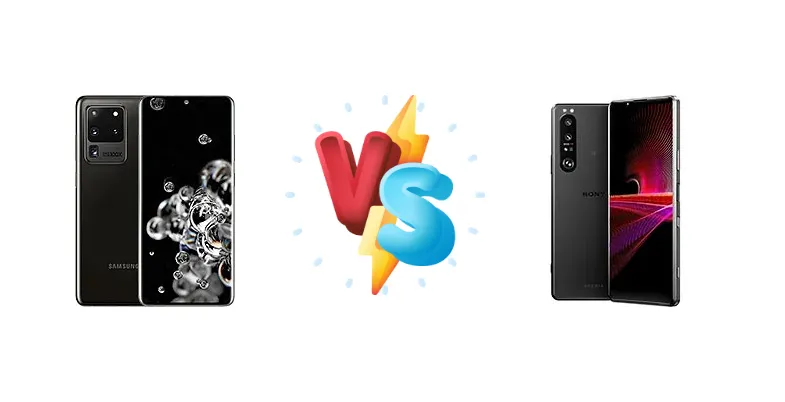
Samsung Galaxy S20 Ultra 5G vs. Sony Xperia 1 III: A Deep Dive Comparison
| Phones Images | |||||
|---|---|---|---|---|---|
|
🏆 Quick Verdict
For the average user, the Samsung Galaxy S20 Ultra 5G offers a more compelling package. Its brighter display, faster charging, and generally more versatile camera system outweigh the Xperia 1 III’s strengths in video recording and processing power, especially considering current pricing.
| PHONES | ||
|---|---|---|
| Phone Names | Samsung Galaxy S20 Ultra 5G | Sony Xperia 1 III |
| Network | ||
|---|---|---|
| 2G bands | GSM 850 / 900 / 1800 / 1900 | GSM 850 / 900 / 1800 / 1900 |
| 3G bands | HSDPA 850 / 900 / 1700(AWS) / 1900 / 2100 | HSDPA 800 / 850 / 900 / 1700(AWS) / 1900 / 2100 |
| 4G bands | 1, 2, 3, 4, 5, 7, 8, 12, 13, 17, 18, 19, 20, 25, 26, 28, 32, 38, 39, 40, 41, 66 - SM-G988B | 1, 2, 3, 4, 5, 7, 8, 12, 13, 17, 19, 20, 25, 26, 28, 29, 32, 34, 38, 39, 40, 41, 46, 66 - Europe |
| 5G bands | 1, 3, 5, 7, 8, 28, 40, 77, 78 SA/NSA/Sub6 - SM-G988B | 1, 3, 5, 7, 8, 20, 28, 38, 40, 41, 77, 78 SA/NSA/Sub6 - Europe |
| Speed | HSPA 42.2/5.76 Mbps, LTE (7CA) Cat20 2000/200 Mbps, 5G (5+ Gbps DL) | HSPA, LTE, 5G |
| Technology | GSM / CDMA / HSPA / EVDO / LTE / 5G | GSM / HSPA / LTE / 5G |
| - | SA/NSA/Sub6/mmWave - USA (specific) | |
| Launch | ||
|---|---|---|
| Announced | 2020, February 11 | 2021, April 14 |
| Status | Available. Released 2020, March 06 | Available. Released 2021, August 25 |
| Body | ||
|---|---|---|
| Build | Glass front (Gorilla Glass 6), glass back (Gorilla Glass 6), aluminum frame | Glass front (Gorilla Glass Victus), glass back (Gorilla Glass 6), aluminum frame |
| Dimensions | 166.9 x 76 x 8.8 mm (6.57 x 2.99 x 0.35 in) | 165 x 71 x 8.2 mm (6.50 x 2.80 x 0.32 in) |
| SIM | · Nano-SIM + eSIM· Nano-SIM + Nano-SIM | Nano-SIM + Nano-SIM |
| Weight | 222 g (7.83 oz) | 186 g / 187.1 g (mmWave) (6.56 oz) |
| - | IP65/IP68 dust/water resistant (up to 1.5m for 30 min) | |
| Display | ||
|---|---|---|
| Protection | Corning Gorilla Glass 6 | Corning Gorilla Glass Victus |
| Resolution | 1440 x 3200 pixels, 20:9 ratio (~511 ppi density) | 1644 x 3840 pixels, 21:9 ratio (~643 ppi density) |
| Size | 6.9 inches, 114.0 cm2 (~89.9% screen-to-body ratio) | 6.5 inches, 98.6 cm2 (~84.2% screen-to-body ratio) |
| Type | Dynamic AMOLED 2X, 120Hz, HDR10+, 1400 nits (peak) | OLED, 1B colors, 120Hz, HDR BT.2020 |
| - | Runs at 1096 x 2560 pixels except for select use cases | |
| Platform | ||
|---|---|---|
| CPU | Octa-core (2x2.73 GHz Mongoose M5 & 2x2.50 GHz Cortex-A76 & 4x2.0 GHz Cortex-A55) - GlobalOcta-core (1x2.84 GHz Cortex-A77 & 3x2.42 GHz Cortex-A77 & 4x1.80 GHz Cortex-A55) - USA | Octa-core (1x2.84 GHz Cortex-X1 & 3x2.42 GHz Cortex-A78 & 4x1.80 GHz Cortex-A55) |
| Chipset | Exynos 990 (7 nm+) - GlobalQualcomm SM8250 Snapdragon 865 5G (7 nm+) - USA | Qualcomm SM8350 Snapdragon 888 5G (5 nm) |
| GPU | Mali-G77 MP11 - GlobalAdreno 650 - USA | Adreno 660 |
| OS | Android 10, upgradable to Android 13, One UI 5.1 | Android 11, upgradable to Android 13 |
| Memory | ||
|---|---|---|
| Card slot | microSDXC (uses shared SIM slot) | microSDXC (uses shared SIM slot) |
| Internal | 128GB 12GB RAM, 256GB 12GB RAM, 512GB 16GB RAM | 256GB 12GB RAM, 512GB 12GB RAM |
| - | UFS 3.X | |
| Main Camera | ||
|---|---|---|
| Features | LED flash, auto-HDR, panorama | Zeiss optics, Zeiss T* lens coating, color spectrum sensor, LED flash, panorama, HDR, eye tracking |
| Single | - | 8 MP, f/2.0, 24mm (wide), 1/4", 1.12µm |
| Triple | 108 MP, f/1.8, 26mm (wide), 1/1.33", 0.8µm, PDAF, OIS 48 MP, f/3.5, 103mm (periscope telephoto), 1/2.0", 0.8µm, PDAF, OIS, 4x optical zoom, 10x hybrid zoom 12 MP, f/2.2, 13mm, 120˚ (ultrawide), 1/2.55" 1.4µm, Super Steady video 0.3 MP, TOF 3D, f/1.0, (depth) | 12 MP, f/1.7, 24mm (wide), 1/1.7", 1.8µm, dual pixel PDAF, OIS 12 MP, f/2.3, 70mm (telephoto), f/2.8, 105mm (telephoto), 1/2.9", dual pixel PDAF, 3x/4.4x optical zoom, OIS 12 MP, f/2.2, 124˚, 16mm (ultrawide), 1/2.6", dual pixel PDAF 0.3 MP, TOF 3D, (depth) |
| Video | 8K@24fps, 4K@30/60fps, 1080p@30/60/240fps, 720p@960fps, HDR10+, stereo sound rec., gyro-EIS & OIS | 4K@24/25/30/60/120fps HDR, 1080p@30/60/120fps; 5-axis gyro-EIS, OIS |
| Selfie camera | ||
|---|---|---|
| Features | HDR | HDR |
| Single | 40 MP, f/2.2, 26mm (wide), 1/2.8", 0.7µm, PDAF | 8 MP, f/2.0, 24mm (wide), 1/4.0", 1.12µm |
| Video | 4K@30/60fps, 1080p@30fps | 1080p@30fps, 5-axis gyro-EIS |
| Sound | ||
|---|---|---|
| 3.5mm jack | - | Yes |
| 35mm jack | No | Yes |
| Loudspeaker | Yes, with stereo speakers | Yes, with stereo speakers |
| - | 24-bit/192kHz audio Dynamic vibration system | |
| Comms | ||
|---|---|---|
| Bluetooth | 5.0, A2DP, LE | 5.2, A2DP, LE, aptX HD, aptX Adaptive |
| NFC | Yes | Yes |
| Positioning | GPS, GLONASS, BDS, GALILEO | GPS, GLONASS, BDS, GALILEO, QZSS |
| Radio | FM radio (Snapdragon model only; market/operator dependent) | No |
| USB | USB Type-C 3.2, OTG | USB Type-C 3.1, OTG, video output |
| WLAN | Wi-Fi 802.11 a/b/g/n/ac/6, dual-band, Wi-Fi Direct | Wi-Fi 802.11 a/b/g/n/ac/6, dual-band, Wi-Fi Direct, DLNA |
| Features | ||
|---|---|---|
| Sensors | Fingerprint (under display, ultrasonic), accelerometer, gyro, proximity, compass, barometer | Fingerprint (side-mounted), accelerometer, gyro, proximity, barometer, compass |
| - | Native Sony Alpha camera support | |
| Battery | ||
|---|---|---|
| Charging | 45W wired, PD3.0 15W wireless (Qi) 4.5W reverse wireless | 30W wired, PD, 50% in 30 min Wireless Reverse wireless |
| Type | Li-Ion 5000 mAh | Li-Po 4500 mAh |
| Misc | ||
|---|---|---|
| Colors | Cosmic Grey, Cosmic Black, Cloud White | Frosted Black, Frosted Gray, Frosted Purple |
| Models | SM-G988, SM-G988U, SM-G988U1, SM-G9880, SM-G988B/DS, SM-G988N, SM-G988B, SM-G988W, SCG03 | XQBC62/V, XQBC52V.UKCX, SO-51B, SOG03, A101SO, XQ-BC62, XQ-BC72, XQ-BC52, XQ-BC01, XQ-BC11, XQ-BC21, XQ-BC72 |
| Price | € 227.11 / $ 184.00 / £ 335.00 | € 505.26 / $ 903.43 |
| SAR | 0.94 W/kg (head) 0.95 W/kg (body) | - |
| SAR EU | 0.32 W/kg (head) 1.56 W/kg (body) | - |
| Tests | ||
|---|---|---|
| Battery life | - | Endurance rating 82h |
| Camera | - | Photo / Video |
| Display | - | Contrast ratio: Infinite (nominal) |
| Loudspeaker | - | -26.5 LUFS (Good) |
| Performance | - | AnTuTu: 607423 (v8) GeekBench: 3515 (v5.1) GFXBench: 54fps (ES 3.1 onscreen) |
Samsung Galaxy S20 Ultra 5G
- Brighter Display for Outdoor Use
- Faster 45W Wired Charging
- More Versatile Camera System with Zoom
- Older Chipset (Exynos 990/Snapdragon 865)
- Potential for Throttling Under Heavy Load
Sony Xperia 1 III
- Newer Snapdragon 888 Chipset
- Superior Video Recording Capabilities
- More Natural Image Processing
- Dimmer Display
- Slower Charging Compared to S20 Ultra
Display Comparison
The Samsung Galaxy S20 Ultra boasts a significantly brighter display, peaking at 894 nits, compared to the Xperia 1 III’s 620 nits. This translates to superior visibility under direct sunlight. While the Xperia 1 III’s display has an infinite contrast ratio, the S20 Ultra’s higher peak brightness is more impactful for everyday use. Both utilize OLED technology, but Samsung’s panel is demonstrably brighter, making it better for media consumption outdoors. The S20 Ultra's larger size also contributes to a more immersive viewing experience.
Camera Comparison
Both phones excel in camera capabilities, but approach it differently. The S20 Ultra’s camera system is geared towards versatility, with a focus on its 108MP main sensor and impressive zoom capabilities. The Xperia 1 III, while also offering a strong camera, emphasizes video recording with features like 4K 120fps recording and real-time tracking autofocus. The Xperia 1 III’s image processing leans towards a more natural look, while Samsung’s tends to be more saturated and contrast-rich. The S20 Ultra’s larger sensor size likely provides better low-light performance, but the Xperia 1 III’s video features are a significant draw for content creators.
Performance
The Sony Xperia 1 III leverages the Qualcomm Snapdragon 888 (5nm) chipset, a generation ahead of the Exynos 990 (7nm+) or Snapdragon 865 (7nm+) found in the S20 Ultra. This 5nm process provides better thermal efficiency and performance per watt. The Xperia 1 III’s CPU, featuring a Cortex-X1 prime core, offers a performance edge over the S20 Ultra’s Mongoose M5 core (Global) or A77 core (USA). While the S20 Ultra is still capable, the Xperia 1 III will exhibit smoother performance in demanding tasks and sustained workloads, potentially experiencing less throttling. The Xperia 1 III's newer chipset also benefits from improved AI processing capabilities.
Battery Life
The Samsung Galaxy S20 Ultra has an endurance rating of 87 hours, slightly better than the Xperia 1 III’s 82 hours. However, the Xperia 1 III compensates with faster charging – 30W wired with a 50% charge in 30 minutes, compared to the S20 Ultra’s 45W wired. While the S20 Ultra supports 15W wireless charging, the Xperia 1 III also offers wireless and reverse wireless charging. The S20 Ultra’s larger battery capacity provides a slight edge in overall endurance, but the Xperia 1 III’s faster charging mitigates this difference for many users.
Buying Guide
Buy the Samsung Galaxy S20 Ultra 5G if you need a versatile camera system capable of excellent zoom, a brighter display for outdoor visibility, and faster charging speeds. Buy the Sony Xperia 1 III if you prioritize professional-grade video recording capabilities, a more streamlined Android experience, and a focus on creative control over image processing.