
Samsung Galaxy S20 Ultra 5G vs LG V60 ThinQ 5G UW: A Deep Dive Comparison
| Phones Images | |||||
|---|---|---|---|---|---|
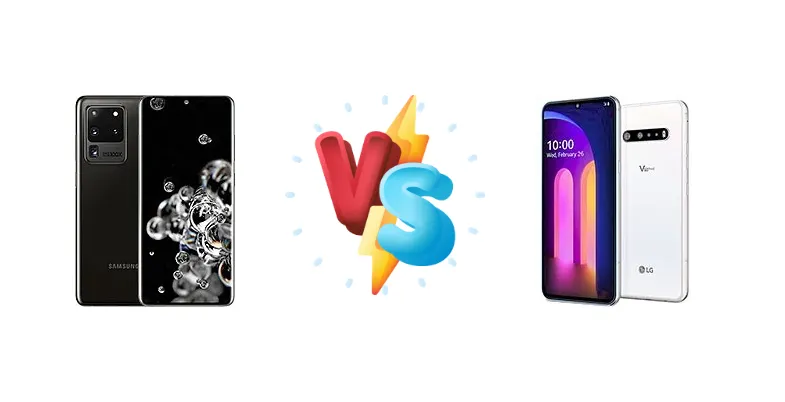
|
🏆 Quick Verdict
For most users, the LG V60 ThinQ 5G UW offers a more compelling package. While the S20 Ultra boasts a brighter display, the V60’s consistent Snapdragon 865 performance, coupled with a more reasonable price point, makes it the smarter buy in 2024. The Exynos variant of the S20 Ultra introduces potential thermal concerns that the V60 avoids.
| PHONES | ||
|---|---|---|
| Phone Names | Samsung Galaxy S20 Ultra 5G | LG V60 ThinQ 5G UW |
| Network | ||
|---|---|---|
| 2G bands | GSM 850 / 900 / 1800 / 1900 | GSM 850 / 900 / 1800 / 1900 |
| 3G bands | HSDPA 850 / 900 / 1700(AWS) / 1900 / 2100 | HSDPA 850 / 900 / 1700(AWS) / 1900 / 2100 |
| 4G bands | 1, 2, 3, 4, 5, 7, 8, 12, 13, 17, 18, 19, 20, 25, 26, 28, 32, 38, 39, 40, 41, 66 - SM-G988B | 2, 3, 4, 5, 7, 12, 13, 20, 28, 46, 48, 66 |
| 5G bands | 1, 3, 5, 7, 8, 28, 40, 77, 78 SA/NSA/Sub6 - SM-G988B | 260, 261 mmWave |
| Speed | HSPA 42.2/5.76 Mbps, LTE (7CA) Cat20 2000/200 Mbps, 5G (5+ Gbps DL) | HSPA 42.2/5.76 Mbps, LTE (7CA) Cat22, 5G |
| Technology | GSM / CDMA / HSPA / EVDO / LTE / 5G | GSM / CDMA / HSPA / EVDO / LTE / 5G |
| - | CDMA2000 1xEV-DO | |
| Launch | ||
|---|---|---|
| Announced | 2020, February 11 | 2020, February 26. Released 2020, April 02 |
| Status | Available. Released 2020, March 06 | Discontinued |
| Body | ||
|---|---|---|
| Build | Glass front (Gorilla Glass 6), glass back (Gorilla Glass 6), aluminum frame | Glass front (Gorilla Glass 5), glass back (Gorilla Glass 6), aluminum frame |
| Dimensions | 166.9 x 76 x 8.8 mm (6.57 x 2.99 x 0.35 in) | 169.3 x 77.6 x 8.9 mm (6.67 x 3.06 x 0.35 in) |
| SIM | · Nano-SIM + eSIM· Nano-SIM + Nano-SIM | Nano-SIM (pre-installed) |
| Weight | 222 g (7.83 oz) | 218 g (7.69 oz) |
| - | IP68 dust/water resistant (up to 1.5m for 30 min) MIL-STD-810G compliant* Method 516.6, Procedure IV "Transit Drop" *does not guarantee ruggedness or use in extreme conditions | |
| Display | ||
|---|---|---|
| Protection | Corning Gorilla Glass 6 | Corning Gorilla Glass 5 |
| Resolution | 1440 x 3200 pixels, 20:9 ratio (~511 ppi density) | 1080 x 2460 pixels (~395 ppi density) |
| Size | 6.9 inches, 114.0 cm2 (~89.9% screen-to-body ratio) | 6.8 inches, 109.8 cm2 (~83.6% screen-to-body ratio) |
| Type | Dynamic AMOLED 2X, 120Hz, HDR10+, 1400 nits (peak) | P-OLED, HDR10+ |
| - | Always-on display | |
| Platform | ||
|---|---|---|
| CPU | Octa-core (2x2.73 GHz Mongoose M5 & 2x2.50 GHz Cortex-A76 & 4x2.0 GHz Cortex-A55) - GlobalOcta-core (1x2.84 GHz Cortex-A77 & 3x2.42 GHz Cortex-A77 & 4x1.80 GHz Cortex-A55) - USA | Octa-core (1x2.84 GHz Cortex-A77 & 3x2.42 GHz Cortex-A77 & 4x1.80 GHz Cortex-A55) |
| Chipset | Exynos 990 (7 nm+) - GlobalQualcomm SM8250 Snapdragon 865 5G (7 nm+) - USA | Qualcomm SM8250 Snapdragon 865 5G (7 nm+) |
| GPU | Mali-G77 MP11 - GlobalAdreno 650 - USA | Adreno 650 |
| OS | Android 10, upgradable to Android 13, One UI 5.1 | Android 10, upgradable to Android 13 |
| Memory | ||
|---|---|---|
| Card slot | microSDXC (uses shared SIM slot) | microSDXC (uses shared SIM slot) - dual-SIM model |
| Internal | 128GB 12GB RAM, 256GB 12GB RAM, 512GB 16GB RAM | 128GB 8GB RAM |
| - | UFS 2.1 | |
| Main Camera | ||
|---|---|---|
| Dual | - | 64 MP, f/1.8, 27mm (standard), 1/1.72", 0.8µm, dual pixel PDAF, OIS 13 MP, f/1.9, 12mm (ultrawide), 1/3.4", 1.0µm 0.3 MP, TOF 3D, f/1.4, (depth) |
| Features | LED flash, auto-HDR, panorama | Dual-LED dual-tone flash, HDR, panorama |
| Triple | 108 MP, f/1.8, 26mm (wide), 1/1.33", 0.8µm, PDAF, OIS 48 MP, f/3.5, 103mm (periscope telephoto), 1/2.0", 0.8µm, PDAF, OIS, 4x optical zoom, 10x hybrid zoom 12 MP, f/2.2, 13mm, 120˚ (ultrawide), 1/2.55" 1.4µm, Super Steady video 0.3 MP, TOF 3D, f/1.0, (depth) | - |
| Video | 8K@24fps, 4K@30/60fps, 1080p@30/60/240fps, 720p@960fps, HDR10+, stereo sound rec., gyro-EIS & OIS | 8K@30fps, 4K@30/60fps, 1080p, HDR10+, 24-bit/192kHz stereo sound rec., gyro-EIS |
| Selfie camera | ||
|---|---|---|
| Features | HDR | HDR |
| Single | 40 MP, f/2.2, 26mm (wide), 1/2.8", 0.7µm, PDAF | 10 MP, f/1.9, 30mm (standard), 1/3.1", 1.22µm |
| Video | 4K@30/60fps, 1080p@30fps | 4K@30fps, gyro-EIS |
| Sound | ||
|---|---|---|
| 3.5mm jack | - | Yes |
| 35mm jack | No | Yes |
| Loudspeaker | Yes, with stereo speakers | Yes, with stereo speakers |
| - | 32-bit/192kHz audio 24-bit/192kHz audio recording | |
| Comms | ||
|---|---|---|
| Bluetooth | 5.0, A2DP, LE | 5.1, A2DP, LE, aptX HD |
| NFC | Yes | Yes |
| Positioning | GPS, GLONASS, BDS, GALILEO | GPS, GLONASS, GALILEO, BDS |
| Radio | FM radio (Snapdragon model only; market/operator dependent) | FM radio (USA model only) |
| USB | USB Type-C 3.2, OTG | USB Type-C 3.1, OTG |
| WLAN | Wi-Fi 802.11 a/b/g/n/ac/6, dual-band, Wi-Fi Direct | Wi-Fi 802.11 a/b/g/n/ac/6, dual-band, Wi-Fi Direct, DLNA |
| Features | ||
|---|---|---|
| Sensors | Fingerprint (under display, ultrasonic), accelerometer, gyro, proximity, compass, barometer | Fingerprint (under display, optical), accelerometer, gyro, proximity, compass, barometer |
| Battery | ||
|---|---|---|
| Charging | 45W wired, PD3.0 15W wireless (Qi) 4.5W reverse wireless | Wired, PD2.0, QC4 Wireless |
| Type | Li-Ion 5000 mAh | Li-Po 5000 mAh |
| Misc | ||
|---|---|---|
| Colors | Cosmic Grey, Cosmic Black, Cloud White | Classy Blue, Classy White |
| Models | SM-G988, SM-G988U, SM-G988U1, SM-G9880, SM-G988B/DS, SM-G988N, SM-G988B, SM-G988W, SCG03 | LM-V600VML, LMV600VML |
| Price | € 227.11 / $ 184.00 / £ 335.00 | About 870 EUR |
| SAR | 0.94 W/kg (head) 0.95 W/kg (body) | 0.85 W/kg (head) 1.12 W/kg (body) |
| SAR EU | 0.32 W/kg (head) 1.56 W/kg (body) | - |
Samsung Galaxy S20 Ultra 5G
- Brighter display for outdoor visibility
- More ambitious camera features (Space Zoom)
- Faster wired and wireless charging
- Potential for thermal throttling (Exynos variant)
- Higher price point
- Larger and heavier design
LG V60 ThinQ 5G UW
- Consistent Snapdragon 865 performance
- Better value for money
- Potentially better thermal management
- Less impressive display brightness
- Less publicized camera system
- May lack some of the S20 Ultra’s advanced features
Display Comparison
The Samsung Galaxy S20 Ultra 5G features a display capable of reaching a measured 894 nits of peak brightness, providing excellent visibility in direct sunlight. While the LG V60 ThinQ 5G UW’s peak brightness isn’t specified, Samsung’s advantage here is significant. However, the V60’s display technology isn’t detailed, and it’s likely a standard OLED panel, lacking the adaptive refresh rate found in some competing devices. The S20 Ultra’s larger size and higher resolution contribute to a more immersive viewing experience, though this comes at the cost of battery life.
Camera Comparison
The S20 Ultra’s camera system is more ambitious, but not necessarily superior. While details on sensor sizes are missing, the S20 Ultra’s focus on high megapixel counts and Space Zoom is a key differentiator. The V60’s camera system is less publicized, but benefits from Qualcomm’s Snapdragon ISP. The S20 Ultra’s image processing tends towards saturation and sharpening, while LG historically favors a more natural look. The inclusion of a 2MP macro camera on the V60 is largely inconsequential, offering minimal benefit over standard digital zoom.
Performance
Both the US variant of the S20 Ultra and the LG V60 ThinQ 5G UW are powered by the Qualcomm Snapdragon 865 5G (7nm+). However, the global S20 Ultra utilizes the Exynos 990 (7nm+). The Snapdragon 865’s CPU, featuring a Cortex-A77 prime core, offers a slight edge in sustained performance over the Exynos 990’s Mongoose M5 core. The Exynos chip has been known to exhibit thermal throttling under heavy load, impacting long-term performance in demanding applications. The V60, consistently using the Snapdragon 865, avoids this potential issue. Both devices utilize LPDDR5 RAM, but the speed isn’t specified, making it difficult to determine a clear advantage.
Battery Life
The Samsung Galaxy S20 Ultra 5G boasts an endurance rating of 87 hours, suggesting respectable battery life. However, its 45W wired charging (PD3.0) and 15W wireless charging (Qi) are offset by the power demands of its high-resolution display and potentially thermally-constrained processor. The LG V60 ThinQ 5G UW’s battery capacity isn’t specified, but it supports wired charging with PD2.0 and QC4, and wireless charging. While the S20 Ultra’s charging speeds are faster on paper, the V60’s more efficient processor and potentially optimized software could result in comparable real-world battery performance.
Buying Guide
Buy the Samsung Galaxy S20 Ultra 5G if you absolutely require the brightest possible display and are willing to potentially contend with thermal throttling, especially if you have the Exynos variant. Buy the LG V60 ThinQ 5G UW if you prioritize consistent performance, a more balanced feature set, and a better value proposition, particularly if you frequently engage in extended gaming or demanding tasks.