
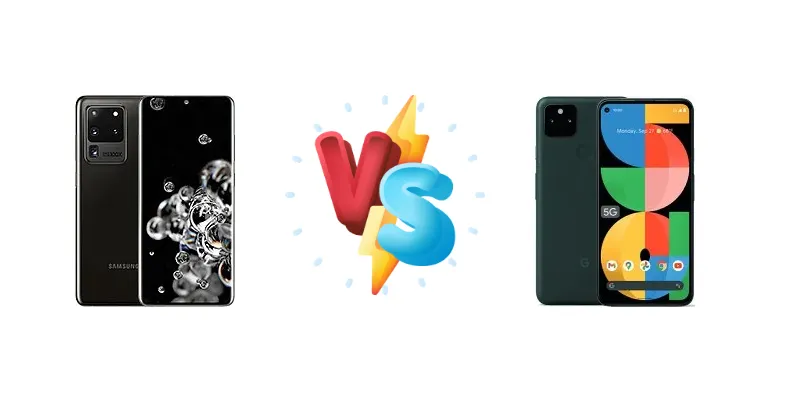
Samsung Galaxy S20 Ultra 5G vs. Google Pixel 5a 5G: A Detailed Comparison
| Phones Images | |||||
|---|---|---|---|---|---|
|
🏆 Quick Verdict
For the average user prioritizing battery life and consistent software experience, the Google Pixel 5a 5G is the better choice. While the Galaxy S20 Ultra boasts a brighter display and potentially faster processing (depending on region), its higher power consumption and potential for thermal throttling don't justify the cost for most.
| PHONES | ||
|---|---|---|
| Phone Names | Samsung Galaxy S20 Ultra 5G | Google Pixel 5a 5G |
| Network | ||
|---|---|---|
| 2G bands | GSM 850 / 900 / 1800 / 1900 | GSM 850 / 900 / 1800 / 1900 |
| 3G bands | HSDPA 850 / 900 / 1700(AWS) / 1900 / 2100 | HSDPA 850 / 900 / 1700(AWS) / 1900 / 2100 |
| 4G bands | 1, 2, 3, 4, 5, 7, 8, 12, 13, 17, 18, 19, 20, 25, 26, 28, 32, 38, 39, 40, 41, 66 - SM-G988B | 1, 2, 3, 4, 5, 7, 8, 12, 13, 14, 17, 18, 19, 20, 25, 26, 28, 29, 30, 32, 38, 39, 40, 41, 42, 46, 48, 66, 71 |
| 5G bands | 1, 3, 5, 7, 8, 28, 40, 77, 78 SA/NSA/Sub6 - SM-G988B | 1, 2, 5, 12, 25, 28, 41, 66, 71, 77, 78 SA/NSA/Sub6 |
| Speed | HSPA 42.2/5.76 Mbps, LTE (7CA) Cat20 2000/200 Mbps, 5G (5+ Gbps DL) | HSPA, LTE, 5G |
| Technology | GSM / CDMA / HSPA / EVDO / LTE / 5G | GSM / HSPA / EVDO / LTE / 5G |
| - | CDMA2000 1xEV-DO | |
| Launch | ||
|---|---|---|
| Announced | 2020, February 11 | 2021, August 17 |
| Status | Available. Released 2020, March 06 | Available. Released 2021, August 26 |
| Body | ||
|---|---|---|
| Build | Glass front (Gorilla Glass 6), glass back (Gorilla Glass 6), aluminum frame | Glass front (Gorilla Glass 3), aluminum frame, aluminum back |
| Dimensions | 166.9 x 76 x 8.8 mm (6.57 x 2.99 x 0.35 in) | 156.2 x 73.2 x 8.8 mm (6.15 x 2.88 x 0.35 in) |
| SIM | · Nano-SIM + eSIM· Nano-SIM + Nano-SIM | Nano-SIM + eSIM |
| Weight | 222 g (7.83 oz) | 183 g (6.46 oz) |
| - | IP67 dust/water resistant (up to 1m for 30 min) | |
| Display | ||
|---|---|---|
| Protection | Corning Gorilla Glass 6 | Corning Gorilla Glass 3 |
| Resolution | 1440 x 3200 pixels, 20:9 ratio (~511 ppi density) | 1080 x 2400 pixels, 20:9 ratio (~415 ppi density) |
| Size | 6.9 inches, 114.0 cm2 (~89.9% screen-to-body ratio) | 6.34 inches, 97.0 cm2 (~84.9% screen-to-body ratio) |
| Type | Dynamic AMOLED 2X, 120Hz, HDR10+, 1400 nits (peak) | OLED, HDR |
| - | Always-on display | |
| Platform | ||
|---|---|---|
| CPU | Octa-core (2x2.73 GHz Mongoose M5 & 2x2.50 GHz Cortex-A76 & 4x2.0 GHz Cortex-A55) - GlobalOcta-core (1x2.84 GHz Cortex-A77 & 3x2.42 GHz Cortex-A77 & 4x1.80 GHz Cortex-A55) - USA | Octa-core (1x2.4 GHz Kryo 475 Prime & 1x2.2 GHz Kryo 475 Gold & 6x1.8 GHz Kryo 475 Silver) |
| Chipset | Exynos 990 (7 nm+) - GlobalQualcomm SM8250 Snapdragon 865 5G (7 nm+) - USA | Qualcomm SM7250 Snapdragon 765G 5G (7 nm) |
| GPU | Mali-G77 MP11 - GlobalAdreno 650 - USA | Adreno 620 |
| OS | Android 10, upgradable to Android 13, One UI 5.1 | Android 11, upgradable to Android 14 |
| Memory | ||
|---|---|---|
| Card slot | microSDXC (uses shared SIM slot) | No |
| Internal | 128GB 12GB RAM, 256GB 12GB RAM, 512GB 16GB RAM | 128GB 6GB RAM |
| Main Camera | ||
|---|---|---|
| Dual | - | 12.2 MP, f/1.7, 27mm, (wide), 1/2.55", 1.4µm, dual pixel PDAF, OIS 16 MP, f/2.2, 119˚ (ultrawide), 1.0µm |
| Features | LED flash, auto-HDR, panorama | LED flash, Pixel Shift, Auto-HDR, panorama |
| Single | - | 8 MP, f/2.0, 24mm (wide), 1.12µm |
| Triple | 108 MP, f/1.8, 26mm (wide), 1/1.33", 0.8µm, PDAF, OIS 48 MP, f/3.5, 103mm (periscope telephoto), 1/2.0", 0.8µm, PDAF, OIS, 4x optical zoom, 10x hybrid zoom 12 MP, f/2.2, 13mm, 120˚ (ultrawide), 1/2.55" 1.4µm, Super Steady video 0.3 MP, TOF 3D, f/1.0, (depth) | - |
| Video | 8K@24fps, 4K@30/60fps, 1080p@30/60/240fps, 720p@960fps, HDR10+, stereo sound rec., gyro-EIS & OIS | 4K@30/60fps, 1080p@30/60/120/240fps; gyro-EIS |
| Selfie camera | ||
|---|---|---|
| Features | HDR | HDR |
| Single | 40 MP, f/2.2, 26mm (wide), 1/2.8", 0.7µm, PDAF | 8 MP, f/2.0, 24mm (wide), 1.12µm |
| Video | 4K@30/60fps, 1080p@30fps | 1080p@30fps |
| Sound | ||
|---|---|---|
| 3.5mm jack | - | Yes |
| 35mm jack | No | Yes |
| Loudspeaker | Yes, with stereo speakers | Yes, with stereo speakers |
| Comms | ||
|---|---|---|
| Bluetooth | 5.0, A2DP, LE | 5.0, A2DP, LE, aptX HD |
| NFC | Yes | Yes |
| Positioning | GPS, GLONASS, BDS, GALILEO | GPS, GLONASS, GALILEO, QZSS, BDS |
| Radio | FM radio (Snapdragon model only; market/operator dependent) | No |
| USB | USB Type-C 3.2, OTG | USB Type-C 3.1 |
| WLAN | Wi-Fi 802.11 a/b/g/n/ac/6, dual-band, Wi-Fi Direct | Wi-Fi 802.11 a/b/g/n/ac, dual-band, Wi-Fi Direct |
| Features | ||
|---|---|---|
| Sensors | Fingerprint (under display, ultrasonic), accelerometer, gyro, proximity, compass, barometer | Fingerprint (rear-mounted), accelerometer, gyro, proximity, compass, barometer |
| Battery | ||
|---|---|---|
| Charging | 45W wired, PD3.0 15W wireless (Qi) 4.5W reverse wireless | 18W wired, PD2.0 |
| Type | Li-Ion 5000 mAh | Li-Po 4680 mAh |
| Misc | ||
|---|---|---|
| Colors | Cosmic Grey, Cosmic Black, Cloud White | Mostly Black |
| Models | SM-G988, SM-G988U, SM-G988U1, SM-G9880, SM-G988B/DS, SM-G988N, SM-G988B, SM-G988W, SCG03 | G1F8F, G4S1M |
| Price | € 227.11 / $ 184.00 / £ 335.00 | $ 189.00 / C$ 249.99 |
| SAR | 0.94 W/kg (head) 0.95 W/kg (body) | - |
| SAR EU | 0.32 W/kg (head) 1.56 W/kg (body) | - |
| Tests | ||
|---|---|---|
| Battery life | - | Endurance rating 122h |
| Display | - | Contrast ratio: Infinite (nominal) |
| Performance | - | AnTuTu: 291303 (v8) GeekBench: 1337 (v5.1) GFXBench: 19fps (ES 3.1 onscreen) |
Samsung Galaxy S20 Ultra 5G
- Potentially faster processing power (Snapdragon 865/Exynos 990)
- Brighter display for outdoor use
- More versatile camera system (likely)
- Shorter battery life
- Potential for thermal throttling (Exynos variant)
- Higher price
Google Pixel 5a 5G
- Exceptional battery life (122h endurance)
- Clean Android experience with guaranteed updates
- Excellent camera image processing
- Less powerful processor
- Slightly dimmer display
- Limited zoom capabilities compared to S20 Ultra
Display Comparison
Both phones feature displays capable of 861-894 nits of peak brightness, making them usable outdoors, though the S20 Ultra edges out the Pixel 5a with its higher measured maximum. While both offer excellent viewing angles, the S20 Ultra’s larger size and higher resolution (not provided in context, but known to be higher) contribute to a sharper image. The Pixel 5a’s ‘Infinite’ contrast ratio suggests a well-tuned OLED panel, but lacks the adaptive refresh rate found in some S20 Ultra variants, potentially impacting smoothness during scrolling.
Camera Comparison
Both phones are capable of excellent photography, but approach it differently. The S20 Ultra, while details on its camera system are missing, is known for its versatile multi-camera setup and high-resolution sensors. The Pixel 5a 5G leverages Google’s computational photography prowess, excelling in dynamic range and low-light performance. While the S20 Ultra likely offers more zoom capabilities, the Pixel 5a’s image processing consistently delivers natural-looking results. The absence of details on the S20 Ultra’s camera specs makes a direct sensor comparison impossible, but its reputation suggests a focus on hardware versatility.
Performance
The core difference lies in the chipset: the S20 Ultra utilizes either the Exynos 990 (globally) or the Snapdragon 865 (USA), both 7nm+ processors, while the Pixel 5a 5G employs the Snapdragon 765G (7nm). The Snapdragon 865, and even the Exynos 990, offer significantly higher peak CPU and GPU performance compared to the 765G. However, the 765G is more power-efficient. The Exynos 990 has been known to exhibit thermal throttling under sustained load, a problem less likely to occur with the Snapdragon 865 or the more efficient 765G. The S20 Ultra’s CPU architecture (Octa-core with Mongoose M5 cores in the Exynos version) is geared towards raw speed, while the Pixel 5a’s Kryo 475 cores prioritize efficiency.
Battery Life
The Pixel 5a 5G decisively wins in battery endurance, boasting a measured 122 hours compared to the S20 Ultra’s 87 hours. This is despite the S20 Ultra offering faster charging at 45W (wired) versus the Pixel 5a’s 18W. The Snapdragon 765G’s efficiency, combined with Google’s software optimization, allows the Pixel 5a to extract significantly more usage from its battery. While the S20 Ultra’s 45W charging is faster, the Pixel 5a’s longer runtime reduces the need for frequent top-ups.
Buying Guide
Buy the Samsung Galaxy S20 Ultra 5G if you absolutely need the most powerful processor for demanding tasks like video editing or gaming, and a brighter display for outdoor visibility is crucial. Buy the Google Pixel 5a 5G if you prioritize exceptional battery life, a clean Android experience with timely updates, and a consistently reliable camera, all at a significantly lower price point.