
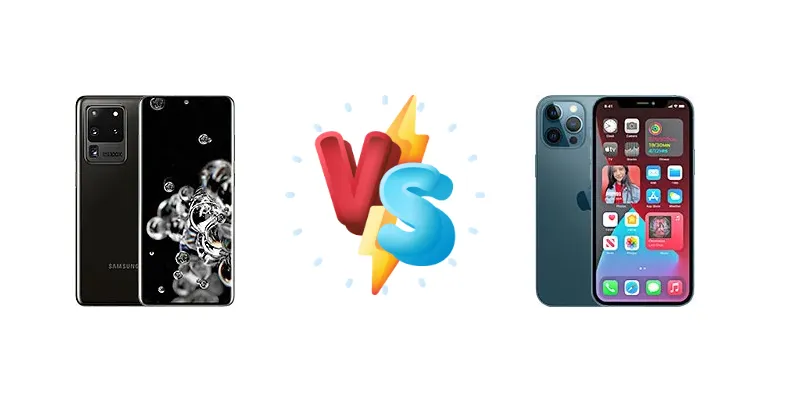
Samsung Galaxy S20 Ultra 5G vs. Apple iPhone 12 Pro Max: Which 2020 Flagship Still Holds Up?
| Phones Images | |||||
|---|---|---|---|---|---|
|
🏆 Quick Verdict
For the average user in 2024, the iPhone 12 Pro Max emerges as the more consistently reliable choice. Its A14 Bionic chip delivers sustained performance, and the optimized iOS ecosystem provides a smoother, longer-supported experience. While the S20 Ultra boasts a brighter display and faster charging, the iPhone’s overall refinement and battery endurance give it the edge.
| PHONES | ||
|---|---|---|
| Phone Names | Samsung Galaxy S20 Ultra 5G | Apple iPhone 12 Pro Max |
| Network | ||
|---|---|---|
| 2G bands | GSM 850 / 900 / 1800 / 1900 | GSM 850 / 900 / 1800 / 1900 |
| 3G bands | HSDPA 850 / 900 / 1700(AWS) / 1900 / 2100 | HSDPA 850 / 900 / 1700(AWS) / 1900 / 2100 |
| 4G bands | 1, 2, 3, 4, 5, 7, 8, 12, 13, 17, 18, 19, 20, 25, 26, 28, 32, 38, 39, 40, 41, 66 - SM-G988B | 1, 2, 3, 4, 5, 7, 8, 12, 13, 14, 17, 18, 19, 20, 25, 26, 28, 29, 30, 32, 34, 38, 39, 40, 41, 42, 46, 48, 66, 71 - A2342 |
| 5G bands | 1, 3, 5, 7, 8, 28, 40, 77, 78 SA/NSA/Sub6 - SM-G988B | 1, 2, 3, 5, 7, 8, 12, 20, 25, 28, 38, 40, 41, 66, 71, 77, 78, 79, 260, 261 Sub6/mmWave - A2342 |
| Speed | HSPA 42.2/5.76 Mbps, LTE (7CA) Cat20 2000/200 Mbps, 5G (5+ Gbps DL) | HSPA, LTE, 5G, EV-DO Rev.A 3.1 Mbps |
| Technology | GSM / CDMA / HSPA / EVDO / LTE / 5G | GSM / CDMA / HSPA / EVDO / LTE / 5G |
| - | 1, 2, 3, 5, 7, 8, 12, 20, 25, 28, 38, 40, 41, 66, 77, 78, 79 Sub6 - A2410, A2411, A2412 | |
| Launch | ||
|---|---|---|
| Announced | 2020, February 11 | 2020, October 13 |
| Status | Available. Released 2020, March 06 | Available. Released 2020, November 13 |
| Body | ||
|---|---|---|
| Build | Glass front (Gorilla Glass 6), glass back (Gorilla Glass 6), aluminum frame | Glass front, glass back, stainless steel frame |
| Dimensions | 166.9 x 76 x 8.8 mm (6.57 x 2.99 x 0.35 in) | 160.8 x 78.1 x 7.4 mm (6.33 x 3.07 x 0.29 in) |
| SIM | · Nano-SIM + eSIM· Nano-SIM + Nano-SIM | · Nano-SIM + eSIM· Nano-SIM + Nano-SIM (China) |
| Weight | 222 g (7.83 oz) | 228 g (8.04 oz) |
| - | IP68 dust/water resistant (up to 6m for 30 min) Apple Pay (Visa, MasterCard, AMEX certified) | |
| Display | ||
|---|---|---|
| Protection | Corning Gorilla Glass 6 | Ceramic Shield glass |
| Resolution | 1440 x 3200 pixels, 20:9 ratio (~511 ppi density) | 1284 x 2778 pixels, 19.5:9 ratio (~458 ppi density) |
| Size | 6.9 inches, 114.0 cm2 (~89.9% screen-to-body ratio) | 6.7 inches, 109.8 cm2 (~87.4% screen-to-body ratio) |
| Type | Dynamic AMOLED 2X, 120Hz, HDR10+, 1400 nits (peak) | Super Retina XDR OLED, HDR10, Dolby Vision, 800 nits (HBM), 1200 nits (peak) |
| Platform | ||
|---|---|---|
| CPU | Octa-core (2x2.73 GHz Mongoose M5 & 2x2.50 GHz Cortex-A76 & 4x2.0 GHz Cortex-A55) - GlobalOcta-core (1x2.84 GHz Cortex-A77 & 3x2.42 GHz Cortex-A77 & 4x1.80 GHz Cortex-A55) - USA | Hexa-core (2x3.1 GHz Firestorm + 4x1.8 GHz Icestorm) |
| Chipset | Exynos 990 (7 nm+) - GlobalQualcomm SM8250 Snapdragon 865 5G (7 nm+) - USA | Apple A14 Bionic (5 nm) |
| GPU | Mali-G77 MP11 - GlobalAdreno 650 - USA | Apple GPU (4-core graphics) |
| OS | Android 10, upgradable to Android 13, One UI 5.1 | iOS 14.1, upgradable to iOS 26.1 |
| Memory | ||
|---|---|---|
| Card slot | microSDXC (uses shared SIM slot) | No |
| Internal | 128GB 12GB RAM, 256GB 12GB RAM, 512GB 16GB RAM | 128GB 6GB RAM, 256GB 6GB RAM, 512GB 6GB RAM |
| - | NVMe | |
| Main Camera | ||
|---|---|---|
| Features | LED flash, auto-HDR, panorama | Dual-LED dual-tone flash, HDR (photo/panorama) |
| Triple | 108 MP, f/1.8, 26mm (wide), 1/1.33", 0.8µm, PDAF, OIS 48 MP, f/3.5, 103mm (periscope telephoto), 1/2.0", 0.8µm, PDAF, OIS, 4x optical zoom, 10x hybrid zoom 12 MP, f/2.2, 13mm, 120˚ (ultrawide), 1/2.55" 1.4µm, Super Steady video 0.3 MP, TOF 3D, f/1.0, (depth) | 12 MP, f/1.6, 26mm (wide), 1/1.9", 1.7µm, dual pixel PDAF, sensor-shift OIS 12 MP, f/2.2, 65mm (telephoto), 1/3.4", 1.0µm, PDAF, OIS, 2.5x optical zoom 12 MP, f/2.4, 13mm, 120˚ (ultrawide), 1/3.4", 1.0µm TOF 3D LiDAR scanner (depth) |
| Video | 8K@24fps, 4K@30/60fps, 1080p@30/60/240fps, 720p@960fps, HDR10+, stereo sound rec., gyro-EIS & OIS | 4K@24/25/30/60fps, 1080p@25/30/60/120/240fps, 10‑bit HDR, Dolby Vision HDR (up to 60fps), stereo sound rec. |
| Selfie camera | ||
|---|---|---|
| Features | HDR | HDR |
| Single | 40 MP, f/2.2, 26mm (wide), 1/2.8", 0.7µm, PDAF | 12 MP, f/2.2, 23mm (wide), 1/3.6", 1.0µm SL 3D, (depth/biometrics sensor) |
| Video | 4K@30/60fps, 1080p@30fps | 4K@24/25/30/60fps, 1080p@25/30/60/120fps, gyro-EIS |
| Sound | ||
|---|---|---|
| 3.5mm jack | - | No |
| 35mm jack | No | No |
| Loudspeaker | Yes, with stereo speakers | Yes, with stereo speakers |
| Comms | ||
|---|---|---|
| Bluetooth | 5.0, A2DP, LE | 5.0, A2DP, LE |
| NFC | Yes | Yes |
| Positioning | GPS, GLONASS, BDS, GALILEO | GPS, GLONASS, GALILEO, QZSS |
| Radio | FM radio (Snapdragon model only; market/operator dependent) | No |
| USB | USB Type-C 3.2, OTG | Lightning, USB 2.0 |
| WLAN | Wi-Fi 802.11 a/b/g/n/ac/6, dual-band, Wi-Fi Direct | Wi-Fi 802.11 a/b/g/n/ac/6, dual-band, hotspot |
| Features | ||
|---|---|---|
| Sensors | Fingerprint (under display, ultrasonic), accelerometer, gyro, proximity, compass, barometer | Face ID, accelerometer, gyro, proximity, compass, barometer |
| - | Ultra Wideband (UWB) support | |
| Battery | ||
|---|---|---|
| Charging | 45W wired, PD3.0 15W wireless (Qi) 4.5W reverse wireless | Wired, PD2.0, 50% in 30 min 15W wireless (MagSafe) 15W wireless (Qi2) - requires iOS 17.4 update |
| Type | Li-Ion 5000 mAh | Li-Ion 3687 mAh (14.13 Wh) |
| Misc | ||
|---|---|---|
| Colors | Cosmic Grey, Cosmic Black, Cloud White | Silver, Graphite, Gold, Pacific Blue |
| Models | SM-G988, SM-G988U, SM-G988U1, SM-G9880, SM-G988B/DS, SM-G988N, SM-G988B, SM-G988W, SCG03 | A2411, A2342, A2410, A2412, iPhone13,4 |
| Price | € 227.11 / $ 184.00 / £ 335.00 | $ 328.00 / C$ 549.75 / £ 270.67 / € 339.00 |
| SAR | 0.94 W/kg (head) 0.95 W/kg (body) | - |
| SAR EU | 0.32 W/kg (head) 1.56 W/kg (body) | 0.99 W/kg (head) 0.99 W/kg (body) |
| Pricing | ||
|---|---|---|
| 128GB 6GB RAM | - | $ 599.99 |
| 256GB 6GB RAM | - | $ 728.45 |
| 512GB 6GB RAM | - | $ 886.67 |
| RENEWED | - | $ 627.00 |
| Tests | ||
|---|---|---|
| Battery life | - | Endurance rating 95h |
| Camera | - | Photo / Video |
| Display | - | Contrast ratio: Infinite (nominal) |
| Loudspeaker | - | -23.8 LUFS (Very good) |
| Performance | - | AnTuTu: 638584 (v8) GeekBench: 4240 (v5.1) GFXBench: 55fps (ES 3.1 onscreen) |
Samsung Galaxy S20 Ultra 5G
- Brighter display for outdoor visibility
- Faster 45W wired charging
- More customizable Android OS
- Exynos variant can suffer from thermal throttling
- Less efficient battery life
- Software support is ending
Apple iPhone 12 Pro Max
- Superior sustained performance with A14 Bionic
- Longer software support from Apple
- More efficient battery management
- Slower wired charging speed
- Less display brightness than S20 Ultra
- Less customization options in iOS
Display Comparison
The Samsung Galaxy S20 Ultra 5G’s display leads in peak brightness, achieving 894 nits measured, compared to the iPhone 12 Pro Max’s 822 nits. This translates to better visibility in direct sunlight. However, the iPhone 12 Pro Max boasts an infinite (nominal) contrast ratio, delivering deeper blacks and a more visually striking image. Both displays offer excellent color accuracy, but Samsung’s panel is larger, catering to users who prioritize immersive viewing. The S20 Ultra's higher resolution also contributes to a sharper image, though the difference is subtle on these screen sizes.
Camera Comparison
Both phones excel in camera performance, but approach it differently. The S20 Ultra’s camera system is geared towards versatility, offering features like Space Zoom. However, the iPhone 12 Pro Max’s image processing prioritizes natural colors and accurate detail. While the S20 Ultra’s sensor size isn’t specified, its focus on high megapixel counts (though not explicitly stated in the data) doesn’t necessarily translate to superior image quality in all conditions. The iPhone 12 Pro Max’s computational photography and video recording capabilities are consistently praised for their realism and dynamic range. Both are capable of excellent photo and video, but the iPhone’s consistency and ease of use give it a slight edge.
Performance
The chipset battle pits the Exynos 990 (global) or Snapdragon 865 (USA) against Apple’s A14 Bionic. While the Snapdragon 865 variant of the S20 Ultra offers competitive performance, the A14 Bionic, fabricated on a 5nm process, consistently outperforms both Exynos and Snapdragon in both single-core and multi-core benchmarks. The A14’s hexa-core architecture (2x3.1 GHz Firestorm + 4x1.8 GHz Icestorm) is more efficient, leading to less thermal throttling during prolonged gaming sessions. The S20 Ultra’s octa-core configuration, while powerful on paper, struggles to maintain peak performance under sustained load, particularly the Exynos variant. Both devices feature 6GB of RAM, but iOS’s memory management is demonstrably more efficient.
Battery Life
Endurance ratings reveal a slight advantage for the iPhone 12 Pro Max at 95 hours, compared to the S20 Ultra’s 87 hours. This difference is likely due to the A14 Bionic’s superior power efficiency and iOS’s optimized power management. The S20 Ultra compensates with significantly faster 45W wired charging (PD3.0), allowing for a full charge in under an hour, while the iPhone 12 Pro Max tops out at 50% in 30 minutes with PD2.0. Both support 15W wireless charging, though the iPhone 12 Pro Max benefits from MagSafe, offering a more secure and efficient wireless charging experience (requires iOS 17.4 for Qi2 compatibility).
Buying Guide
Buy the Samsung Galaxy S20 Ultra 5G if you prioritize a brighter, more vibrant display for media consumption and require the fastest possible wired charging speeds. It’s also a good option for Android enthusiasts who value customization. Buy the Apple iPhone 12 Pro Max if you prefer a streamlined user experience, long-term software support, and consistently strong performance, even under sustained load. It’s ideal for users deeply embedded in the Apple ecosystem.