
Samsung Galaxy S20 FE vs OnePlus 8T+ 5G: A Deep Dive into Performance and Value
| Phones Images | |||||
|---|---|---|---|---|---|
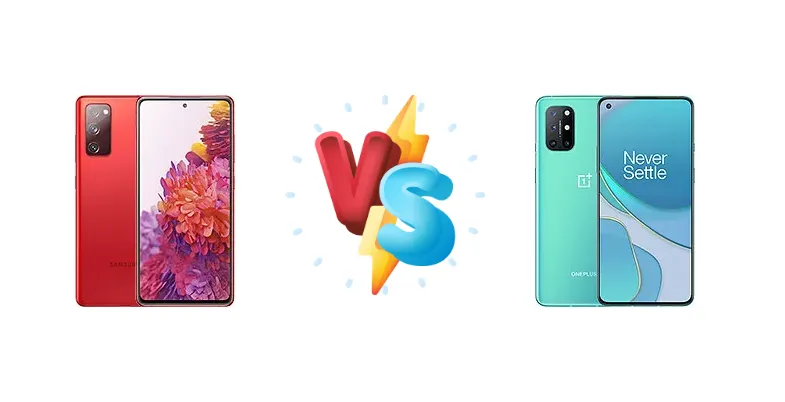
|
🏆 Quick Verdict
For most users, the OnePlus 8T+ 5G emerges as the superior choice. While the S20 FE offers a version with the Snapdragon 865, the consistent Snapdragon 865 in the 8T+ paired with its blazing-fast 65W charging provides a smoother, more convenient daily experience. The Exynos variant of the S20 FE introduces potential thermal concerns.
| PHONES | ||
|---|---|---|
| Phone Names | Samsung Galaxy S20 FE | OnePlus 8T+ 5G |
| Network | ||
|---|---|---|
| 2G bands | GSM 850 / 900 / 1800 / 1900 | GSM 850 / 900 / 1800 / 1900 |
| 3G bands | HSDPA 850 / 900 / 1700(AWS) / 1900 / 2100 | HSDPA 850 / 900 / 1700(AWS) / 1900 / 2100 |
| 4G bands | 1, 2, 3, 4, 5, 7, 8, 12, 13, 17, 20, 26, 28, 32, 38, 40, 41, 66 - International | 1, 2, 3, 4, 5, 7, 8, 12, 13, 17, 18, 19, 20, 25, 26, 28, 29, 30, 34, 38, 39, 40, 41, 46, 48, 66, 71 |
| 5G bands | - | 2, 25, 41, 66, 71 Sub6/mmWave |
| Speed | HSPA 42.2/5.76 Mbps, LTE (5CA) Cat19 1800/200 Mbps | HSPA 42.2/5.76 Mbps, LTE (5CA) Cat18 1200/200 Mbps, 5G 7.5 Gbps DL |
| Technology | GSM / CDMA / HSPA / EVDO / LTE | GSM / CDMA / HSPA / LTE / 5G |
| CDMA2000 1xEV-DO | - | |
| Launch | ||
|---|---|---|
| Announced | 2020, September 23 | 2020, October 14 |
| Status | Available. Released 2020, October 02 | Available. Released 2020, October 16 |
| Body | ||
|---|---|---|
| Build | Glass front (Gorilla Glass 3), plastic back, aluminum frame | Glass front (Gorilla Glass 5), glass back (Gorilla Glass 5), aluminum frame |
| Dimensions | 159.8 x 74.5 x 8.4 mm (6.29 x 2.93 x 0.33 in) | 160.7 x 74.1 x 8.4 mm (6.33 x 2.92 x 0.33 in) |
| SIM | · Nano-SIM· Nano-SIM + Nano-SIM | Nano-SIM |
| Weight | 190 g (6.70 oz) | - |
| IP68 dust/water resistant (up to 1.5m for 30 min) | - | |
| Display | ||
|---|---|---|
| Protection | Corning Gorilla Glass 3 | Corning Gorilla Glass 5 |
| Resolution | 1080 x 2400 pixels, 20:9 ratio (~407 ppi density) | 1080 x 2400 pixels, 20:9 ratio (~402 ppi density) |
| Size | 6.5 inches, 101.0 cm2 (~84.8% screen-to-body ratio) | 6.55 inches, 103.6 cm2 (~87.0% screen-to-body ratio) |
| Type | Super AMOLED, 120Hz, HDR10+ | Fluid AMOLED, 120Hz, HDR10+ |
| Always-on display | - | |
| Platform | ||
|---|---|---|
| CPU | Octa-core (2x2.73 GHz Mongoose M5 & 2x2.50 GHz Cortex-A76 & 4x2.0 GHz Cortex-A55) - Version 1Octa-core (1x2.84 GHz Cortex-A77 & 3x2.42 GHz Cortex-A77 & 4x1.80 GHz Cortex-A55) - Version 2 | Octa-core (1x2.84 GHz Cortex-A77 & 3x2.42 GHz Cortex-A77 & 4x1.80 GHz Cortex-A55) |
| Chipset | Exynos 990 (7 nm+) - Version 1Qualcomm SM8250 Snapdragon 865 5G (7 nm+) - Version 2 | Qualcomm SM8250 Snapdragon 865 5G (7 nm+) |
| GPU | Mali-G77 MP11 - Version 1Adreno 650 - Version 2 | Adreno 650 |
| OS | Android 10, upgradable to Android 13, One UI 5.1 | Android 11, OxygenOS 11 |
| Memory | ||
|---|---|---|
| Card slot | microSDXC (uses shared SIM slot) | No |
| Internal | 128GB 6GB RAM, 128GB 8GB RAM, 256GB 6GB RAM, 256GB 8GB RAM | 256GB 12GB RAM |
| UFS 3.1 | - | |
| Main Camera | ||
|---|---|---|
| Features | LED flash, auto-HDR, panorama | Dual-LED flash, HDR, panorama |
| Quad | - | 48 MP, f/1.7, 26mm (wide), 1/2.0", 0.8µm, PDAF, OIS 16 MP, f/2.2, 14mm, 123˚ (ultrawide), 1/3.6", 1.0µm 5 MP (macro) Auxiliary lens |
| Triple | 12 MP, f/1.8, 26mm (wide), 1/1.76", 1.8µm, dual pixel PDAF, OIS 8 MP, f/2.4, 76mm (telephoto), 1/4.5", 1.0µm, PDAF, OIS, 3x optical zoom 12 MP, f/2.2, 13mm, 123˚ (ultrawide), 1/3.0", 1.12µm | - |
| Video | 4K@30/60fps, 1080p@30/60fps, gyro-EIS | 4K@30/60fps, 1080p@30/60/240fps, Auto HDR, gyro-EIS |
| Selfie camera | ||
|---|---|---|
| Features | HDR | HDR |
| Single | 32 MP, f/2.2, 26mm (wide), 1/2.74", 0.8µm | 16 MP, f/2.4, (wide), 1/3.06", 1.0µm |
| Video | 4K@30/60fps, 1080p@30/60fps, gyro-EIS | 1080p@30fps, gyro-EIS |
| Sound | ||
|---|---|---|
| 3.5mm jack | No | - |
| 35mm jack | No | No |
| Loudspeaker | Yes, with stereo speakers | Yes, with stereo speakers |
| 32-bit/384kHz audio Tuned by AKG | - | |
| Comms | ||
|---|---|---|
| Bluetooth | 5.0, A2DP, LE | 5.1, A2DP, LE, aptX HD |
| NFC | Yes | Yes |
| Positioning | GPS, GLONASS, BDS, GALILEO | GPS (L1+L5), GLONASS (G1), BDS (B1), GALILEO (E1+E5a) |
| Radio | No | No |
| USB | USB Type-C 3.2, OTG | USB Type-C 3.1, OTG |
| WLAN | Wi-Fi 802.11 a/b/g/n/ac/6, dual-band, Wi-Fi Direct | Wi-Fi 802.11 a/b/g/n/ac/6, dual-band, Wi-Fi Direct, DLNA |
| Features | ||
|---|---|---|
| Sensors | Fingerprint (under display, optical), accelerometer, gyro, compass | Fingerprint (under display, optical), accelerometer, gyro, proximity, compass, barometer (market dependant) |
| Virtual proximity sensing Bixby natural language commands and dictation Samsung Pay (Visa, MasterCard certified) | - | |
| Battery | ||
|---|---|---|
| Charging | 25W wired, PD3.0 15W wireless (Qi) 4.5W reverse wireless | 65W wired, 100% in 39 min |
| Type | Li-Ion 4500 mAh | Li-Po 4500 mAh |
| Misc | ||
|---|---|---|
| Colors | Cloud Lavender, Cloud Mint, Cloud Navy, Cloud White, Cloud Red, Cloud Orange | Aquamarine Green, Lunar Silver |
| Models | SM-G780F, SM-G780F/DSM, SM-G780G | KB2007 |
| Price | About 390 EUR | About 640 EUR |
| SAR EU | 0.24 W/kg (head) 1.45 W/kg (body) | - |
Samsung Galaxy S20 FE
- Potential for more versatile camera system
- Wireless and reverse wireless charging
- Snapdragon 865 variant offers competitive performance
- Exynos 990 variant prone to throttling
- Slower 25W wired charging
- Software support may be waning
OnePlus 8T+ 5G
- Blazing-fast 65W wired charging
- Consistent Snapdragon 865 performance
- Clean and optimized OxygenOS software
- No wireless charging
- Less camera versatility (potentially)
- May lack some Samsung-specific features
Display Comparison
Both phones feature 6.5-inch AMOLED displays, but detailed specifications are missing. However, given OnePlus’s history, the 8T+ likely boasts a higher refresh rate (120Hz vs the S20 FE’s 120Hz) for smoother scrolling. The S20 FE’s plastic back, while durable, contrasts with the 8T+'s likely glass construction, impacting perceived premium feel. Color accuracy is likely comparable, given both brands’ AMOLED expertise.
Camera Comparison
Detailed camera specs are unavailable, but the S20 FE likely offers a more versatile camera system with potentially larger sensors and more lens options. However, the image processing style differs significantly. Samsung tends towards vibrant, saturated colors, while OnePlus aims for a more natural look. The Snapdragon ISP in the 8T+ 5G is highly capable, but the S20 FE’s potential for more advanced computational photography features gives it an edge, assuming software support remains consistent. The presence of a 2MP macro camera on the S20 FE is largely inconsequential.
Performance
The core performance difference hinges on the chipset. The OnePlus 8T+ 5G consistently utilizes the Qualcomm Snapdragon 865 5G (7nm+), featuring an octa-core CPU with a 1x2.84 GHz Cortex-A77 prime core and 3x2.42 GHz Cortex-A77 performance cores. The S20 FE, however, shipped in two variants: one with the same Snapdragon 865, and another with the Exynos 990 (7nm+). The Exynos 990, with its Mongoose M5 cores, historically exhibited more thermal throttling under sustained load compared to the Snapdragon 865, impacting long gaming sessions. Both phones utilize LPDDR5 RAM, ensuring fast memory access.
Battery Life
The OnePlus 8T+ 5G’s 65W wired charging is its standout feature, achieving a 100% charge in just 39 minutes. The S20 FE is limited to 25W wired charging, significantly slower. While battery capacity isn’t specified, the charging speed advantage of the 8T+ effectively mitigates any potential capacity difference. The S20 FE does offer 15W wireless charging and 4.5W reverse wireless charging, features absent on the 8T+.
Buying Guide
Buy the Samsung Galaxy S20 FE if you prioritize camera versatility and are willing to gamble on potentially better software support, *and* can confirm you're getting the Snapdragon 865 variant. Buy the OnePlus 8T+ 5G if you value consistently fast performance, incredibly rapid charging, and a clean, optimized software experience. The 8T+ is the better choice for power users and those who frequently top up their battery.