
Samsung Galaxy S20 5G vs OnePlus 8 Pro: A Deep Dive into 2020 Flagship Performance
| Phones Images | |||||
|---|---|---|---|---|---|
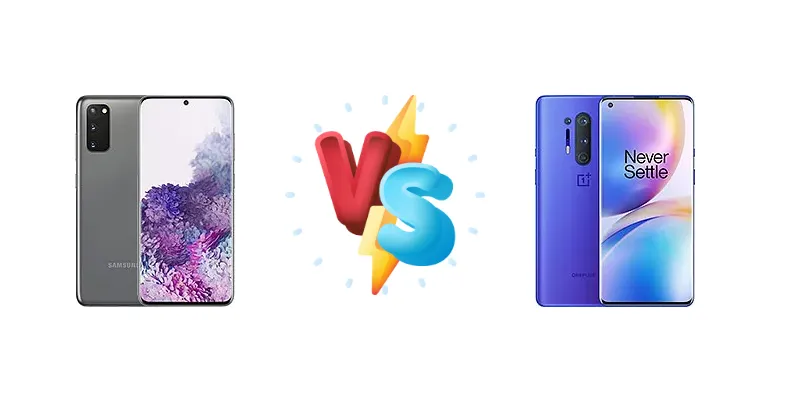
|
🏆 Quick Verdict
For most users, the OnePlus 8 Pro emerges as the stronger choice. Its consistent Snapdragon 865 performance, coupled with significantly faster 30W wired and wireless charging, provides a smoother, more reliable experience than the Galaxy S20 5G, particularly the Exynos variant. While Samsung offers a more refined camera experience, the OnePlus 8 Pro’s value proposition is undeniable.
| PHONES | ||
|---|---|---|
| Phone Names | Samsung Galaxy S20 5G | OnePlus 8 Pro |
| Network | ||
|---|---|---|
| 2G bands | GSM 850 / 900 / 1800 / 1900 | GSM 850 / 900 / 1800 / 1900 |
| 3G bands | HSDPA 850 / 900 / 1700(AWS) / 1900 / 2100 | HSDPA 800 / 850 / 900 / 1700(AWS) / 1800 / 1900 / 2100 |
| 4G bands | 1, 2, 3, 4, 5, 7, 8, 12, 13, 17, 18, 19, 20, 25, 26, 28, 32, 38, 39, 40, 41, 66 - SM-G981B | 1, 2, 3, 4, 5, 7, 8, 12, 13, 17, 18, 19, 20, 25, 26, 28, 32, 34, 38, 39, 40, 41, 42, 46, 66 - EU |
| 5G bands | 1, 3, 5, 7, 8, 28, 40, 77, 78 SA/NSA/Sub6 - SM-G981B | 1, 3, 7, 28, 78 SA/NSA - EU |
| Speed | HSPA 42.2/5.76 Mbps, LTE (7CA) Cat20 2000/200 Mbps, 5G (5+ Gbps DL) | HSPA 42.2/5.76 Mbps, LTE (5CA) Cat18 1200/150 Mbps, 5G 7.5 Gbps DL |
| Technology | GSM / CDMA / HSPA / EVDO / LTE / 5G | GSM / CDMA / HSPA / LTE / 5G |
| 2, 5, 41, 66, 71 SA/NSA/Sub6 - SM-G981U | 78 SA/NSA - IN | |
| Launch | ||
|---|---|---|
| Announced | 2020, February 11 | 2020, April 14 |
| Status | Available. Released 2020, March 06 | Available. Released 2020, April 21 |
| Body | ||
|---|---|---|
| Build | Glass front (Gorilla Glass 6), glass back (Gorilla Glass 6), aluminum frame | Glass front (Gorilla Glass 5), glass back (Gorilla Glass 5), aluminum frame |
| Dimensions | 151.7 x 69.1 x 7.9 mm (5.97 x 2.72 x 0.31 in) | 165.3 x 74.4 x 8.5 mm (6.51 x 2.93 x 0.33 in) |
| SIM | · Nano-SIM + eSIM· Nano-SIM + Nano-SIM | Nano-SIM + Nano-SIM |
| Weight | 163 g (5.75 oz) | 199 g (7.02 oz) |
| IP68 dust/water resistant (up to 1.5m for 30 min) | IP68 dust/water resistant | |
| Display | ||
|---|---|---|
| Protection | Corning Gorilla Glass 6 | Corning Gorilla Glass 5 |
| Resolution | 1440 x 3200 pixels, 20:9 ratio (~563 ppi density) | 1440 x 3168 pixels (~513 ppi density) |
| Size | 6.2 inches, 93.8 cm2 (~89.5% screen-to-body ratio) | 6.78 inches, 111.7 cm2 (~90.8% screen-to-body ratio) |
| Type | Dynamic AMOLED 2X, 120Hz, HDR10+, 1200 nits (peak) | Fluid AMOLED, 1B colors, 120Hz, HDR10+ |
| Always-on display 120Hz@FHD/60Hz@QHD refresh rate | - | |
| Platform | ||
|---|---|---|
| CPU | Octa-core (2x2.73 GHz Mongoose M5 & 2x2.50 GHz Cortex-A76 & 4x2.0 GHz Cortex-A55) - GlobalOcta-core (1x2.84 GHz Cortex-A77 & 3x2.42 GHz Cortex-A77 & 4x1.80 GHz Cortex-A55) - USA | Octa-core (1x2.84 GHz Cortex-A77 & 3x2.42 GHz Cortex-A77 & 4x1.80 GHz Cortex-A55) |
| Chipset | Exynos 990 (7 nm+) - GlobalQualcomm SM8250 Snapdragon 865 5G (7 nm+) - USA | Qualcomm SM8250 Snapdragon 865 5G (7 nm+) |
| GPU | Mali-G77 MP11 - GlobalAdreno 650 - USA | Adreno 650 |
| OS | Android 10, upgradable to Android 13, One UI 5.1 | Android 10, upgradable to Android 13, OxygenOS 13 |
| Memory | ||
|---|---|---|
| Card slot | microSDXC (uses shared SIM slot) | No |
| Internal | 128GB 8GB RAM, 128GB 12GB RAM | 128GB 8GB RAM, 256GB 12GB RAM |
| UFS 3.0 | UFS 3.0 | |
| Main Camera | ||
|---|---|---|
| Features | LED flash, auto-HDR, panorama | Laser AF, Dual-LED flash, HDR, panorama |
| Quad | - | 48 MP, f/1.8, 25mm (wide), 1/1.43", 1.12µm, multi-directional PDAF, OIS 8 MP, f/2.4, (telephoto), 1/1.0µm, PDAF, OIS, 3x optical zoom 48 MP, f/2.2, 14mm, 116˚ (ultrawide), 1/2.0", 0.8µm, PDAF 5 MP, f/2.4, (Color filter camera) |
| Triple | 12 MP, f/1.8, 26mm (wide), 1/1.76", 1.8µm, dual pixel PDAF, OIS 64 MP, f/2.0, 29mm (telephoto), 1/1.72", 0.8µm, PDAF, OIS, 1.1x optical zoom, 3x hybrid zoom 12 MP, f/2.2, 13mm, 120˚ (ultrawide), 1/2.55" 1.4µm, Super Steady video | - |
| Video | 8K@24fps, 4K@30/60fps, 1080p@30/60/240fps, 720p@960fps, HDR10+, stereo sound rec., gyro-EIS & OIS | 4K@30/60fps, 1080p@30/60/240fps, Auto HDR, gyro-EIS |
| Selfie camera | ||
|---|---|---|
| Features | HDR | HDR |
| Single | 10 MP, f/2.2, 26mm (wide), 1/3.24", 1.22µm, dual pixel PDAF | 16 MP, f/2.5, (wide), 1/3.06", 1.0µm |
| Video | 4K@30/60fps, 1080p@30fps | 1080p@30fps, gyro-EIS |
| Sound | ||
|---|---|---|
| 3.5mm jack | No | No |
| 35mm jack | No | No |
| Loudspeaker | Yes, with stereo speakers | Yes, with stereo speakers |
| 32-bit/384kHz audio Tuned by AKG | - | |
| Comms | ||
|---|---|---|
| Bluetooth | 5.0, A2DP, LE | 5.1, A2DP, LE, aptX HD |
| NFC | Yes | Yes |
| Positioning | GPS, GLONASS, BDS, GALILEO | GPS (L1+L5), GLONASS (G1), BDS (B1), GALILEO (E1+E5a) |
| Radio | FM radio (Snapdragon model only; market/operator dependent) | No |
| USB | USB Type-C 3.2, OTG | USB Type-C 3.1, OTG |
| WLAN | Wi-Fi 802.11 a/b/g/n/ac/6, dual-band, Wi-Fi Direct | Wi-Fi 802.11 a/b/g/n/ac/6, dual-band, Wi-Fi Direct, DLNA |
| Features | ||
|---|---|---|
| Sensors | Fingerprint (under display, ultrasonic), accelerometer, gyro, proximity, compass, barometer | Fingerprint (under display, optical), accelerometer, gyro, proximity, compass |
| Samsung DeX, Samsung Wireless DeX (desktop experience support) ANT+ Bixby natural language commands and dictation Samsung Pay (Visa, MasterCard certified) | - | |
| Battery | ||
|---|---|---|
| Charging | 25W wired, PD3.0 15W wireless (Qi) 4.5W reverse wireless | 30W wired, 50% in 23 min 30W wireless, 50% in 30 min 3W reverse wireless |
| Type | Li-Ion 4000 mAh | Li-Po 4510 mAh, non-removable |
| Misc | ||
|---|---|---|
| Colors | Cosmic Grey, Cloud Blue, Cloud Pink, Cloud White, Aura Red | Glacial Green, Ultramarine Blue, Onyx Black |
| Models | SM-G981, SM-G981F, SM-G981F/DS, SM-G981B/DS, SM-G981U, SM-G981U1, SM-G981N, SM-G981B, SM-G9810, SM-G981W, SC-51A, SCG01 | IN2023, IN2020, IN2021, IN2025 |
| Price | $ 158.44 / £ 144.99 / € 272.39 | About 310 EUR |
| SAR | 1.07 W/kg (head) 1.03 W/kg (body) | - |
| SAR EU | 0.38 W/kg (head) 1.52 W/kg (body) | - |
| Pricing | ||
|---|---|---|
| 128GB 8GB RAM | - | $ 428.39 |
| 256GB 12GB RAM | - | $ 853.51 |
| RENEWED | - | $ 486.00 |
| Tests | ||
|---|---|---|
| Battery life | - | Endurance rating 103h |
| Camera | - | Photo / Video |
| Display | - | Contrast ratio: Infinite (nominal) |
| Loudspeaker | - | -23.5 LUFS (Very good) |
| Performance | - | AnTuTu: 573276 (v8) GeekBench: 3374 (v5.1) GFXBench: 24fps (ES 3.1 onscreen) |
Samsung Galaxy S20 5G
- More versatile camera system with advanced video features
- Samsung’s One UI offers extensive customization options
- Potentially superior display color accuracy (depending on panel)
- Exynos 990 variant suffers from performance throttling
- Slower charging speeds (wired and wireless)
- Regional chipset fragmentation creates inconsistent experience
OnePlus 8 Pro
- Consistent Snapdragon 865 performance
- Blazing-fast 30W wired and wireless charging
- Cleaner, more streamlined Android experience
- Generally better value for money
- Camera image processing may not appeal to all users
- Larger size may not be ideal for all hands
- Reverse wireless charging is relatively slow
Display Comparison
Both the Galaxy S20 5G and OnePlus 8 Pro boast displays with an 'Infinite' contrast ratio, indicating excellent black levels. However, detailed specifications regarding peak brightness and color accuracy are missing. Given Samsung’s history with display technology, it likely holds a slight edge in color calibration. Both feature 120Hz refresh rates, but the OnePlus 8 Pro’s larger display size (6.78 inches vs 6.2 inches) may offer a more immersive viewing experience. PWM dimming rates are not specified, but users sensitive to flicker should investigate further as this can vary between panels.
Camera Comparison
Both phones offer capable camera systems, but approach photography differently. While both feature multi-lens setups, the Galaxy S20 5G historically emphasizes image processing for vibrant, sometimes oversaturated, results. The OnePlus 8 Pro aims for a more natural look. Detailed sensor information is lacking, but the focus should be on the main sensor performance and optical image stabilization (OIS). The inclusion of a 2MP macro camera on both devices is largely a marketing gimmick, offering limited practical benefit. The Galaxy S20 5G’s video capabilities are generally considered more robust, offering features like 8K recording.
Performance
The core performance difference lies in the chipset. The OnePlus 8 Pro exclusively ships with the Qualcomm Snapdragon 865 5G (7nm+), featuring an octa-core CPU with a 1x2.84 GHz Cortex-A77 prime core and 3x2.42 GHz Cortex-A77 performance cores. The Galaxy S20 5G, however, suffers from regional fragmentation, utilizing either the Exynos 990 (7nm+) globally or the Snapdragon 865 in the USA. The Exynos 990’s CPU architecture, while octa-core, uses older Cortex-A76 cores alongside the Mongoose M5, resulting in demonstrably lower sustained performance and a higher propensity for thermal throttling compared to the Snapdragon 865. The OnePlus 8 Pro’s consistent performance is a significant advantage for demanding tasks like gaming and video editing.
Battery Life
The OnePlus 8 Pro boasts a clear advantage in charging speed. Its 30W wired charging can reach 50% charge in just 23 minutes, while the Galaxy S20 5G’s 25W wired charging is comparatively slower. Similarly, the OnePlus 8 Pro’s 30W wireless charging (50% in 30 minutes) significantly outpaces the Galaxy S20 5G’s 15W wireless charging. Both offer reverse wireless charging, but at a meager 3W (OnePlus) and 4.5W (Samsung), it’s primarily a convenience feature. Both phones have an endurance rating of 103h, suggesting similar overall battery life despite the charging differences.
Buying Guide
Buy the Samsung Galaxy S20 5G if you prioritize a highly versatile camera system with extensive pro-level video features and prefer Samsung’s One UI software experience. Buy the OnePlus 8 Pro if you value consistent performance, blazing-fast charging speeds (both wired and wireless), and a cleaner, more streamlined Android experience. Gamers and power users will particularly appreciate the OnePlus 8 Pro’s thermal management.